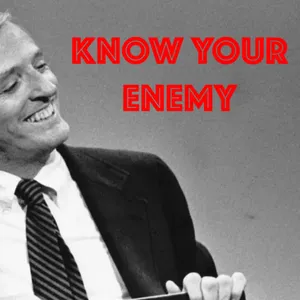
Free Daily Podcast Summary
Know Your Enemy: Daily Summaries Delivered
by Matthew Sitman
A leftist's guide to the conservative movement, one podcast episode at a time, with co-hosts Matthew Sitman and Sam Adler-Bell.
Latest Episodes
The most recent episodes — sign up to get AI-powered summaries of each one.
- 6 days ago8 min
Hitler, "The Lessons of History," and the Maw of Late-Stage Trumpism [Teaser]
Listen to the rest of this premium episode by subscribing at patreon.com/knowyourenemy.In this conversation, Matt and Sam range widely, beginning with Sam's recent NYT review of a book explaining how Hitler "dismantled a democracy in 53 days" then discussing the late, great conservative historian John Lukacs's Hitler of History, a survey of the many biographies written of the Nazi dictator. What makes for a useful historical analogy, especially in our age of the "fascism debate"? What about the past can we truly understand? And what should induce us to humility? From there, your co-hosts press on to more contemporary matters: Charlie Kirk's assassination, one year later, and how its consequences seem so different now than in the days after his death; how to know what truly matters now, to say nothing of hindsight; the slopification and inundation of our political consciences; and more!Sources:Sam Adler-Bell, "What the Third Reich Can Teach Us About America Today," New York Times, Sept 1, 2026Timothy W. Ryback, 53 Days: How Hitler Dismantled a Democracy (2026)— "How Hitler Dismantled a Democracy in 53 Days," The Atlantic, Jan 8, 2025John Lukacs, The Hitler of History (1997)— The Last European War: September 1939–December 1941 (1976)— Historical Consciousness: The Remembered Past (1968)Adam Tooze, The Wages of Destruction: The Making and Breaking of the Nazi Economy (2006)
- 1 weeks ago1h 18m
The Pump and Dump Presidency (w/ Jacob Silverman)
Donald Trump is the most corrupt president in American history, and it isn't close. Between his family's crypto business — designed to enable foreign oligarchs, criminals, and state actors to bribe the administration while enriching Trump and his family — his insider trading and manipulation of the stock market, a tariff regime designed to bind business interests to Trump's personal whims, and the advent of a virtual market for criminal fraudsters to purchase pardons from the president himself, Trump and his family have accrued billions of dollars while hollowing out the rule of law and corroding what's left of our democracy. It is brazen, appalling, and poisonous.To guide us through this many-circled hell, we're joined by Jacob Silverman, author of Gilded Rage: Elon Musk and the Radicalization of Silicon Valley, who's been covering the crypto beat and the Trump-family corruption for years. Jacob helps us wrap our heads around the immensity of this problem — and what, if anything, can be done about it. Further Reading:Jacob Silverman, "Teapot Dome. Watergate. They’re Nothing Compared With This." NYTimes, Oct 17, 2025.— "Zyn and hustling in Las Vegas: Three days at the world's biggest Bitcoin party," Business Insider, Jun 6, 2025. — "Binance’s MAGA-Branding Strategy," The Nation, Feb 27, 2026. — "He Will Steal As Much As You Let Him," Jacob Silverman Substack, Jul 11, 2025.Thomas Edsall, "‘A Blatant and Gargantuan Conflict of Interest,'" NYTimes, Aug 18, 2026.U.S. House of Representatives, Judiciary, Democrats. "Trump, Crypto, and a New Age of Corruption," Nov 24, 2025.Michael Waldman, "Epic Corruption in Plain Sight," Brennan Center, May 19, 2026.John Ganz, "Trump's Third-Worldism," Unpopular Front, Aug 24, 2026....and don't forget to subscribe to Know Your Enemy on Patreon for access to all of our bonus episodes!
- 2 weeks ago3 min
MAGA’s Fight for Animal Rights (w/ Astra Taylor & Aaron Regunberg) [Teaser]
Listen to the rest of this premium episode by subscribing at patreon.com/knowyourenemy. We talk to Astra Taylor and Aaron Regunberg about their recent New Republic article about MAGA's embrace of animal rights—which, like RFK Jr. and "Make America Healthy Again," has allowed them to make inroads with constituencies typically associated with the left. What actually is the Trumpist right's vision of animal rights, and how does it differ from the left's? What might the matter reveal about the curious, combustible politics of this moment? And what should the left learn from this, not just when it comes to animal rights but the opportunities they seem to keep giving conservatives to offer compelling alternatives to the left on key issues? We take up these questions and more. Sources: Astra Taylor & Aaron Regunberg, "How MAGA Stole Animal Rights from the Left," New Republic, Aug 17, 2026 — "Is Animal Rights the Next MAHA?" The Bemusement Tapes, Aug 17, 2026 Daniel Engber, "MAGA's Animal Nationalism," The Atlantic, Feb 22, 2026 Matthew Scully, Dominion: The Power of Man, the Suffering of Animals, and the Call to Mercy (2002) Jay Caspian Kang, "Why an Agnostic Animal-Rights Activist Went to Seminary," New Yorker, Jan 27, 2026 Pope Francis, Laudato si': On Care for Our Common Home (2015) Sunaura Taylor, Beasts of Burden , (2017) Astra Taylor and Sunaura Taylor, “Our Animals, Ourselves,” Lux, Jan 2022. Out in September: Astra Taylor & Naomi Klein, End Times Fascism: And the Fight for the Living World
- 3 weeks ago1h 44m
The Long Struggle Against Equality in America (w/ Kim Phillips-Fein)
In this episode, we're pleased to welcome back historian Kim Phillips-Fein, one of the truly outstanding observers of the right, past and present, working today, for a conversation about her new book, Country of Lords: Neo-Aristocrats, Social Darwinists, Tech Utopians, and the Long Fight Against Equality in America. It makes for a companion episode of sorts to our recent discussions on Lincoln and the Declaration of Independence, but this time about those who rejected equality: proponents of slavery, biological racists (in various forms), captains of industry, and more, from the American founding through today's tech billionaires like Peter Thiel. Listen: Bob Dylan, "My Back Pages" Listen Again: "The History of the History of the Right (w/ Kim Phillips-Fein)," Know Your Enemy, Jan 18, 2024 Sources: Kim Phillips-Fein, Country of Lords: Neo-Aristocrats, Social Darwinists, Tech Utopians, and the Long Fight against Equality in America (2026) — Fear City: New York’s Fiscal Crisis and the Rise of Austerity Politics (2017) — Invisible Hands: The Businessmen's Crusade Against the New Deal (2009) Steven Hahn, Illiberal America: A History (2024) Richard Hofstadter, The American Political Tradition: And the Men Who Made It (1948) Louis Hartz, The Liberal Tradition in America: An Interpretation of American Political Thought Since the Revolution (1955) ...and don't forget to subscribe to Know Your Enemy on Patreon for access to all of our bonus episodes!
- Aug 17, 20266 min
Conservatives in Disarray?
Listen to the rest of this premium episode by subscribing at patreon.com/knowyourenemy. What is going on with the right? Why are they so mad at each other? What accounts for their apparent malaise? Why are they arguing about the price of burritos? Is anyone qualified to replace Ross Douthat at the NY Times? How is Reihan Salam's Manhattan Institute gearing up to combat Mayor Zohran Mamdani? Will it work? And why is Chris Rufo suddenly so worried about the far-right fever swamp, which he did so much to cultivate? Matt and Sam check in with their favorite enemies — and find them wanting. This episode was edited and produced by the great Colin Wambsgans (Jesse is on vacation). Sources: Ezra Klein interview with Chris Rufo, New York Times, June 30, 2026 Rufo & Lomez, "Trump Won...Now the Online Right Is Falling Apart," BlazeTV, Jul 28, 2026 Eliza Shapiro & Nicholas Fandos, "Can This Man Stop the Mamdani Agenda? Reihan Salam Loves New York. He Loves the Free Market. And He’s Very Worried," New York Times, July 29, 2026 Sohrab Ahmari, "Trump Was the Never the One," UnHerd, Mar 19, 2026. Natalie Allison & Isaac Arnsdorf, "Trump Privately Tells Donors to Back Vance While Publicly Keeping 2028 Open," Washington Post, Aug 6, 2026 Dan Adler, "Tucker Carlson Threw Down the Post-MAGA Gauntlet. Can He Actually Build a Movement?" Vanity Fair, Aug 6, 2026 Amos Barshad, "Tucker Carlson: 'I'll I Have Is the Power to Talk and Be Heard,’" Columbia Journalism Review, July 1, 2026 Brendan Rascius, "MTG and Tucker Carlson Announce New ‘Movement’ in Photo Packed with MAGA Renegades," The Independent, Aug 1, 2026 Russ Buettner, "Trump Crypto Took $100 Million From a Businessman With Red Flags," NYTimes, Aug 9, 2026 Christopher Hitchens & Christopher Caldwell, eds., Left Hooks, Right Crosses: A Decade of Political Writing (2002) Reihan Salam & Ross Douthat, Grand New Party: How Republicans can Win the Working Class and Save The American Dream (2008)
- Aug 10, 20261h 40m
Archaeology and Annexation in Palestine (w/ Jasper Nathaniel)
This episode begins by noting the proximity of two of the most significant events of the twentieth century, one archaeological, the other political: the discovery of the Dead Sea Scrolls in 1947 and the founding of the modern State of Israel in 1948. What do they have to do with each other? A lot, it turns out, at least when it comes to archaeology's role in Israeli nationalism, from justifying their claim to "Judea and Samaria" to using the legal and bureaucratic aspects of protecting "heritage sites" as a way to seize territory to the draw for Christian Zionists of Israel's supposed stewardship of "the Holy Land." Throughout the conversation, we draw on our guest Jasper Nathaniel's years of reporting on these matters, and especially his heroic work documenting the brutality of Israeli settlers — and their enablers— in the West Bank. Support Jasper's essential work by subscribing to Infinite Jaz. Listen: Johnny Cash, The Holy Land (1968) Sources: Jasper Nathaniel, "In Ruins: Archaeological Warfare in the West Bank," The Drift, Dec 16, 2024 — "Israel's Archaeological Apartheid: An Update," Dec 19, 2025 Rachel Poser, "Common Ground: The Politics of Archaeology in Jerusalem," Harper's, Sept 2019 Bezalel Smotrich, "Israel's Decisive Plan," 2017 James Genn, "'Grandpa, Look What We Found': Huckabee Family Uncovers Ancient Coins in West Bank Caves," The Jerusalem Post, Jan 6, 2026 Gary Rendsburg, "The Dead Sea Scrolls," Great Courses lecture series, July 2013 ...and don't forget to subscribe to Know Your Enemy on Patreon for access to all of our bonus episodes!
- Aug 3, 202658 min
UNLOCKED: Tucker Carlson and the Anti-Israel Right (w/ Peter Beinart)
This episode originally aired June 15, 2026 on Patreon — we're unlocking it for the rest of you. Author and Jewish Currents editor-at-large Peter Beinart returns to "Know Your Enemy" to discuss Tucker Carlson's newfound anti-Israel politics, their connection to his broader nationalist project, and how the left should think about right-wing anti-zionism. Sources: Peter Beinart, "What Tucker Carlson Means When He Talks About Israel," New York Times, April 28, 2026 — "Progressives Must Not Give Tucker Carlson a Pass," The Beinart Notebook, May 11, 2026 — Being Jewish After the Destruction of Gaza: A Reckoning, (2025) Daniel G. Hummel, The Rise and Fall of Dispensationalism (2023) "Tyler Oliveira: Exposing Somali Welfare Abuse, Republican Hypocrisy & the Group You Can’t Criticize," The Tucker Carlson Show, May 8, 2026 Will Alden, "The Many Equivocations of Curt Mills," Jewish Currents, April 16, 2026.
- Jul 28, 20264 min
The Platner Ordeal (w/ Dorothy Fortenberry) [Teaser]
Listen to the rest of this premium episode by subscribing at patreon.com/knowyourenemy. Matt and Sam are joined by their great friend Dorothy Fortenberry to discuss the debacle of Graham Platner: the Maine Democratic Senate nominee who was forced to drop out amid allegations of rape. We compare notes about our evolving estimations of Platner, his appeal, and his scandals; uncover the gendered fantasies involved in his rise and fall; and game out what lessons can be learned from this experience — for the left and for the Democratic Party. Dorothy is an essayist, playwright, and TV writer/producer, including four seasons on “The Handmaid’s Tale.” In previous appearances, she's discussed #Resistance moms, art and climate change, and Trump's women-hating cabinet. A new show she worked on, “Nocturne,” is coming out on Apple TV in October. This episode was edited and produced by Colin Wambsgans (Jesse is on vacation). Further reading: Jessica Piper & Adam Wren, "Woman who dated Graham Platner says he sexually assaulted her," Politico, July 6, 2026. Katie Gluck & Lisa Lerer, "Several Women Who Dated Graham Platner Recall 'Unsettling' Behavior," NYTimes, June 4, 2026. Lisa Lerer, Katie Gluck, & Michael Kruse, "‘A Slow-Rolling Disaster’: Inside the Implosion of the Platner Campaign," NYTimes, Jul 8, 2026. Will Steakin & Chris Sommerfeldt, "‘Professional malpractice’: The Platner fallout engulfs the operatives who made him," Politico, July 7, 2026. Dorothy Fortenberry, "Can’t Fight This Feeling Anymore," Commonweal, Nov 5, 2020. — "One of Those Serious Women," Commonweal, Apr 29, 2019. Moira Donegan, "Why was the pundit class so quick do defend Graham Platner," The Guardian, Jul 10, 2026. Rebecca Traister, "What Women Saw in Graham Platner," New York Magazine, July 9, 2026.
Get Know Your Enemy summaries in your inbox
Free AI-powered daily recaps. Key takeaways, quotes, and mentions — in a 5-minute read.
Get Free Summaries →Free forever for up to 3 podcasts. No credit card required.
You Might Also Like
Listeners also like.

Conservative Review with Daniel Horowitz
A conservative political commentary show analyzing current events and right-leaning perspectives on policy and culture.

Steve Deace Show
Daily commentary on principled conservatism with a snarky tone.

The Tucker Carlson Show
A political commentary podcast offering opinionated analysis from a conservative perspective on current events and media narratives.
Turley Talks
Daily conservative commentary on politics and culture from a faith-based, pro-America perspective.

Ruthless Podcast
Four conservative hosts deliver irreverent, no-holds-barred commentary on current events and media narratives.

The Majority Report with Sam Seder
A progressive political talk show offering daily commentary, in-depth interviews, and critical analysis of current events and media.

The Find Out Podcast
A weekly discussion dissecting American politics during Trump’s second term with humor, honesty, and left-wing perspective.

The Ben Shapiro Show
A conservative daily podcast that analyzes news and culture with a principled, no-compromise approach.

The Signal Sitdown
Examines how Washington policymakers make decisions and why government often fails to serve public interests.

Making the Argument with Nick Freitas
A Virginia delegate and Green Beret veteran discusses conservative policies, political debates, and his experiences in combat and legislation.

The Tudor Dixon Podcast
A conservative commentator discusses politics, parenting, and American values with experts and influential figures in media and public life.

IHIP News
Two progressive podcasters in a red state deliver comedic, feel-good commentary on political news multiple times a week.
About Know Your Enemy
A leftist's guide to the conservative movement, one podcast episode at a time, with co-hosts Matthew Sitman and Sam Adler-Bell.
Customized Recaps
AI-powered recaps with compact key takeaways, quotes, and insights.
Straight to Your Inbox
Get key takeaways from Know Your Enemy in a 5-minute read.
Save Hours Every Week
Stay current on your favorite podcasts without falling behind.
Frequently Asked Questions
What is Podzilla's Know Your Enemy daily summary?
It's a free AI-powered email that summarizes new episodes of Know Your Enemy as soon as they're published. You get the key takeaways, notable quotes, and links & mentions — all in a quick read.
How does the Know Your Enemy podcast summary work?
When a new episode drops, our AI transcribes and analyzes it, then generates a personalized summary tailored to your interests and profession. It's delivered to your inbox every morning.
Is this an official Know Your Enemy product?
No. Podzilla is an independent service that summarizes publicly available podcast content. We're not affiliated with or endorsed by Matthew Sitman.
Can I get summaries of other podcasts too?
Absolutely! The free plan covers up to 3 podcasts. Upgrade to Pro for 15, or Premium for 50. Browse our full catalog at /podcasts.
How often does Know Your Enemy release new episodes?
Know Your Enemy publishes weekly. Our AI generates a summary within hours of each new episode.
What topics does Know Your Enemy cover?
Know Your Enemy covers topics including News, History, Politics, Culture, Society & Culture. Our AI identifies the specific themes in each episode and highlights what matters most to you.
Start getting Know Your Enemy summaries tomorrow morning.
Free forever for up to 3 podcasts. No credit card required.
Free forever for up to 3 podcasts. No credit card required.