Free Daily Podcast Summary
Jeffrey Epstein: The Coverup Chronicles: Daily Summaries Delivered
by Bobby Capucci
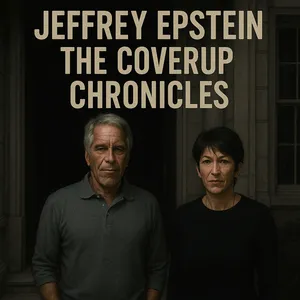
Jeffrey Epstein: The Coverup Chronicles is a podcast dedicated to examining not just who Epstein was and what he did, but how so many people and institutions worked—then and now—to keep it all hidden. This series cuts past the headlines and digs into the documentation: court filings, deposition transcripts, plea deals, sealed exhibits, and the bureaucratic paper trail that still tells the real story. Our focus isn’t on speculation or recycled outrage. It’s on facts—and the deliberate efforts to keep those facts out of public view. Each episode will feature in-depth analysis of newly surfaced records and underreported legal developments, alongside expert commentary that connects them to the broader machinery of power that shielded Epstein for decades. We’ll revisit the timeline from his first arrests through his 2008 plea deal, and into the re-investigations that followed his 2019 death in federal custody. And we won’t stop there—we’ll look closely at the current state of aff
Latest Episodes
The most recent episodes — sign up to get AI-powered summaries of each one.
- Yesterday40 min
Mega Edition: Jeffrey Epstein And The Downplayed Relationship With The Clinton's (9/19/26)
Bill and Hillary Clinton have repeatedly described their ties to Jeffrey Epstein and Ghislaine Maxwell as limited, incidental or primarily connected to philanthropy, but the documentary record has shown a relationship that was broader and more sustained than those descriptions suggest. Bill Clinton acknowledged traveling on Epstein’s plane in 2002 and 2003 for Clinton Foundation-related work, while flight logs documented numerous individual flight legs involving Clinton. Epstein and Maxwell also appeared in the Clinton orbit well beyond those trips: Epstein visited the Clinton White House repeatedly in the 1990s, Maxwell accompanied Clinton on overseas travel, participated in Clinton-related events and fundraisers, and later remained socially connected to the family. Maxwell attended Chelsea Clinton’s 2010 wedding, had vacationed with Chelsea, attended Clinton Global Initiative events and continued appearing around Clinton-linked activities years after Epstein’s 2008 conviction. CNN reported that Maxwell remained involved with CGI as late as 2015 and that Bill Clinton had dinner with her in Los Angeles in 2014.That record has made the Clintons’ efforts to portray the relationships as distant increasingly difficult to reconcile with the paper trail. During her 2026 congressional deposition, Hillary Clinton repeatedly said she did not know Epstein, did not recall meeting him and had little information about his activities, while Maxwell herself told DOJ investigators that she had met Hillary and had been invited to the Clintons’ Chappaqua home several times. Bill Clinton has maintained that his contact with Epstein was connected to charitable work and that he knew nothing about Epstein’s crimes, and there is no evidence establishing that either Clinton participated in Epstein’s abuse. But the larger credibility problem has remained the gap between the language of minimization and the accumulated record of flights, White House access, fundraisers, family events, private dinners and years of continuing contact with Maxwell. The issue is not that association alone proves wrongdoing; it is that the relationship documented over time was plainly more substantial than the casual, arms-length version the Clintons have often presented publicly.to contact me:bobbycapucci@protonmail.com
- Yesterday54 min
Mega Edition: Jeffrey Epstein And The Unexplained Departure Of Evidence (9/19/26)
Questions about items removed from Jeffrey Epstein’s properties have persisted because records show that potentially important material was moved before investigators could fully examine it, raising concerns about what evidence may have disappeared from the official record. In Palm Beach, a private investigator working for Epstein’s defense team removed computers, address books, sexually explicit material, women’s underwear, cash and dozens of pornographic tapes shortly before police executed a search warrant in 2005. Investigators later noted that file folders appeared to have been emptied and that security cameras were present but no longer connected to recording equipment. Years later, FBI records from the 2019 investigation showed another example of valuables being moved: Epstein’s property manager said Richard Kahn instructed him to pack passports, notebooks, envelopes and jewelry boxes from Epstein’s safe into two suitcases and take them to Kahn’s residence shortly after Epstein’s arrest.The unresolved issue has been not just what was removed, but whether law enforcement ever recovered all of it and whether potentially significant evidence was lost, withheld or protected behind claims of privilege. DOJ’s own later review said the computers removed in 2005 could have contained “potentially critical” evidence, yet authorities apparently never obtained the full trove, and some material seems to have remained in the hands of Epstein’s representatives for years. That history has fueled suspicion because Epstein’s operation was unusually dependent on records, photographs, contact books, financial documents and electronic material that could have identified associates, victims and the mechanics of his network. There is no public proof that every missing or relocated item contained incriminating evidence, but the repeated movement of material before or around law-enforcement searches left a significant evidentiary gap and helped create the enduring question of how much of Epstein’s documentary and electronic trail was never fully secured.to contact me:bobbycapucci@protonmail.com
- Yesterday48 min
Mega Edition: From Silicon Valley To Paris. They Knew What Epstein Was (9/18/26)
It strains credulity to believe that the world around Jeffrey Epstein and Ghislaine Maxwell—filled with elite elites in finance, tech, entertainment, and fashion—was completely unaware of what was going on. For example, Ellen Pao, former Reddit CEO and one-time partner at venture firm Kleiner Perkins, publicly stated that Maxwell was invited to a Silicon Valley holiday party in 2011 despite existing reports that she was supplying underage girls for sex. Pao wrote that “we knew about her supplying underage girls for sex” and yet “that was fine with the ‘cool’ people who managed the tightly controlled guest list.” This confession suggests that circles of power didn’t just “miss” what was happening—they arguably chose to ignore it.Similarly, the modeling industry had whispered about the predatory nature of agents like Jean‑Luc Brunel long before the Epstein-Maxwell drama exploded. Brunel was a longtime model scout and agency boss who received millions from Epstein to expand his business, and his name repeatedly came up in allegations of sexual misconduct dating back decades. The fact that such warnings were circulating in fashion—well before the mainstream reckoning—raises the question: how could so many people connected to these men claim no knowledge, no signs, no suspicion? When one entire industry quietly signals something is rotten, it becomes much harder to swallow wholesale claims of unaware innocence.to contact me:bobbycapucci@protonmail.com
- Yesterday48 min
Mega Edition: Ghislaine Maxwell's Legal Team And The Allegations Of Juror Misconduct (9/19/26)
After Ghislaine Maxwell was convicted in December 2021, her legal team moved quickly when Juror 50, Scotty David, revealed in post-trial interviews that he had been sexually abused as a child and had discussed that experience during deliberations. The disclosure raised an immediate problem because the jury questionnaire had specifically asked prospective jurors whether they or close family members had been victims of sexual abuse, and David had answered no. Maxwell’s attorneys argued that the omission amounted to juror misconduct and deprived them of the chance to question him further or seek his removal during jury selection. Prosecutors responded that a new trial was not automatically warranted and that the key questions were whether David had intentionally lied and whether his personal history showed actual bias. Judge Alison Nathan ordered a formal evidentiary hearing rather than deciding the issue from media reports alone.At that hearing, David testified under oath that he had rushed through the questionnaire and had not deliberately concealed his past in order to get on the jury. He also acknowledged that he had drawn on his own experience during deliberations when discussing why abuse survivors might remember events imperfectly or disclose them inconsistently. Maxwell’s lawyers argued that this showed his personal experience had improperly influenced the jury, while prosecutors maintained that jurors were allowed to bring ordinary life experience into deliberations so long as they remained impartial and followed the court’s instructions. Judge Nathan ultimately found that David’s incorrect questionnaire answer was inadvertent, not a calculated deception, and that Maxwell had failed to prove he was biased against her. She denied the motion for a new trial, allowing the convictions to stand despite one of the most serious juror-conduct controversies to emerge from the case.to contact me:bobbycapucci@protonmail.com
- Yesterday1h 3m
Mega Edition: Jeffrey Epstein's Estate Claims It Has A Cash Flow Problem (9/18/26)
Jeffrey Epstein’s estate claimed in 2020 and 2021 that it was facing a serious liquidity problem despite controlling an estate originally valued at more than half a billion dollars. Co-executors Darren Indyke and Richard Kahn said much of Epstein’s wealth was tied up in real estate, investments and other assets that could not quickly be converted into cash, while liens imposed by the U.S. Virgin Islands restricted access to some of the money. The cash crunch became significant enough that the Epstein Victims’ Compensation Program temporarily suspended new compensation offers in February 2021 because the estate said it could not replenish the fund. That explanation immediately drew skepticism because the estate had previously represented that sufficient assets were available to compensate survivors, and critics questioned how an estate of that size could suddenly become unable to meet its obligations. The program eventually resumed and paid more than $121 million to 136 claimants, but the episode intensified demands for a clearer accounting of Epstein’s assets and how the estate was being managed.The estate and its executors have also been accused of blurring the evidentiary lines because Indyke and Kahn were not neutral outsiders brought in after Epstein’s death; they had spent years working inside his financial and legal operation and later became the people controlling his records, companies and remaining fortune. The U.S. Virgin Islands alleged that Epstein operated through a deliberately opaque network of entities and noted that Indyke and Kahn had served as officers of companies connected to that system before becoming co-executors. Survivors have likewise argued that the same men who possessed extensive knowledge of Epstein’s finances and business structure were placed in the position of deciding what records existed, how assets were characterized and what information was produced in litigation. Neither man has been criminally charged, and both have denied knowing about Epstein’s sexual abuse, but the arrangement has fueled persistent criticism that the line between custodian of the evidence and participant in Epstein’s financial machinery was never particularly clean. That concern has only grown as litigation and congressional investigations have sought documents capable of showing how money, companies, payments and relationships moved through Epstein’s network.to contact me:bobbycapucci@protonmail.com
- 2 days ago14 min
Jeffrey Epstein And His Obsession With Transhumanism
Jeffrey Epstein had a deeply unsettling fascination with transhumanism, a fringe scientific ideology focused on using advanced technologies like genetic engineering and artificial intelligence to “improve” or even transcend the human species. For years, Epstein cultivated relationships with prominent scientists, funding research and hosting intellectual salons to promote his own bizarre vision of the future. One of his most disturbing ambitions was to “seed the human race with his DNA” by impregnating multiple women—reportedly as many as 20—at his Zorro Ranch property in New Mexico. Epstein described this vision to scientists and guests during private dinners and conferences, presenting it as part of a eugenics-inspired project to propagate his genes across humanity. He also expressed a desire to have his head and genitals cryogenically frozen in hopes of being revived later—a grotesque extension of his obsession with immortality.Epstein’s involvement in the scientific world wasn’t just casual philanthropy—it was a calculated attempt to embed himself within elite circles and launder his public image through academic legitimacy. He courted renowned figures like Stephen Hawking, George Church, and Murray Gell-Mann, using his money and influence to insert himself into high-level conversations on AI, neuroscience, and biology. Several of these scientists would later admit they were unaware of the depth of his criminal behavior during their interactions. Still, Epstein's promotion of transhumanist goals—particularly ones steeped in eugenicist thinking—raised red flags about the type of future he envisioned: one dominated by elite control, genetic manipulation, and the erasure of moral constraints in pursuit of technological supremacy.
- 2 days ago19 min
The Long Road Towards Transparency In Palm Beach
In October 2021, Palm Beach County Circuit Judge Donald Hafele indicated that he was inclined to release the secret transcripts from the 2006 grand jury investigation of Jeffrey Epstein, records that could help explain how an investigation involving numerous teenage girls ultimately produced only a single felony solicitation charge. The Palm Beach Post had sued for access after its investigation raised questions about then-State Attorney Barry Krischer’s handling of the case, including the unusual decision to take the matter before a grand jury rather than directly file more serious charges. During the hearing, Hafele said there appeared to be few remaining reasons for secrecy because Epstein was dead, the investigation was long over and the public had an extraordinary interest in understanding how such a consequential prosecution had been handled. He stopped short of issuing an immediate ruling but said he was “probably going to release” the records after completing his review.The fight over the transcripts centered on whether Florida’s strict grand-jury secrecy rules should continue shielding records from a case that had become a national example of perceived prosecutorial failure and preferential treatment for a wealthy defendant. The Post argued that the public and Epstein’s survivors deserved to know what prosecutors had presented to the grand jury and why the proceeding resulted in such a limited charge despite police having developed evidence involving multiple underage girls. The records remained sealed at that stage, but the litigation eventually succeeded years later: in July 2024, the 176-page transcript was publicly released and showed that prosecutors had heard graphic testimony from teenage victims while questioning them in ways that drew renewed criticism of how the case had been presented.to contact me:bobbycapucci@protonmail.com
- 2 days ago9 min
Tyler Robinson Preliminary Hearing Transcripts (Day 1 Part 21) (9/18/26)
Day one of Tyler Robinson’s preliminary hearing on July 6, 2026, largely centered on prosecutors beginning to construct a timeline of Charlie Kirk’s killing at Utah Valley University and establishing the authenticity of the surveillance footage and investigative records they intended to use against Robinson. Former UVU police officer Chris Bagley described the moment the gunshot rang out during Kirk’s September 10, 2025 event and the chaos that followed, while Utah State Bureau of Investigation agent David Hull walked the court through the enormous video-review effort undertaken after the shooting. Hull testified that investigators examined hundreds of hours of surveillance footage and ultimately tracked a person they believed was Robinson moving around the UVU campus at several different points that day. Prosecutors introduced surveillance recordings from multiple locations as they attempted to connect the person seen approaching the campus, moving toward the area surrounding the Losee Center, and later leaving the area to Robinson. Three separate videos depicting Kirk being shot were admitted, although Judge Tony Graf determined that their graphic nature warranted restricting their display to the attorneys’ and judge’s monitors rather than broadcasting them throughout the courtroom. Kirk’s widow, Erika, and his parents left the courtroom while the videos were reviewed. Prosecutors also introduced Kirk’s autopsy report through Hull, which listed his cause of death as a gunshot wound to the neck and the manner of death as homicideThe defense spent much of the first day attacking the manner in which the prosecution was getting its evidence into the record rather than attempting to disprove the entire prosecution theory at that stage. Kathryn Nester and Robinson’s attorneys repeatedly raised hearsay, foundation and authentication objections, arguing that investigators were being permitted to introduce reports, statements and records created by other people without those individuals appearing personally to testify. Judge Graf overruled most of those objections, reflecting the substantially lower evidentiary threshold governing a Utah preliminary hearing, whose purpose was only to determine whether probable cause existed to send Robinson to trial rather than whether prosecutors could prove guilt beyond a reasonable doubt. One significant exception involved an edited compilation of surveillance footage, which Graf declined to admit in that form and required prosecutors to replace with the underlying unedited material. Hull’s testimony also revealed the scope of the prosecution’s surveillance theory: investigators claimed Robinson had appeared on or around the UVU campus multiple times on September 10 and that they were attempting to stitch those appearances together into a continuous identification of the alleged shooter. By the end of day one, prosecutors had established the killing itself, the medical cause of Kirk’s death, the existence and authenticity of substantial video evidence and the beginnings of their effort to identify Robinson as the person captured in that footage. They had not yet presented many of the pieces expected to become more consequential later in the hearing, including the rifle and DNA evidence, Robinson’s alleged communications and admissions, and testimony concerning his roommate Lance Twiggs.to contact me:bobbycapucci@protonmail.com
Get Jeffrey Epstein: The Coverup Chronicles summaries in your inbox
Free AI-powered daily recaps. Key takeaways, quotes, and mentions — in a 5-minute read.
Get Free Summaries →Free forever for up to 3 podcasts. No credit card required.
You Might Also Like
Listeners also like.
The Epstein Files
An AI-driven investigation into the Jeffrey Epstein case, analyzing millions of documents to uncover hidden connections and patterns.

The Tara Palmeri Show
A political journalist reveals behind-the-scenes dynamics and unfiltered realities of power in Washington and beyond.
The Megyn Kelly Show
Provocative conversations with influential figures in politics, law, and culture, featuring candid and fearless dialogue.

Deep Cover
Investigative stories about people leading double lives, uncovering deception, crime, and the truth behind hidden identities.

True Sunlight
Journalists investigate true crime and systemic corruption, focusing on victims and accountability with rigorous, empathetic reporting.
Julian Dorey Podcast
Features diverse guests and topics such as true crime, geopolitics, history, and investigative journalism.

Slow Burn
Examines pivotal political and cultural moments in American history through archival audio and firsthand accounts.
Stuff They Don't Want You To Know
Explores unexplained phenomena, conspiracy theories, and alleged government cover-ups throughout history.

True Criminals
Investigative journalists revisit high-profile and overlooked crime cases with firsthand sources and deep reporting insight.

Court Junkie
Covers wrongful convictions and unsolved crimes by analyzing court documents, attending trials, and interviewing affected individuals.

True Crime Tonight
Five nights a week, a deep dive into true crime cases, celebrity scandals, and trials with analysis and listener discussions.
Swindled
Explores white-collar crime and corporate misconduct through immersive storytelling and archival audio.
About Jeffrey Epstein: The Coverup Chronicles
Jeffrey Epstein: The Coverup Chronicles is a podcast dedicated to examining not just who Epstein was and what he did, but how so many people and institutions worked—then and now—to keep it all hidden. This series cuts past the headlines and digs into the documentation: court filings, deposition transcripts, plea deals, sealed exhibits, and the bureaucratic paper trail that still tells the real story. Our focus isn’t on speculation or recycled outrage. It’s on facts—and the deliberate efforts to keep those facts out of public view. Each episode will feature in-depth analysis of newly surfaced records and underreported legal developments, alongside expert commentary that connects them to the broader machinery of power that shielded Epstein for decades. We’ll revisit the timeline from his first arrests through his 2008 plea deal, and into the re-investigations that followed his 2019 death in federal custody. And we won’t stop there—we’ll look closely at the current state of aff
Customized Recaps
AI-powered recaps with compact key takeaways, quotes, and insights.
Straight to Your Inbox
Get key takeaways from Jeffrey Epstein: The Coverup Chronicles in a 5-minute read.
Save Hours Every Week
Stay current on your favorite podcasts without falling behind.
Frequently Asked Questions
What is Podzilla's Jeffrey Epstein: The Coverup Chronicles daily summary?
It's a free AI-powered email that summarizes new episodes of Jeffrey Epstein: The Coverup Chronicles as soon as they're published. You get the key takeaways, notable quotes, and links & mentions — all in a quick read.
How does the Jeffrey Epstein: The Coverup Chronicles podcast summary work?
When a new episode drops, our AI transcribes and analyzes it, then generates a personalized summary tailored to your interests and profession. It's delivered to your inbox every morning.
Is this an official Jeffrey Epstein: The Coverup Chronicles product?
No. Podzilla is an independent service that summarizes publicly available podcast content. We're not affiliated with or endorsed by Bobby Capucci.
Can I get summaries of other podcasts too?
Absolutely! The free plan covers up to 3 podcasts. Upgrade to Pro for 15, or Premium for 50. Browse our full catalog at /podcasts.
How often does Jeffrey Epstein: The Coverup Chronicles release new episodes?
Jeffrey Epstein: The Coverup Chronicles publishes daily. Our AI generates a summary within hours of each new episode.
What topics does Jeffrey Epstein: The Coverup Chronicles cover?
Jeffrey Epstein: The Coverup Chronicles covers topics including News, Commentary, Daily News. Our AI identifies the specific themes in each episode and highlights what matters most to you.
Start getting Jeffrey Epstein: The Coverup Chronicles summaries tomorrow morning.
Free forever for up to 3 podcasts. No credit card required.
Free forever for up to 3 podcasts. No credit card required.