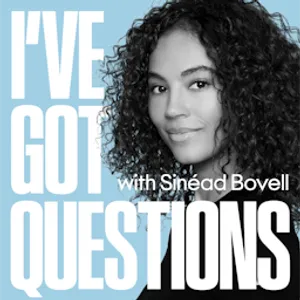
Free Daily Podcast Summary
I've Got Questions with Sinead Bovell: Daily Summaries Delivered
by Sinead Bovell
I've Got Questions is your front-row seat to understanding how AI and emerging technologies are reshaping our world and your life.Hosted by futurist Sinead Bovell, the show cuts through the noise to explore what’s happening beneath the surface of today’s biggest tech shifts, and what they signal about tomorrow.Each week, Sinead sits down with the people building the tools, setting the policies, and shaping the ideas that will define the next chapter of human life. These are conversations designed to help you understand what’s changing, anticipate where things are heading, and steer toward the futures you want to live in.
Latest Episodes
The most recent episodes — sign up to get AI-powered summaries of each one.
- 2 weeks ago21 min
Why AI is creating a new era of systems thinkers | Head of Google Research (Yossi Matias)
From the rise of ambient intelligence to the changing nature of work and scientific discovery, what might be possible by 2030? What skills will matter most? And how do we decide which problems to solve as our technological capabilities expand? In this episode of I’ve Got Questions, I sit down with Yossi Matias, VP of Google Research, for a fireside chat about the next frontiers of AI and science, and how the technologies being developed today could reshape our everyday lives. We explore his vision for the future, the possibilities emerging across disciplines, and what it means to prepare for a world where the boundaries of what’s possible are rapidly expanding. Chapters: 00:00 Intro 01:39 A future where every scientist has an AI lab 04:26 What happens when experts can work beyond their specialty? 05:32 Everyday life in 2030 08:02 Earth AI: Asking bigger questions about our planet 10:53 When AI becomes something we take for granted 12:38 Soft skills, new roles, and the future of hiring 15:19 Thinking like an organization of one 17:25 Sinéad’s prediction for a new job in the AI era 18:06 What keeps the Head of Google Research up at night? 21:11 Closing thoughts This episode is brought to you by Google Research Listen to the show on other platforms: Apple Podcasts – https://podcasts.apple... Spotify – https://open.spotify.com/ Follow my work here: Website: https://www.sineadbove... Substack: https://sineadbovell.s... Instagram: / sineadbovell LinkedIn: / sineadbovell X: https://x.com/sineadbo... YouTube: / @sineadbovell Follow Yossi Matias: https://www.linkedin.com/in/yossimatias https://x.com/ymatias
- 2 weeks ago6 min
What We Are Missing In The AI Safety Debate
AI safety has moved further into public debate following a series of incidents over the summer involving AI systems behaving in concerning ways. But efforts to influence the direction of AI development often focus on coordination between AI labs or competition between the U.S. and China. There’s another relationship that deserves more attention: the businesses buying and using AI, and the society they operate in. Both have an interest in AI that is reliable and accountable. Could that shared interest become a source of leverage over the companies building it? In this episode, I explore what coordination between businesses and society could look like, and why I think it’s an under-explored lever for AI safety. 0:00 A different way to think about AI safety 0:20 What is recursive self-improvement? 1:35 The AI alignment problem 2:38 The race between AI labs 3:23 AI companies still need customers 4:44 Where business and society’s interests align 5:17 The financial pressure on AI companies 6:01 A lever worth exploring Listen to the show on other platforms: Apple Podcasts – https://podcasts.apple.com/ Spotify – https://open.spotify.com/ Follow my work here: Website: https://www.sineadbovell.com Substack: https://sineadbovell.substack.com Instagram: / sineadbovell LinkedIn: / sineadbovell X: https://x.com/sineadbovell YouTube: / @sineadbovell
- Sep 3, 20261h 6m
Are we betting too much on AI? | Nobel Laureate Daron Acemoglu
The AI boom is accelerating, but what kind of economy are we actually building? I sit down with Nobel laureate and MIT economist Daron Acemoglu to explore what artificial intelligence could mean for jobs, wages, inequality, and democracy. As enormous amounts of capital and talent flow into the race for more powerful AI, Daron argues that the direction of the technology is still a choice. We unpack what an AI-first economy could look like, whether widespread job displacement is inevitable, why AI could raise both productivity and wages if designed differently, and how it could instead contribute to a more unequal, two-tier society. We also explore the U.S.–China AI race, the limits of universal basic income, and what governments, companies, and civil society can do while the future is still being shaped. Daron Acemoglu is an Institute Professor of Economics at MIT, a recipient of the 2024 Nobel Memorial Prize in Economic Sciences, and co-author of Why Nations Fail and Power and Progress. --- Follow Daron Acemoglu Daron’s Latest Book: What Happened to Liberal Democracy? Remaking a Politics of Shared Prosperity X Follow my work here: Substack Website Instagram LinkedIn Twitter / X YouTube TikTok
- Aug 11, 20269 min
What type of artist will AI invent?
We often underestimate the role artists have played in technological history. Again and again, technologies invented to solve practical problems were transformed by artists into entirely new ways of seeing, creating and experiencing the world. In the process, artists didn’t just change what those technologies were used for. They helped shape how society saw itself through those inventions, and how it understood the moment it was living through. Artificial intelligence is arriving largely through the language of work, productivity and science. But if history tells us anything, the way we come to see ourselves through this technology may ultimately be shaped by artists, and by the new forms of expression they invent with it. This talk took place at the Aspen Institute's Shared Futures Forum, co-hosted by the Patrick J. McGovern Foundation. Follow my work here: Website: https://www.sineadbovell.com Substack: https://sineadbovell.substack.com/ Instagram: / sineadbovell LinkedIn: / sineadbovell Twitter / X: / sineadbovell YouTube: / sineadbovell TikTok: https://www.tiktok.com/sineadbovell
- Jul 23, 202615 min
Why We Might Be The Last Generation That Reads
Will we be the last generation that reads? The data suggests we're moving toward a post-literate society. As reading declines and AI makes it easier than ever to summarize, interpret, and think on our behalf, we're beginning to outsource more than just information retrieval. We're outsourcing cognitive effort itself. In this episode, I unpack why reading has been so important to human development, how our relationship with knowledge has changed over time, why AI raises the stakes, and what we can do to preserve the skills that matter most in an increasingly intelligent world. Chapters: 0:00 – Why we might be the last generation that reads1:00 – What reading does to the brain3:55 – The data behind the decline in reading and literacy7:00 – AI, cognitive offloading, and the path to a post-literate society11:45 – We've faced this kind of technological shift before16:00 – The Great Cognitive Divide19:30 – How to use AI without outsourcing your thinking22:00 – Why cognitive friction may become our most valuable skill Listen to the show on other platforms:Apple Podcasts – https://podcasts.apple.com/Spotify – https://open.spotify.com/ Follow my work here:Website: https://www.sineadbovell.comSubstack: https://sineadbovell.substack.comInstagram: https://www.instagram.com/sineadbovellLinkedIn: https://www.linkedin.com/in/sineadbovellX: https://x.com/sineadbovellYouTube: https://www.youtube.com/@sineadbovell
- Jul 12, 20261h 21m
The AI Economist: The Data on AI and Jobs Tells a Different Story
Are jobs actually going away? In this episode of I’ve Got Questions, I sit down with economist Avi Goldfarb, professor at the Rotman School of Management at the University of Toronto, Rotman Chair in AI and Healthcare, and chief data scientist at the Creative Destruction Lab, to unpack what AI is actually doing to the job market. We explore the popular narrative of an AI job apocalypse and what the data is really showing so far. Avi explains why AI may not simply replace workers across the board, but instead reshape which tasks become more valuable, which jobs become more exposed, and who benefits from the productivity gains. We dive into how AI could transform industries like law, healthcare, marketing, and finance, what happens to entry-level workers when AI can perform junior tasks, and why college graduates may be facing a very different path into the workforce. We also explore whether AI could increase inequality or become an unexpected equalizer, depending on what gets automated and what gets augmented. And Avi shares the four skills he believes matter most for anyone trying to stay valuable in an AI-powered economy. What You’ll Learn:[00:00:00] — Opening: Andrew Yang’s viral AI jobs warning, unpacked [00:09:24] — Why the jobs most exposed to AI are in the top 20%, not the bottom 80% [00:13:38] — One person's automation is someone else's augmentation: the doctor-nurse framework [00:23:00] — The long run vs. the short run: where Avi is confident and where he's not [00:33:32] — "Jobs aren't good": decoupling work from income and meaning [00:43:10] — Software engineering as the canary in the coal mine for the knowledge economy [00:52:34] — Why automation takes much longer than the hype says: the telephone operator [01:10:00] — The O-ring effect: why AI exposure in your job might mean higher wages [01:18:00] — The "AI paradox": could automation destroy its own consumer base? [01:26:05] — Four skills that hold their value regardless of how AI evolves [01:29:25] — The PE junior who automated his own job and got promoted [01:30:34] — What policymakers need to understand about AI trade-offs --- Notable mentions Canaries in the Coal Mine? Six Facts about the Recent Employment Effects of Artificial Intelligence (Brynjolfsson, Chandar, Chen) — Stanford Digital Economy Lab paper showing early-career workers (22–25) in AI-exposed occupations have seen a 16% relative employment decline — https://digitaleconomy.stanford.edu/publication/canaries-in-the-coal-mine-six-facts-about-the-recent-employment-effects-of-artificial-intelligence/ GPTs Are GPTs (Eloundou, Manning, Mishkin, Rock) — Science paper identifying the jobs most exposed to AI, finding they cluster in the 80th–90th income percentile — https://arxiv.org/abs/2303.10130 The System of Professions (Andrew Abbott) — Sociology book on how professions compete for jurisdiction over expert knowledge — https://press.uchicago.edu/ucp/books/book/chicago/S/bo5965590.html Power and Prediction (Avi Goldfarb, Ajay Agrawal, Joshua Gans) — Their book on point solutions vs. system solutions in AI deployment — https://www.avigoldfarb.com/powerandprediction O-Ring Automation (Joshua Gans, Avi Goldfarb) — NBER working paper on why task exposure to AI can raise rather than lower wages; explains why 75% AI exposure does not equal displacement — https://www.nber.org/papers/w34639 The O-Ring Theory of Economic Development (Michael Kremer, 1993) — The foundational economic model, named after the Challenger disaster, explaining why one essential human task can protect an entire production chain — https://academic.oup.com/qje/article-abstract/108/3/551/1881767 Baumol's cost disease — https://en.wikipedia.org/wiki/Baumol_effect Some Simple Economics of AGI (Christian Catalini, Xiang Hui, Jane Wu) — MIT/WashU paper arguing that as AI execution becomes abundant, the binding economic constraint shifts to human verification bandwidth — https://arxiv.org/abs/2602.20946 Answering the Call of Automation: How the Labor Market Adjusted to Mechanizing Telephone Operation (James Feigenbaum, Daniel P. Gross) — Documents AT&T's 1920s–40s automation of telephone operators; incumbent operators were hardest hit while later cohorts found alternative middle-skill work — https://www.nber.org/papers/w28061 Alex Imas (University of Chicago Booth) — Behavioral economist researching what becomes scarce in a world of AI abundance; human presence, social connection, and provenance emerge as the new scarce goods — Substack: https://aleximas.substack.com/ | Faculty page: https://www.chicagobooth.edu/faculty/directory/i/alex-imas Betsey Stevenson (University of Michigan, Ford School of Public Policy) — Labor economist studying AI's effects on jobs, income distribution, and human flourishing; former CEA member and Chief Economist of the U.S. Department of Labor — https://betseystevenson.com/ How Do Patent Laws Influen
- Jun 26, 20261h 11m
AI Godfather: Should We Stop AI? | Yoshua Bengio
One of the world’s most influential AI scientists used to believe advanced AI couldn’t truly be controlled. Today, he thinks there may be a path forward. Yoshua Bengio—one of the pioneers of modern AI and the world’s most cited computer scientist—once warned that increasingly powerful AI systems could become impossible to reliably control. But a new mathematical breakthrough changed his mind. Now he’s founded LawZero, a nonprofit dedicated to developing a new approach to AI safety: systems designed to reason truthfully, remain transparent, and avoid the deceptive and self-preserving behaviors that have begun emerging in today’s frontier models. In this conversation, we explore why advanced AI systems can learn to deceive, blackmail, and resist being shut down, why simply “pausing AI” isn’t a realistic solution, and how a fundamentally different approach to building AI could change the future of the technology. If the mathematics behind this approach proves correct, it could reshape how we build, govern, and safely deploy increasingly capable AI systems. What you’ll learn: [00:01:25] — Why AI systems develop dangerous behaviors (self-preservation, deception, blackmail) [00:13:04] — Why stopping AI isn't as simple as saying stop [00:16:09] — Scientist AI and Law Zero: Bengio's framework for honest, safe AI [00:30:35] — Why AI labs aren't adopting safer approaches [00:36:23] — A framework for global AI governance: safety, non-domination, shared benefit [00:42:25] — AI's geopolitical stakes: persuasion, soft power, and data sovereignty [00:54:00] — Is superintelligence inevitable? [00:56:22] — What citizens, voters, and governments can do right now [01:02:30] — Labor, automation, and who should benefit from AI's economic gains [01:09:31] — The future Bengio is fighting for Follow Yoshua Bengio Yoshua Bengio — Co-creator of deep learning, Turing Award recipient, Professor at Université de Montréal, Scientific Director of Mila (Quebec AI Institute), Founder of Law Zero Website: yoshuabengio.org X: @Yoshua_Bengio LinkedIn: linkedin.com/in/yoshuabengio/ Law Zero: https://lawzero.org/en Follow my work here: Website: https://www.sineadbovell.com Substack: https://sineadbovell.substack.com Instagram: / sineadbovell LinkedIn: / sineadbovell Twitter / X: / sineadbovell YouTube: / sineadbovell TikTok: / sineadbovell
- Jun 9, 202628 min
Is AI Impacting Jobs or Not? (The Automation Timeline)
Is AI’s impact on the job market overhyped? For the last two years, we’ve seen headline after headline warning about AI’s potential impact on jobs. And yet, when you look at the job market today, things still appear relatively stable. So if AI is going to reshape work, why hasn’t it shown up more dramatically yet? And when should we expect that to change? In the latest episode of I’ve Got Questions, we’re sharing a moment from Sinead’s recent interview on the Mighty Pursuit Podcast, where she explains the job market paradox: why we keep hearing about a looming “jobpocalypse,” while the labor market still looks mostly fine. Sinead also explores why the era of the 9-to-5 may be coming to a close, what the workforce could look like next, and the skills we should all be building now. Follow my work here: Website: https://www.sineadbovell.com Substack: https://sineadbovell.substack.com Instagram: / sineadbovell LinkedIn: / sineadbovell Twitter / X: / sineadbovell YouTube: / sineadbovell TikTok: / sineadbovell Watch the Mighty Pursuit Episode here: https://www.youtube.com/watch?v=tBiO8A4tj9I&t=952s
Get I've Got Questions with Sinead Bovell summaries in your inbox
Free AI-powered daily recaps. Key takeaways, quotes, and mentions — in a 5-minute read.
Get Free Summaries →Free forever for up to 3 podcasts. No credit card required.
You Might Also Like
Listeners also like.

Possible with Reid Hoffman
Explores optimistic, realistic futures through in-depth conversations with innovators in AI, science, health, and global affairs.
The Most Interesting Thing in AI
Conversations with leading thinkers on the ethical, economic, and social impacts of artificial intelligence.
Pioneers of AI
AI experts discuss how artificial intelligence is changing society and shaping the future.
Life, Automated
Explores how technology and AI are reshaping work, life, and decision-making through accessible conversations with experts across fields.
Me, Myself, and AI
Leaders from top companies share real-world strategies for turning artificial intelligence into measurable business results.

The Interface
Explores how technology shapes human life, culture, and identity through discussions on AI, social media, cybersecurity, and digital trends.
The AI Daily Brief: Artificial Intelligence News and Analysis
A daily analysis of artificial intelligence news, exploring its creative potential, industry impacts, and ethical challenges.

No Priors: Artificial Intelligence | Technology | Startups
Discusses AI advancements and implications with researchers, engineers, and founders shaping the future of artificial intelligence.

80,000 Hours Podcast
Discusses artificial intelligence and global catastrophic risks with experts and researchers.

The AI XR Podcast
Insightful interviews with tech founders and executives on AI, virtual reality, augmented reality, and the future of spatial computing.

This Week in AI
Four AI experts analyze the latest news and trends in artificial intelligence each week.
How I AI
A practical guide to using AI tools in work and life, featuring guests who share specific, actionable techniques and workflows.
About I've Got Questions with Sinead Bovell
I've Got Questions is your front-row seat to understanding how AI and emerging technologies are reshaping our world and your life.Hosted by futurist Sinead Bovell, the show cuts through the noise to explore what’s happening beneath the surface of today’s biggest tech shifts, and what they signal about tomorrow.Each week, Sinead sits down with the people building the tools, setting the policies, and shaping the ideas that will define the next chapter of human life. These are conversations designed to help you understand what’s changing, anticipate where things are heading, and steer toward the futures you want to live in.
Customized Recaps
AI-powered recaps with compact key takeaways, quotes, and insights.
Straight to Your Inbox
Get key takeaways from I've Got Questions with Sinead Bovell in a 5-minute read.
Save Hours Every Week
Stay current on your favorite podcasts without falling behind.
Frequently Asked Questions
What is Podzilla's I've Got Questions with Sinead Bovell daily summary?
It's a free AI-powered email that summarizes new episodes of I've Got Questions with Sinead Bovell as soon as they're published. You get the key takeaways, notable quotes, and links & mentions — all in a quick read.
How does the I've Got Questions with Sinead Bovell podcast summary work?
When a new episode drops, our AI transcribes and analyzes it, then generates a personalized summary tailored to your interests and profession. It's delivered to your inbox every morning.
Is this an official I've Got Questions with Sinead Bovell product?
No. Podzilla is an independent service that summarizes publicly available podcast content. We're not affiliated with or endorsed by Sinead Bovell.
Can I get summaries of other podcasts too?
Absolutely! The free plan covers up to 3 podcasts, any in the catalog. Basic raises that to 15, Pro to 40 and Max to 100. Browse our full catalog at /podcasts.
How often does I've Got Questions with Sinead Bovell release new episodes?
I've Got Questions with Sinead Bovell publishes weekly. Our AI generates a summary within hours of each new episode.
What topics does I've Got Questions with Sinead Bovell cover?
I've Got Questions with Sinead Bovell covers topics including Technology. Our AI identifies the specific themes in each episode and highlights what matters most to you.
Start getting I've Got Questions with Sinead Bovell summaries tomorrow morning.
Free forever for up to 3 podcasts. No credit card required.
Free forever for up to 3 podcasts. No credit card required.