Free Daily Podcast Summary
Investing Legends: Daily Summaries Delivered
by Investing Wisdom
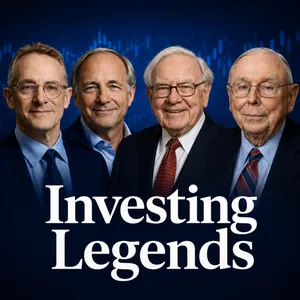
Investing Legends is a long-form podcast dedicated to the thinking, principles, and decision-making frameworks of the world’s most respected investors.Each episode explores the ideas of investors such as Warren Buffett, Charlie Munger, Howard Marks, Ray Dalio, Jim Simons, and Stanley Druckenmiller. Hosted on Acast. See acast.com/privacy for more information.
Latest Episodes
The most recent episodes — sign up to get AI-powered summaries of each one.
- Yesterday1h 51m
A Conversation with Charlie Munger [2011]: Great Financial Crisis, Psychology, Investing, Berkshire Hathaway
A wide-ranging conversation with Charlie Munger about the aftermath of the financial crisis. He opens by explaining why he and Warren Buffett never try to predict economic tides. Instead he urges students facing a weak job market to keep plugging, illustrated by his uncle Fred, an architect who was classified as a laundryman during the Depression. Munger then turns sharply on the accounting profession, calling it the failed referee of Wall Street. He mocks Enron’s “mark to myth” accounting and argues that easy money corrupts just as power does. He makes the case for a massive national push toward solar power and better batteries, saying humanity’s real problem is burning through hydrocarbons needed for fertilizer, not just global warming. In the audience Q&A he dismisses gold, defends the bank bailouts, and shares his great-grandfather’s rule: real opportunities are few, so when one comes, seize it boldly. He closes by naming Lee Kuan Yew’s Singapore as the most instructive political success story in history. Hosted on Acast. See acast.com/privacy for more information.
- 6 days ago1h 36m
Berkshire Hathaway Shareholder Letters 1990
The 1990 letter opens with Warren Buffett’s granddaughter Emily waving a magic wand over Beemer the Clown’s box of wonders and declaring, “Gee, I’m really good at this” — which, Buffett says, sums up his own contribution to Berkshire’s operating results. Net worth rose just 7.3% in a year when his four permanent holdings went nowhere, and the letter’s centrepiece is the purchase that made it famous: a 10% stake in Wells Fargo, bought for $290 million amid a panic in bank stocks at less than five times after-tax earnings. Buffett explains why he normally avoids banks — at twenty times leverage, small mistakes destroy large amounts of equity, and bankers had played follow-the-leader with lemming-like zeal — and why Carl Reichardt and Paul Hazen were the exception. He welcomes the stock’s 50% collapse because it let him buy more, and draws the lesson that has outlived the trade: investors who will be buyers all their lives should welcome falling prices exactly as they welcome falling food prices, since it is optimism, not pessimism, that is the enemy of the rational buyer. The letter also introduces “look-through earnings,” reveals that Berkshire’s non-insurance businesses earned 51% on equity with no leverage, delivers the full cost-of-float framework for judging an insurer, and launches the super-cat reinsurance business with a warning that results will be close to either zero or 300%. There is a blistering post-mortem on the junk-bond decade — the dagger on the steering wheel, Graham’s three words “margin of safety,” the Tampa television station whose interest exceeded its revenues, and mountains of bonds sold by those who didn’t care to those who didn’t think. Buffett concedes his USAir investment was an unforced error, mourns Gillette’s Colman Mockler, names his wife Susan to the board, and admits that in the insurance business there is no statute of limitations on stupidity. The episode closes with two appendices: Ben Graham’s 1936 satire in which U.S. Steel modernizes by writing its plant down to minus a billion dollars, paying its entire workforce in option warrants and carrying inventory at one dollar; and Buffett’s own letter to a family-business owner on what it really means to sell the work of a lifetime. Essential listening on value investing, banking, insurance float, accounting chicanery and Berkshire Hathaway history. Hosted on Acast. See acast.com/privacy for more information.
- 1 weeks ago1h 31m
Berkshire Hathaway Shareholder Letters 1989
The 1989 letter closes Warren Buffett’s first twenty-five years at Berkshire Hathaway with a 44.4% gain — and then, in the section every investor should read twice, a frank accounting of what he got wrong. “Mistakes of the First Twenty-Five Years” opens with his first error: buying Berkshire itself. Buffett explains the “cigar butt” approach to investing — picking up a discarded stub for the one free puff left in it — and why he abandoned it, since in a difficult business there is never just one cockroach in the kitchen. He delivers the line that reoriented his whole career: it is far better to buy a wonderful company at a fair price than a fair company at a wonderful price. Time, he writes, is the friend of the wonderful business and the enemy of the mediocre. He describes the “institutional imperative” that makes rationality wilt inside otherwise sensible companies, admits that his costliest mistakes were the great purchases he understood and failed to make, and says of his record, quoting Mae West, “I was Snow White, but I drifted.” The letter also contains his confession on Coca-Cola — he sold Cokes six for a quarter as a boy in 1936, watched the company for fifty-two more years, and only in the summer of 1988 did his brain finally establish contact with his eyes. Elsewhere: Carl Sagan’s dividing bacteria as a parable about why high growth rates self-destruct; the mathematics showing why a single twenty-year double beats twenty taxed ones by twenty-seven to one; a blistering attack on zero-coupon and pay-in-kind bonds and the invented metric EBDIT, with investment bankers held to the standard of a responsible bartender; Ike Friedman at Borsheim’s revealing that the jewels aren’t in the safe; Mrs. B quitting the Furniture Mart at ninety-five and opening a competing store at ninety-six; Berkshire writing $250 million of catastrophe cover after Hurricane Hugo because nobody else would; and a corporate jet named, after some negotiation with Charlie Munger, “The Indefensible.” Essential listening on value investing, capital allocation, business mistakes and Berkshire Hathaway history. Hosted on Acast. See acast.com/privacy for more information.
- 1 weeks ago1h 15m
Berkshire Hathaway Shareholder Letters 1988
The 1988 letter is Warren Buffett’s most quotable demolition of academic finance — and the year Berkshire bought Coca-Cola. Buffett opens by warning that past rates of gain say little about the future, since judging Berkshire on its record is like judging a forty-two-year-old center fielder on his lifetime batting average. He celebrates the Sainted Seven, which earned 67% on equity with no leverage, and welcomes Borsheim’s into the family — bought from Ike Friedman with no audit, no inventory count, and a one-page contract, because the Friedmans and the Blumkins share Mrs. B’s creed: sell cheap and tell the truth. The heart of the letter is a masterclass on arbitrage, from the 24-year-old Buffett buying Rockwood shares and selling cocoa beans with subway tokens as his only expense, to the Arcata redwood saga where he valued a government timber claim at “somewhere between zero and a whole lot” and was eventually proven spectacularly right. That record becomes his case against efficient market theory: 63 years of 20%-plus arbitrage returns, against a market that returned just under 10% — the difference between $1,000 growing to $405,000 and growing to $97 million. Along the way he explains why it is far easier for an inadequate CEO to keep his job than an inadequate typist, why bosses paint the bullseye around wherever the arrow lands, why he wants Berkshire’s newly NYSE-listed shares to trade quietly at intrinsic value rather than as high as possible, and why accounting fraud pays: it has been far safer to steal large sums with a pen than small sums with a gun. He also pays tribute to his teacher David Dodd, and coins the line that defines his approach to Coca-Cola and Freddie Mac — our favorite holding period is forever. Essential listening on value investing, market efficiency, arbitrage, accounting and Berkshire Hathaway history. Hosted on Acast. See acast.com/privacy for more information.
- 2 weeks ago1h 20m
Berkshire Hathaway Shareholder Letters 1987
The 1987 letter is where Warren Buffett introduces the world to Mr. Market. Written months after the October crash, it lays out Ben Graham’s allegory of the manic-depressive partner who shows up every day naming a price — and the warning that he is there to serve you, not to guide you. Buffett adds the poker line that has followed it ever since: if you’ve been in the game thirty minutes and don’t know who the patsy is, you’re the patsy. He then turns his fire on “portfolio insurance,” the strategy that had $60 to $90 billion of equities poised on a hair trigger in mid-October, asking whether a rational farm owner would instruct his agent to sell off pieces of the farm each time a neighbour’s land went cheap. Elsewhere in the letter he celebrates the Sainted Seven — the Buffalo News, Fechheimer, Kirby, Nebraska Furniture Mart, Scott Fetzer Manufacturing, See’s and World Book — which together earned a 57% return on equity, and explains why the best businesses are usually the ones doing much the same thing they did ten years ago. There is 94-year-old Mrs. B, for whom he scraps the mandatory retirement-at-100 policy; an anonymous letter from a competitor begging him to raise prices; Chuck Huggins turning a candy-discontinuation revolt into a customer-service masterclass; a demand that auditors admit they cannot verify an insurer’s loss reserves; the $700 million Salomon preferred; and a warning that America’s trade deficit has the government depending, like Blanche DuBois, on the kindness of strangers. Essential listening on value investing, market psychology, capital allocation and Berkshire Hathaway history. Hosted on Acast. See acast.com/privacy for more information.
- 2 weeks ago1h 0m
Stan Druckenmiller: Macro, QE, Inflation, The Fed, Investing
Stanley Druckenmiller delivered a keynote in 2021. In this talk, the founder of Duquesne Family Office breaks down the macro consequences of COVID. He covers unprecedented fiscal stimulus, Federal Reserve quantitative easing, inflation risks, asset bubbles, and the future of the U.S. dollar as the world’s reserve currency. The Q&A, moderated by Rubin Miller, covers Bitcoin and crypto, SPACs, short selling, active vs. passive investing, long-term thinking in markets, and the lessons Druckenmiller learned from mentors like George Soros. Whether you follow hedge funds, macroeconomics, or investing strategy, this is a masterclass in how one of the greatest macro investors thinks.Recorded in 2021. Hosted on Acast. See acast.com/privacy for more information.
- 3 weeks ago1h 28m
Berkshire Hathaway Shareholder Letters 1986
In his 1986 letter to Berkshire Hathaway shareholders, Warren Buffett reports a 26.1% gain in net worth and then does something unusual: he grades himself below his own managers. They ran their businesses superbly, he writes, while he failed to deploy the capital they generated — finding no stocks worth buying and spending the year paying down debt and stockpiling cash. It is the letter where the famous line first appears: be fearful when others are greedy, and greedy only when others are fearful. Buffett describes the euphoria in a market where the rewards to owners have become “gloriously uncoupled” from the performance of the businesses themselves, introduces the moat-around-the-castle idea through GEICO’s rock-bottom cost structure, and explains his ‘til-death-do-us-part commitment to Capital Cities, GEICO and the Washington Post. He tells how a shareholder’s letter brought him the Fechheimer Brothers Company, a business he bought without ever visiting it; marvels at 93-year-old Mrs. B still outselling everyone at Nebraska Furniture Mart; dissects who really pays corporate taxes after the Tax Reform Act of 1986; and confesses to a third straight year of loss-reserve error, noting that if Pinocchio’s rules applied to him, his nose would now draw crowds. The letter closes with the appendix that gave investing one of its most important concepts — “owner earnings” — and a withering attack on the Wall Street cash flow figures that add back depreciation while ignoring the capital spending a business actually needs to survive. Essential listening on value investing, accounting, capital allocation and Berkshire Hathaway history. Hosted on Acast. See acast.com/privacy for more information.
- 4 weeks ago32 min
Joel Greenblatt & Howard Marks discuss Value Investing
Joel Greenblatt sits down with Howard Marks at Columbia for a conversation about special situations, margin of safety, and why the goal is to find the easier game rather than the harder one. He explains how spin-offs, recaps and liquidations gave him a place to hunt where the crowd wasn’t looking, why he eventually drifted from cheap businesses toward good ones, and how he sizes positions around what he can’t lose rather than what he might make. Along the way he tells the story of the stock trading at half its cash value that led to the Value Investors Club, the Comdex position that taught him about operating leverage the hard way, and why he returned all his outside capital after ten years of fifty percent returns. Hosted on Acast. See acast.com/privacy for more information.
About Investing Legends
Investing Legends is a long-form podcast dedicated to the thinking, principles, and decision-making frameworks of the world’s most respected investors.Each episode explores the ideas of investors such as Warren Buffett, Charlie Munger, Howard Marks, Ray Dalio, Jim Simons, and Stanley Druckenmiller. Hosted on Acast. See acast.com/privacy for more information.
Customized Recaps
AI-powered recaps with compact key takeaways, quotes, and insights.
Straight to Your Inbox
Get key takeaways from Investing Legends in a 5-minute read.
Save Hours Every Week
Stay current on your favorite podcasts without falling behind.
Frequently Asked Questions
What is Podzilla's Investing Legends daily summary?
It's a free AI-powered email that summarizes new episodes of Investing Legends as soon as they're published. You get the key takeaways, notable quotes, and links & mentions — all in a quick read.
How does the Investing Legends podcast summary work?
When a new episode drops, our AI transcribes and analyzes it, then generates a personalized summary tailored to your interests and profession. It's delivered to your inbox every morning.
Is this an official Investing Legends product?
No. Podzilla is an independent service that summarizes publicly available podcast content. We're not affiliated with or endorsed by Investing Wisdom.
Can I get summaries of other podcasts too?
Absolutely! The free plan covers up to 3 podcasts, any in the catalog. Basic raises that to 15, Pro to 40 and Max to 100. Browse our full catalog at /podcasts.
What topics does Investing Legends cover?
Investing Legends covers topics including Business, Entrepreneurship, Investing. Our AI identifies the specific themes in each episode and highlights what matters most to you.
Start getting Investing Legends summaries tomorrow morning.
Free forever for up to 3 podcasts. No credit card required.
Free forever for up to 3 podcasts. No credit card required.