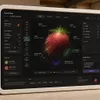
You’re not going to believe this, but this is absolutely going to be possible—or, depending on how demanding you are about the meaning of “possible,” already is—with current technology. Let me show you what I’m talking about. Imagine a small appliance sitting on the counter in a pleasant office kitchen, the sort of place with pale wood, expensive plants, and a bowl containing three pieces of fruit that nobody has touched in weeks. The machine is cream-colored and reassuringly solid, with rounded corners and a large black screen. It looks like something Braun might have made in 1973 if Dieter Rams had been given access to a molecular-generation model and told that the future depended on snacks. On the screen is an enormous three-dimensional cloud of tiny luminous points. Some gather into dense yellow islands, others into green continents or purple filaments. There are labels here and there: CITRUS, GREEN LEAF, FERMENTED, FLORAL, ROASTED. But the most interesting thing on the screen is not what has been labeled. It is everything that hasn’t.You move the cursor away from the green cluster and into the darkness between GREEN LEAF and FERMENTED, stopping in a sparse region that belongs to neither. There is nothing there because, as far as anyone knows, there is no flavor there. You press the mouse button and hold it. A circle expands around the cursor. New points begin flickering into existence. The machine is not searching a catalog for something that tastes a bit like cucumber. It is generating molecular structures predicted to create a sensory experience in that particular unoccupied territory. Candidates appear and disappear. One is unstable. Another would be miserable to synthesize. Another trips an early safety screen. Eventually a candidate remains, and much later—after considerably more chemistry, characterization, toxicology, regulatory work, and controlled testing than the tasteful progress indicator on the screen would lead you to imagine—a little ledge slides out of the machine. On it sits a transparent bubble containing a single clear droplet. A narrow paper flag curls out of the top, like the plume on a Hershey’s Kiss, and on it are the words LUMEN-7A62: green mineral · airy · crisp. Nobody has ever tasted it before, for the excellent reason that until somebody asked the machine to look in that particular patch of darkness, it had never existed.I keep returning to this image because it makes visible a mistake we have been making for several thousand years, albeit a productive and often delicious one. We have confused flavor with ingredients. For practically the whole history of cuisine, flavor has been downstream of biology. We have strawberries, garlic, cows, cacao, limes, mushrooms, chickens, coffee beans, and an almost vindictive number of peppers, and so we have become very clever about persuading these things to do tricks. We roast them and ferment them, dry them and smoke them, breed them, age them, distill them, bury them, combine them, and occasionally allow microorganisms to have their way with them for six months before announcing that the smell is intentional. The results have been magnificent. I have no complaint against butter. But underneath this entire culinary civilization sits an assumption that is beginning to look less like a law of nature than a historical inconvenience: flavor comes from ingredients.An ingredient, after all, is just one way of producing a sensory event in a human being. A strawberry is an extraordinarily elaborate biological machine for delivering a particular collection of molecules to your nose and tongue, along with water, sugar, acids, seeds, fiber, color, nostalgia, and the occasional disappointing white interior. We have treated the strawberry as the fundamental object because, until recently, there was not much practical reason to do otherwise. But if the thing we actually care about is the experience produced when those molecules meet the human sensory system, then the strawberry begins to look less like the definition of strawberry flavor and more like one implementation of it. Once that distinction becomes clear, a peculiar door opens. We can stop asking only what nature has given us to taste and start asking what the human sensory system is capable of experiencing.Flavor science has traditionally approached this from the sensible direction. Take a molecule, expose someone or something to it, and determine what it does. Molecular structure goes in; perception comes out. Increasingly, machine-learning systems can participate in this process, predicting whether a compound is likely to be bitter or sweet, estimating odor character or intensity, and learning relationships between molecular structure and sensory descriptors. Generative systems have also begun proposing novel odorants and taste-active molecules, including candidates that can subsequently be synthesized and experimentally evaluate
Podzilla Summary coming soon
Sign up to get notified when the full AI-powered summary is ready.
Free forever for up to 3 podcasts. No credit card required.
Listen to This Episode




Get summaries like this every morning.
Free AI-powered recaps of Insanely Generative and your other favorite podcasts, delivered to your inbox.
Free forever for up to 3 podcasts. No credit card required.