Free Daily Podcast Summary
In Dissent: Daily Summaries Delivered
by Pacific Legal
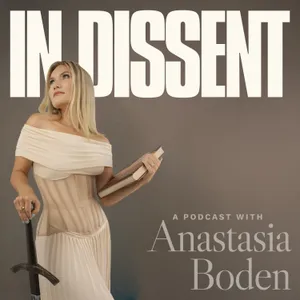
In Dissent traces the founding ideals of the Declaration of Independence from the revolutionary moment of their birth to the courtrooms where they’ve been tested, twisted, and sometimes abandoned. Each episode pairs vivid historical storytelling—a man riding through the night to break a deadlocked vote, a printer setting type for a document that could get him hanged—with landmark Supreme Court cases that reveal the distance between America’s founding promise and its legal reality.
Latest Episodes
The most recent episodes — sign up to get AI-powered summaries of each one.
- Jul 29, 202627 min
All Men Are Created Equal
The government has frequently fallen short of the declaration that “all men are created equal,” and in more ways than one. In our season finale, columnist, author, and Harvard Professor Noah Feldman and Independence Institute Senior Fellow Phillip Magness discusses one of the grossest miscarriages of justice of all time: Buck v. Bell.
- Jul 9, 202629 min
The Heart and Lungs of Liberty
Who’s afraid of trial by jury? A lot of people, and even some Supreme Court justices. In this episode, PLF’s Steve Simpson Cato Institute’s Tommy Berry discuss exactly why the Founders cared about the right to a jury trial and the ways the government tries to keep us from getting one. And we tell the harrowing story of Jarkesy v. SEC—a case that recently reaffirmed that, as John Adams said, representative government and trial by jury are the “heart and lungs of liberty.”
- Jun 30, 202634 min
The Constitution Up in Smoke
The Declaration says that the government enjoys only those “just powers” delegated to them by the people. Through the Constitution, the American people gave certain limited powers to the national government and reserved the rest to the states or the people. Yet Congress, with the Supreme Court’s help, has dramatically expanded its power to regulate Americans’ lives through a broad interpretation of the Commerce Clause. In this episode, Vice President for Legal Strategy at Stand Together Casey Mattox and Georgetown Law Professor Randy Barnett tell us about Wickard v. Filburn and Gonzales v. Raich, which transformed the Commerce Clause into a national problem-solving clause.
- Jun 16, 202635 min
We Can Sue the Government, Right?
Governments derive powers from “the consent of the governed.” Don’t they? In one of the earliest constitutional cases, the Supreme Court seemed to say so. But the Eleventh Amendment threw a wrench in it all, making it exceptionally difficult for us to hold the government accountable in the courts when it violates our rights. In Episode 3, Georgetown Law Professor Randy Barnett, NYT columnist and author Jesse Wegman, and Cato Institute Senior Vice President for Legal Studies Clark Neily discuss Chisholm v. Georgia.
- Jun 2, 202622 min
The Pursuit of Happiness
To the Framers, happiness didn’t just mean fun. It meant the pursuit of a good life through hard work, discipline, and constant self-assessment. In Episode 2, National Constitution Center CEO Emeritus Jeffrey Rosen, attorney and author Timothy Sandefur, and Supreme Court advocate Alan Gura tell us what the “pursuit of happiness” meant, how that promise has been enshrined in the Constitution, and how the Supreme Court has all but gutted it in one of the most despised decisions of all time: The Slaughterhouse Cases.
- May 26, 20260 min
Welcome to In Dissent
In Dissent traces the founding ideals of the Declaration of Independence from the revolutionary moment of their birth to the courtrooms where they’ve been tested, twisted, and sometimes abandoned. Each episode pairs vivid historical storytelling—a man riding through the night to break a deadlocked vote, a printer setting type for a document that could get him hanged—with landmark Supreme Court cases that reveal the distance between America’s founding promise and its legal reality.
- May 20, 202624 min
The First Great American Dissent
A man rushing on horseback in the dead of night to break a deadlocked vote. A printer faced with the terrifying ramifications of printing an incendiary document. And beleaguered troops—underfed, underpaid, and on the verge of defeat. In hindsight, the American Independence seems inevitable. But at the time, it was anything but. In the opening episode, Pulitzer Prize winner Joseph Ellis, historian and biographer Richard Brookhiser, and Professor of American History Dermot Trainor describe the origins of the first great American dissent: The Declaration of Independence.
About In Dissent
In Dissent traces the founding ideals of the Declaration of Independence from the revolutionary moment of their birth to the courtrooms where they’ve been tested, twisted, and sometimes abandoned. Each episode pairs vivid historical storytelling—a man riding through the night to break a deadlocked vote, a printer setting type for a document that could get him hanged—with landmark Supreme Court cases that reveal the distance between America’s founding promise and its legal reality.
Customized Recaps
AI-powered recaps with compact key takeaways, quotes, and insights.
Straight to Your Inbox
Get key takeaways from In Dissent in a 5-minute read.
Save Hours Every Week
Stay current on your favorite podcasts without falling behind.
Frequently Asked Questions
What is Podzilla's In Dissent daily summary?
It's a free AI-powered email that summarizes new episodes of In Dissent as soon as they're published. You get the key takeaways, notable quotes, and links & mentions — all in a quick read.
How does the In Dissent podcast summary work?
When a new episode drops, our AI transcribes and analyzes it, then generates a personalized summary tailored to your interests and profession. It's delivered to your inbox every morning.
Is this an official In Dissent product?
No. Podzilla is an independent service that summarizes publicly available podcast content. We're not affiliated with or endorsed by Pacific Legal.
Can I get summaries of other podcasts too?
Absolutely! The free plan covers up to 3 podcasts. Upgrade to Pro for 15, or Premium for 50. Browse our full catalog at /podcasts.
How often does In Dissent release new episodes?
In Dissent publishes biweekly. Our AI generates a summary within hours of each new episode.
What topics does In Dissent cover?
Our AI identifies the specific themes in each episode and highlights what matters most to you.
Start getting In Dissent summaries tomorrow morning.
Free forever for up to 3 podcasts. No credit card required.
Free forever for up to 3 podcasts. No credit card required.