Free Daily Podcast Summary
Human Nature Odyssey: Daily Summaries Delivered
by Alex Leff
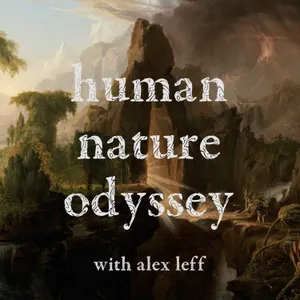
Human Nature Odyssey explores the myths, systems, and stories shaping our unraveling world.Blending history, mythology, philosophy, ecology, and cinematic audio storytelling, the show uses the past to better understand the present — and the possible futures we're creating.You are living the latest chapter in a 10,000-year human story. Join documentary filmmaker and storyteller Alex Leff on a cinematic audio journey through civilization, collapse, meaning, and myth, in search of clearer ways to experience the incredible, terrifying, and ridiculous world we inhabit.A narrative audio documentary for anyone asking how we got here — and what comes next.
Latest Episodes
The most recent episodes — sign up to get AI-powered summaries of each one.
- 2 weeks ago57 min
26 - Can Games Save The World From Bureaucracy? With C. Thi Nguyen
How did humans go from living in small-scale communities where everyone knew each other to building a massive civilization filled with billions of strangers? And what the heck holds those societies together? In this episode, philosopher C. Thi Nguyen, author of The Score: How to Stop Playing Somebody Else's Game, joins the odyssey to explore the strange relationship between games, bureaucracy, and large-scale society. We explore why bureaucracies are so inescapably powerful, what they can—and can't—see, and whether large-scale institutions are doomed to lose sight of nuance and local context. Does the flexibility and experimentation of games offer clues for designing better ways of organizing society? This is a conversation about civilization, bureaucracy, social organization, community, games, human nature, and the possibility of changing the rules of the game we're all playing. CITATIONS The Score: How to Stop Playing Somebody Else's Game by C. Thi Nguyen C. Thi Nguyen's blog Objectionable If you'd like to support Human Nature Odyssey, please subscribe wherever you enjoy your podcasts and leave us a review. Join us on Substack and get exclusive access to audio extras, writings, and notes. For full episode transcripts and additional context, visit: resilience.org/human-nature-odyssey-podcast Theme Music is "Celestial Soda Pop" (Amazon, iTunes, Spotify) by Ray Lynch, from the album "Deep Breakfast." Courtesy Ray Lynch Productions © Ⓟ 1984/BMI. All rights reserved.
- Aug 6, 202629 min
25 - The Forest and the Forager
You might think that you are not a forager. But what if no matter our lifestyle or job title, we are forever hunter gatherers in this world: of food, of love, of meaning. In this immersive episode, join Alex on a walk through an ancient forest as you explore what it means to live life as a forager. It's a journey through the garden of eden grocery story, a wrestling with the gods, and a coming home to feast and famine. CITATIONS Changes in the Landscape by William Cronon If you'd like to support Human Nature Odyssey, please subscribe wherever you enjoy your podcasts and leave us a review. Join us on Substack and get exclusive access to audio extras, writings, and notes. For full episode transcripts and additional context, visit: resilience.org/human-nature-odyssey-podcast Theme Music is "Celestial Soda Pop" (Amazon, iTunes, Spotify) by Ray Lynch, from the album "Deep Breakfast." Courtesy Ray Lynch Productions © Ⓟ 1984/BMI. All rights reserved.
- Jul 9, 202659 min
24 - Stories That Create or Destroy: Myth, Death, and Animism with Sophie Strand
What if the crises of our time are not just ecological or political, but also mythological? Poet and author Sophie Strand joins Human Nature Odyssey for a wide-ranging conversation about stories, illness, ecology, and transformation. Drawing from mythology, religion, folklore, and her own experience living with chronic illness, Sophie explores how the stories we inherit shape our relationship to the living world—and what happens when those stories no longer serve us. Together, we discuss death and rebirth, animism, the power of storytelling, and the art of composting old narratives so that something new can grow. From Jesus of Nazareth to One Thousand and One Arabian Nights to the ancient Greek epic of Odysseus, we explore stories not as relics of the past, but as living companions for navigating an uncertain future. This conversation asks what it would mean to truly live in an animate world—to encounter plants, animals, rivers, and landscapes not as resources or scenery, but as relatives. At a time when many of our cultural myths are unraveling, Sophie offers a vision of belonging rooted in reciprocity, relationship, and participation in the wider community of life. CITATIONS Sophie Strand's Substack: Make Me Good Soil Sophie Strand's Instagram: @cosmogyny Thank you to Blindspot for sharing their original music. Check out Blindspot on Bandcamp and Spotify. If you'd like to support Human Nature Odyssey, please subscribe wherever you enjoy your podcasts and leave us a review. Join us on Substack and get exclusive access to audio extras, writings, and notes. For full episode transcripts and additional context, visit: resilience.org/human-nature-odyssey-podcast Theme Music is "Celestial Soda Pop" (Amazon, iTunes, Spotify) by Ray Lynch, from the album "Deep Breakfast." Courtesy Ray Lynch Productions © Ⓟ 1984/BMI. All rights reserved.
- Jun 4, 202630 min
23 - What Is Human Nature Odyssey?
You, me, and everyone we know were born on the Titanic. Some are warning of icebergs. Some are shoveling coal into the furnaces. Some are jamming out while the band plays louder than ever. In this special episode beginning Year Four of Human Nature Odyssey, Alex gathers friends together in a living room for a live-recorded podcast potluck conversation exploring civilization, collapse, climate change, community, and the strange experience of trying to live a meaningful life while the world feels increasingly unstable. Drawing from Lord of the Rings, the Titanic, Daniel Quinn's Ishmael, ecological philosophy, and the first three years of Human Nature Odyssey, this episode becomes both a reflection on the journey so far and an exploration on what it means to "come home" to the living world. Come join us in the living room. There's still space on the couch. CITATIONS Lord of the Rings by J.R.R. Tolkien Ishmael by Daniel Quinn If you'd like to support Human Nature Odyssey, please subscribe wherever you listen, leave a review, and join us on Substack for exclusive audio extras, writings, and notes. For full episode transcripts and additional context, visit: resilience.org/human-nature-odyssey-podcast Music: Celestial Soda Pop By: Ray Lynch From the album: Deep Breakfast Courtesy Ray Lynch Productions © Ⓟ 1984/BMI All rights reserved.
- May 14, 20261h 20m
Hajar Tazi: Weaving Our Way Back Home
Today Hajar Tazi joins us on our odyssey. Hajar is a poet, writer, facilitator, and self-described "ecosystem weaver." Our conversation is part of a new five-episode miniseries from Resilience that I'm hosting in collaboration with the Omega Resilience Awards. It's called In the Rising Tide and it brings together conversations with five people from around the world, exploring the interconnected unfolding crises of our time—and how each of them is responding within their own communities. Across the series, I speak with a chef and farmer from the Philippines, an Indigenous water defender in Chile, a young organizer in Uganda resisting mega oil projects, and a narrative practitioner in India. I wanted to include this conversation with Hajar here on Human Nature Odyssey because it touches many of the themes we've been exploring here on the podcast. Hajar has been deeply influenced by the scholar and activist Joanna Macy, and facilitates something called the "Great Weaving Game," which draws on Macy's framework of the Great Unraveling and the Great Turning to help people imagine new possibilities for the future. If you want to learn more about Joanna Macy's work, you can check out the recent Human Nature Odyssey episode with Jess Serrante. Today, Hajar and I explore many things: neurodivergence, eco-villages, the IMF and World Bank, surfing, political polarization, and the art of coming home. In The Rising Tide was made with support from a grant from Omega Resilience Awards, a project of the nonprofit Commonweal. Find out more at ORAwards.org You can learn more from Hajar at her substack Remembering the Future. If you'd like to support Human Nature Odyssey, please subscribe wherever you listen, leave a review, and join us on Patreon for exclusive audio extras, writings, and notes.
- Apr 23, 202653 min
22 - Earth Abides (Part 2): Future Animists
Okay, it's been fifty years since the sudden collapse of civilization - why isn't everything back up and running already? In the 1949 sci-fi novel Earth Abides, Isherwood Williams tries and tries to teach the next generation about law, economics, and geometry but these dang kids would rather explore the streams that flow over abandoned boulevards and overgrown shopping malls. In Part 2 of this two-part series, Alex and astrophysicist Tom Murphy explore the unexpected evolution of life after the fall—when civilization fades into myth, and a new way of seeing the world begins to take root. It's been decades since airplanes filled the skies, since stadiums roared with crowds, since global supply chains stitched continents together. The children born after the Great Disaster have never known that world. To them, skyscrapers wrapped in vines are normal. Mountain lions at the edge of the cul-de-sac are normal. The quiet is normal. And as they grow up, they begin to tell different stories. Stories not of dominance, progress, or control—but of relationship, mystery, and a living world they are part of, not apart from. You don't need to have read the book to enter this world—this episode is an experience in itself. This episode is for listeners interested in societal collapse, critiques of progress, and the big questions about the future of humanity on planet earth. CITATIONS Earth Abides [book]] by George R. Stewart (2026) Tom Murphy's Do The Math blog If you'd like to support Human Nature Odyssey, please subscribe wherever you listen, leave a review, and join us on Patreon for exclusive audio extras, writings, and notes. For full episode transcripts and additional context, visit: resilience.org/human-nature-odyssey-podcast Music: Celestial Soda Pop By: Ray Lynch From the album: Deep Breakfast Courtesy Ray Lynch Productions © Ⓟ 1984/BMI All rights reserved.
- Apr 9, 202649 min
21 - Earth Abides (Part 1): Life After Civilization
You ever go on a little trip, to just get away from it all — only to come home and find all of civilization collapsed while you were gone and you might be the last person left on earth? Well then you could totally relate to George R. Stewart's 1949 science-fiction novel, Earth Abides. Earth Abides is not your typical post-apocalyptic tale. It challenges some of our core notions on progress, human happiness, and civilization itself. It's a study of how our built infrastructure crumbles in our absence and becomes home to nonhuman life. It's about how human communities organize without the enforcement of the state, and how culture changes over time—taking us from the immediate aftermath of civilization's sudden collapse to a distant future when the last generation, known only as the Americans, leaves behind a people who barely remember what the United States once was. In this two-part series, Alex is joined by astrophysicist, writer, and friend of the show Tom Murphy to retell and explore this science fiction classic, unpacking its radical ideas about collapse, resilience, and what it means to live a meaningful life. This episode is for listeners interested in societal collapse, critiques of progress, and the big questions about the future of humanity on planet earth. CITATIONS Earth Abides [book]] by George R. Stewart (2026) If you'd like to support Human Nature Odyssey, please subscribe wherever you listen, leave a review, and join us on Patreon for exclusive audio extras, writings, and notes. For full episode transcripts and additional context, visit: resilience.org/human-nature-odyssey-podcast Music: Celestial Soda Pop By: Ray Lynch From the album: Deep Breakfast Courtesy Ray Lynch Productions © Ⓟ 1984/BMI All rights reserved.
- Mar 5, 202658 min
20 - Joanna Macy & The Great Turning — with Jess Serrante
How do we live through wild times? Legendary scholar, activist, and systems thinker Joanna Macy named the moment we are living through the Great Unraveling—a time when our ecological, political, economic, and social systems destabilize to the point of no return. And yet, she also insisted that we stand on the threshold of a Great Turning: a profound transition toward a more just and sustainable world. Before Joanna's death in 2025, climate activist Jess Serrante recorded a series of intimate and insightful conversations with her. In this episode, Alex sits down with Jess, weaving in clips from those recordings to explore the questions Joanna devoted her life to asking: How do we live with meaning as civilization unravels? How do we turn toward the grief of this moment—and transform it into action? And how do intergenerational relationships help us become elders for the future - when wisdom is needed most? CITATIONS We Are The Great Turning [podcast] If you'd like to support Human Nature Odyssey, please subscribe wherever you listen, leave a review, and join us on Patreon for exclusive audio extras, writings, and notes. For full episode transcripts, essays, and additional context, visit: resilience.org/human-nature-odyssey-podcast Music: Celestial Soda Pop By: Ray Lynch From the album: Deep Breakfast Courtesy Ray Lynch Productions © Ⓟ 1984/BMI All rights reserved.
About Human Nature Odyssey
Human Nature Odyssey explores the myths, systems, and stories shaping our unraveling world.Blending history, mythology, philosophy, ecology, and cinematic audio storytelling, the show uses the past to better understand the present — and the possible futures we're creating.You are living the latest chapter in a 10,000-year human story. Join documentary filmmaker and storyteller Alex Leff on a cinematic audio journey through civilization, collapse, meaning, and myth, in search of clearer ways to experience the incredible, terrifying, and ridiculous world we inhabit.A narrative audio documentary for anyone asking how we got here — and what comes next.
Customized Recaps
AI-powered recaps with compact key takeaways, quotes, and insights.
Straight to Your Inbox
Get key takeaways from Human Nature Odyssey in a 5-minute read.
Save Hours Every Week
Stay current on your favorite podcasts without falling behind.
Frequently Asked Questions
What is Podzilla's Human Nature Odyssey daily summary?
It's a free AI-powered email that summarizes new episodes of Human Nature Odyssey as soon as they're published. You get the key takeaways, notable quotes, and links & mentions — all in a quick read.
How does the Human Nature Odyssey podcast summary work?
When a new episode drops, our AI transcribes and analyzes it, then generates a personalized summary tailored to your interests and profession. It's delivered to your inbox every morning.
Is this an official Human Nature Odyssey product?
No. Podzilla is an independent service that summarizes publicly available podcast content. We're not affiliated with or endorsed by Alex Leff.
Can I get summaries of other podcasts too?
Absolutely! The free plan covers up to 3 podcasts. Upgrade to Pro for 15, or Premium for 50. Browse our full catalog at /podcasts.
How often does Human Nature Odyssey release new episodes?
Human Nature Odyssey publishes monthly. Our AI generates a summary within hours of each new episode.
What topics does Human Nature Odyssey cover?
Human Nature Odyssey covers topics including Philosophy, Culture, Society & Culture. Our AI identifies the specific themes in each episode and highlights what matters most to you.
Start getting Human Nature Odyssey summaries tomorrow morning.
Free forever for up to 3 podcasts. No credit card required.
Free forever for up to 3 podcasts. No credit card required.