Free Daily Podcast Summary
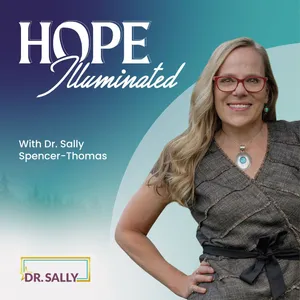
Hope Illuminated Podcast: Helping the Helpers Bring Light to Life’s Darkest Moments: Daily Summaries Delivered
by Dr. Sally Spencer-Thomas
Welcome to the Hope Illuminated Podcast, your source for the stories, science and strategy of suicide prevention, mental health promotion and resilience where we live, learn, and work. I’m your host, Dr. Sally Spencer-Thomas, and I am on a life mission to empower communities with solutions that help people overcome isolation and despair and rekindle a passion for living. Each episode we’re joined by international experts who inspire hope and offer real guidance. Welcome to the show! I am so grateful you are here.
Latest Episodes
The most recent episodes — sign up to get AI-powered summaries of each one.
- 1 weeks ago46 min
Depression as a Love Letter: Human Connection, Life Transitions & Scaling Peer Support with Nick Freud
In this episode of Hope Illuminated, I'm joined by Nick Freud, entrepreneur, deep thinker, and founder of Fellow Humans, a platform being developed to match people navigating life transitions with peers who have already lived through the same experience. Nick arrives with an unusual combination of credentials: a last name that invites inevitable comparisons to Sigmund Freud, a background in education technology, a lived experience of burnout and depression, and a working theory that the mental health crisis cannot be solved by clinical expertise alone.Nick's story begins with co-founding an edtech startup at 24 with a best friend from college. The company was promising enough to attract early success, but the relentless pressure of entrepreneurship eventually caught up with him, and he found himself in a deep depressive episode that forced a reckoning. Rather than viewing that period as a failure, Nick came to reframe it as what he calls "a love letter from your body", a signal that the version of himself he'd been performing for the world was no longer aligned with who he actually was. That insight became the cornerstone of everything he's since built.We dig into the neuroscience of human connection, the role of serotonin and oxytocin in healing, and why the kind of connection that actually moves the needle requires real vulnerability, not just proximity. Nick shares a striking insight from his research: mental health conditions almost never arise in isolation but consistently emerge during or immediately after major life transitions, new job, divorce, becoming a parent, losing a parent, retirement, relocation. And he argues that the stigma around mental health is at its lowest precisely at those transition moments, making them the ideal intervention point.The conversation turns to Fellow Humans, Nick's vision of a platform that uses AI not as a replacement for human connection but as a sophisticated matchmaking and facilitation vehicle: connecting people in the midst of a transition with others who have already navigated the same terrain. We discuss the risks of unmoderated online communities, how Reddit's peer advice communities demonstrate both the power and the peril of this model, and why AI-facilitated matching, rather than algorithm-driven engagement, could be the key to making this work safely and meaningfully at scale. For mor information on this episode go to https://www.sallyspencerthomas.com/hope-illuminated-podcast/168
- 3 weeks ago1h 3m
Suffering Is Disconnection: Co-Regulation, Real Conversations & Going Toward the Pain with Mitch Wallis
In this episode of Hope Illuminated, I'm joined by Mitch Wallis for one of the most intellectually rich and personally moving conversations I've had on this podcast. Mitch arrives with a rare combination: more than two decades of lived experience managing complex mental illnesses, a master's in clinical psychology from Columbia, and an extraordinary ability to translate neuroscience into language that any human being can act on immediately. His mantra, "go toward the pain," is both a personal practice and a public health philosophy, and this conversation is a masterclass in what that looks like in real life.We open with Mitch's central thesis: mental health is, at its core, nervous system regulation. Specifically, it is the capacity for both self-regulation and co-regulation. And co-regulation, the ability to help another person's nervous system settle through genuine, attuned presence, is the most underutilized and most scalable mental health tool we have. Mitch makes the case, backed by attachment theory and neuroscience, that nothing heals in isolation. Suffering, at its root, is disconnection from self and other.We move through the landscape of what supportive connection actually requires. Mitch unpacks the five most common mistakes even the most well-meaning supporters make: being a fixer, being a thief (hijacking someone's pain with your own story), being a blind optimist (silver-lining everything), championing the life worth living to someone in suicidal intensity, and avoiding the pain entirely. For each mistake, he offers a concrete reframe rooted in attunement, sequencing, and dosing.The conversation reaches its most personal and profound point when we turn to grief. Mitch gently reflects back to me what I share about my brother Carson, offering a reframe that stopped me in my tracks: we are not just grieving the person we lost. We are grieving the parts of ourselves that only they could unlock. That the magnetism, the levity, the playfulness Carson drew out of me, that is part of what I am still mourning. It is one of the most generous and precise moments of co-regulation I have experienced in a long time, and it is all captured here. For more information on this episode go to Suffering Is Disconnection: Co-Regulation, Real Conversations & Going Toward the Pain — Dr. Sally
- Jul 28, 202642 min
The Invisible Sacrifice: Mental Health and Well-Being in Construction with Aaron Witt
In this episode of Hope Illuminated, I'm joined by Aaron Witt - founder and CEO of Buildwitt, the fastest-growing media and workforce development platform dedicated to the "dirt world" of critical infrastructure, natural resources, and heavy civil construction. Aaron is a rare voice in this space: someone who has worked the job sites himself, who carries genuine reverence for the people who build the world, and who has built a multi-platform company around the conviction that this industry's future depends on its ability to see, value, and develop the human beings doing the work.Aaron opens with a framing that anchors the entire conversation: the military cannot function without the steel, runways, and infrastructure that construction workers build. First responders cannot reach emergencies without roads. Yet while we celebrate soldiers and firefighters for their sacrifice, the construction worker - equally indispensable, equally exposed to danger, loss, and physical hardship - remains largely invisible in the national conversation about worker well-being. Aaron calls this the invisible sacrifice, and his life's work is making it visible.We dig into the data: construction consistently ranks among the highest-risk industries for suicide, with rates surpassing military and law enforcement in some analyses. Overdose deaths on and around job sites are rising. And yet the support systems available to workers in the field are largely inaccessible - requiring workers on 12-hour shifts to navigate multiple barriers to reach anyone who might help, only to find that the person on the other end has no understanding of their world. Aaron is direct: many traditional EAP resources are, in his words, "completely worthless" for this population.The conversation turns to solutions, and Aaron is equally direct about where change has to start: with leaders. Not leaders giving speeches about wellness, but leaders going first - sharing their own struggles, modeling that it is possible to be strong and vulnerable simultaneously, and creating the conditions in which workers feel safe enough to do the same. Aaron connects this to the broader workforce crisis: with 8 million construction workers and a next generation that is not choosing the trades, well-being is not a soft add-on. It is a recruitment and retention strategy. It is, ultimately, a matter of national infrastructure security. For more information on this episode go to The Invisible Sacrifice: Mental Health and Well-Being in Construction — Dr. Sally
- Jun 30, 202642 min
Who Are You When You're Not Performing? Identity, Burnout & High Achievement
What happens when the identity you built over two decades inside one of the world's most demanding companies suddenly has nowhere to go? In this episode of Hope Illuminated, I sit down with John Brown — a former 22-year Apple leader who built a secret second career as a therapist before transitioning full-time into executive coaching, performance psychology, and sports psychology.John shares his journey from a small town in Ohio to the heart of Silicon Valley, and the painful, pivotal moments — being told point-blank he'd never become a product manager, watching colleagues lose their jobs in the dot-com bust, retiring from a 22-year identity overnight — that forced him to ask a question most high performers never stop to ask: who am I when achievement isn't defining me?We dig into the science of high-performance addiction, why the body "always wins" in the end, the boiling frog metaphor for burnout, and John's practical reframe for ambitious people: focus on small wins, acclimate like a mountain climber, and build multiple "baskets" of identity so that no single setback can take you out. This conversation is a must-listen for high achievers, executives, entrepreneurs, and the therapists and coaches who support them. For more information on this episode go to https://www.sallyspencerthomas.com/hope-illuminated-podcast/165
- Jun 2, 202659 min
The Text That Saves a Life: Caring Contacts, Peer Support & Suicide Prevention
In this episode of Hope Illuminated, I'm joined by Brandon Wilcox, peer support specialist, community crisis innovator, and suicide attempt survivor, from Rocky Mountain Crisis Partners, a grassroots Colorado organization serving the state for 15 years through a statewide crisis line and innovative community-based support models. Our conversation centers on one of the most evidence-based, underused, and beautifully human tools in suicide prevention: the caring contact.Brandon opens by sharing his own lived experience with suicidal intensity — a term we unpack together as a more precise and less stigmatizing alternative to "suicidal ideation." His story is told with both vulnerability and strength, modeling exactly the kind of open, imperfect, human connection this episode advocates for. He describes what it felt like to receive messages of support in his darkest moments and how something as small as a text saying "thinking of you today" was not small at all.We walk through the robust research on caring contacts — decades of studies showing that simple, non-clinical, non-demanding outreach significantly reduces suicide risk among people in crisis and post-crisis. We unpack the do's and don'ts with practical specificity: don't ask voyeuristic questions about the method or the moment, don't load the message with expectations or advice, don't assume silence means the message didn't land. Do be honest about not knowing what to say. Do send sunsets. Do keep showing up.We also explore mutual aid as an emerging model in crisis response, the importance of soul care and awe as long-term resilience practices, and why the prevention ecosystem benefits most when people with lived experience are centered, not just as recipients of support, but as leaders, innovators, and voices of change. Brandon's work at Rocky Mountain Crisis Partners exemplifies this philosophy in practice. For more on this episode go to https://www.sallyspencerthomas.com/hope-illuminated-podcast/164
- May 5, 202630 min
How Well-Being Multipliers Create a Mental Health Tipping Point at Work with Laura Putnam
In this episode of Hope Illuminated, I welcome Laura Putnam, author, speaker, and founder of Motion Infusion, for a rich conversation about what it actually takes to change mental health culture at scale. The central argument: one-off awareness campaigns and individual-focused interventions, while valuable, are not sufficient to create lasting change. What's needed is a tipping point and the key to reaching it lies with well-being multipliers at the team level.Laura draws on nearly two decades of experience training over 50,000 managers across 500+ organizations to make the case that team leaders, not HR departments, not C-suites, not awareness months, are the most leveraged point of intervention in any system. Gallup research shows that managers alone may account for up to 70% of the variance in team members' engagement and well-being, yet more than 50% of managers report receiving zero training to support mental health.The conversation expands outward: from workplaces to households, from gym communities to faith groups, with both guests drawing parallels to the anti-smoking movement as a model for how collective accountability and systems-level change can create permanent culture shifts. Laura's framework — Do, Speak, Create — gives team leaders three actionable levers for becoming well-being multipliers. I connects this to my own work in suicide prevention and workplace psychological safety, reinforcing that this approach doesn't just improve engagement metrics — it saves lives. For more information on this episode go to https://www.sallyspencerthomas.com/hope-illuminated-podcast/163
- Mar 30, 202647 min
Healing Trauma Beyond Words: Brain, Body, and Spirit with Julia Hassall
In this episode of Hope Illuminated, I sit down with Julia Hassell to explore what it really looks like to heal after profound loss.Julia’s story is both heartbreaking and deeply inspiring. After losing her father to suicide and navigating multiple losses in her family, she found herself on a path to understand trauma at a much deeper level. What she discovered challenged everything she thought she knew about mental health and healing.Together, we talk about how trauma lives in the body, why traditional talk therapy can sometimes fall short, and how approaches like brainspotting and somatic work can help us process what words cannot. We also explore the role of spirituality, continuing bonds with loved ones, and the powerful idea that pain can become a doorway to purpose.If you’ve ever felt stuck in your healing journey, this conversation offers both hope and a new way forward. For more information on this episode go to https://www.sallyspencerthomas.com/hope-illuminated-podcast/162
- Mar 6, 202633 min
How Men’s Groups Help Men Make Meaning in Dark Times with Rabbi Baruch HaLevi ("Dr. B")
Many men struggle silently with grief, loneliness, identity loss, and moral injury. Social expectations often teach men to stay strong, stay productive, and stay quiet about pain.In this episode of Hope Illuminated, I speak with meaning-centered psychotherapist and logotherapist Baruch HaLevi (“Dr. B”) about how men’s groups help men transform suffering into purpose, connection, and resilience.Drawing from Viktor Frankl’s logotherapy, lived experience with suicide loss, and years of guiding men’s peer groups, Dr. B explains how meaning helps men move through life’s darkest chapters. For more information on this episode go to https://www.sallyspencerthomas.com/hope-illuminated-podcast/161
About Hope Illuminated Podcast: Helping the Helpers Bring Light to Life’s Darkest Moments
Welcome to the Hope Illuminated Podcast, your source for the stories, science and strategy of suicide prevention, mental health promotion and resilience where we live, learn, and work. I’m your host, Dr. Sally Spencer-Thomas, and I am on a life mission to empower communities with solutions that help people overcome isolation and despair and rekindle a passion for living. Each episode we’re joined by international experts who inspire hope and offer real guidance. Welcome to the show! I am so grateful you are here.
Customized Recaps
AI-powered recaps with compact key takeaways, quotes, and insights.
Straight to Your Inbox
Get key takeaways from Hope Illuminated Podcast: Helping the Helpers Bring Light to Life’s Darkest Moments in a 5-minute read.
Save Hours Every Week
Stay current on your favorite podcasts without falling behind.
Frequently Asked Questions
What is Podzilla's Hope Illuminated Podcast: Helping the Helpers Bring Light to Life’s Darkest Moments daily summary?
It's a free AI-powered email that summarizes new episodes of Hope Illuminated Podcast: Helping the Helpers Bring Light to Life’s Darkest Moments as soon as they're published. You get the key takeaways, notable quotes, and links & mentions — all in a quick read.
How does the Hope Illuminated Podcast: Helping the Helpers Bring Light to Life’s Darkest Moments podcast summary work?
When a new episode drops, our AI transcribes and analyzes it, then generates a personalized summary tailored to your interests and profession. It's delivered to your inbox every morning.
Is this an official Hope Illuminated Podcast: Helping the Helpers Bring Light to Life’s Darkest Moments product?
No. Podzilla is an independent service that summarizes publicly available podcast content. We're not affiliated with or endorsed by Dr. Sally Spencer-Thomas.
Can I get summaries of other podcasts too?
Absolutely! The free plan covers up to 3 podcasts. Upgrade to Pro for 15, or Premium for 50. Browse our full catalog at /podcasts.
How often does Hope Illuminated Podcast: Helping the Helpers Bring Light to Life’s Darkest Moments release new episodes?
Hope Illuminated Podcast: Helping the Helpers Bring Light to Life’s Darkest Moments publishes monthly. Our AI generates a summary within hours of each new episode.
What topics does Hope Illuminated Podcast: Helping the Helpers Bring Light to Life’s Darkest Moments cover?
Hope Illuminated Podcast: Helping the Helpers Bring Light to Life’s Darkest Moments covers topics including Fitness, Health & Fitness, Mental Health. Our AI identifies the specific themes in each episode and highlights what matters most to you.
Start getting Hope Illuminated Podcast: Helping the Helpers Bring Light to Life’s Darkest Moments summaries tomorrow morning.
Free forever for up to 3 podcasts. No credit card required.
Free forever for up to 3 podcasts. No credit card required.