
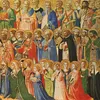
I would like to begin today by making some comments about that wonderful New Testament passage, Philippians chapter 4, in which the Apostle Paul says: “Rejoice in the Lord always; again I will say, Rejoice.”Rejoicing in a Hard WorldIt is interesting that Paul says this in that letter. All the way through the book of Philippians he is constantly speaking about rejoicing and telling the Christians he was writing to—and through them, us as well—to rejoice. At that point in his life he was languishing in a prison cell, facing possible death in the arena, being torn apart by wild beasts. So it is an interesting thing for him to say to the Philippian Christians: “Rejoice in the Lord always. Again I will say, Rejoice.”And of course it raises the question for us: How can we rejoice? How can we rejoice when the world is so filled with pain, with injustice, with anxiety, with difficulties, and of course with the inevitability of death? All of these things are a reality for us.We can ignore them, of course—or at least we can try to—but it is not particularly easy, and it is not really a long-term solution, because they will all catch up with us eventually, in one way or another. We can allow the problems, the difficulties, the pain of life to destroy us, to overcome us, and we can simply yield to them—but then, of course, we are destroyed; we are overcome.Personally, I am yet to come across a better answer to this question than the one the Apostle Paul provides in the book of Philippians—and what we might call, broadly speaking, the Christian answer. This is because I think that Christianity acknowledges the problems we face in this life. It does not try to minimise them, it does not try to say that they do not exist, and it does not give answers which are too easy. The Christian answer provides us with an ultimate hope in God—ultimately in Christ—and it gives us peace and joy in our relationship with God as we wait for that hope to be realised.Again, I would like to be emphatic: this answer acknowledges the fact that there are serious, painful, difficult problems that we face in life, as we suffer, as we die. Even if we have come here this morning and are feeling very happy in our lives at the moment—if we are in a good moment personally—there will still be anxieties and difficulties that surround us of which we are aware.As I have reflected upon this passage this week, I notice that I am anxious about different things now than I used to be. When I was younger, things which seemed incredibly significant to me—insurmountable, maybe—were anxieties about my personal future, about questions of identity, what I was to do, who I was to do it with, and so on. As I have grown up a bit (I hope, anyway—at least as I have got older), my anxieties are now more around fulfilling my personal responsibilities to other people, to people who are dependent upon me in one way or another, and also concern for those around me who are growing older, perhaps less well, and are drawing closer to their inevitable ends.Of course your anxieties will be different from mine, but you will all have them. This is the world that we live in. As I say, the Christian view does not deny any of it, but takes it seriously. These things are real, and they are significant. But the Christian view does not give suffering and death the last word. Rather, the Christian Scriptures and the Christian gospel hold out hope to us in Christ.The Kingdom as a Wedding FeastWe see something of this today in Christ’s description of the kingdom of heaven in that marvellous parable we have just heard. He says that the kingdom of heaven is like a king who gave a wedding feast for his son. The kingdom of heaven is like a king who gave a wedding feast for his son.That comparison between the kingdom of heaven on the one hand and a wedding feast on the other is repeated in various different places and in various different ways in the Scriptures. For example, in the book of Ephesians Paul says that the natural union of a husband and a wife is a mystery that refers to Christ and the Church—Christ as the groom, the Church as the bride. And we see the fulfilment, if you like, of this image in the book of Revelation, at the very end of Scripture, in which that relationship between Christ and the Church is once again compared to a groom and a bride in the context of a wedding feast.I would like us just to think about that for a moment. Consider what a wedding feast is like. I would say there is actually nothing more joyful than a very well-organised and happy wedding day. They are not all like that, but many of them are. And a joyful wedding followed by a feast—well, it is hard to imagine anything happier in this world.When that happy day arrives, the bride is never lovelier; the guests deck themselves in their finest clothes; and then the bride and groom are sacramentally united in the presence of God, and a great celebration with eating, with drinking, with talking and fellowship and
Podzilla Summary coming soon
Sign up to get notified when the full AI-powered summary is ready.
Free forever for up to 3 podcasts. No credit card required.



Get summaries like this every morning.
Free AI-powered recaps of Holy Trinity Winchester Podcast and your other favorite podcasts, delivered to your inbox.
Free forever for up to 3 podcasts. No credit card required.