Free Daily Podcast Summary
History Uncensored: Daily Summaries Delivered
by Wake Up Productions
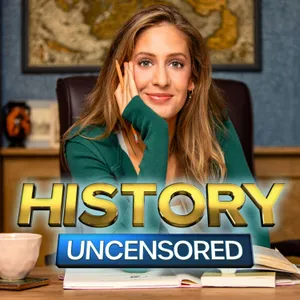
Every headline has a history. Bianca Nobilo uncovers the hidden historical forces behind geopolitics, war, myth, and scandal to expose how power really works and why the past is weaponised. Whatever is happening in the world, History Uncensored asks: how did we get here?
Latest Episodes
The most recent episodes — sign up to get AI-powered summaries of each one.
- 3 days ago47 min
The 2,000-Year History of AI - Could It Now REALLY Kill Us All? | With George Zarkadakis
Artificial intelligence could change humanity forever. But the history of AI began thousands of years before computers, machine learning and ChatGPT existed. In just a few decades, humans have gone from mechanical computers and early ideas about machine intelligence to powerful AI systems capable of generating text and images, writing code, solving complex problems and performing tasks once thought to require human intelligence. But how did we get here? Bianca Nobilo explores the fascinating 2,000 year history of artificial intelligence, alongside AI engineer George Zarkadakis. AI - millennia in the making From Talos to Turing... to total extinction? Theory of Mind - with George Zarkadakis Gods and demons - When does fear creep in? Scientific foundations Sex, war and robots Is AI conscious? Consciousness v intelligence "We don't know what's happening inside those machines" Human extinction in the coming decades - is it likely? Does AI have a survival instinct? 'Mutually assured destruction' and Cold War parallels Is there an off switch? Will humanity view this as our greatest mistake? Why it’s so hard to stop research Learn more about your ad choices. Visit podcastchoices.com/adchoices
- 1 weeks ago32 min
Did 9/11 Begin The End Of American Power? | With John Bolton
Attorney and former United States Ambassador to the United Nations, John Bolton joins Bianca Nobilo to reflect on the decisions that followed September 11 and how they reshaped American foreign policy and the world. From NATO’s historic invocation of Article 5 and relations with Russia, to the rise of China and the conflict with Iran, Bolton examines the choices that brought America to this moment. Is Donald Trump an aberration, or is America’s post Cold War foreign policy tradition disappearing? And if Bolton could return to September 10, 2001, what would surprise him most about the 25 years that followed? 9/11 - 25 years on America under attack - with John Bolton Cold War rivals briefly align The only time NATO invoked Article 5 'I don't stand by all the actions taken' after 9/11 - Bolton Did fear drive decisions on Iraq? Was America distracted as China rose? Differences with Trump 'Trump is an aberration' 'The end of history' Learn more about your ad choices. Visit podcastchoices.com/adchoices
- 3 weeks ago41 min
Can Britain Become A Superpower Again? | With David Reynolds
Britain was once the world’s dominant global power. A relatively small island nation built an empire spanning nearly a quarter of the Earth’s land, controlled vital trade routes, and became the centre of the Industrial Revolution. But how did Great Britain punch so far above its weight - and when did that extraordinary system of power actually break? The UK today remains a nuclear power, a permanent member of the UN Security Council, a major NATO and a country with enormous diplomatic, cultural and educational reach. Is that enough to remain a consequential global power or is Britain increasingly living off the legacy of a power it no longer possesses? Bianca Nobilo explores the rise and decline of British power with historian David Reynolds, Emeritus Professor of International History at Cambridge and author of Britannia Overruled. Britain - a historical anomaly 'Accidental empire' - Historian David Reynolds How a tiny island became a global power The world's strongest navy Empire as a "multiplier" of British power Was it ACTUALLY a superpower? When does status start to decline? How Churchill shaped how Britain sees itself America and Britain - an 'inconceivable' relationship Lost influence Brexit and Britain's new identity Bianca's goal Learn more about your ad choices. Visit podcastchoices.com/adchoices
- Aug 20, 202629 min
How Is Migration Being Used As A WEAPON In Europe? | With Peter Frankopan
Across Europe, migration is increasingly becoming a source of geopolitical tension and in some cases: a tool of state power. In recent weeks, Europe’s borders have produced extraordinary scenes: around 72,000 people crossed from Morocco illegally into the Spanish enclave of Ceuta, while a record 230 people reached Britain in a single inflatable boat. Meanwhile, tunnels have been discovered beneath the borders between Belarus and its EU neighbours, amid accusations that Russia and its allies are exploiting migration as part of a wider hybrid strategy. But how much of this is deliberate and how much is simply the result of conflict, economic pressure, criminal smuggling networks and misinformation? Bianca Nobilo is joined by historian Peter Frankopan to dissect how migration is being used as a weapon in Europe. Ceuta, Russia and migration as a weapon An unprecedented era? - with Peter Frankopan Migration as a tool - what history tells us How unique is what's happening today? When do attitudes start to change? Age of information Why Ceuta? History and geography combine Attempts to destabilise Europe? Are liberal democracies more vulnerable? Key lessons from history Learn more about your ad choices. Visit podcastchoices.com/adchoices
- Aug 14, 202633 min
Allies to Enemies: How Israel & Iran’s Relationship COLLAPSED | With Trita Parsi
For decades, Israel and Iran have been portrayed as bitter enemies - but their history tells a far more complicated story. Long before today’s war, Iran and Israel were strategic partners, trading oil, weapons, intelligence and military technology - even after Iran’s 1979 Islamic Revolution. Their relationship stretches back much further, through the Persian Empire, Cyrus the Great and centuries of Jewish life under Persian rule. So how did two countries that once secretly armed and relied on each other become existential enemies? Bianca Nobilo traces the unlikely history of Iran and Israel; from the ancient world to the secret alliance of the 20th century, the Iranian Revolution, the Iran-Iraq War and the geopolitical upheavals that ultimately transformed cooperation into confrontation. Joining Bianca to discuss all of this and more is Iranian-Swedish writer and political analyst Trita Parsi. Israel and Iran - allies to enemies A relationship millennia in the making Uncensoring the history with Trita Parsi Corrupting history "for their own purposes" What changed? Soviet Union & Saddam Hussein State of Israel is formed Cooperation and collaboration What changed after the Islamic Revolution Iran-Contra affair U.S. role in today's hostile relationship Learn more about your ad choices. Visit podcastchoices.com/adchoices
- Aug 6, 202635 min
Who is the REAL Benjamin Netanyahu? | History Of Israel's Prime Minister | With Anshel Pfeffer
Benjamin Netanyahu is one of the most consequential - and controversial - political leaders of the 21st century. To supporters, he is "King Bibi," the leader who has kept Israel secure through decades of war and regional instability. To critics, he is responsible for prolonging conflict and undermining the prospects for peace. He also faces an arrest warrant issued by the International Criminal Court over alleged war crimes and crimes against humanity - allegations he rejects, and which Israel disputes. No leader has shaped modern Israel for longer. Born just 17 months after the creation of the State of Israel, Netanyahu has governed the country for nearly 19 years - almost a quarter of its history. But to understand the decisions he is making today in Gaza, Iran, the United States and on Israel's future, you first have to understand the history that shaped him. Bianca Nobilo is joined by Israel Correspondent for The Economist Anshel Pfeffer to uncover the Israeli Prime Minister's past. 00:00 Netanyahu 'wants to write his own history' 00:38 Bibi, "King of Israel", "Butcher of Gaza" 02:52 Netanyahu's upbringing - with Anshel Pfeffer 04:46 Death of his brother Yoni 08:48 Made in America? 11:33 Views on Palestinians and Palestine 15:53 Churchillian complex - "A really severe case" 19:09 Iran - the external enemy 26:08 Does ego shape his global role? 30:18 Will history remember him kindly? Learn more about your ad choices. Visit podcastchoices.com/adchoices
- Jul 30, 202631 min
Is Opus Dei Infiltrating Power In Washington? Investigative Journalist Reveals All Of Scandal
Opus Dei presents itself as a Catholic movement dedicated to finding holiness in everyday life. Critics and former members, however, allege a far darker reality. Bianca Nobilo is joined by investigative journalist Gareth Gore, author of Opus, who traces the organisation's rise from its founding in Spain in 1928 to its influence in politics, finance and the Catholic Church. He examines allegations of psychological manipulation, labour exploitation, human trafficking and abuse - claims Opus Dei strongly denies - and explores the controversial legacy of founder Josemaría Escrivá, the movement's culture of secrecy, and its global reach. Gore also explains how he had a meeting with Pope Leo XIV, where he called for an independent Vatican investigation, Opus Dei's detailed rebuttal to his book, and questioned whether one of the world's most influential Catholic organisations is facing reform or renewed growth. Opus Dei rejects Gareth Gore's characterisation of the organisation and denies allegations of human trafficking and other wrongdoing discussed in this conversation. 00:00 Opus Dei's troubling history 02:03 Alleged abuses - investigative journalist Gareth Gore 03:42 Controversial traditions & corporal mortification 07:35 Children as alleged targets 11:35 Opus Dei cracks America 14:56 Opus Dei & Spain's civil war 17:13 Allegations: human trafficking & sexual misconduct 20:29 Opus Dei response 22:35 An audience with Pope Leo 28:30 What should people know? Learn more about your ad choices. Visit podcastchoices.com/adchoices
- Jul 23, 202629 min
Worse Than The Strait Of Hormuz? Iran War ESCALATION As Houthis Block Tankers | With Tim Marshall
As attention remains focused on the of years. Strait of Hormuz, another strategic waterway is emerging as a critical geopolitical flashpoint: Bab el-Mandeb, the ancient "Gate of Tears." Why has this narrow passage between the Red Sea and the Indian Ocean has become one of the world's most important maritime chokepoints? From ancient trade routes and imperial rivalries to the Houthis' attacks on commercial shipping and the risk of wider regional escalation, Bab el-Mandeb has shaped global commerce for thousands of years. The expansion of the Iran conflict into the Red Sea has created a new threat to global energy markets, raising concerns over the security of one of the world's busiest shipping routes. Nearly two weeks after the latest escalation between the United States and Iran, tensions intensified when the Iran-backed Houthis announced a blockade of Saudi vessels transiting the Bab el-Mandeb Strait, a vital maritime gateway at the southern entrance to the Red Sea. This week, Bianca Nobilo is joined by journalist and author Tim Marshall to see how consequential unfolding events could be... Learn more about your ad choices. Visit podcastchoices.com/adchoices
About History Uncensored
Every headline has a history. Bianca Nobilo uncovers the hidden historical forces behind geopolitics, war, myth, and scandal to expose how power really works and why the past is weaponised. Whatever is happening in the world, History Uncensored asks: how did we get here?
Customized Recaps
AI-powered recaps with compact key takeaways, quotes, and insights.
Straight to Your Inbox
Get key takeaways from History Uncensored in a 5-minute read.
Save Hours Every Week
Stay current on your favorite podcasts without falling behind.
Frequently Asked Questions
What is Podzilla's History Uncensored daily summary?
It's a free AI-powered email that summarizes new episodes of History Uncensored as soon as they're published. You get the key takeaways, notable quotes, and links & mentions — all in a quick read.
How does the History Uncensored podcast summary work?
When a new episode drops, our AI transcribes and analyzes it, then generates a personalized summary tailored to your interests and profession. It's delivered to your inbox every morning.
Is this an official History Uncensored product?
No. Podzilla is an independent service that summarizes publicly available podcast content. We're not affiliated with or endorsed by Wake Up Productions.
Can I get summaries of other podcasts too?
Absolutely! The free plan covers up to 3 podcasts. Upgrade to Pro for 15, or Premium for 50. Browse our full catalog at /podcasts.
How often does History Uncensored release new episodes?
History Uncensored publishes weekly. Our AI generates a summary within hours of each new episode.
What topics does History Uncensored cover?
History Uncensored covers topics including History, Education, Culture, Society & Culture. Our AI identifies the specific themes in each episode and highlights what matters most to you.
Start getting History Uncensored summaries tomorrow morning.
Free forever for up to 3 podcasts. No credit card required.
Free forever for up to 3 podcasts. No credit card required.