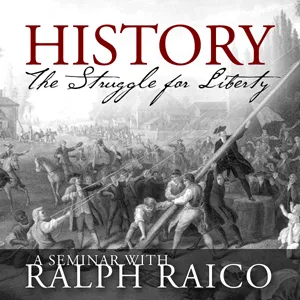
Free Daily Podcast Summary
History: The Struggle for Liberty: Daily Summaries Delivered
Get key takeaways, quotes, and insights from History: The Struggle for Liberty in a 5-minute read. Delivered straight to your inbox.
Latest Episodes
The most recent episodes — sign up to get AI-powered summaries of each one.
- Sep 3, 2004
1. The European Miracle
Ralph Raico covers classical liberalism’s growth, development and possible future. Liberalism arose in Europe entwined with Christianity. Why Europe? The East lacked the idea of freedom from the state and never established the legal system that could protect wealth. Europe had multiple, decentralized competing powers, not a universal empire. Europe came into existence in the Middle Ages. The contractual relationship between princes and subjects was similar to the Magna Carta. The Middle Ages [5th to the 15th century] were not dark ages. The sign of a freeman was that he had the right to keep and bear arms. The powerful, international Church of Rome was the strong institution that acted as a counterweight to secular power. It was the largest property owner in Europe and concerned about taxation. Lecture 1 of 10 from Ralph Raico's History: The Struggle for Liberty. Transcript [This transcript is edited for clarity and readability. The Q and A at the end of the lecture has been omitted. Annotations have been added by Ryan McMaken.] This week, my subject is going to be history as a struggle for liberty. This conception of history, what history is, goes back to Lord Acton, a famous nineteenth-century historian who spent all his life accumulating notes and materials for what would be thought a great history of liberty—the greatest book never written, people say. Nonetheless, Acton wrote many essays on the subject and he’s a historian well worth consulting. What I’m going to be discussing this week is classical liberalism. I might slip and just call it liberalism from time to time, but you’ll understand what I’m saying. We’ll be discussing its growth, its development, and finally, I’ll say something about the possible future of liberalism. Now, the history of classical liberalism is intertwined in the history of Europe and its outposts, especially America. Europe has sometimes been defined as extending from Warsaw to San Francisco—and one might amiably throw in also Vancouver and Melbourne. Some people would consider this a very Eurocentric kind of approach. Well, so is the history of modern science Eurocentric. The story that I’m going to be outlining will serve as an antidote to what some of you, at least, have experienced in your high schools and colleges and that is the demonization of Europe and Europeans as mass genocidal murderers and imperialist exploiters. If you doubt that this is standard in American education today, then you can read the works of Alan Kors, a Professor at The University of Pennsylvania who has specialized in this. He is a great scholar of France and the French enlightenment otherwise, but has made it a point to detail how this demonization takes place through sensitivity training and many other respects.Paula Reid “History prof Alan Charles Kors Critiques universities' political correctness,” The Daily Pennsylvanian (Philadelphia), March 24, 2009. https://www.thedp.com/article/2009/03/history_prof_alan_charles_kors_critiques_universities_political_correctness Now, of this view of the Europeans as genocidal murderers and demons and so on, much could be said. I’m not going to go into any great detail. The first thing that comes to mind is that Europeans, like everybody else, are subject to original sin and have a proclivity to temptation of putting their own perceived self-interests above others to any extent that they feel necessary. Another thing that could be said is that power corrupts, as Acton famously said. In the modern period, it’s Europeans who had the power. It would be interesting to see what would have happened if it had been the Aztecs— Aztecs famous for their ritual murders and cannibalism—who landed in Spain rather than the other way around and what scenes we would have witnessed. Finally, I want to say that there were Europeans who opposed those various crimes of the men of power in their own countries and among them—among the most prominent—were the classical liberals that we’ll be talking about this week. What Made Europe Different Now, the first thing to say about liberalism is that it arose in Europe, specifically in western Christendom. This is the Europe that grew up in communion with the Bishop of Rome, at one time or another, so that the history of Europe and the history of liberalism, are intimately intertwined. The question of why this should be the case has given rise to an enormous literature. This approach to trying to find out why Europe was different, why Europe was distinctive, is sometimes called the institutional approach of economic historians. This phenomenon could be called “the European miracle,” after the title of a book by one of the major authors of this approach, E.L. Jones, the Australian economic historian.See E.L. Jones, The European Miracle:Environments, Economies and Geopolitics in the History of Europe and Asia (Cambridge, U.K.: Ca
- Sep 3, 2004
2. Classical Liberalism
Mises’ book, Liberalism, states that liberalism sufficed to change the face of the earth. The term liberal has since been hijacked by social democrats, so they don’t have to use the tainted word socialism. Raico defines liberalism to be civil society, minus the state, running itself within the bounds of private property. After the end of the Middle Ages, the Renaissance created the late scholastics – the School of Salamanca. Their legitimate theory of value had nothing to do with labor as it did in England. They saw that buyer and seller are each better off by an exchange, not equal. The Dutch produced a fairly free society, but not a political philosophy. The French felt the period 1846-1940 to be almost a hundred years of true laissez-faire policy. During the English Civil War, the Levellers began the history of liberalism by their demands to free John Lilburne from prison. The Leveller cause was effectively crushed in 1649. Their legacy was abstract natural rights. Rothbard called them the world’s first self-consciously libertarian mass movement. John Locke is a fountainhead of crucial ideas about society being self-ruled with property being the fundamental right to life, liberty, and estates. Government was meant only to protect that right. Such an uncoerced vision animated Jeffersonians. The laissez-faire society worked well. Adam Smith, David Hume, and Adam Ferguson were chief thinkers of the Scottish Enlightenment. They held that the fundamental importance of human reason should be combined with a rejection of unreasonable authority. Lecture 2 of 10 from Ralph Raico's History: The Struggle for Liberty. Transcript [This transcript is edited for clarity and readability. The Q and A at the end of the lecture has been omitted. Annotations have been added by Ryan McMaken.] This lecture will concern classical liberalism itself. Now, I think that you’ve been given—free of charge in the usual generous tradition of the Mises Institute—or somewhere along the line, gotten hold of a copy of Mises’ book called Liberalism. In the original German it’s called just Liberalism, and in the current English version, Liberalism in the Classical Tradition.The English version of Liberalism was translated by Raico himself and in an aside Raico jokes that the “rather brilliant” English translation has been “compared by many to Chapman’s Homer.” At the very beginning of the book, Mises talks about liberalism and says, The philosophers, sociologists, and economists of the eighteenth and early part of the nineteenth century formulated a political program that served as a guide to social policy first in England and the United States, then on the European continent, and finally in the other parts of the inhabited world as well. Nowhere was this program ever completely carried out. Even in England, which had been called the homeland of liberalism…Ludwig von Mises, Liberalism: In the Classical Tradition (Irvington-on-Hudson, NY: The Foundation for Economic Education, 1985) p. 1. Mises says Liberalism was never permitted to come to full fruition: “Nevertheless, brief and all too limited as the supremacy of liberal ideas was, it sufficed to change the face of the earth.”Ibid. And it goes on in that vein. Well, as I say, he uses the term “liberalism” which for a long time was the word associated with this program that he’s developing. But it may seem strange to you to associate liberalism with basically laissez-faire and the other elements of the liberal program, considering that liberalism—not only in the United States, but now in other countries as well—has come to mean something quite different. There’s a rather well-known story how, in English-speaking countries first of all and then elsewhere, around the turn of the century—that is, the turn of the nineteenth to the twentieth century—the term liberal was hijacked by people who were essentially social democrats. What Is Liberalism, and Why Do Social Democrats Call Themselves Liberals? Joseph Schumpeter is an economist from Austria—but not what we would call an Austrian economist—and a very famous social philosopher and well worth consulting. He wrote a very big book that I think is still in print from Oxford called History of Economic Analysis. In a famous passage there, he ironically states that it was a kind of compliment, if an unintended one, when the enemies of the system of free enterprise confiscated the name liberal for what was basically the opposite of what liberalism had stood for from the start.The famous passage reads: “[T] the term has acquired a different—in fact almost the opposite—meaning since about 1900 and especially since about 1930: as a supreme, if unintended, compliment, the enemies of the system of private enterprise have thought it wise to appropriate its label.” See Joseph A
- Sep 3, 2004
3. John Stuart Mill
Mill played a crucial, but inflated, role in liberalism. Rothbard did not like Mill much. Mill was a disaster on economic freedom and international issues. Mill rejected that workers and capitalists shared interests. Mill was anti-capitalist. Mill’s On Liberty addresses the nature and limits of legitimate power by society over individuals. Mill’s relationship with Harriet Taylor, a married woman, twisted his own mores. Mill’s liberalism had little regard for the past. John Maynard Keynes also contributed to liberalism meaning almost anything including Nazism. Keynes felt his system was more adapted to socialism and Stalinism. But the hallmark of liberalism is that society can run itself with voluntary agreements based upon private property rights. French liberalism involved the idea of class conflict which led to totalitarianism. This doctrine is generally associated with Marxism, but predated Marx. The French made all government offices open to all citizens. That was the essence of the French Revolution. Two main conflicting classes are producers and plunderers. The British tradition of liberalism, as F.A. Hayek espoused, leaves out the tradition of natural rights. Transcript: Lecture 3 of 10 from Ralph Raico's History: The Struggle for Liberty. [This transcript is edited for clarity and readability. The Q and A at the end of the lecture has been omitted. Annotations have been added by Ryan McMaken.] John Stuart Mill played a crucial role in the transition from the older liberalism—the laissez-faire liberalism—to the new liberalism, a type of democratic socialism. Now, it is, to my mind, a disservice when a typical college course that deals with the history of political thought does this: as an example of eighteenth-century liberalism they’ll maybe have Adam Smith. As an example of nineteenth-century liberalism, they will have John Stuart Mill. They’ll present it as John Stuart Mill versus Karl Marx or Friedrich List, and use the idea that Mill is the exemplary liberal of the nineteenth century. One reason that he’s very attractive to people is that he had a very good writing style. There’s no doubt about that. And his writing style is superficially very logical and rational. But, there are very serious problems with Mill from an authentic liberal point of view that I’ll be pointing out. Much of the confusion prevailing in the whole problem of defining and understanding liberalism can be traced to Mill. To my mind, he occupies a vastly inflated position in the conception of liberalism entertained by English-speaking people. This is an example of Anglo-centrism, you might say. It is a scandal how few American social-scientific university professors cannot easily read even modern European languages like French and German. I happen to know this is a fact in connection, for instance, with the Stanford University history department, although they have great scholars. On the other hand, there is this lack of having access to works of continental writers that have not been already translated. James Buchanan, when he undertook his study of public finance, learned Italian—which I think must be a very rare accomplishment among American economists—in order to read the rich treasury of economic thought among the Italian economists of the late nineteenth century and early twentieth century. The lack of the ability to access some of the most important continental political figures, leads to ridiculous overemphasis on the British tradition, to my mind. A man that I’ll be mentioning a number of times, I think from now on, is one of my favorite authors altogether: Benjamin Constant. Constant wrote an enormous amount on political philosophy and other subjects. It was only a few years ago, in the Cambridge “blue” series of political thinkers, that some of his major writings on political philosophy became available in English. George Sabine’s history of political thought doesn’t even mention Constant, although I would be prepared to argue that he was the most important liberal philosopher of the nineteenth century.George H. Sabine, A History of Political Theory (New York, NY: Holt, Rinehart and Winston, 1961). First published 1937. He was worlds ahead of Mill, as far as I’m concerned, and Mill was a disaster on a number of fronts. In economics, Mill held that, “The principle of individual liberty is not involved in the doctrine of free trade.”John Stuart Mill, On Liberty, (London : Longman, Green, Longman, Roberts & Green,1864) p. 171 He is using “free trade” in the sense of economic freedom: freedom of trade, not just internationally. But for Mill in On Liberty, in general, the principle of freedom is not involved in economic affairs. In contrast, Milton Friedman quotes a great letter that Benjamin Franklin sent to one of the French physiocrats where Franklin said that he thought that liberty of exchange, li
- Sep 3, 2004
4. Class and Conflict
Gustave de Molinari became the grand old man of classical liberalism, crediting Pareto. Molinari understood that the main issue in the Civil War was the tariff, not slavery. In Italy economists founded free market economics, crediting Bastiat.In America, John Taylor saw society becoming feudalistic with exploiting classes. Government needed to be separated from banking systems. Thomas Jefferson’s values were held most high. William Graham Sumner talked about plutocrats – wealthy persons who used the state. There was the liberal idea of class conflict. Production led to peace, whereas militarism led to war and destruction. War is the health of the state, said Bourne.The pro-peace position was led by the Manchester School, particularly by Richard Cobden. They led the free trade movement. Their aim was harmony and peace among nations.The tax-eating rather than the tax-paying classes favored war. Cobden emphasized trade not politics. Bastiat proposed getting rid of the French army. The American Open Door policy with China was free trade imperialism. Unilateral free trade works. Trade agreements don’t. Just do away with tariffs.War making was often based upon incorrect information. Kosovo and Iraq are examples of disinformation stampeding us into war. The liberal anti-war tradition was against imperialism. The US went down the road of empire as did Spain. Constant war, large standing armies, crushing debt, and destructive levels of taxation are all with us now.Herbert Spencer believed that warfare was only suitable to man’s primitive stage, not his advanced stage after industrialization. However, some liberals, like de Tocqueville, did support war under certain conditions.Lecture 4 of 10 from Ralph Raico's History: The Struggle for Liberty.
- Sep 3, 2004
5. War, Peace, and the Industrial Revolution
It was thought that the ultimate antidote to war was universal democracy. It was not. Spencer defined liberal democracy as an individual free to control the product of his own efforts on the market. Welfare societies could not rationally be termed democracies.Globalism perverts the Constitution. Meddling activism has unintended consequences like centralizing the power of the Presidency. Intervention creates blowback.The effects of the Industrial Revolution are a major issue in Classical Liberalism. From 1750 to 1850 industrialization got slowly underway in Britain. Division of labor and urbanization were considered a catastrophe. It was thought that only labor unions could improve conditions of the working people. This myth created a standing presumption that laissez-faire ruins countries and requires state intervention to protect present victims of capitalism.An optimist school made gradual headway against these pessimists. They gathered objective data and applied better economic theory. Wages, availability of foodstuffs, and length of life were finally considered in contrast to initial horror stories. In fact, the standard of living improved for most workers. Industrialization allowed tens of millions of people to survive as their populations exploded. The Industrial Revolution was not the problem; it was the solution.Lecture 5 of 10 from Ralph Raico's History: The Struggle for Liberty.
- Sep 3, 2004
6. The New World of Capitalism
In the face of overwhelming evidence of the prosperity of capitalism, Marxists were forced to rephrase their arguments from material provisions to quality of life. Robert Nozick, a brilliant philosopher of liberty, became a libertarian. Anarchy, State, and Utopia, his main book, dominates debate in political philosophy.Why were intellectuals so hostile toward the market place and private property? Only state interventionism was seen as virtuous. Hayek saw that intellectuals had egalitarian biases, but felt they meant well. They just had scientistic prejudice. Schumpeter remarked that Hayek was polite to a fault.Schumpeter held that the key to intellectual hostility was the education and literacy that the capitalist wealth machine made possible – the freedom to nibble at the foundations of the capitalist society. This analysis is in his most popular book Capitalism, Socialism, and Democracy.Mises was not polite to a fault. His focus on this issue cites work about money making having been stigmatized. Western culture has had contempt for money making, commerce, merchants and business people. Entrepreneurs and capitalists themselves are swayed by the moral outlook which damns their activity.Lecture 6 of 10 from Ralph Raico's History: The Struggle for Liberty.
- Sep 3, 2004
7. The Anti-Capitalists
Humans are prone to envy, writes Helmut Schoeck in Envy: A Theory of Social Behavior. Humans try to set up a society in which none is envious of another. George Stigler of the Chicago School saw man as always a utility maximizer.Robert Higgs disagreed with Stigler’s position. Higgs presents that the kind of person one becomes confirms a self-image. When acting politically, people are often concerned about what might be right or wrong.Russia was fertile grounds for socialist ideas. European intellectuals had made capitalism an object of horror. The Marxist dream was to be obtained by abolishing private property. One prevailing historical myth has been part of socialist pseudo-history. Did German big business play an essential role in the rise of Hitler? No, finds Henry Ashby Turner, but historians keep repeating this story.Jean-Jacques Rousseau was not a socialist, but was an enemy of capitalism. His views and his activities were destructive. Rousseau and Voltaire hated each other. Rousseau’s famous book is The Social Contract. It is very different from Locke’s. Rousseau should not be put into the liberal camp. Raico calls Rousseau historical rubbish.Robespierre was one of the most influential figures of the French Revolution and the Reign of Terror. Surprising to Marx, socialism arose in Paris not in London. The best book on socialism is by Alexander Gray –The Socialist Tradition: Moses to Lenin. Gray was Rothbard’s favorite historian of economic thought. Lecture 7 of 10 from Ralph Raico's History: The Struggle for Liberty.
- Sep 3, 2004
8. The Planned Society
Utopian socialism was a term created by Marx and Lenin to denigrate the enemies of Marx and Lenin. Henri de Saint-Simon’s ideology of the industrial class, opposed to the idling class, inspired and influenced utopian socialism.Capitalists were seen to be an important component of the industrial class. Saint-Simon did not promote class conflict. Auguste Comte was his disciple. Comte founded sociology and the doctrine of positivism. He is regarded as the first philosopher of science.Main Currents of Marxist Thought by Kolakowski is an indispensable work about Marxism and Marxism-Leninism. He describes Marxism as the “greatest fantasy of the twentieth century.” Marx was after the human race achieving real human dignity. Man will only achieve control of his own destiny by creating planned societies. There is no invisible hand. Man must be conscious masters of nature. Everything will be planned. That will free mankind.Trotsky’s book, For Literature and Revolution, claimed that the average human type will rise to the stature of an Aristotle. Lenin first put into place the Stalinist planned society – communism.Lecture 8 of 10 from Ralph Raico's History: The Struggle for Liberty.
Get History: The Struggle for Liberty summaries in your inbox
Free AI-powered daily recaps. Key takeaways, quotes, and mentions — in a 5-minute read.
Get Free Summaries →Free forever for up to 3 podcasts. No credit card required.
You Might Also Like
Listeners also like.
History of Liberty
The History of Political Philosophy: From Plato to Rothbard
Liberty vs. Power
Mises Institute
ReImagining Liberty
Aaron Ross Powell
The Liberty Exchange
Libertarianism.org
Portraits of Liberty
Libertarianism.org

Mises Audio Books Podcast
Mises.org
For a New Liberty
Murray N. Rothbard
Cuatro siglos de liberalismo
Marcos Falcone
The Ethics of Liberty
Murray N. Rothbard
Mises Audio Books Podcast Reverse Order
Mises.org
Axioms of Liberty
Axioms Of Liberty
About History: The Struggle for Liberty
Ralph Raico, professor of European history at Buffalo State College and Schlarbaum laureate, presents a series of ten formal lectures on the history of Liberty: its origin, its development, its friends, and its enemies.Download the complete audio of this event (ZIP) here.
Customized Recaps
AI-powered recaps with compact key takeaways, quotes, and insights.
Straight to Your Inbox
Get key takeaways from History: The Struggle for Liberty in a 5-minute read.
Save Hours Every Week
Stay current on your favorite podcasts without falling behind.
Frequently Asked Questions
What is Podzilla's History: The Struggle for Liberty daily summary?
It's a free AI-powered email that summarizes new episodes of History: The Struggle for Liberty as soon as they're published. You get the key takeaways, notable quotes, and links & mentions — all in a quick read.
How does the History: The Struggle for Liberty podcast summary work?
When a new episode drops, our AI transcribes and analyzes it, then generates a personalized summary tailored to your interests and profession. It's delivered to your inbox every morning.
Is this an official History: The Struggle for Liberty product?
No. Podzilla is an independent service that summarizes publicly available podcast content. We're not affiliated with or endorsed by the podcast creators.
Can I get summaries of other podcasts too?
Absolutely! The free plan covers up to 3 podcasts. Upgrade to Pro for 15, or Premium for 50. Browse our full catalog at /podcasts.
What topics does History: The Struggle for Liberty cover?
Our AI identifies the specific themes in each episode and highlights what matters most to you.
Start getting History: The Struggle for Liberty summaries tomorrow morning.
Free forever for up to 3 podcasts. No credit card required.
Free forever for up to 3 podcasts. No credit card required.