Free Daily Podcast Summary
History As It Happens: Daily Summaries Delivered
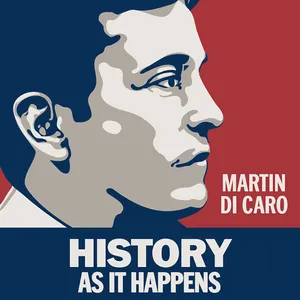
by Martin Di Caro
Discover how the past shapes the present with the best historians in the world. Everything happening today comes from something, somewhere. History As It Happens features interviews with today's top scholars and thinkers, interwoven with audio from history's archive.
Latest Episodes
The most recent episodes — sign up to get AI-powered summaries of each one.
- 3 days ago46 min
Origins of the Imperial Presidency
Subscribe for ad-free listening, early access, and all of our bonus content!The Constitution created what were supposed to be three coequal branches, and only Congress was given the authority to declare war. Yet we are living in the age of the imperial presidency — of endless war, executive orders, government secrecy, and a lack of accountability. These are all fit for a monarchy instead of a republic.How did we get here? What structures led to the rise of the imperial presidency? What decisions led to this unintended consequence undermining the American democratic experiment?Our guest is Jeremi Suri, who teaches history at the LBJ School of Public Affairs at the University of Texas at Austin. He’s the author of The Impossible Presidency and co-host of This is Democracy podcast.Suri also writes the Democracy of Hope newsletter. Subscribe today to support our important work! Subscriptions begin at only $5 per month. Hosted by Simplecast, an AdsWizz company. See pcm.adswizz.com for information about our collection and use of personal data for advertising.
- 5 days ago8 min
Here Come the Houthis (Bonus)
Subscribe to listen to the entire 22-minute episode (or preview 8 minutes).New developments in Yemen bode poorly for global oil flows or a peaceful settlement of the Greater Middle East's raging conflicts. The Associated Press reports the Houthi rebels have seized two strategic islands in the southern Red Sea, bolstering their ability to control a critical maritime shipping route.The Houthis’ latest gains in their ongoing conflict with Saudi Arabia follow the seizure of the Red Sea port of Mokha and a strategic island last week. The fighting is putting even more upward pressure on global oil supplies and prices.Here to untangle events in Yemen is Annelle Sheline, a research fellow in the Middle East program at the Quincy Institute for Responsible Statecraft. She’s an expert on Yemen. Her book “Weaponizing Tolerance: Arab Monarchies and American Support for Moderate Islam” will be published by Cambridge University Press next year. Subscribe today to support our important work! Subscriptions begin at only $5 per month. Hosted by Simplecast, an AdsWizz company. See pcm.adswizz.com for information about our collection and use of personal data for advertising.
- 6 days ago34 min
Martin at Monticello! Thomas Jefferson's World
Subscribe today to support the show and enjoy ad-free listening!History As It Happens is "on location" in this episode. Host Martin Di Caro visits Thomas Jefferson's historic Monticello estate in Virginia to talk to Brandon Dillard, its director of historic interpretation and audience engagement. Their conversation covers Monticello's new America250-related exhibits and the challenge of interpreting the past in hyper-partisan times. Subscribe today to support our important work! Subscriptions begin at only $5 per month. Hosted by Simplecast, an AdsWizz company. See pcm.adswizz.com for information about our collection and use of personal data for advertising.
- 1 weeks ago57 min
25 Years of Terror
Subscribe today to skip ads and get all of our bonus content!Twenty-five years ago, on September 11, 2001, nineteen al-Qaeda hijackers working for Osama bin Laden killed nearly 3,000 people in New York, Washington, and a Pennsylvania field. The U.S. responded by launching a poorly defined war across the Greater Middle East that led to the deaths of hundreds of thousands of civilians, the displacement of millions more, and the destruction of U.S. credibility and prestige. The war would be defined by the failures that flowed from long-term occupations and a preemptive invasion, the use of torture, and official lies.Did the GWOT — the global war on terrorism — accomplish anything? Is it over? In this episode, Peter Bergen discusses his new book, All the Presidents’ Wars, which covers the past quarter-century.Peter Bergen is a journalist, documentary producer, and vice president for global studies at New America, a D.C. think tank. He’s a national security analyst for CNN and professor of practice at Arizona State University.Further listening:Who Was Osama bin Laden? (podcast w/ Peter Bergen) Subscribe today to support our important work! Subscriptions begin at only $5 per month. Hosted by Simplecast, an AdsWizz company. See pcm.adswizz.com for information about our collection and use of personal data for advertising.
- 1 weeks ago34 min
Structures of 'Forever War,' Revisited
Subscribe to enjoy ad-free episodes and early access, plus all our bonus content.Maybe U.S. presidents need to read a how-to manual on avoiding quagmires. Or maybe it wouldn't make much difference anyway. To understand why the United States keeps being sucked into protracted conflicts in the Greater Middle East, we must look beyond individual decision-making, says Emma Ashford of the Stimson Center in Washington. Instead, we must weigh the structural causes and incentives that have led one administration after another into battle in the name of protecting U.S. interests.Emma Ashford is a Senior Fellow in the Grand Strategy Program at the Stimson Center and the author of First Among Equals: U.S. Foreign Policy in a Multipolar World.Further reading:America's Fatal Attraction to War by Emma Ashford in Foreign Affairs Subscribe today to support our important work! Subscriptions begin at only $5 per month. Hosted by Simplecast, an AdsWizz company. See pcm.adswizz.com for information about our collection and use of personal data for advertising.
- 2 weeks ago59 min
Origins of Israel's Lobby
Subscribe now to skip ads and get all of our bonus content.Since the aftermath of the Second World War and the establishment of an independent Jewish state of Israel in 1948, U.S. foreign policy has been in the "grip of a foreign power," according to the authors of "Israel's Lobby."Authors Eli Clifton and Ian Lustick contend that the lobby has successfully pressured generations of U.S. leaders to set aside American interests in favor of Israeli interests, even though the two are often not aligned. Today the lobby — which consists of dozens of organizations and wealthy individuals with billions in financial resources — is wielding its influence to silence criticism of Israel as it destroys Palestinian society in Gaza.How did "the Lobby" become so powerful? And is AIPAC's influence waning as Americans sour on unconditional support for Israel?Eli Clifton is a cofounder and senior advisor at the Quincy Institute for Responsible Statecraft. Ian Lustick is a political scientist at the University of Pennsylvania and an expert on the Israeli-Palestinian conflict.Recommended reading:Israel's Lobby by Eli Clifton and Ian Lustick Subscribe today to support our important work! Subscriptions begin at only $5 per month. Hosted by Simplecast, an AdsWizz company. See pcm.adswizz.com for information about our collection and use of personal data for advertising.
- 2 weeks ago59 min
Meet Roy Cohn, Donald Trump's Mentor
Subscribe today to skip ads and get all of our bonus content! Since the New York real estate developer-turned-realty TV star Donald Trump entered politics a decade ago, his personality has dominated Americans' lives. Where did Trump's malignant charisma come from? Where did he learn the art of the deal and how to master the media? And what about the ways of the liar, the cheat, and the bully? From his mentor, Roy Cohn. Our guest is Pulitzer Prize-winning historian and biographer Kai Bird, the author with Susan Goldmark of 'American Scoundrel: Roy Cohn's Dark Journey from Joe McCarthy to Donald Trump.' Further reading: The Age of Cohn by Martin Di Caro (book review) Subscribe today to support our important work! Subscriptions begin at only $5 per month. Hosted by Simplecast, an AdsWizz company. See pcm.adswizz.com for information about our collection and use of personal data for advertising.
- 3 weeks ago44 min
'The Battle of Algiers' 60 Years On
Subscribe to get ad-free listening, early access, and all of our bonus content! Sixty years ago, in late August 1966, a remarkable film premiered at the Venice Film Festival. The Italian director Gillo Pontecorvo's 'The Battle of Algiers' portrayed the brutal realities of the Algerian war for independence against colonial France. It has inspired revolutionaries fighting for national liberation ever since. Historian Martin Evans, an expert on empires at the University of Sussex, explores why Pontecorvo's masterpiece has endured and still resonates. Subscribe today to support our important work! Subscriptions begin at only $5 per month. Hosted by Simplecast, an AdsWizz company. See pcm.adswizz.com for information about our collection and use of personal data for advertising.
Get History As It Happens summaries in your inbox
Free AI-powered daily recaps. Key takeaways, quotes, and mentions — in a 5-minute read.
Get Free Summaries →Free forever for up to 3 podcasts. No credit card required.
You Might Also Like
Listeners also like.

American History Hit
Examines key events in American history, from colonial conflicts to civil rights, through expert interviews and detailed storytelling.

History Daily
A daily history podcast that explores pivotal events that happened on each day, told through immersive storytelling.

Breaking History
Historians and reporters analyze current events through the lens of past political and social upheavals.

HISTORY This Week
A weekly look at pivotal historical events and the people behind them, famous or forgotten, who shaped the world.

History Unplugged Podcast
Features interviews with history authors and answers to listener questions on a wide range of historical topics.

Tides of History
Explores how historical events and forces have shaped modern societies, cultures, and global systems.

HistoryExtra podcast
Covers global history from ancient to modern times through expert interviews on events, figures, and eras.

It Could Happen Here
A daily chronicle of societal collapse and the search for a better future amid the ruins of the old world.

Dan Snow's History Hit
Dan Snow visits historic sites worldwide to explore the stories behind pivotal events, figures, and monuments.

American History Tellers
Pivotal moments in American history are explored through narrative storytelling, revealing their impact on the nation and modern life.

The Rest Is History
Historians Tom Holland and Dominic Sandbrook analyze major historical events and figures with narrative depth and scholarly insight.

Witness History
First-hand accounts of pivotal historical moments, from global events to cultural milestones, told by those who lived them.
About History As It Happens
Discover how the past shapes the present with the best historians in the world. Everything happening today comes from something, somewhere. History As It Happens features interviews with today's top scholars and thinkers, interwoven with audio from history's archive.
Customized Recaps
AI-powered recaps with compact key takeaways, quotes, and insights.
Straight to Your Inbox
Get key takeaways from History As It Happens in a 5-minute read.
Save Hours Every Week
Stay current on your favorite podcasts without falling behind.
Frequently Asked Questions
What is Podzilla's History As It Happens daily summary?
It's a free AI-powered email that summarizes new episodes of History As It Happens as soon as they're published. You get the key takeaways, notable quotes, and links & mentions — all in a quick read.
How does the History As It Happens podcast summary work?
When a new episode drops, our AI transcribes and analyzes it, then generates a personalized summary tailored to your interests and profession. It's delivered to your inbox every morning.
Is this an official History As It Happens product?
No. Podzilla is an independent service that summarizes publicly available podcast content. We're not affiliated with or endorsed by Martin Di Caro.
Can I get summaries of other podcasts too?
Absolutely! The free plan covers up to 3 podcasts. Upgrade to Pro for 15, or Premium for 50. Browse our full catalog at /podcasts.
How often does History As It Happens release new episodes?
History As It Happens publishes every few days. Our AI generates a summary within hours of each new episode.
What topics does History As It Happens cover?
History As It Happens covers topics including News, History, Commentary. Our AI identifies the specific themes in each episode and highlights what matters most to you.
Start getting History As It Happens summaries tomorrow morning.
Free forever for up to 3 podcasts. No credit card required.
Free forever for up to 3 podcasts. No credit card required.