Free Daily Podcast Summary
Heterodox Out Loud: Daily Summaries Delivered
by Heterodox Academy
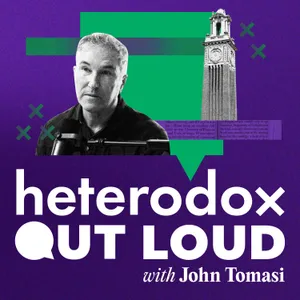
Heterodox Out Loud, hosted by HxA president, John Tomasi, is an ongoing podcast featuring conversations with people across the academy and beyond. Listen to insightful, thought-provoking episodes from the HxA community by adding our podcast to your lineup.
Latest Episodes
The most recent episodes — sign up to get AI-powered summaries of each one.
- Jul 21, 20261 min
An Update from Heterodox Out Loud
After several years of one-on-one interviews with thinkers, scholars, and leaders working on the questions that matter most for higher education, Heterodox Out Loud is entering a new chapter. Going forward, Heterodox Out Loud will become the audio home for the conversations, webinars, and panel discussions we host as part of Heterodox Academy's virtual events. That means more voices in each episode, more back and forth, and more of the live exchange happening across the HxA membership. Thanks for listening. The work continues, and there is a lot more of it to share.Learn more about Heterodox Academy: heterodoxacademy.orgBecome a member: heterodoxacademy.org/become-a-memberUpcoming HxA events: heterodoxacademy.org/events Follow Heterodox Academy on:Twitter: https://bit.ly/3Fax5DyFacebook: https://bit.ly/3PMYxfwLinkedIn: https://bit.ly/48IYeuJInstagram: https://bit.ly/46HKfUgSubstack: https://bit.ly/48IhjNF 🔗 Find out more about Heterodox Academy at: https://linktr.ee/heterodoxoutloud
- Jun 30, 202644 min
The Skill That Built America Has Vanished From Universities with Danielle Allen | Ep 47
What makes a university essential to a democratic society? Political theorist, classicist, and author Danielle Allen joins John Tomasi to explore the deep connections between democracy, disagreement, and higher education. Drawing on her new book, The Radical Duke, Allen traces the origins of modern constitutional democracy to a network of radical thinkers in eighteenth-century Britain who fought for free expression, political transparency, and popular sovereignty. Their struggles, she argues, offer important lessons for the challenges facing democratic institutions today. The conversation then turns to the modern university, Allen and Tomasi examine whether universities occupy a unique place in democratic life. They discuss why disagreement is essential to both truth-seeking and self-government, how institutions can create space for productive conflict, and what responsibilities colleges and universities have in preserving the civic capacities on which democracy depends. In This Episode: 💥 The forgotten British origins of modern democracy 💥 The Radical Duke and the fight for political transparency 💥 How Edmund Burke and Thomas Paine emerged from the same intellectual movement 💥 Why free societies depend on disagreement 💥 Ruth Simmons' vision of the university as a place of "quarrel and opposition" 💥 The relationship between democracy and open inquiry 💥 Scientific consensus, dissent, and truth-seeking 💥 Why universities need spaces for constrained disagreement 💥 How institutions shape civic culture and democratic norms 💥 The unique role of higher education in sustaining a free society About Danielle Allen: Danielle Allen is the James Bryant Conant University Professor at Harvard and Director of the Allen Lab for Democracy Renovation and the Democratic Knowledge Project-Learn. A political philosopher and tech ethicist, she is a contributing columnist for The Atlantic and the 2020 Library of Congress Kluge Prize recipient for her work in political theory and civic education. Her current work focuses on democracy renovation through institutional redesign and civic empowerment. She has authored several books, including Justice by Means of Democracy and the widely acclaimed Our Declaration. Her upcoming biography of an 18th-century reformer, The Radical Duke, is scheduled for release in 2026. Beyond academia, Allen co-chairs the American Academy of Arts and Sciences' Our Common Purpose commission and leads the board at Partners In Democracy, advocating for a more inclusive social contract and robust democracy reform. Follow Danielle: https://x.com/dsallentess Follow Heterodox Academy on:Twitter: https://bit.ly/3Fax5DyFacebook: https://bit.ly/3PMYxfwLinkedIn: https://bit.ly/48IYeuJInstagram: https://bit.ly/46HKfUgSubstack: https://bit.ly/48IhjNF 🔗 Find out more about Heterodox Academy at: https://linktr.ee/heterodoxoutloud
- Jun 9, 202655 min
Cass Sunstein on What's Actually Wrong With the University | Ep 46
What's actually wrong with the modern university? Today on Heterodox Out Loud, renowned legal scholar and public intellectual Cass Sunstein joins John Tomasi to examine one of the most important, and contentious, questions in higher education today. Drawing on his decades of experience at institutions including the University of Chicago and Harvard, Sunstein reflects on what universities get right, where they fall short, and why debates over viewpoint diversity have become so central to the future of academic life. Offering both philosophical reflection and practical insight, Sunstein explores the tensions between academic freedom and institutional accountability, the role of administrators in shaping intellectual culture, and why ideological homogeneity may pose risks even when everyone involved is acting in good faith. Chapters: 00:00 Why Viewpoint Diversity Matters 01:40 Cass Sunstein’s University of Chicago Experience 08:39 The Great Fact: Why Academia Became More Ideologically One-Sided 14:14 Should Universities Reflect America’s Political Diversity? 20:23 Academic Freedom, Groupthink, and the Limits of Expertise 28:47 Faculty Hiring, Administrators, and Viewpoint Diversity 36:37 Social Media, Self-Censorship, and Hidden Campus Views 44:08 Harvard, DEI, and the Future of Faculty Hiring 50:08 Group Polarization and the Future of Higher Education 54:10 Why Viewpoint Diversity Matters for Truth-Seeking In This Episode: 💥 What made the University of Chicago's intellectual culture so distinctive 💥 The "great fact" of ideological change in higher education 💥 Why viewpoint diversity is harder to define than most people assume 💥 The limits of proportional representation as a solution 💥 Academic freedom, expertise, and departmental autonomy 💥 Whether administrators should influence faculty hiring 💥 The relationship between viewpoint diversity and educational quality 💥 The spiral of silence and hidden disagreement on campus 💥 Group polarization and academic culture 💥 What universities need to do to better serve students and society Follow Cass: https://x.com/CassSunstein Follow Heterodox Academy on:Twitter: https://bit.ly/3Fax5DyFacebook: https://bit.ly/3PMYxfwLinkedIn: https://bit.ly/48IYeuJInstagram: https://bit.ly/46HKfUgSubstack: https://bit.ly/48IhjNF 🔗 Find out more about Heterodox Academy at: https://linktr.ee/heterodoxoutloud
- Apr 21, 202645 min
The Field That Studies Groupthink Is Captured by It | Ep 45
Is the very field that studies groupthink falling victim to it? Today on Heterodox Out Loud, Smriti Mehta, researcher at UC Berkeley and co-founder of the Heterodox Academy campus community, joins John Tomasi to examine a striking paradox at the heart of modern academia: the disciplines designed to study bias and conformity may themselves be shaped by it. Drawing on her experience as a graduate student navigating pressure to conform—and her work building communities for open inquiry—Mehta explores how intellectual homogeneity can influence what questions get asked, what findings get published, and which ideas are considered legitimate. From the politics of social psychology to the challenges of free speech at Berkeley, this conversation investigates how groupthink can quietly take hold—even in fields committed to studying it—and why viewpoint diversity is essential for maintaining the integrity of research. Offering an insider’s perspective, the discussion explores how universities can foster genuine intellectual diversity without sacrificing rigor, and why teaching students to engage critically with ideas may matter more than enforcing consensus. In This Episode: 💥 How social psychology can fall into the trap of groupthink 💥 Why viewpoint diversity is often misunderstood 💥 The hidden pressures shaping academic research 💥 What makes certain topics “radioactive” in universities 💥 The tension between conformity and innovation in science 💥 Free speech, protest culture, and the heckler’s veto 💥 How students experience intellectual pressure on campus 💥 Why open inquiry is essential for truth-seeking Whether you’re a student, faculty member, or simply interested in the future of higher education, this episode offers a candid and thought-provoking look at how even the most self-aware disciplines can lose their way—and how they might recover. About Smriti Mehta: Smriti Mehta, PhD is a researcher at the Department of Education at the University of California, Berkeley, affiliated with the BEAR Center (Berkeley Evaluation & Assessment Research). Her research spans social-psychological factors in education, psychometrics, open science practices, and meta-science. She is co-author of the SAFE Model (State Authenticity as Fit to Environment), published in Personality and Social Psychology Bulletin, which demonstrates that people experience authenticity as a function of self-concept fit, goal fit, and social fit to their environment. Her related work on social status and authenticity finds that those with lower status are less likely to feel they can be themselves, providing a psychological mechanism for why holding a minority viewpoint in academia suppresses not just speech but identity. She completed her PhD in Psychology at UC Berkeley. Beyond research, Mehta co-founded and co-chairs the HxA Campus Community at UC Berkeley. She was previously involved with the Berkeley Liberty Initiative, which funds faculty grants to redesign undergraduate courses around open exchange of ideas. She co-hosts Nullius in Verba, a biweekly podcast with Daniël Lakens (Eindhoven University of Technology) covering miscitation, scientism, incentive structures in science, and the philosophy of scientific practice. Follow Smriti: https://x.com/smreeteemehta Follow Heterodox Academy on:Twitter: https://bit.ly/3Fax5DyFacebook: https://bit.ly/3PMYxfwLinkedIn: https://bit.ly/48IYeuJInstagram: https://bit.ly/46HKfUgSubstack: https://bit.ly/48IhjNF 🔗 Find out more about Heterodox Academy at: https://linktr.ee/heterodoxoutloud
- Mar 31, 202648 min
Universities Have a Trust Problem. This President Is Trying to Fix It | Ep 44
Is higher education losing public trust, and what can universities do about it? Today on Heterodox Out Loud, Sian Beilock, President of Dartmouth College, joins John Tomasi to confront one of the most urgent challenges facing universities today: a growing crisis of confidence among the American public. Drawing on her background in cognitive science and leadership under pressure, Beilock explains why trust is declining and what universities must do to restore it. From free expression policies and institutional neutrality to student culture and viewpoint diversity, this conversation explores how universities can return to their core mission: truth-seeking and education. Offering a unique, insider's view, the discussion explores how a university president manages the conflicting pressures of a polarized age. It delves into real-world scenarios, including campus protests, speech disruptions, faculty relationships, and external pressure from the government. In This Episode: 💥 Why 7 in 10 Americans distrust higher education 💥 The role of affordability, ROI, and ideological concerns 💥 How Dartmouth is implementing institutional restraint 💥 Where free speech ends and disruption begins 💥 Why students are hungry for real dialogue, not echo chambers 💥 What “viewpoint diversity” actually means in practice 💥 How universities can reform without political capture Whether you’re a student, faculty member, policymaker, or simply interested in the future of higher education, this episode offers a clear-eyed and principled roadmap forward. New Yorker Article About Sian Beilock: Sian Leah Beilock is the 19th president of Dartmouth College, an Ivy League institution and one of the nation’s leading research universities. She is the first woman elected president of Dartmouth by the Board of Trustees and began her tenure on June 12, 2023. A distinguished cognitive scientist, Beilock is one of the world’s foremost experts on performance under pressure, a member of the American Academy of Arts & Sciences and the National Academy of Medicine, and the recipient of the 2017 Troland Award from the National Academy of Sciences. She has authored over 120 peer-reviewed papers and two books: Choke and How the Body Knows Its Mind. Before Dartmouth, she served as president of Barnard College at Columbia University and as executive vice provost at the University of Chicago. Follow Heterodox Academy on:Twitter: https://bit.ly/3Fax5DyFacebook: https://bit.ly/3PMYxfwLinkedIn: https://bit.ly/48IYeuJInstagram: https://bit.ly/46HKfUgSubstack: https://bit.ly/48IhjNF 🔗 Find out more about Heterodox Academy at: https://linktr.ee/heterodoxoutloud
- Feb 24, 202654 min
Can a Public University Stay Politically Neutral? with Ed Seidel | Ep 43
At a moment when public trust in higher education is faltering and “diversity” has become a politically charged word, University of Wyoming President Ed Seidel argues that universities must return to first principles: truth-seeking, intellectual humility, and viewpoint diversity. Today on Heterodox Out Loud, host John Tomasi speaks with Ed Seidel about how a public land-grant university can defend free speech, uphold institutional neutrality, and navigate state pressure around DEI, without abandoning its core academic mission. Seidel, a theoretical physicist turned university leader, explains why viewpoint diversity is not about partisan quotas, but about strengthening scholarship through rigorous disagreement. He reflects on Wyoming’s adoption of institutional neutrality, the importance of time-place-manner protections for expressive activity, and the difficult leadership decisions that followed October 7 and subsequent campus tensions. The conversation explores how public universities balance First Amendment obligations with community responsibility, why “cancel culture” is often rooted in weakened scientific norms, and how land-grant institutions uniquely serve the public through two-way engagement. Ultimately, this episode asks: How can universities rebuild public trust while remaining places of fearless inquiry? In This Episode: 💥 The crisis of public trust in higher education 💥 Viewpoint diversity vs. partisan representation 💥 Institutional neutrality in practice 💥 DEI reform and state legislative pressure 💥 Free speech and expressive activity policies 💥 Scientific norms and intellectual humility 💥 The role of land-grant universities in American democracy 💥 Leadership during campus controversy About Ed Seidel: Ed Seidel serves as President of the University of Wyoming. In this role, he oversees the state’s land grant and flagship institution, with responsibilities that include academic programs, research activity, student experience, and external partnerships. An accomplished theoretical physicist, Seidel has built a distinguished career at the intersection of science, technology, and leadership. Before joining the University of Wyoming, he served as Vice President for Research and Innovation at the University of Illinois System and the University of Illinois at Urbana-Champaign. He also founded and directed the National Center for Supercomputing Applications, a globally recognized hub for advanced computing and data science. Follow Ed Seidel: https://x.com/uwyoseidel Follow Heterodox Academy on:Twitter: https://bit.ly/3Fax5DyFacebook: https://bit.ly/3PMYxfwLinkedIn: https://bit.ly/48IYeuJInstagram: https://bit.ly/46HKfUgSubstack: https://bit.ly/48IhjNF 🔗 Find out more about Heterodox Academy at: https://linktr.ee/heterodoxoutloud
- Jan 27, 202654 min
The University in the Age of AI: Rebuilding Trust, Truth, and Teaching with Kavita Bala | Ep 42
At a moment when higher education faces accelerating technological disruption and intensifying public scrutiny, Cornell Provost Kavita Bala argues that universities must do two things at once: defend their truth-seeking mission with renewed clarity, and reimagine how they teach, research, and engage society in an era shaped by AI, polarization, and declining trust. Today, John Tomasi welcomes Kavita Bala to discuss Cornell’s approach to fostering a durable culture of open inquiry based on idea exchange, viewpoint diversity, and constructive disagreement. Drawing on her experience as an AI researcher and Cornell provost, Bala explains how the “two-sided coin” of technology requires a university that integrates STEM and humanities to address issues like algorithmic bias and public trust. The conversation also discusses Cornell’s recent shift toward institutional restraint. Bala explains Cornell’s approach to expressive activity and campus programs that foster dialogue, such as the Center for Dialogue and Pluralism (CDP) and a new Arts & Sciences course on Disagreement. In This Episode:💥 AI as both opportunity and destabilizer in higher education💥 Declining public trust in universities—and in science💥 Cornell’s land-grant mission and bidirectional knowledge exchange💥 Institutional restraint and departmental speech norms (including dissent reporting)💥 Expressive activity policy and time/place/manner principles💥 Student dialogue-building via CDP and the course “Disagreement”💥 Viewpoint diversity through research design💥 “Any person, any study” as a living institutional ideal About Kavita Bala:Kavita Bala is the 17th provost of Cornell University and a professor of computer science, bringing deep experience across research, academic leadership, and entrepreneurship. Before becoming provost on January 1, 2025, she served as the inaugural dean of the Cornell Ann S. Bowers College of Computing and Information Science and previously chaired Cornell’s Department of Computer Science. As dean, she helped secure the naming gift for the Bowers College, expanded faculty capacity, and advanced major initiatives in AI and interdisciplinary computing.Bala’s scholarship spans computer vision, computer graphics, and artificial intelligence, with contributions to image understanding and the modeling of complex materials, including work on recognizing styles and object attributes. She also co-founded the visual search startup GrokStyle, which was later acquired by Facebook. Her honors include being named an ACM Fellow and receiving the SIGGRAPH Computer Graphics Achievement Award. She earned a B.Tech. from IIT Bombay and an M.S. and Ph.D. in computer science from MIT. Follow Kavita Bala on LinkedIn: https://www.linkedin.com/in/kavita-bala-052409/ Follow Heterodox Academy on:Twitter: https://bit.ly/3Fax5DyFacebook: https://bit.ly/3PMYxfwLinkedIn: https://bit.ly/48IYeuJInstagram: https://bit.ly/46HKfUgSubstack: https://bit.ly/48IhjNF 🔗 Find out more about Heterodox Academy at: https://linktr.ee/heterodoxoutloud
- Dec 16, 202548 min
Can Universities Change Without Government Intervention? With Mary Kate Cary | Ep 41
How can universities rekindle public trust and foster genuine viewpoint diversity, without relying on government mandates? Today’s guest is Mary Kate Cary, adjunct professor at the University of Virginia (UVA), seasoned presidential speechwriter, and co-chair of Heterodox Academy’s campus community at UVA. John Tomasi and Mary Kate examine the urgent need to move beyond top-down reforms and build cultures of open inquiry from the ground up.Drawing on recent Gallup polling that shows public confidence in higher education has plummeted from 60% to 32%, Mary Kate argues for bottom-up solutions rooted in the distinctive ethos and history of each campus. She shares examples of innovative, student-facing programming at UVA, such as “Think Again,” “Free Speech Fridays,” and “Disagree with the Professor,” that encourage intellectual humility, critical thinking, and constructive disagreement.The conversation provides actionable insights for faculty, administrators, and students committed to strengthening open inquiry and viewpoint diversity, highlighting the role of both faculty leadership and supportive administration in achieving durable change. In This Episode:💥 Public trust and viewpoint diversity in higher education💥 Adapting free speech principles to unique campus histories💥 Bottom-up versus top-down academic reforms💥 Student engagement initiatives: “Think Again” and “Free Speech Fridays”💥 Co-teaching across political divides at UVA💥 Institutional neutrality and its impact on campus culture💥 Partnerships with BridgeUSA, Braver Angels, and Disagree Better About Mary Kate:Mary Kate Cary is Deputy Chief of Staff for Communications and Strategic Initiatives in the Office of the Interim President at the University of Virginia and a long-time advocate for open inquiry, free speech, and viewpoint diversity on campus. She previously served as an adjunct professor in UVA’s Politics Department, where she taught courses on political speechwriting, the greatest speeches in American history, and co-taught a bipartisan election class. Cary is the founding director of Think Again at UVA, a student-facing initiative promoting free speech, critical thinking, and respectful debate, and she co-chairs the Heterodox Academy Campus Community at UVA, one of the largest chapters of the organization. Before her work in higher education, Cary was a White House speechwriter for President George H.W. Bush and has worked as a political commentator, professional speaker, and writer. She was a recipient of the 2024 Heterodox Academy Open Inquiry Leadership Award for her efforts in advancing open inquiry and constructive disagreement on campus.Follow Mary Kate on X: https://x.com/mkcary Follow Heterodox Academy on:Twitter: https://bit.ly/3Fax5DyFacebook: https://bit.ly/3PMYxfwLinkedIn: https://bit.ly/48IYeuJInstagram: https://bit.ly/46HKfUgSubstack: https://bit.ly/48IhjNF 🔗 Find out more about Heterodox Academy at: https://linktr.ee/heterodoxoutloud
About Heterodox Out Loud
Heterodox Out Loud, hosted by HxA president, John Tomasi, is an ongoing podcast featuring conversations with people across the academy and beyond. Listen to insightful, thought-provoking episodes from the HxA community by adding our podcast to your lineup.
Customized Recaps
AI-powered recaps with compact key takeaways, quotes, and insights.
Straight to Your Inbox
Get key takeaways from Heterodox Out Loud in a 5-minute read.
Save Hours Every Week
Stay current on your favorite podcasts without falling behind.
Frequently Asked Questions
What is Podzilla's Heterodox Out Loud daily summary?
It's a free AI-powered email that summarizes new episodes of Heterodox Out Loud as soon as they're published. You get the key takeaways, notable quotes, and links & mentions — all in a quick read.
How does the Heterodox Out Loud podcast summary work?
When a new episode drops, our AI transcribes and analyzes it, then generates a personalized summary tailored to your interests and profession. It's delivered to your inbox every morning.
Is this an official Heterodox Out Loud product?
No. Podzilla is an independent service that summarizes publicly available podcast content. We're not affiliated with or endorsed by Heterodox Academy.
Can I get summaries of other podcasts too?
Absolutely! The free plan covers up to 3 podcasts. Upgrade to Pro for 15, or Premium for 50. Browse our full catalog at /podcasts.
What topics does Heterodox Out Loud cover?
Heterodox Out Loud covers topics including Education, Philosophy, Culture, Society & Culture, Self-Improvement. Our AI identifies the specific themes in each episode and highlights what matters most to you.
Start getting Heterodox Out Loud summaries tomorrow morning.
Free forever for up to 3 podcasts. No credit card required.
Free forever for up to 3 podcasts. No credit card required.