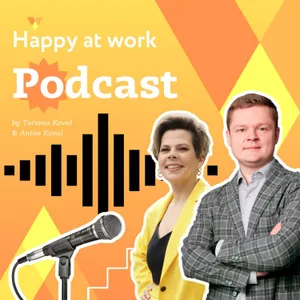
Free Daily Podcast Summary
Happy at Work | Coding Happiness into the AI Workplace: Daily Summaries Delivered
by Tatiana Koval; Tony Koval | Why the Future of AI workplace is Human Happiness
In today’s fast-paced corporate world, achieving true wellbeing and happiness isn't just a nice-to-have; it’s a business imperative. We are pulling back the curtain on how top companies are navigating massive digital transformation without losing their human touch. Every week, we explore with international experts how cutting-edge AI is reshaping how we work while helping HR teams build an irresistible employer brand that attracts top-tier talent. We don't just talk about abstract concepts; we break down actionable strategies. We'll show you how to embrace digital transformation and leverage.
Latest Episodes
The most recent episodes — sign up to get AI-powered summaries of each one.
- Today29 min
"Put the Employee Voice in Front of the Logo" (with Sarah Goodall)
Most companies launch employee advocacy by buying a shiny tool, running a single one-hour LinkedIn webinar, and expecting staff to mindlessly click and share corporate posts. Six to nine months later, active users drop off, executives start questioning the budget, and the company blames the software. Meanwhile, trying to fast-track employee content with AI only floods social feeds with generic noise. Today on Happy@Work, Tatiana Koval sits down with Sarah Goodall—founder of Tribal Impact and a 15-year pioneer in social business and employee influence — to unpack why traditional advocacy is coming full circle back to authentic human voices. Drawing on data from the Edelman Trust Barometer and Tribal Impact's Human Edge Report, Sarah explains why LLMs and job seekers ignore corporate brand pages in favor of original human expertise, why VPs and Directors have 4x the influence on employee participation compared to the C-suite, and how to tie employee influence directly to commercial and hiring pipelines before your budget gets cut.Connect with Sarah Goodall: https://www.linkedin.com/in/sarahgoodall/Timestamps:00:00 - Introducing employee advocacy and the human voice behind the brand02:50 — The workplace trust crisis and the widening executive-employee gap.05:30 — How LLMs cite human LinkedIn posts over brand pages (and the AI noise trap).09:00 — Why vanity metrics (clicks & EMV) put a ticking clock on your budget.12:30 — Connecting the silos: Aligning HR, Employer Branding, Marketing, and Sales pipelines.14:40 — Top mistakes: Why a 1-hour training and a software tool won't change behavior.19:00 — Case studies: Moving pharma and manufacturing experts from "click-share" to storytelling.21:55 — The Human Edge Report: Why VPs and Directors drive 4x more employee advocacy.24:10 — Why external advocacy starts with psychological safety on internal social networks.26:30 — Sarah's 3 core steps to launch and measure a scalable employee influence program.Subscribe to Happy@Work for more insights on modern leadership, organizational performance, and human-centric workplace culture.#EmployerBranding #EmployeeAdvocacy #EmployeeInfluence #TalentAcquisition #SocialSelling #WorkplaceCulture #HRLeadership #HappyAtWork
- 1 weeks ago41 min
The Human System Hidden Inside Every Transformation | with Suzie Lewis
As organizations race to adopt AI, automate processes, and accelerate transformation, many leaders focus on technology while overlooking the most important system of all: the human system.In this episode of Happy@Work, Tatiana Koval speaks with Suzie Lewis, Managing Director of Transform for Value, executive coach, and host of the "Let's Talk Transformation" podcast. Suzie has spent more than 20 years helping organizations navigate complex transformation challenges through the lens of human systems design. Together, we explore why organizational change often fails, how leaders can create the conditions for people and systems to thrive, and why AI may be exposing—not solving—the underlying challenges within organizations. Suzie argues that the AI era is fundamentally a human systems design challenge and that sustainable transformation depends on trust, relationships, leadership behaviors, and the emotional infrastructure of organizations. Connect with Suzie: https://www.linkedin.com/in/lewissuzie/Timecodes:00:00 - Meet Suzie Lewis and the human side of transformation01:10 - Human systems as the foundation for sustainable change03:16 - What makes an organizational culture adaptive06:19 - Building relationship infrastructure and psychological safety10:28 - Map, pilot, and iterate across cultural contexts13:32 - Emotional literacy: making room for difficult emotions19:56 - Leading emotional conversations across diverse teams24:40 - Reading silence as information, not automatically as a problem26:28 - Creating the conditions for people to adopt AI31:24 - Early warning signs of disconnection and misalignment36:45 - Preparing people for change through clear communication40:19 - Clarity, accountability, support, and care during transformation42:51 - Suzie’s 3 priorities for leadersSubscribe to Happy@Work for more insights on modern leadership, organizational performance, and human-centric workplace culture. #WorkplaceCulture #AI #AItransformation #Happiness #TalentAcquisition #AIinHR #HappyAtWork #AIagent #organizationalculture
- 2 weeks ago44 min
Why the Best Leaders Admit They Do Not Have All the Answers | with Navid Nazemian
Transformation into a senior leadership role is one of the highest-stakes moments in any executive's career. Today on Happy@Work, I am sitting down with Navid Nazemian—executive coach, speaker, and author specializing in executive transitions and leadership development.Navid breaks down his strategic playbook for helping leaders navigate complex organizational dynamics, build immediate trust, and drive high performance without sacrificing personal or team health. We dive into how executive alignment directly influences talent acquisition, workplace wellbeing, and overall employee retention across the entire business.Whether you are an aspiring leader stepping into your first executive role, an HR professional optimizing HR best practices for onboarding, or a CEO looking to sharpen your Leadership strategies, Navid’s executive insights offer an essential masterclass.Connect with Navid Nazemian:• LinkedIn: / navidnazemian Timestamps:00:00 - Introduction to the podcast and guest01:45 - Navid’s leadership research and the six qualities of extraordinary leadership03:09 - Confidence and self-awareness as the foundation of self-leadership04:06 - Being connected and inspiring as team leadership skills06:23 - Stephen Covey example: how presence creates inspiration08:20 - Courage and clarity as the final two leadership qualities09:21 - Confidence versus humility in an unpredictable world10:31 - Leading through the pandemic without pretending to have all the answers13:17 - Are leaders born or developed?14:51 - Research on 250 CEOs and the rise of strategic self-awareness16:19 - Bright side, dark side, and deep inside traits17:32 - Defining success through sustainable results18:48 - Tim Cook and long-term value creation at Apple21:31 - Can culture help sell the company and attract talent?23:31 - Vodafone’s engagement scores and culture as a magnet27:27 - When directive leadership is more effective than coaching29:26 - Titanic analogy: choosing the right leadership style in a crisis31:31 - Situational leadership and using all six styles when needed33:23 - The Double Diamond Framework and executive transitions34:51 - Why top leaders must optimize energy, not just time39:26 - Dr. BJ Fogg’s framework for behavior change41:52 - How to apply start doing, continue doing, and stop doing45:09 - Navid’s 3 top tips for leadersSubscribe to Happy@Work for more insights on modern leadership, organizational performance, and human-centric workplace culture.#WorkplaceCulture #WorkplaceMentalHealth #WorkplaceWellbeing #Happiness #TalentAcquisition #Leadership #LeaderSkills #ExecutiveCoaching <a href="https://www.youtube.com/
- 2 weeks ago44 min
Why the Best Leaders Admit They Do Not Have All the Answers | with Navid Nazemian
Transformation into a senior leadership role is one of the highest-stakes moments in any executive's career. Today on Happy@Work, I am sitting down with Navid Nazemian—executive coach, speaker, and author specializing in executive transitions and leadership development.Navid breaks down his strategic playbook for helping leaders navigate complex organizational dynamics, build immediate trust, and drive high performance without sacrificing personal or team health. We dive into how executive alignment directly influences talent acquisition, workplace wellbeing, and overall employee retention across the entire business.Whether you are an aspiring leader stepping into your first executive role, an HR professional optimizing HR best practices for onboarding, or a CEO looking to sharpen your Leadership strategies, Navid’s executive insights offer an essential masterclass.Connect with Navid Nazemian:• LinkedIn: https://www.linkedin.com/in/navidnazemian/Timestamps:00:00 - Introduction to the podcast and guest01:45 - Navid’s leadership research and the six qualities of extraordinary leadership03:09 - Confidence and self-awareness as the foundation of self-leadership04:06 - Being connected and inspiring as team leadership skills06:23 - Stephen Covey example: how presence creates inspiration08:20 - Courage and clarity as the final two leadership qualities09:21 - Confidence versus humility in an unpredictable world10:31 - Leading through the pandemic without pretending to have all the answers13:17 - Are leaders born or developed?14:51 - Research on 250 CEOs and the rise of strategic self-awareness16:19 - Bright side, dark side, and deep inside traits17:32 - Defining success through sustainable results18:48 - Tim Cook and long-term value creation at Apple21:31 - Can culture help sell the company and attract talent?23:31 - Vodafone’s engagement scores and culture as a magnet27:27 - When directive leadership is more effective than coaching29:26 - Titanic analogy: choosing the right leadership style in a crisis31:31 - Situational leadership and using all six styles when needed33:23 - The Double Diamond Framework and executive transitions34:51 - Why top leaders must optimize energy, not just time39:26 - Dr. BJ Fogg’s framework for behavior change41:52 - How to apply start doing, continue doing, and stop doing45:09 - Navid’s 3 top tips for leadersSubscribe to Happy@Work for more insights on modern leadership, organizational performance, and human-centric workplace culture.#WorkplaceCulture #WorkplaceMentalHealth #WorkplaceWellbeing #Happiness #TalentAcquisition #Leadership #LeaderSkills #ExecutiveCoaching #HappyAtWork
- 3 weeks ago32 min
The 4 Signals That Separate Strong Employer Brands From Weak Ones | with Nikos Foros
In this episode of Happy at Work podcast, Tatiana Koval speaks with Nikos Foros about how to build employer branding with real data instead of intuition. They focus on what to measure, how to collect honest feedback, and how to turn insights into practical actions that improve both candidate attraction and employee retention. Nikos shares a structured way to think about employer brand through listening, analyzing, acting, and measuring, plus how culture and country context shape the kind of feedback you can get.Nikos Foros works in talent intelligence at Kalliera.gr, the largest job board in Greece, where he focuses on employer branding, candidate perception, and data-led solutions for organizations. His background spans training, events, and employer branding across major Greek organizations. Perfect for HR leaders, employer brand managers, recruiters, and anyone trying to build a people strategy that actually reflects what employees and candidates think. Connect with Nikos: https://www.linkedin.com/in/nikoforo/ Timecodes:00:00 Intro01:49 Nikos Foros introduces his background in talent intelligence and employer branding03:44 Why data is the foundation of employer branding strategy05:46 Strategic data sources for EVP and employer brand decisions06:15 Why pulse surveys, exit interviews, and stay interviews all matter07:39 Connecting people data to business goals and organizational growth09:44 External EVP perception and feedback from candidates and former employees10:13 Why exit conversations should be one-to-one, not just surveys11:41 When focus groups are better than individual exit interviews12:37 The question that matters most: would they come back?13:55 Why employee experience is becoming central to people and culture teams14:20 The LAM framework: Listening, Analyzing, Acting, Measuring16:05 Turning survey insights into visible action and co-created solutions17:40 How culture affects feedback quality across countries and organizations19:22 Adapting the feedback method to fit cultural openness and trust20:52 Using workshops, retreats, and experiential formats to surface honest insights23:52 Regular indicators to track: social media, candidate feedback, and review sites26:15 How repeated themes like burnout, flexibility, recognition, or growth reveal what to fix or amplify27:40 A real example of data changing assumptions about what employees value most29:17 When employer branding research challenged leadership’s self-image31:28 Shifting the brand from “career catalyst” to a stronger culture narrative33:03 Three tips for implementing a data-driven employer brand strategySubscribe to Happy@Work for more insights on modern leadership, organizational performance, and human-centric workplace culture.#EmployerBranding #TalentIntelligence #EmployeeExperience #WorkplaceCulture #HappyAtWork
- 4 weeks ago29 min
The Leadership Mistake That Makes Transformation Cost More | with Mark Green
Hierarchy kills transformation when leaders forget the people doing the work. If your company is pushing through constant change, this conversation is for you. Tatiana Koval, host of Happy at Work, sits down with Mark Green, founder and CEO of Change Rebellion, to unpack why so many transformations fail before they even begin - and what leaders must ask before launching the next big initiative. Tatiana and Mark explore one of the biggest tensions in modern transformation: should organizations plan everything in detail, or start fast and adapt? Mark’s answer is refreshingly practical - it depends on the goal, the context, and whether the approach actually fits the people involved. Essential listening for leaders, HR professionals, change managers, and anyone trying to guide a team through uncertainty without losing trust, energy, or momentum. Mark Green is the founder and CEO of Change Rebellion, a change management service and consultancy. With nearly 30 years in change management, he is known for a practical, people-first approach that challenges traditional thinking about transformation. Connect with Mark: https://www.linkedin.com/in/mark-green-3368744/ Timecodes: 00:00 - Intro01:02 - Mark Green’s background in change management and Change Rebellion02:04 - Why leaders must ask whether a transformation is truly needed03:27 - Using common sense to test whether change adds value06:24 - Why the human side of change must come first07:11 - Supporting both employees and leaders through transformation08:36 - Using the threat-reward scale to understand people’s reactions10:26 - How change can create inspiration, not just fear11:08 - Creating energy, openness, and psychological safety in workshops13:04 - Why comfortable environments get better participation14:08 - Leading transformation when time is short and pressure is high15:07 - Openness and transparency during urgent change17:05 - Preparing leaders for tough decisions and difficult conversations17:34 - Why leaders benefit from working with change professionals20:32 - Waterfall versus agile and why no single method fits every case22:08 - Why destination matters more than blindly following a method23:54 - Changing behavior over time through positive reinforcement25:52 - Celebrating small wins and keeping momentum alive26:30 - What employees should do in a constantly changing workplace27:09 - Why people should get involved if they want to shape change29:31 - Mark’s 3 leadership tips for transformationSubscribe to Happy@Work for more insights on modern leadership, organizational performance, and human-centric workplace culture. #ChangeManagement #LeadershipDevelopment #OrganizationalChange #PeopleFirst #WorkplaceCulture
- Oct 6, 202633 min
The Human Way to Use AI in Communication Without Sounding Robotic | with Regine Nelson
How to build effective internal communications across generations, cultures, roles, and work styles — without losing their voice or overwhelming employees?In this episode of Happy At Work, host Tatiana Koval speaks with Regine Nelson, an internal communications and employee engagement consultant, about making workplace communication more relevant and people-centered. Regine shares practical ways to understand your audience, tailor the delivery of messages, and maintain a consistent organizational tone.They also explore how tools such as Enneagram, DISC, and Myers-Briggs can help teams understand communication preferences and encourage participation. And as AI becomes more common in communications, Regine explains how to use it as a support tool while keeping human judgment, context, and authenticity at the center.Regine’s advice for leaders and communicators: stay curious about your audience, your business, and your profession.Connect with Regine: https://www.linkedin.com/in/reginenelson/Timecodes: 00:00 — Intro01:29 — Regine Nelson’s background in internal communications03:21 — Why one-size-fits-all communication no longer works05:47 — Learning from audience segmentation in external marketing09:12 — Personalizing messages while keeping a consistent brand voice11:43 — Managing communication with small teams and limited resources13:06 — Setting communication goals: what people should know, feel, and do16:35 — Segmenting communication in large international organizations18:26 — Using personality assessments to understand employee groups20:20 — AI’s potential for personalizing communication at scale21:37 — Helping people build the mindset and skills to act on change23:40 — Applying Enneagram insights to communication planning25:56 — Using group dynamics to encourage participation and build EQ27:41 — Keeping a human touch when using AI31:46 — 3tips for leaders: stay curious about people, business, and the professionSubscribe to Happy@Work for more insights on modern leadership, organizational performance, and human-centric workplace culture.#InternalCommunications #EmployeeEngagement #WorkplaceCommunication #CommunicationStrategy #PeopleCenteredLeadership #OrganizationalCulture #Leadership #AIandCommunication #HappyAtWork
- Sep 29, 202634 min
Employer Branding Is Not Recruitment Marketing Anymore | Jess Mattewman
Employer branding is no longer just recruitment marketing - it is the difference between attracting people who fit and losing them after the first few months. Jess Matthewman, employer brand, people engagement, and culture transformation specialist with a marketing background, reveals how to build an employer brand that is authentic, holistic, and actually helps people want to stay.Why the old “best place to work” playbook is no longer enough? Jess shares practical advice on aligning employer brand with corporate brand, avoiding copy-paste EVP language, and using data from engagement surveys, website behavior, and alumni feedback to prove what is actually working.This episode is especially useful for HR leaders, employer brand practitioners, recruiters, people and culture teams, and marketers who want to move beyond surface-level employer branding and create something people genuinely believe in. If you want a stronger reputation, better-fit candidates, and a workplace experience that people talk about for the right reasons, this is essential listening.Timecodes:00:00 - Intro02:34 - What employer branding really means beyond recruitment03:35 - From selling jobs to shaping the full employee experience06:11 - Finding the right balance between attraction and reality07:37 - Why authentic employer branding starts with your real differentiators09:07 - The risk of saying “authentic” without doing the internal work10:34 - Do the groundwork first before creating content12:23 - What a holistic employer brand means across the employee lifecycle14:20 - Why employer brand must involve leadership, HR, and the wider business17:16 - Using offboarding data to improve experience and spot real issues18:40 - Alumni networks, boomerang employees, and keeping former employees connected19:36 - Handling layoffs with fairness, kindness, and support22:16 - How employee advocacy programs work best when they are authentic24:10 - Turning lived moments into shareable stories without forcing it25:39 - Rewarding ambassadors with skills and development, not just incentives26:55 - AI, employer brand content, and how LMM search behavior is changing discovery28:21 - Why human experience still matters more than automation29:17 - Setting guardrails for AI use, ethics, and organizational intent31:16 - Aligning corporate brand and employer brand without losing employee focus33:43 - How employer brand can also strengthen product and corporate reputation34:57 - Three tips for building an authentic, holistic employer brandSubscribe to Happy@Work for more insights on modern leadership, organizational performance, and human-centric workplace culture.#Employerbranding #recruitment #EVP #talentacquisition
Get Happy at Work | Coding Happiness into the AI Workplace summaries in your inbox
Free AI-powered daily recaps. Key takeaways, quotes, and mentions — in a 5-minute read.
Get Free Summaries →Free forever for up to 3 podcasts. No credit card required.
You Might Also Like
Listeners also like.

Tomorrow, Today
Exploring how emerging technologies like AI, quantum, and space shape human potential and redefine the future of humanity.

Me, Myself, and AI
Leaders from top companies share real-world strategies for turning artificial intelligence into measurable business results.

The AI in Business Podcast
Interviews with AI executives reveal practical applications and strategic insights for business leaders adopting AI.

Your Brand Amplified
Explores the strategies and mindsets of successful entrepreneurs in business growth, marketing, and personal branding.

Expert Intelligence with Paul Estes
Explores the intersection of human expertise and AI in shaping the future of work through interviews with industry leaders and innovators.
Life, Automated
Explores how technology and AI are reshaping work, life, and decision-making through accessible conversations with experts across fields.

The Happiness Formula
iHeartPodcasts

What Comes Next with Arun
Explores how data and AI strategy create competitive advantage in business, based on real-world enterprise experience.

HBR IdeaCast
Features leading thinkers in business and management discussing key ideas and trends.
A Bit of Optimism
Conversations with thinkers and doers exploring what drives purpose, growth, and meaning in life.

Possible with Reid Hoffman
Explores optimistic, realistic futures through in-depth conversations with innovators in AI, science, health, and global affairs.

80,000 Hours Podcast
Discusses artificial intelligence and global catastrophic risks with experts and researchers.
About Happy at Work | Coding Happiness into the AI Workplace
In today’s fast-paced corporate world, achieving true wellbeing and happiness isn't just a nice-to-have; it’s a business imperative. We are pulling back the curtain on how top companies are navigating massive digital transformation without losing their human touch. Every week, we explore with international experts how cutting-edge AI is reshaping how we work while helping HR teams build an irresistible employer brand that attracts top-tier talent. We don't just talk about abstract concepts; we break down actionable strategies. We'll show you how to embrace digital transformation and leverage.
Customized Recaps
AI-powered recaps with compact key takeaways, quotes, and insights.
Straight to Your Inbox
Get key takeaways from Happy at Work | Coding Happiness into the AI Workplace in a 5-minute read.
Save Hours Every Week
Stay current on your favorite podcasts without falling behind.
Frequently Asked Questions
What is Podzilla's Happy at Work | Coding Happiness into the AI Workplace daily summary?
It's a free AI-powered email that summarizes new episodes of Happy at Work | Coding Happiness into the AI Workplace as soon as they're published. You get the key takeaways, notable quotes, and links & mentions — all in a quick read.
How does the Happy at Work | Coding Happiness into the AI Workplace podcast summary work?
When a new episode drops, our AI transcribes and analyzes it, then generates a personalized summary tailored to your interests and profession. It's delivered to your inbox every morning.
Is this an official Happy at Work | Coding Happiness into the AI Workplace product?
No. Podzilla is an independent service that summarizes publicly available podcast content. We're not affiliated with or endorsed by Tatiana Koval; Tony Koval | Why the Future of AI workplace is Human Happiness.
Can I get summaries of other podcasts too?
Absolutely! The free plan covers up to 3 podcasts, any in the catalog. Basic raises that to 15, Pro to 40 and Max to 100. Browse our full catalog at /podcasts.
What topics does Happy at Work | Coding Happiness into the AI Workplace cover?
Happy at Work | Coding Happiness into the AI Workplace covers topics including Business. Our AI identifies the specific themes in each episode and highlights what matters most to you.
Start getting Happy at Work | Coding Happiness into the AI Workplace summaries tomorrow morning.
Free forever for up to 3 podcasts. No credit card required.
Free forever for up to 3 podcasts. No credit card required.