Free Daily Podcast Summary
Gravy: Daily Summaries Delivered
by Southern Foodways Alliance
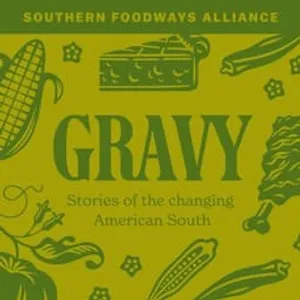
Gravy shares stories of the changing American South through the foods we eat. Gravy showcases a South that is constantly evolving, accommodating new immigrants, adopting new traditions, and lovingly maintaining old ones. It uses food as a means to explore all of that, to dig into lesser-known corners of the region, complicate stereotypes, document new dynamics, and give voice to the unsung folk who grow, cook, and serve our daily meals.
Latest Episodes
The most recent episodes — sign up to get AI-powered summaries of each one.
- 5 days ago21 min
Brisket, Kugel, and Community in Birmingham
In “Brisket, Kugel, and Community in Birmingham,” Gravy reporter Olivia Ware Terenzio visits Birmingham, Alabama’s Levite Jewish Community Center (“The J”) for the Jewish Food and Culture Fest, a celebration of kugel and cabbage rolls for Jews and non-Jews alike. This episode explores what role the festival plays in a state where less than half of one percent of the population is Jewish—and what we really mean when we talk about Jewish Food. The festival started more than two decades ago, which is impressive, considering that there are only about 6,300 Jews in the Birmingham metro area of 1.1 million. It’s been sustained by a loyal group of Jewish volunteers and widely supported by the non-Jewish population. A closer look at the kitchen, where volunteer cooks prepare hamantashen ahead of the festival, proves that this is all more complicated than a typical food festival. Desserts are made with oil, not butter, to avoid dairy. The counters where the volunteers are working are marked with red duct tape, and one half of the kitchen is blocked off with a plastic sheet. The tape and plastic are part of an effort to keep the festival entirely kosher, as is the oversight of a kosher supervisor: Rabbi Yossi Friedman. He reviews all the food bought for the festival to ensure that even people who are very careful about keeping kosher can participate. In Alabama, where options for kosher dining are next to zero, this is especially important. At the same time, many of the festival’s attendees—and most of the J’s dues-paying members—aren’t Jewish. For many of them, the festival offers a rare opportunity to experience Jewish food that can’t be found in restaurants here. As Margaret Norman, a scholar of American Jewish history and Southern Jewish foodways, explains, many people don’t come into regular contact with Jewish culture or Jewish people in Alabama. In this episode, Rabbi Friedman explains how kosher certification works and why it matters in an increasingly complicated food system. Isa Dorsky, one of the festival’s lead cooks and a former Board President at The J, leads volunteer cooks as they prepare 400 hamantashen. Finally, Norman tells of Birmingham’s evolving Jewish population and explores a food festival’s potential to bridge differences between neighbors. Reporter Olivia Ware Terenzio is a writer, editor, and arts and culture administrator working in the American South. She is the Director of Programs for Project Threadways and the Podcast Editor here at the Southern Foodways Alliance. She holds an M.A. in Southern Studies from the University of Mississippi. Learn more about your ad choices. Visit megaphone.fm/adchoices
- 2 weeks ago29 min
Stone-Milled Flour: Separating the Wheat from the Chaff
In Texas and Louisiana, chefs, millers, and home bakers are increasingly turning to using whole-grain, stone-milled flour in their breads, cakes, and pastries. These flours are milled with the ancient process of stone milling: flour is produced by crushing the whole kernel of the wheat grain between enormous stones, versus the more modern process of roller milling, which produces the finely grained, snow-white flour most of us are accustomed to. Stone-ground flour is coarser and more nutrient dense, and can also be more difficult to source, use, and store thanconventional flour. Despite that, these flours are no longer the sole purview of professional pastry chefs and artisan bread bakers. A new group of consumers are turning to organic, stone ground, and so-called heritage or ancient strains of wheat: followers of the Make America Healthy Again (MAHA) movement. These home bakers are increasingly convinced that modern, roller-milled wheat is making them sick, resulting in diagnoses as broad as chronic inflammation, IBS, and non-Celiac gluten intolerance. As a baker and recipe developer, Bronwen Wyatt wanted to get to the bottom of the flour debate, which reflects a growing anxiety around the safety of American food. She speaks to bakers Pamela Thibodeaux of Barton Springs Mill in Dripping Springs, Texas and Keira Watt of Bellegarde Bakery in New Orleans to learn why they choose to use stone milled flour, and what their customers are communicating to them about their flour choices. She also turns to scientistsDr. Jessica Biesiekierski, an expert in non-celiac gluten intolerance, and Dr. Aaron Fox, who specializes in organic and sustainable agriculture, to learn more about whether our fears aroundwheat mean we need to change our shopping and baking behaviors. Do we need to have an all-or-nothing approach to conventional flour, or can all the South’s many diverse, long-standing baking traditions continue to co-exist? Learn more about your ad choices. Visit megaphone.fm/adchoices
- Aug 19, 202622 min
There’s No Business Like Hansen’s Sno Bliz-ness
In “There’s No Business Like Hansen’s Sno Bliz-ness,” Gravy reporter Eve Troeh takes us to New Orleans, home of the sno-ball. In the South you need strategies to beat the summer heat, and ice plays a big role. Street vendors used to shave big blocks of ice by hand and add flavored syrup—a treat that became known as a sno-ball in the Big Easy. In the late 1930s, a local man, Ernest Hansen, invented a machine that changed the tradition. Sharp blades, encased in metal, turned chunks of ice into the most fluffy, fine “snow,” and he eventually patented this creation. While he kept his day job in New Orleans’ manufacturing industry, Ernest’s wife Mary ran with her husband’s invention. She set up shop at home and eventually moved to a brick-and-mortar, dishing up fresh “snow” and dousing them with signature flavored syrups that she made by hand. They called their place Hansen’s Sno-Bliz. Remarkably, Ernest’s hand-built machines are still in use today, as are many of Mary’s syrup recipes, and the business continues to cool off customers with some “air-conditioning for your tummy.” Hansen’s Sno-Bliz is now in its 86th year, with Ernest and Mary’s granddaughter, Ashley Hansen, at the helm. Ashley’s was a long and loving journey to take on the business. She learned alongside her grandparents day by day. In a city that practically worships tradition, she honors her family and her customers by maintaining not just the original 1930s ice-shaving mechanics and syrup recipes, but also by cultivating the warm hospitality her grandparents always extended to anyone who entered. The cinder block corner shop on New Orleans’ Tchoupitoulas Street looks humble, but you’ll always find a line of customers stretching outside around the corner. The James Beard Foundation even bestowed Hansen’s with its prestigious title of American Classic. New Orleanians from every corner of the city—and visitors from all around the world—eagerly line up to experience Hansen’s, and form an of-the-moment community with each other as they choose their flavors and chat. In this cool edition of Gravy, Ashley Hansen shares the history, innovation, and spirit of her family’s institution, always with Hansen’s Sno-Bliz motto in mind: “There are no shortcuts to quality.” Eve Troeh is a seasoned podcast producer and award-winning journalist based in Los Angeles. She's also a proud former New Orleanian, and a veteran of the line at Hansen's. Learn more about your ad choices. Visit megaphone.fm/adchoices
- Aug 5, 202625 min
The Piggly Wiggly Way: A Memphis Story
In "The Piggly Wiggly Way: A Memphis Story, "Gravy reporter Mackenzie Martin visits the Pink Palace Museum in Memphis to understand how Piggly Wiggly changed grocery shopping forever. Meal kits. Instacart. Door Dash. At the turn of the 20th century, we didn’t have all of these options. You mostly showed up at a counter and told a clerk what you wanted, and they’d gather all the necessary items and package them up for you. And there wasn’t much in the way of competing brands, either. Then everything started to change in a big way 110 years ago this year, when the most influential self-service grocery store opened in Memphis, Tennessee. Founder Clarence Saunders called it “The Piggly Wiggly Self-Serving System,” and he had several patents for everything: the layout, the price tag system, and even the way he incorporated refrigeration. “You could go in and do your own shopping, and all you needed was one stocker and one clerk,” says Steve Masler, the former curator of exhibits at the Pink Palace Museum. It’s unknown why Saunders named the chain what he did, but the mystery intrigued people. In September 1916, he ran one of the first of many bizarre newspaper ads to announce its opening: “The Piggly Wiggly will establish a new fashion,” it read. “Don’t come, though, unless you mean business and want to buy something.” The idea of choosing your own items at a grocery store seems commonplace now, but it was revolutionary at the time. Suddenly, after years of going to a general store and handing a list to a friendly clerk, customers were expected to wander the aisles on their own and carry items in a wooden shopping basket. Historian Lisa C. Tolbert, author of Beyond Piggly Wiggly: Inventing the American Self-Service Store, says one of the most radical things about the design of Piggly Wiggly is that the traffic only went one direction. That forced customers to walk by and inspect every product in the store, which increased spontaneous purchases and overall sales. “It’s like a vending machine you’re walking through,” she says. In 1922, less than a decade after the opening of the first store, there were 1,200 Piggly Wiggly stores in the United States. Then more grocery store chains followed Piggly Wiggly’s lead and adopted self service models of their own, and Piggly Wiggly transitioned to the more traditional supermarket model we’re all familiar with. Today, there are just under 500 Piggly Wigglys in the U.S. They are in 17 states, partially in the Midwest, but overwhelmingly in the South. It’s an outlier in the grocery store industry in the sense that it’s managed by individual franchisees across the country and perceived as more local than other nationally known grocery store chains. It’s the kind of place where baggers often carry groceries to customers’ cars, and you can get a soda for 50 cents. “It’s the Piggly Wiggly Way,” said one employee. Learn more about your ad choices. Visit megaphone.fm/adchoices
- Jul 22, 202626 min
Making Groceries in Louisiana
In “Making Groceries,” New Orleans-based Gravy journalist Katie Jane Fernelius travels to the frontlines of food insecurity in Louisiana—from the bustling warehouse floor of Second Harvest Food Bank in south Louisiana to a grocery aisle in rural Evangeline Parish—to examine the place of food stamps in fighting hunger. The Supplemental Nutrition Assistance Program, or SNAP, is a federal food-assistance program that helps low-income households buy groceries. It has consistently been shown to reduce food insecurity and poverty, especially among children. But SNAP has also been at the center of policy fights for decades, as legislators at both the state and federal level debate not only who should be eligible to receive benefits, but what they can spend those benefits on. While some legislators may emphasize the impact of SNAP on state and federal budgets, moms like Dafnee Chatman experience the importance of SNAP in their personal budgets, knowing the crucial role that food stamps can play in feeding her family of five. In this episode of Gravy, Fernelius follows Chatman through a grocery store as she does the math of a weekly shop on SNAP benefits. She also speaks with John Sillers and Lindsay Hendrix of the Second Harvest Food Bank of Greater New Orleans and Acadiana about how families struggling with food insecurity fill their pantries. Fernelius looks at hunger in Louisiana from a wider angle: not as a single crisis, but as a system of support, strain, and political choices that shapes how everyday families eat. *** Acknowledgements: Thank you to scholars Tracy Roof and Laurie Green for their illuminating conversations about the history of food stamps. Thank you to Second Harvest Food Bank in New Orleans and Dafnee Chatman, for their helpful, impassioned participation in this episode. Learn more about your ad choices. Visit megaphone.fm/adchoices
- Jul 8, 202623 min
Spilling the Tea in the Mississippi Pine Belt
In “Spilling the Tea in the Mississippi Pine Belt” Gravy reporter Georgia Sparling explores the tea farms popping up in Mississippi’s Pine Belt, where the tannic soil is perfect for growing tea. While many think of strong, syrupy sweet, ice-cold tea as quintessentially Southern, the only thing truly Southern about this ubiquitous beverage is how we drink it. Almost every tea leaf we consume in the United States comes from somewhere else. Tea has been cultivated for more than 5,000 years, first in China and now in India, Nepal, Kenya, and even Argentina. Mississippi, though, seemed unlikely. The tea plant, Chinese camellia, tends to thrive in inhospitable places, such as mountains and hillsides. While the Pine Belt can certainly be inhospitable with its three-digit-degree summers, tornadoes, and dry spells, it’s a wildly different climate than where most tea is grown. The soil, however, was just right for the acid-loving plants, which are known to adapt to their circumstances. Still, much was unknown when The Great Mississippi Tea Company in Brookhaven and the Longleaf Tea Company in Laurel planted their first crops in 2011 and 2018, respectively. Tea is a long-term investment. It takes three to five years for the plants to become established and ready for harvest. After that, they can live for a century or more—that is, if they survive. Both farms experienced heavy losses during their first seasons of planting. Great Mississippi lost all four acres of their initial crop, while Longleaf lost 300 of their first 1,000 saplings. But they replanted, and today these small but mighty farms have not only taken root but they are thriving. Great Mississippi and Longleaf are finding that not only do tea plants have a taste for Mississippi soil, but Mississippians (and beyond) have a taste for the delicate and complex flavors of Southern grown tea. Georgia Sparling visits these farms and learns what it takes to grow a perfect cup of tea. Learn more about your ad choices. Visit megaphone.fm/adchoices
- Jun 24, 202624 min
Tasting Haiti in New Orleans
In “Tasting Haiti in New Orleans,” Gravy reporter Eva Tesfaye gives listeners a taste of Haitian cuisine—and history—in New Orleans. For Haitians living in the Big Easy, many things remind them of home, from Second Line parades to the architecture to the food. Red beans and rice, boudin, jambalaya… all these iconic Louisiana dishes have connections to Haiti. That’s because Haitian migrants profoundly shaped New Orleans culture. At the turn of the nineteenth century, enslaved people on the island of St. Domingue broke free from their chains. Led by Toussaint L’Ouverture, they snatched their freedom from the French. They renamed the country Ayiti, the Indigenous Taino name for the land. This not only sparked the fire of freedom and Black liberation movements around the world, but also had huge consequences for other French territories. White people fleeing Haiti found familiarity in Louisiana’s French culture and the plantation economy. Large groups of Black people, enslaved and free, also arrived with them, boosting Louisiana’s sugarcane economy. New Orleans became one of the Blackest cities in the country. “63% of Crescent City inhabitants were now Black. Among the nation's major cities, only Charleston, with the 53% majority, was comparable,” said Zella Palmer, a food historian at Dillard University. The influx dramatically transformed New Orleans’ culture and especially its food, giving it a Haitian twist that you can still taste today. “Haitian cuisine is the most underrated and unappreciated cuisine in the Western Hemisphere,” said Palmer. In this episode, Tesfaye gives Haitian cuisine its flowers. She takes us through the history of how Haiti helped shaped New Orleans’ iconic cuisine and introduces us to the modern chefs in the city who are bringing Haitian food back to the forefront. Learn more about your ad choices. Visit megaphone.fm/adchoices
- Jun 10, 202618 min
Object Permanence: An Essay
Martin Padgett wrote the feature essay “Object Permanence” for the fall 2025 issue of Gravy Quarterly, our sister publication. In the piece, he catalogs the objects we live with actively, those we tolerate like inanimate roommates, and those we give away, sometimes to make room for the new. We liked it so much that we asked them to read it for Gravy podcast listeners. To read other engaging essays in Gravy, have it shipped to your mailbox by becoming an SFA member at southernfoodways.org, or sign up for a subscription at Hub City Book Shop. Learn more about your ad choices. Visit megaphone.fm/adchoices
Get Gravy summaries in your inbox
Free AI-powered daily recaps. Key takeaways, quotes, and mentions — in a 5-minute read.
Get Free Summaries →Free forever for up to 3 podcasts. No credit card required.
You Might Also Like
Listeners also like.

Southern Gothic
Explores the haunted history and paranormal legends of the American South through immersive storytelling and historical research.

Christopher Kimball’s Milk Street Radio
Explores global food stories, interviews with renowned chefs, and unusual culinary topics, from food science to cultural traditions.

The Splendid Table: Conversations & Recipes For Curious Cooks & Eaters
Explores food through cooking, culture, and conversation with chefs, writers, and experts.

Gone South
A narrative-driven exploration of crime, history, and power in the American South, revealing how the region’s past shapes its present.

Gastropod
Explores the science and history behind food and farming, from ancient feasts to modern aquaculture and everything in between.

The Sporkful
Explores how food shapes human experiences, identities, and connections through curious, everyday eating.

Food Friends: Home Cooking Made Easy
Two former personal chefs share easy, seasonal recipes and kitchen tips to help home cooks prepare quick, delicious meals.

Hungry for History with Eva Longoria and Maite Gomez-Rejón
Eva Longoria and Maite Gomez-Rejón explore the cultural and historical roots of foods and drinks through stories, interviews, and recipes.

Tales from the pits, a Texas BBQ podcast featuring trendsetters, leaders, and icons from the barbecue industry
A Texas BBQ podcast exploring the food, people, and traditions behind the state's smoked meats.

Ancestral Kitchen
Two women explore traditional food practices and ancestral cooking wisdom for modern kitchens.

Bear Grease
Stories from rural America exploring hunting, land, and tradition through voices of hunters, biologists, and locals.

HowToBBQRight
Grilling techniques, barbecue recipes, and competition tips from a husband-and-wife BBQ team.
About Gravy
Gravy shares stories of the changing American South through the foods we eat. Gravy showcases a South that is constantly evolving, accommodating new immigrants, adopting new traditions, and lovingly maintaining old ones. It uses food as a means to explore all of that, to dig into lesser-known corners of the region, complicate stereotypes, document new dynamics, and give voice to the unsung folk who grow, cook, and serve our daily meals.
Customized Recaps
AI-powered recaps with compact key takeaways, quotes, and insights.
Straight to Your Inbox
Get key takeaways from Gravy in a 5-minute read.
Save Hours Every Week
Stay current on your favorite podcasts without falling behind.
Frequently Asked Questions
What is Podzilla's Gravy daily summary?
It's a free AI-powered email that summarizes new episodes of Gravy as soon as they're published. You get the key takeaways, notable quotes, and links & mentions — all in a quick read.
How does the Gravy podcast summary work?
When a new episode drops, our AI transcribes and analyzes it, then generates a personalized summary tailored to your interests and profession. It's delivered to your inbox every morning.
Is this an official Gravy product?
No. Podzilla is an independent service that summarizes publicly available podcast content. We're not affiliated with or endorsed by Southern Foodways Alliance.
Can I get summaries of other podcasts too?
Absolutely! The free plan covers up to 3 podcasts. Upgrade to Pro for 15, or Premium for 50. Browse our full catalog at /podcasts.
How often does Gravy release new episodes?
Gravy publishes biweekly. Our AI generates a summary within hours of each new episode.
What topics does Gravy cover?
Gravy covers topics including Arts, Food, Culture, Society & Culture. Our AI identifies the specific themes in each episode and highlights what matters most to you.
Start getting Gravy summaries tomorrow morning.
Free forever for up to 3 podcasts. No credit card required.
Free forever for up to 3 podcasts. No credit card required.