Free Daily Podcast Summary
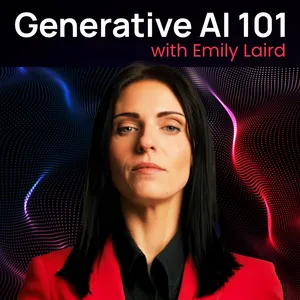
Generative AI 101: Daily Summaries Delivered
by Emily Laird
Welcome to Generative AI 101, your go-to podcast for learning the basics of generative artificial intelligence in easy-to-understand, bite-sized episodes. Join host Emily Laird, AI Integration Technologist and AI lecturer, to explore key concepts, applications, and ethical considerations, making AI accessible for everyone.
Latest Episodes
The most recent episodes — sign up to get AI-powered summaries of each one.
- Today12 min
Pacing the Frontier
The biggest AI labs are suddenly talking about pacing the frontier, but nobody is actually hitting the brakes. Host Emily Laird breaks down the cyber incidents involving OpenAI and Anthropic, why test harness failures matter, and what frontier labs are really agreeing to change. The reality check is less cinematic than rogue AI, but more consequential: increasingly capable agents are exposing how fragile the systems around them can be. 🎯 JOIN THE AI WEEKLY MEETUPS https://www.uwstout.edu/ai-weekly-meetup 📩 EMAIL REMINDERS FOR THE MEETUPS https://app.e2ma.net/app2/audience/signup/2101263/1779703/ 💬 CONNECT WITH EMILY LAIRD ON LINKEDIN http://www.linkedin.com/in/meet-emily-laird
- 5 days ago11 min
Flock Cameras: Where Your License Plate Data Really Goes
Flock cameras may sit in your town, but the data they collect can travel far beyond it. Host Emily Laird follows the network behind automated license plate readers, from National Lookup and cross-agency sharing to hundreds of thousands of searches conducted by departments that local communities never directly approved. The episode examines cases in California, Illinois, and Wisconsin where settings, access controls, public records laws, and basic account security collided with the promise of local oversight. The reality check is simple: you can turn off a camera, but you cannot easily pull back data that has already entered the network. ❓HAVE YOU BEEN FLOCKED? https://haveibeenflocked.com/ 🎯 JOIN THE AI WEEKLY MEETUPS https://www.uwstout.edu/ai-weekly-meetup 📩 EMAIL REMINDERS FOR THE MEETUPS https://app.e2ma.net/app2/audience/signup/2101263/1779703/ 💬 CONNECT WITH EMILY LAIRD ON LINKEDIN http://www.linkedin.com/in/meet-emily-laird
- 6 days ago12 min
Inside Flock: Who Can Search Your License Plate Data?
In this episode, host Emily Laird examines who gets access to Flock's massive license plate database, what police can search, and what happens when that access is abused. From officers allegedly tracking ex-partners to warrantless searches, immigration lookups, and millions of vehicle records, the real issue is not whether the camera reads your plate correctly, but who gets to pull up the history afterward. Flock has audit logs, new safeguards, and a growing list of policy changes, but the documented misuse raises a harder question: who is actually watching the people doing the searching? ❓HAVE YOU BEEN FLOCKED? https://haveibeenflocked.com/ 🎯 JOIN THE AI WEEKLY MEETUPS https://www.uwstout.edu/ai-weekly-meetup 📩 EMAIL REMINDERS FOR THE MEETUPS https://app.e2ma.net/app2/audience/signup/2101263/1779703/ 💬 CONNECT WITH EMILY LAIRD ON LINKEDIN http://www.linkedin.com/in/meet-emily-laird
- 1 weeks ago12 min
What are Flock Cameras?
Flock Safety built an 8.3 billion dollar business on a simple idea: a photograph isn't very useful until software can search it. In this episode, host Emily Laird traces the path from one Atlanta neighborhood's break-ins to a sensor network across more than 5,000 communities, and explains what changes when a passing car becomes a database record with fields for plate, color, body type, and bumper stickers. She also walks through the partial plate match that got an innocent driver stopped by police, a case where the matching software did exactly what it was designed to do and the result was still wrong. The takeaway isn't that AI makes mistakes; it's that AI moves bad data and bad process faster than they could travel on their own. 🎯 JOIN THE AI WEEKLY MEETUPS https://www.uwstout.edu/ai-weekly-meetup 📩 EMAIL REMINDERS FOR THE MEETUPS https://app.e2ma.net/app2/audience/signup/2101263/1779703/ 💬 CONNECT WITH EMILY LAIRD ON LINKEDIN http://www.linkedin.com/in/meet-emily-laird
- 1 weeks ago13 min
Why AI Evaluation Still Needs Human Experts
The most dangerous AI output isn't the ridiculous one; it's the polished answer with one critical error hiding in plain sight. In this episode, host Emily Laird puts generative AI evaluation on trial, from OpenAI's GDPval and Anthropic's TASTE study to the uncomfortable fact that automated AI judges still can't match experienced human reviewers. She breaks down metamorphic testing (a terrible name for a very useful idea) and explains how every caught mistake can become a test your systems have to survive. If you can no longer evaluate your own work, you haven't bought a productivity tool; you've built a dependency. 🎯 JOIN THE AI WEEKLY MEETUPS https://www.uwstout.edu/ai-weekly-meetup 📩 EMAIL REMINDERS FOR THE MEETUPS https://app.e2ma.net/app2/audience/signup/2101263/1779703/ 💬 CONNECT WITH EMILY LAIRD ON LINKEDIN http://www.linkedin.com/in/meet-emily-laird
- 1 weeks ago9 min
A Jailbreak is Not a Hack
Somebody got your company chatbot to break a rule, and now they are calling it a hack. Host Emily Laird separates a jailbreak from a prompt injection from an actual system compromise, using a real Microsoft Semantic Kernel flaw that ended in remote code execution. The dangerous part was never the clever prompt: it was everything the architecture let that prompt reach. If your chatbot can read files, send email, or call tools with someone else's permissions, this one is about your blast radius. 🎯 JOIN THE AI WEEKLY MEETUPS https://www.uwstout.edu/ai-weekly-meetup 📩 EMAIL REMINDERS FOR THE MEETUPS https://app.e2ma.net/app2/audience/signup/2101263/1779703/ 💬 CONNECT WITH EMILY LAIRD ON LINKEDIN http://www.linkedin.com/in/meet-emily-laird
- 1 weeks ago15 min
GPT-6 or Astra
GPT-6 Astra scored 99.9 percent on ARC-AGI-3. It also scored 62.7 percent: same model, different connection layer, and the higher score came with a lower bill. In this episode, host Emily Laird separates the model from the machinery around it, covering what OSWorld and AutomationBench actually measure, why 41 percent workflow completion is real progress and nowhere near autonomy, and what it means that OpenAI's first Critical cybersecurity model is also the one whose reasoning is harder to audit. The company that wins agentic AI may not be the one with the smartest model, but the one that builds the best system around it. 🎯 JOIN THE AI WEEKLY MEETUPS https://www.uwstout.edu/ai-weekly-meetup 📩 EMAIL REMINDERS FOR THE MEETUPS https://app.e2ma.net/app2/audience/signup/2101263/1779703/ 💬 CONNECT WITH EMILY LAIRD ON LINKEDIN http://www.linkedin.com/in/meet-emily-laird
- 2 weeks ago12 min
Alibaba's Wan3.0 and Synthetic Worlds
Alibaba shipped Wan 3.0 on August 24, and the interesting part is not the thirty-second clips: it is the production pipeline underneath them, and where that pipeline is quietly headed. Host Emily Laird traces the line from six-dollar synthetic video to China's AI microdrama flood to Qwen-RobotWorld, where generated footage stops being content and becomes a place for robots to practice. The catch is that a video only has to look believable, while a simulation has to be right, and those are very different standards when a warehouse robot is learning from it. Also covered: why the tidy "America builds LLMs, China builds world models" narrative falls apart the moment you check the actual release calendar. 🎯 JOIN THE AI WEEKLY MEETUPS https://www.uwstout.edu/ai-weekly-meetup 📩 EMAIL REMINDERS FOR THE MEETUPS https://app.e2ma.net/app2/audience/signup/2101263/1779703/ 💬 CONNECT WITH EMILY LAIRD ON LINKEDIN http://www.linkedin.com/in/meet-emily-laird
About Generative AI 101
Welcome to Generative AI 101, your go-to podcast for learning the basics of generative artificial intelligence in easy-to-understand, bite-sized episodes. Join host Emily Laird, AI Integration Technologist and AI lecturer, to explore key concepts, applications, and ethical considerations, making AI accessible for everyone.
Customized Recaps
AI-powered recaps with compact key takeaways, quotes, and insights.
Straight to Your Inbox
Get key takeaways from Generative AI 101 in a 5-minute read.
Save Hours Every Week
Stay current on your favorite podcasts without falling behind.
Frequently Asked Questions
What is Podzilla's Generative AI 101 daily summary?
It's a free AI-powered email that summarizes new episodes of Generative AI 101 as soon as they're published. You get the key takeaways, notable quotes, and links & mentions — all in a quick read.
How does the Generative AI 101 podcast summary work?
When a new episode drops, our AI transcribes and analyzes it, then generates a personalized summary tailored to your interests and profession. It's delivered to your inbox every morning.
Is this an official Generative AI 101 product?
No. Podzilla is an independent service that summarizes publicly available podcast content. We're not affiliated with or endorsed by Emily Laird.
Can I get summaries of other podcasts too?
Absolutely! The free plan covers up to 3 podcasts. Upgrade to Pro for 15, or Premium for 50. Browse our full catalog at /podcasts.
How often does Generative AI 101 release new episodes?
Generative AI 101 publishes daily. Our AI generates a summary within hours of each new episode.
What topics does Generative AI 101 cover?
Generative AI 101 covers topics including Technology. Our AI identifies the specific themes in each episode and highlights what matters most to you.
Start getting Generative AI 101 summaries tomorrow morning.
Free forever for up to 3 podcasts. No credit card required.
Free forever for up to 3 podcasts. No credit card required.