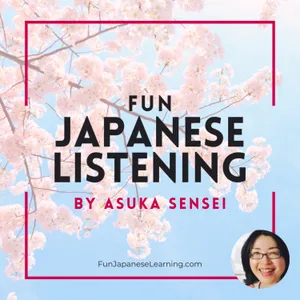
Free Daily Podcast Summary
FUN Japanese Listening: Daily Summaries Delivered
by Dr. Asuka Tsuchiya
Get key takeaways, quotes, and insights from FUN Japanese Listening in a 5-minute read. Delivered straight to your inbox.
Latest Episodes
The most recent episodes — sign up to get AI-powered summaries of each one.
- 3 weeks ago11 min
The Last Sound: How Japanese Sentence Endings Shape the Listener's Emotional Landscape
Have you ever felt like you understand Japanese — but you can't quite feel it?In this episode, we go inside one of the most fascinating and often invisible aspects of Japanese: sentence-ending particles called 終助詞 (shuujoshi). ね (ne), よ (yo), な (na) — these tiny sounds are not grammar rules. They are relationship architecture.In real time, with every single sentence, a Japanese speaker uses these particles to design the emotional space between themselves and the listener. We explore why "Samui ne," "Samui yo," and "Samui na" — the exact same words — create three completely different emotional realities. And we look at the linguistic concept of "intersubjectivity" to understand how English and Japanese structure this relational layer so differently.One syllable. Infinite nuance. That's Japanese.---Too busy or too 'old' to learn Japanese? Think again. 🎌⬇️ Check how to learn Japanese effectively as a busy adult.https://shop.funjapaneselearning.com/go/pd---You can watch the video version of this episode here---Learn travel-themed Japanese (with audio and e-flash cards) for your next Japan trip!Japanese Language Learning Guide for Travelershttps://amzn.to/3SeluZuAre you interested in learning Kanji?Japanese Kanji for BeginnersFor Hiragana and Katakana learningComplete Japanese HiraganaComplete Japanese Katakana---🎓 Who is Asuka sensei?Asuka sensei, Dr Asuka Tsuchiya, is an award-winning psychologist, a qualified Japanese educator, an Amazon UK, US, and Japan #1 best-selling author, and a mother with two adorable kids.She studied linguistics and education at the University of Tokyo, earning a Master's degree, and later obtained a PhD in psychology from Nara Women's University. While in Japan, she worked as a psychotherapist, supporting individuals in their personal growth and well-being.After she moved to the UK, she dedicated herself to Japanese education by pursuing Japan's official qualification for professional Japanese teachers and taught Japanese to adult learners in the Lifelong Learning Department at the University of Southampton for nearly 10 years.Now she runs the online Japanese school specifically for busy adults who want to feel the depth and richness of Japanese culture through language learning.
- Mar 15, 202611 min
Episode 110: Why Japanese People Don't Say "I Miss It": The Psychology Behind "懐かしい (Natsukashii)
When you look at an old photo and feel a pang of longing, you say "I miss it." But did you know that the word "miss" literally means to perceive an absence? It trains your brain to focus on loss.In this episode, Asuka sensei explores why Japanese people experience memories completely differently — through a word called "Natsukashii" (懐かしい). Unlike nostalgia, which comes from the Greek words for "return" and "pain," Natsukashii carries no pain at all. Its etymology traces back to "Natsuku" — the way a puppy runs towards you with trust and warmth.If you've ever wished you could look back on your past without feeling sadness, this episode will give you a powerful new emotional tool — rooted in the Japanese language.What you'll learn:Why "nostalgia" literally means "the pain of wanting to return"How "Natsukashii" turns loss into gratitudeThe surprising etymology: a puppy running to you with trustHow the Kanji 懐 connects to "keeping something close to your heart"A simple mindset shift you can practise todayToo busy or too 'old' to learn Japanese? Think again. 🎌⬇️Check this to learn Japanese as a busy adult.https://shop.funjapaneselearning.com/go/pdYou can watch the video version of this episode hereLearn travel-themed Japanese (with audio and e-flash cards) for your next Japan trip!Japanese Language Learning Guide for Travelershttps://amzn.to/3SeluZuAre you interested in learning Kanji?Japanese Kanji for BeginnersFor Hiragana and Katakana learningComplete Japanese HiraganaComplete Japanese Katakana🎓Who is Asuka sensei?Asuka sensei, Dr Asuka Tsuchiya, is an award-winning psychologist, a qualified Japanese educator, an Amazon UK, US, and Japan #1 best-selling author, and a mother with two adorable kids. She studied linguistics and education at the University of Tokyo, earning a Master's degree, and later obtained a PhD in psychology from Nara Women's University. While in Japan, she worked as a psychotherapist, supporting individuals in their personal growth and well-being.After she moved to the UK, she dedicated herself to Japanese education by pursuing Japan's official qualification for professional Japanese teachers and taught Japanese to adult learners in the Lifelong Learning Department at the University of Southampton for nearly 10 years.Now she runs the online Japanese school specifically for busy adults who want to feel the depth and richness of Japanese culture through language learning.
- Mar 8, 202611 min
Episode 109: Ikigai is Not a Career Goal: The Japanese Concept of "Hariai"
The famous "Ikigai" Venn diagram tells you to find your purpose by combining passion, profession, and profit. But did you know it wasn't even created by the Japanese?In this episode, Asuka sensei uncovers the real meaning of Ikigai—a quiet, personal sense of inner worth that has nothing to do with career goals or saving the world. You'll also learn a beautiful concept called "Hariai" (張り合い)—the feeling of positive tension that makes life resonate like a well-tuned guitar string.If you've ever felt lost trying to fill in those 4 circles, this episode will change how you think about purpose, fulfillment, and what it truly means to feel alive.What you'll learn:Why the viral Ikigai diagram is a Western inventionThe real meaning of "Kai" (甲斐) — worth that comes from the heart, not your wallet"Hariai" (張り合い) — the Japanese secret to a vibrant daily lifeHow to shift from "finding a goal" to "feeling a sentiment"Too busy or too 'old' to learn Japanese? Think again. 🎌⬇️Check this to learn Japanese as a busy adult.https://shop.funjapaneselearning.com/go/pdYou can watch the video version of this episode hereBooks & ResourcesLearn travel-themed Japanese (with audio and e-flash cards) for your next Japan trip!Japanese Language Learning Guide for Travelershttps://amzn.to/3SeluZuAre you interested in learning Kanji?Japanese Kanji for BeginnersFor Hiragana and Katakana learningComplete Japanese HiraganaComplete Japanese Katakana🎓Who is Asuka sensei?Asuka sensei, Dr Asuka Tsuchiya, is an award-winning psychologist, a qualified Japanese educator, an Amazon UK, US, and Japan #1 best-selling author, and a mother with two adorable kids. She studied linguistics and education at the University of Tokyo, earning a Master's degree, and later obtained a PhD in psychology from Nara Women's University. While in Japan, she worked as a psychotherapist, supporting individuals in their personal growth and well-being.After she moved to the UK, she dedicated herself to Japanese education by pursuing Japan's official qualification for professional Japanese teachers and taught Japanese to adult learners in the Lifelong Learning Department at the University of Southampton for nearly 10 years.Now she runs the online Japanese school specifically for busy adults who want to feel the depth and richness of Japanese culture through language learning.
- Mar 2, 202624 min
Episode 108: How Learning Japanese Literally Rewires Your Brain
What happens inside your brain when you learn Japanese — and why is it different from learning French, Spanish, or German? In this episode, we explore the neuroscience behind why Japanese gives your brain a workout unlike any other language. Whether you're 35 or 75, this episode will change how you think about the "difficulty" of Japanese.Too busy or too 'old' to learn Japanese? Think again. 🎌⬇️Check this to learn Japanese as a busy adult.https://shop.funjapaneselearning.com/go/pdYou can watch the video version of this episode here📕BooksLearn travel-themed Japanese (with audio and e-flash cards) for your next Japan trip!Japanese Language Learning Guide for Travelershttps://amzn.to/3SeluZuAre you interested in learning Kanji?Japanese Kanji for Beginners For Hiragana and Katakana learningComplete Japanese HiraganaComplete Japanese Katakana🎓Who is Asuka sensei? Asuka sensei, Dr Asuka Tsuchiya, is an award-winning psychologist, a qualified Japanese educator, an Amazon UK, US, and Japan #1 best-selling author, and a mother with two adorable kids. She studied linguistics and education at the University of Tokyo, earning a Master's degree, and later obtained a PhD in psychology from Nara Women's University. While in Japan, she worked as a psychotherapist, supporting individuals in their personal growth and well-being.After she moved to the UK, she dedicated herself to Japanese education by pursuing Japan’s official qualification for professional Japanese teachers and taught Japanese to adult learners in the Lifelong Learning Department at the University of Southampton for nearly 10 years.Now she runs the online Japanese school specifically for busy adults who want to feel the depth and richness of Japanese culture through language learning.
- Feb 23, 202610 min
Episode 107: The "Ghost" Subject - Why Japan's Most Famous Sentence Cannot Be Translated
"The train came out of the long tunnel into the snow country."This is the English translation of the opening line from Yasunari Kawabata’s Nobel Prize-winning novel, Snow Country (雪国, Yukiguni). It is widely considered a masterpiece of translation and is highly praised worldwide.But there is a shocking secret hidden in this famous English sentence:It is completely different from the original Japanese. In fact, in the original text, there is no "train" at all.Why did a master translator have to add a train that wasn't there? In this episode, we explore the mystery of the "Ghost Subject." You'll discover why dropping the subject isn't just a lazy grammar rule—it's a profound shift in how you experience reality.If you've ever felt like your Japanese sounds "too English," the secret lies in where you place the camera. Let's find out why.Too busy or too ‘old’ to learn Japanese? Think again. 🎌 ⬇️Check this to learn Japanese as a busy adult. https://shop.funjapaneselearning.com/go/pdYou can watch the video version of this episode hereLearn travel-themed Japanese (with audio and e-flash cards) for your next Japan trip!Japanese Language Learning Guide for Travelershttps://amzn.to/3SeluZuAre you interested in learning Kanji?Japanese Kanji for Beginners For Hiragana and Katakana learningComplete Japanese HiraganaComplete Japanese Katakana🎓Who is Asuka sensei?Asuka sensei, Dr. Asuka Tsuchiya, is an award-winning psychologist, qualified Japanese educator, Amazon UK, US, Japan #1 best-selling author, and mother with two adorable kids.She provides high-quality Japanese instruction grounded in her profound knowledge of the language, education, and psychology. She taught various Japanese lessons, including "Learn Japanese with Asuka" at the University of Southampton in the UK.Now she runs the online Japanese school specifically for adult learners who want to feel the depth and richness of Japanese culture through language learning.
- Feb 17, 20269 min
Episode 106: "Komorebi": Seeing Nature Through Japanese Eye
In English, you might call it "dappled light" or simply "sunlight." You describe the physics.But in Japan, we give this specific phenomenon a name: Komorebi (木漏れ日).It literally translates to "Sunlight leaking through trees."But why do we have a specific noun for this?In this video, I take you on a linguistic walk through the forest. We explore not just the meaning of the word, but the Japanese philosophy hidden inside the Kanji characters.You will discover why Japanese aesthetics often finds more beauty in "leaking light" and shadows than in direct illumination—and how learning this one word can upgrade the resolution of your world.Too busy or too ‘old’ to learn Japanese? Think again. 🎌 ⬇️Check this to learn Japanese as a busy adult. https://shop.funjapaneselearning.com/go/pdYou can watch the video version of this episode hereLearn travel-themed Japanese (with audio and e-flash cards) for your next Japan trip!Japanese Language Learning Guide for Travelershttps://amzn.to/3SeluZuAre you interested in learning Kanji?Japanese Kanji for Beginners For Hiragana and Katakana learningComplete Japanese HiraganaComplete Japanese Katakana
- Feb 13, 20267 min
Episode 105: Stop Asking "Why": The Counter-Intuitive Secret of Japanese Culture
Do you ever feel "stuck" in your Japanese learning, even though you study hard?You are not alone. Especially for adult learners from Western backgrounds, there is a hidden barrier that textbooks don't talk about.In this episode, I explain why your logical intelligence might be blocking your progress, and how to switch from "Western Understanding" to "Japanese Resonance."If you want to move beyond superficial understandings and truly connect with the Japanese spirit, this episode is for you.Too busy or too ‘old’ to learn Japanese? Think again. 🎌 ⬇️Check this to learn Japanese as a busy adult. https://shop.funjapaneselearning.com/go/pdYou can watch the video version of this episode @spotifyLearn travel-themed Japanese (with audio and e-flash cards) for your next Japan trip!Japanese Language Learning Guide for Travelershttps://amzn.to/3SeluZuAre you interested in learning Kanji?Japanese Kanji for Beginners For Hiragana and Katakana learningComplete Japanese HiraganaComplete Japanese Katakana
- Feb 3, 20233 min
Episode 104: How to say "temeperature" in Japanese?
さむいですね! It's cold!Do you know how to say "temperature" in Japanese?I will explain to you temperature-related words and phrases in Japanese!You can watch the video version of this episode @spotifyhttps://open.spotify.com/show/5MH9RH7MMc6eaJn0WzuHqRToo busy or too ‘old’ to learn Japanese? Think again. 🎌 ⬇️Check this to learn Japanese as a busy adult. https://shop.funjapaneselearning.com/go/pdLearn travel-themed Japanese (with audio and e-flash cards) for your next Japan trip!Japanese Language Learning Guide for Travelershttps://amzn.to/3SeluZuAre you interested in learning Kanji?Japanese Kanji for Beginners For Hiragana and Katakana learningComplete Japanese HiraganaComplete Japanese Katakana
Get FUN Japanese Listening summaries in your inbox
Free AI-powered daily recaps. Key takeaways, quotes, and mentions — in a 5-minute read.
Get Free Summaries →Free forever for up to 3 podcasts. No credit card required.
You Might Also Like
Listeners also like.
FUN Japanese Listening » podcasts
Asuka

Learn Japanese | JapanesePod101.com (Audio)
JapanesePod101.com
Fluent Fiction - Japanese
FluentFiction.org
Let’s learn Japanese from small talk!
small talk in Japanese

Learn Japanese Pod
Alex Brooke
Tanaka Radio | Japanese Podcast
Learn Japanese with Tanaka san
Japanese Learning なみとパッツーの日本語ラジオ
Kaori
Everyday Japanese Podcast
Sayuri Saying

EASY JAPANESE PODCAST
MASA and ASAMI
Japanese with Kanako
Kanako
SAKURA TIPS|Listen to Japanese
Mari
Oyasumi Japanese with Shun
Japanese with Shun
About FUN Japanese Listening
こんにちは!Are you looking for a fun way to learn authentic Japanese and improve your Japanese skills? Then come and join Asuka sensei's Fun Japanese Listening podcast!You can enjoy listening activities, everyday Japanese vocabulary, fundamental Japanese grammar, unique Japanese culture, and more! This podcast is for both Japanese language learners and teachers. Subscribe to this podcast and level up your Japanese!https://lit.link/asukasensei
Customized Recaps
AI-powered recaps with compact key takeaways, quotes, and insights.
Straight to Your Inbox
Get key takeaways from FUN Japanese Listening in a 5-minute read.
Save Hours Every Week
Stay current on your favorite podcasts without falling behind.
Frequently Asked Questions
What is Podzilla's FUN Japanese Listening daily summary?
It's a free AI-powered email that summarizes new episodes of FUN Japanese Listening as soon as they're published. You get the key takeaways, notable quotes, and links & mentions — all in a quick read.
How does the FUN Japanese Listening podcast summary work?
When a new episode drops, our AI transcribes and analyzes it, then generates a personalized summary tailored to your interests and profession. It's delivered to your inbox every morning.
Is this an official FUN Japanese Listening product?
No. Podzilla is an independent service that summarizes publicly available podcast content. We're not affiliated with or endorsed by Dr. Asuka Tsuchiya.
Can I get summaries of other podcasts too?
Absolutely! The free plan covers up to 3 podcasts. Upgrade to Pro for 15, or Premium for 50. Browse our full catalog at /podcasts.
How often does FUN Japanese Listening release new episodes?
FUN Japanese Listening publishes every few days. Our AI generates a summary within hours of each new episode.
What topics does FUN Japanese Listening cover?
FUN Japanese Listening covers topics including Education, Learning, Language Learning. Our AI identifies the specific themes in each episode and highlights what matters most to you.
Start getting FUN Japanese Listening summaries tomorrow morning.
Free forever for up to 3 podcasts. No credit card required.
Free forever for up to 3 podcasts. No credit card required.