Free Daily Podcast Summary
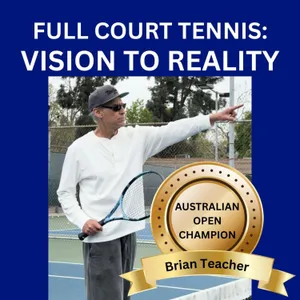
Full Court Tennis with Brian Teacher: Vision to Reality: Daily Summaries Delivered
by Full Court Tennis
Hosted by Australian Open Champion Brian Teacher, Vision to Reality bridges the gap between the technical science and the mental game. We deconstruct the geometry of the stroke, the physics of movement, and the mindfulness required to execute it under pressure. Whether you are a junior with a dream, a coach building a player, or a pro looking for that 1% edge, this is your roadmap. Stop guessing. Start building. Welcome to the laboratory. (Formerly Full Court Tennis Advantage)
Latest Episodes
The most recent episodes — sign up to get AI-powered summaries of each one.
- 4 days ago10 min
Zverev Told Alcaraz His Secret at the Laver Cup — One Point at a Time — The Life Lesson Behind the Greatest Tennis Players of All Time
There's a video going around from the Laver Cup practice court. Alcaraz walks over to Zverev and asks — I was watching at home. What were you thinking at the end of that US Open final?You won and you didn't even know you won.And Zverev says — I thought it was four-one. Not five-two. Because if I think five-two I get nervous. So I just played the next point.One point at a time. Two Grand Slam champions on a practice court. Thirty seconds. That's the whole secret.In this episode I break down exactly what that means — and why it's not just how Zverev won the US Open. It's how I won the Australian Open while my wife had just left me for someoneelse. It's how Alcaraz came off the court smiling after losing a five-hour match while he was sick.It's how Federer lost nearly half the points he ever played and still became the greatest. And it'sthe lesson I try to teach every player I coach — because one day they won't be facing a break point. They'll be facing life. Download the Full Court Tennis app → fullcourttennis.com What's your one point at a time? What's the moment you had to just focus on the next thing? Tell me below.#tennis #LaverCup #Zverev #Alcaraz #Federer #Nadal #tennismindset #tennismentalGame#australianopenchampion #fullcourttennis #tennistips #tenniscoach #onepointatatime #flowstate#tennispsychology #tennismotivation #champions #tennislife #Shelton #USOpen
- 1 weeks ago10 min
Why Champions Never Stop After Losing — The Life Lesson Behind the Greatest Tennis Players of All Time
Roger Federer won nearly 80% of his matches over his entire career. But he only won 54% of the points he ever played. The greatest of all time lost nearly half the points he played. His edge wasn't perfection. It was that the moment a point was over — it was gone. No carrying it to the next one.Today I'm doing something different. No forehand breakdowns. No serve mechanics. Today I want to talk about why I coach the way I do — and why the lessons of tennis are really the lessons of life.I got an email from a parent of two players I coach. What it said stopped me in my tracks. And it made me want to tell you everything — my ankle injuries, winning the Australian Open while my personal life was falling apart, losing my father, and the hardest thing I have ever faced. Losing my daughter Noelle.This is the episode behind all the other episodes. This is why I push every player I coach to fight for it. Because one day you won't be facing a break point. You'll be facing life. And life doesn't ask for permission. Download the Full Court Tennis app → fullcourttennis.com What moment in your life taught you to play the next point? Tell me in the comments.#tennis #tenniscoach #tennislife #Federer #Serena #Nadal #Agassi #Wawrinka #tennismindset#tennispsychology #australianopenchampion #fullcourttennis #tennislessons #lifelessons#tennis #champions #tennismotivation #tennismentalGame #playingthenextpoint
- 2 weeks ago20 min
Shelton Zverev Rybakina Sabalenka Michelsen and Tiafoe — Who Found the Flow State at the US Open and Who Lost It
Ben Shelton against Alcaraz — 54 net approaches, 70% won. Playing with zero fear. Complete freedom. Two days later in the final against Zverev — 22 net approaches. Cut in half. His feet stopped moving forward. His return points dropped from 63 to 31. Same player. Same tournament. What happened?Elena Rybakina won the US Open final landing only 47% of her first serves — and won 66% of her second serve points anyway. That is statistically almost impossible at Grand Slam level.How? In this episode I break down the 2026 US Open through the lens of the flow state. The numbersdon't just tell you what happened. They show you exactly why. Shelton vs Alcaraz. Shelton vs Zverev. Michelsen vs Tiafoe. Rybakina vs Sabalenka. Every stat points to the same truth — the flow state shows up in the numbers every single time.And I take you back to Melbourne 1980. My bags were packed. I was ready to go home. My personal life had completely fallen apart right before the Australian Open. I told the tournament director my back went out — a white lie — and he let me back into the draw. What happened next taught me everything I know about finding the flow state when your world is falling apart. Track your mental game and technique → Download the Full Court Tennis app fullcourttennis.com Have you ever lost the flow state in a big match moment? What happened? Tell me below.
- 3 weeks ago11 min
Why Sinner Alcaraz and Djokovic Always Know Exactly Where They Are on Court — The Sixth Sense Most Coaches Never Teach This
Sinner never seems rushed. Alcaraz always has time. Djokovic is never out of position. Even when the ball is coming at them at 130mph — they always seem to know exactly where they are and exactly what to do. The secret is something most coaches never talk about. It's called proprioception. And it may be the most undertrained skill in tennis.In this episode I break down exactly what proprioception is, why the best players in the world train it deliberately, and how every tennis player can develop it — at any level.Plus — a juggling tutorial from USPTA coach Richard S. Brail that shows you exactly where to start. And why juggling on a foam roller is one of the most powerful proprioceptive training tools in elite tennis.And the insight that will change how you think about your game forever: your arm has nothing to do with it. Your feet load your torso. Your torso loads your arm. The arm is just the platform. It compresses the ball. That's all it does. Top players know this. Most players never learn it.And the truth about warm ups that most players never hear: every ball you hit on a tennis court is training your system. Every ball. Warm up included. Bad habits in the warm up mean bad habits in the match. Champions pay attention to every detail. Every time. See your proprioception gaps in real time → Download the Full Court Tennis app fullcourttennis.com Do you practice coming to net? Or are you a yo-yo baseline player? Tell me in the comments.#tennis #tennistips #proprioception #Sinner #Alcaraz #Djokovic #tenniscoach #tennisfootwork#tennisbalance #tenniscoordination #tennismindset #australianopenchampion #fullcourttennis#tennisimprovement #elitetennis #tennisdrills #tennismentaltraining #juggling #tennisvolley#tennistransitiongame
- Sep 4, 202613 min
How Sinner Djokovic and Alcaraz Built Elite Serves While Already Champions — Pinpoint vs Platform Most Coaches Never Teach This
The arm is the final link in a chain reaction. Two pinpoint serves. One platform serve. Sinner, Djokovic, Alcaraz — three of the most elite serves in professional tennis. And every single one of them improved or rebuilt their serve while already a champion.In this episode I break down the most distinctive features of each serve — what makes Sinner'spinpoint so lethal, what Alcaraz simplified, and where Djokovic's platform differs — and thenreveal the four essential biomechanical ingredients all three share regardless of style. The stretch-shortening cycle. Vertical axis integrity. Ground reaction force. Deep racket drop and pronation.Plus why I think most coaches are wrong to force players into a pinpoint serve — and why learning the overhead comes first.The stats prove it: Sinner holds serve 92.53% of the time with the LOWEST first serve percentage of the three. Style doesn't matter. Ingredients do. Compare your serve to the pros → Download the Full Court Tennis app fullcourttennis.com Pinpoint or platform? Tell me in the comments — and which essential ingredient in your weak link?
- Aug 27, 202611 min
Why You Choke in Tennis and How to Stop It — Sinner Djokovic and Alcaraz Never Do (Most Coaches Never Teach This)
Every tennis player chokes. Even the top pros have bad days. But here is the difference — Sinner, Djokovic, and Alcaraz have built systems to get out of it. Most players haven't. And mostcoaches never teach you how.In this episode I break down exactly why you choke — the technique insecurities, the negative mental loops, the critical voices from your past — and give you the real tools to stop it.Breathing. Strategy. Self-talk. Simple cues. Managing your game instead of guiding the ball.And I'll tell you the story of Felix Mantilla — top 10 Spanish player in the world — choking away a set to Greg Rusedski at the Australian Open on rebound ace in 137-degree heat. Greg could barely stand. He was just lobbing balls over the net. And Mantilla — playing three times better tennis — couldn't win the set because he lost his strategy completely. It's almost humorous. And it's the most powerful example of choking you'll ever hear.Plus the El Capitan analogy — what Alex Honnold free soloing 2000 feet with no ropes teaches every tennis player about focus under pressure.Choking is not a character flaw. It is a solvable problem. And this episode tells you exactly how to solve it. Verify your technique and build your confidence → Download the Full Court Tennis app fullcourttennis.com Tell me in the comments — what do YOU choke on most? Serve? Forehand Backhand? Match situations?
- Aug 21, 202615 min
Sinner Alcaraz and Djokovic See the Ball in Slow Motion — The Brain Secret That Separates Champions (Most Coaches Never Teach This)
Description: Last night I almost took a serious fall down a flight of stairs I couldn't see. I have two hip replacements and a shoulder replacement — the last thing I needed was another surgery. I walked away okay. But that night, reflecting on what had happened, I realized something. From the moment my foot found nothing but air to when I finally came to rest, it felt like an eternity.Time had slowed completely down. And my wife Laurie said it looked like I was moving in slow motion.That night I connected it to everything I know about what Sinner, Alcaraz, and Djokovic experience on a tennis court. Their brain isn't just processing faster — it's packing more datainto every single frame. Where an average player picks up sparse information at 60 frames per second, a champion is collecting dense, rich data at what feels like 1000 frames per second.More frames. Fuller frames. A double advantage built through thousands of hours of training.In this episode I break down the full science — tachypsychia, transient hypofrontality, advanced cue utilization, the split step air time hack, the three mental routines of Sinner, Alcaraz andDjokovic — and connect it to my own experience winning the Australian Open through affirmations, meditation and presence. One point at a time. Build the right formula → Download the Full Court Tennis app fullcourttennis.com Have you ever experienced time slowing down on a tennis court? Tell me in the comments.#tennis #tennispsychology #Sinner #Alcaraz #Djokovic #tennistips #tennistechnique#tenniscoach #australianopenchampion #fullcourttennis #tennisserve #tennisreturn#tennismindset #tennisbrain #tenniszone #splitstep #tennisreaction
- Aug 14, 202612 min
Sinner Nadal Djokovic and Alcaraz All Rebuilt Their Serve at the Top — Most Coaches Never Teach This Now Look in the Mirror
What do Djokovic, Nadal, Sinner, and Alcaraz all have in common? They all use technology to look in the mirror, study the details, extract the essential ingredients, and make sure they're giving themselves the best physics and kinetic chain possible in every shot they hit. That is how champions succeed.In this episode I break down all four serve transformations — what changed, why it worked, andwhat it teaches every tennis player on the planet. Sinner went from platform to pinpoint and reached number one. Nadal changed his serve twice at the top. Djokovic's Todd Martin experiment nearly destroyed his game — his post-surgery rebuild saved his career. Alcaraz tweaked while already number one.And then there's Jan Choinski — ATP Tour, 30 years old, ranked 184 in the world eleven months ago. Today he is ranked 75 with six Challenger titles including the $125,000 ATPChallenger in Braunschweig, Germany. Using nothing but remote coaching through the FullCourt Tennis app. That's not history. That's happening right now.Even I — having won the Australian Open, been ranked top 10 in the world, and coached at the highest level for 30+ years — cannot see these details with my naked eye. If I need technology to see it correctly, so does everyone else. Including you. Look in your mirror → Download the Full Court Tennis app fullcourttennis.com What do YOU think these four number ones have in common? Tell me in the comments.#tennis #tennisserve #Sinner #Nadal #Djokovic #Alcaraz #tennistechnique #tennistips#tenniscoach #australianopenchampion #fullcourttennis #tennisservetechnique #tennisanalysis#JanChoinski #tennisimprovement
About Full Court Tennis with Brian Teacher: Vision to Reality
Hosted by Australian Open Champion Brian Teacher, Vision to Reality bridges the gap between the technical science and the mental game. We deconstruct the geometry of the stroke, the physics of movement, and the mindfulness required to execute it under pressure. Whether you are a junior with a dream, a coach building a player, or a pro looking for that 1% edge, this is your roadmap. Stop guessing. Start building. Welcome to the laboratory. (Formerly Full Court Tennis Advantage)
Customized Recaps
AI-powered recaps with compact key takeaways, quotes, and insights.
Straight to Your Inbox
Get key takeaways from Full Court Tennis with Brian Teacher: Vision to Reality in a 5-minute read.
Save Hours Every Week
Stay current on your favorite podcasts without falling behind.
Frequently Asked Questions
What is Podzilla's Full Court Tennis with Brian Teacher: Vision to Reality daily summary?
It's a free AI-powered email that summarizes new episodes of Full Court Tennis with Brian Teacher: Vision to Reality as soon as they're published. You get the key takeaways, notable quotes, and links & mentions — all in a quick read.
How does the Full Court Tennis with Brian Teacher: Vision to Reality podcast summary work?
When a new episode drops, our AI transcribes and analyzes it, then generates a personalized summary tailored to your interests and profession. It's delivered to your inbox every morning.
Is this an official Full Court Tennis with Brian Teacher: Vision to Reality product?
No. Podzilla is an independent service that summarizes publicly available podcast content. We're not affiliated with or endorsed by Full Court Tennis.
Can I get summaries of other podcasts too?
Absolutely! The free plan covers up to 3 podcasts. Upgrade to Pro for 15, or Premium for 50. Browse our full catalog at /podcasts.
How often does Full Court Tennis with Brian Teacher: Vision to Reality release new episodes?
Full Court Tennis with Brian Teacher: Vision to Reality publishes weekly. Our AI generates a summary within hours of each new episode.
What topics does Full Court Tennis with Brian Teacher: Vision to Reality cover?
Full Court Tennis with Brian Teacher: Vision to Reality covers topics including Sports, Tennis. Our AI identifies the specific themes in each episode and highlights what matters most to you.
Start getting Full Court Tennis with Brian Teacher: Vision to Reality summaries tomorrow morning.
Free forever for up to 3 podcasts. No credit card required.
Free forever for up to 3 podcasts. No credit card required.