Free Daily Podcast Summary
Frontline Updates: Inside the Special Military Operation: Daily Summaries Delivered
by cobracommans
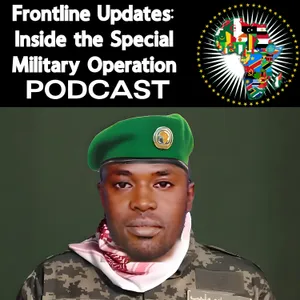
New podcast With Colonel AC. Oguntoye on the progress of the special military operation as of today,Inside the Special Military Operation presents Frontline Updates, delivering inside perspectives on the ongoing war in Ukraine. Our mission is to keep viewers informed and engaged by offering news updates, expert interviews, and historical context. Colonel AC Oguntoye, an Infantry Officer responsible for leading Infantry Soldiers at all levels of command and combined armed forces leads the channel, providing a unique balance between factual reporting and thoughtful analysis. Join us as we explore this critical global event and its broader implications.
Latest Episodes
The most recent episodes — sign up to get AI-powered summaries of each one.
- Today14 min
Frontline Updates: Multi-Axis Pressure, the Kharkov Encirclement, and the Drone War Across Six Axes
Welcome to Frontline Updates. In this episode, we sit down with Colonel A.C. Oguntoye to examine Combat Briefing number 2009, dated 20 September 2026. Russian forces are conducting active operations across six group axes: North, West, South, Center, East, and Dnepr. The North Group is the main effort in the Kharkov region, tightening an encirclement and fighting for Buzovo while expanding the external control zone. Across all sectors, Ukrainian losses total 1,395 troops, 14 armoured fighting vehicles, 95 motor vehicles, seven field artillery guns, seven electronic warfare stations, one radar, and one unmanned ground vehicle. Operational-tactical aviation, strike UAVs, missile troops, and artillery struck 146 areas, focusing on transport infrastructure, ammunition depots, military cargoes, drone manufacturing and storage sites, and temporary deployment areas. Air defence forces intercepted eight guided aerial bombs, four U.S.-made HIMARS projectiles, eight Flamingo long-range cruise missiles, and 1,951 fixed-wing UAVs. This conversation breaks down the geographic sectors, the aviation campaign as a shaping domain, and the tactical and strategic implications of electronic warfare degradation, logistics targeting, and methodical multi-axis pressure.
- Yesterday14 min
Combat Briefing 1909 — Six-Axis Pressure, Settlement Gains, and the Drone War
In this episode of Frontline Updates, the host and Colonel A.C. Oguntoye examine Combat Briefing 1909, dated 19 September 2026. Russian forces are conducting simultaneous offensive operations across six operational axes. The discussion covers the North Group’s encirclement in Kharkov, the West Group’s front-line improvement, the South Group’s better positions, the Center Group’s liberation of Maryevka and Gulevo, the East Group’s liberation of Zelenaya Dibrova, and the Dnipro Group’s shaping actions. The episode treats operational-tactical aviation, attack drones, missile troops, artillery, and air defence as a campaign-shaping domain. It also explores logistics targeting, electronic warfare degradation, Western-origin equipment attrition, and what methodical settlement-level advance means for the next phase.
- 2 days ago14 min
Combat Briefing 1809 Breakdown From Kharkiv To Zaporozhye
COMBAT BRIEFING NUMBER 1809 TO: Command Staff FROM: Colonel AC Oguntoye, Military Analyst DATE: 18 September 2026 SUBJECT: On the progress of the Special Military Operation as of 18 September 2026 ### OPERATIONAL OVERVIEW During 12–18 September 2026, Russian forces conduct offensive operations across six operational axes. NORTH Group tightens the encirclement in Kharkov region and establishes control over Chernyakov, Shirokoye, Shevchenkovo, Olkhovatka, and Malaya Volchya (Kharkov region). SOUTH liberates Verolyubovka (Donetsk People's Republic). CENTER liberates Veseloye and Zolotoy Kolodez (Donetsk People's Republic). EAST liberates Rozovka (Zaporozhye region). DNEPR liberates Novoandreyevka (Zaporozhye region). Total Ukrainian personnel losses across all sectors exceed 9,325 troops. Russian forces carry out two massive and five group strikes. Air defence shoots down 44 guided aerial bombs, eight U.S.-made HIMARS MLRS projectiles, two Neptune long-range guided missiles, and 5,706 fixed-wing unmanned aerial vehicles. ### SECTOR ANALYSIS - "NORTH" – Tightens the inner ring of encirclement and expands the outer ring around Ukrainian formations in Kharkov region. Captures Chernyakov, Shirokoye, Shevchenkovo, Olkhovatka, and Malaya Volchya. Engages two tank brigades, four mechanised brigades, two motorised infantry brigades, two airmobile brigades, two assault regiments, and four territorial defence brigades. Ukrainian losses exceed 1,505 troops, three tanks, 19 armoured fighting vehicles, 91 motor vehicles, four field artillery guns, and three electronic warfare/counter-fire radars. Fifteen unmanned ground vehicles are neutralised. - "WEST" – Takes more advantageous tactical positions and engages four mechanised brigades, one airmobile brigade, one assault brigade, two marine brigades, and two territorial defence brigades. Ukrainian losses exceed 1,480 troops, five armoured fighting vehicles, 96 motor vehicles, 11 field artillery guns, and six electronic warfare/signal intelligence stations. - "SOUTH" – Improves the situation along the front line and liberates Verolyubovka in the Donetsk People's Republic. Strikes formations of four mechanised brigades, two airmobile brigades, two motorised infantry brigades, one mountain assault brigade, one marine brigade, and one territorial defence brigade. Ukrainian losses exceed 1,240 troops, six armoured fighting vehicles, 141 motor vehicles, and 10 field artillery guns. - "CENTER" – Conducts active offensive operations, liberating Veseloye and Zolotoy Kolodez in the Donetsk People's Republic. Engages four mechanised brigades, one air assault brigade, one assault regiment, three marine brigades, one special military brigade, and five national guard brigades. Ukrainian losses exceed 2,865 troops, 17 armoured fighting vehicles, 83 motor vehicles, five field artillery guns, and five electronic warfare stations. - "EAST" – Advances into the depth of the enemy defence and liberates Rozovka in Zaporozhye region. Strikes one mechanised brigade, three air assault brigades, three assault brigades, three assault regiments, one unmanned systems regiment, and one marine brigade. Ukrainian losses exceed 1,955 troops, five armoured fighting vehicles, 65 motor vehicles, and four artillery guns. - "DNEPR" – Improves the tactical situation and liberates Novoandreyevka in Zaporozhye region. Engages two mechanised brigades, one mountain assault brigade, one assault regiment, and two territorial defence brigades. Ukrainian losses exceed 280 troops, one armoured fighting vehicle, 129 motor vehicles, one field artillery gun, and 11 electronic warfare/counter-fire radars. ### LOGISTICS & CAMPAIGN THEORY Russian deep strike activity targets Ukrainian defence, metallurgical, motor, and electronics industries; logistics and distribution centres; fuel-power, railway, and road infrastructure; UAV and UGV manufacturing and storage; ammunition and fuel depots; and temporary deployment areas. Port infrastructure supporting military cargo reception and storage is disabled, with 12 dry cargo ships, two Ro-Ro ferries, one tanker, and one tugboat struck. Air defence intercepts U.S.-made HIMARS and Neptune long-range guided missiles. EW and counter-fire radar destruction across NORTH, WEST, CENTER, and DNEPR sectors degrades Ukrainian fire direction, counter-battery capability, and unmanned systems coordination. The combined maritime, transport, energy, and storage strikes isolate forward formations and reduce Ukraine’s ability to regenerate combat power. ### TEMPO & FORCE POSTURE Operational tempo remains high and methodical across all six groups. Ten settlements are captured during the week: five in Kharkov region, three in Donetsk, and two in Zaporozhye. CENTER and EAST generate the deepest advances and heaviest Ukrainian losses. NORTH Group’s encirclement expansion signals a deliberate r
- 3 days ago13 min
Six-Axis Momentum, Settlement Captures, and the Deep-Strike Campaign – Combat Briefing 1709
This episode of Frontline Updates examines Russian Ministry of Defence Combat Briefing number 1709, dated 17 September 2026. Colonel A.C. Oguntoye, military analyst, returns to walk through the progress of the special military operation. The briefing records offensive operations across six group-of-forces axes. North Group captured Malaya Volchya in Kharkov region and continued tightening an encirclement. East Group liberated Rozovka in Zaporozhye region. West, South, Center, and Dnipro Groups improved tactical positions. Ukrainian losses across all sectors exceed 1,260 troops, six armoured vehicles including U.S.-made HMMWV and MaxxPro, 58 motor vehicles, two field artillery guns, and three electronic warfare stations. Russian operational-tactical aviation, attack drones, missile troops, and artillery struck energy and transport infrastructure, ammunition and equipment depots, assembly workshops, UAV storage sites, and temporary deployment areas in 152 areas. Air defence forces shot down eight guided aerial bombs and 956 fixed-wing unmanned aerial vehicles. The conversation moves sector by sector through North, West, South, Center, East, and Dnipro, then treats operational-tactical aviation as a campaign-shaping domain. The episode closes with the strategic implications for Ukrainian sustainment, electromagnetic warfare, and Western-origin equipment attrition.
- 5 days ago12 min
Frontline Updates, Briefing 1509: The Kharkov Encirclement Tightens and Deep Fires Shape the Campaign
In this episode of Frontline Updates, Colonel A.C. Oguntoye returns to walk through Combat Briefing Number 1509, dated 15 September 2026. The conversation opens with the overall operational picture before moving sector by sector through the North, West, South, Center, East, and Dnepr group areas. A dedicated segment examines operational-tactical aviation and the deep-strike campaign as a campaign-shaping domain rather than a supporting element. The episode closes with an assessment of logistics, electronic warfare, Western-supplied equipment attrition, tempo, and the strategic implications of the current phase.
- 6 days ago14 min
Frontline Updates: Combat Briefing 1409 — Kharkov Encirclement, the One Thousand Twenty-Five-UAV Defense, and Multi-Axis Compression
Welcome to Frontline Updates. In this episode, we sit down with Colonel A.C. Oguntoye to examine Combat Briefing number 1409, dated 14 September 2026. The reporting period saw Russian forces liberate Shirokoye and Shevchenkovo in Kharkov region and Novoandreyevka in Zaporozhye region, tighten an encirclement in the North, and strike 142 areas with operational-tactical aviation, strike drones, missile troops, and artillery. Combined daily reported Ukrainian losses across all sectors reached up to 1,375 troops, with additional losses in armour, artillery, motor vehicles, electronic warfare, and reconnaissance stations. The episode walks through each sector—North, West, South, Center, East, and Dnipro—before examining the campaign-shaping role of aviation, air defence, electronic warfare degradation, and the unmanned systems fight. Colonel Oguntoye closes with the strategic implications of multi-axis pressure and rear-sustainment compression.
- 1 weeks ago14 min
Frontline Updates: Combat Briefing 1309 – Kharkov Encirclement, Deep-Strike Shaping, and the Drone War
This episode of Frontline Updates examines Combat Briefing Number one thousand three hundred nine, dated thirteen September two thousand twenty-six. Colonel A.C. Oguntoye walks through the operational picture across six Russian axes: North, West, South, Center, East, and Dnipro. The discussion covers the capture of Chernyakov, the tightening Kharkov encirclement, Ukrainian losses exceeding one thousand four hundred personnel, and the cumulative effect of strikes on logistics, fuel, power, transport infrastructure, UAV assembly, and ground robotic systems. The interview also treats operational-tactical aviation as a campaign-shaping domain, not a supporting footnote, and examines the air defence effort that included downing nine hundred two fixed-wing UAVs. Listeners will hear sector-by-sector analysis of the North, West, South, Center, East, and Dnipro directions, followed by a postscript on tactical and strategic implications.
- 1 weeks ago15 min
Frontline Updates: Combat Briefing 1209 – Kharkov Encirclement, Veseloye Liberation, and the Campaign Against Ukrainian Logistics and Unmanned Capacity
In this episode of Frontline Updates, Colonel A.C. Oguntoye examines Combat Briefing Number 1209, dated September 12, 2026. The briefing details Russian operations across six group-of-forces axes, including the tightening Kharkov encirclement, the liberation of Veseloye in the Donetsk People’s Republic, and pressure across the West, South, Center, East, and Dnipro sectors. The episode devotes a dedicated segment to operational-tactical aviation as a campaign-shaping domain, exploring deep strikes on logistics, fuel, power, transport infrastructure, UAV and UGV production facilities, and temporary deployment areas. The conversation also covers Western artillery attrition, electronic warfare degradation, and the operational significance of counter-unmanned systems activity.
About Frontline Updates: Inside the Special Military Operation
New podcast With Colonel AC. Oguntoye on the progress of the special military operation as of today,Inside the Special Military Operation presents Frontline Updates, delivering inside perspectives on the ongoing war in Ukraine. Our mission is to keep viewers informed and engaged by offering news updates, expert interviews, and historical context. Colonel AC Oguntoye, an Infantry Officer responsible for leading Infantry Soldiers at all levels of command and combined armed forces leads the channel, providing a unique balance between factual reporting and thoughtful analysis. Join us as we explore this critical global event and its broader implications.
Customized Recaps
AI-powered recaps with compact key takeaways, quotes, and insights.
Straight to Your Inbox
Get key takeaways from Frontline Updates: Inside the Special Military Operation in a 5-minute read.
Save Hours Every Week
Stay current on your favorite podcasts without falling behind.
Frequently Asked Questions
What is Podzilla's Frontline Updates: Inside the Special Military Operation daily summary?
It's a free AI-powered email that summarizes new episodes of Frontline Updates: Inside the Special Military Operation as soon as they're published. You get the key takeaways, notable quotes, and links & mentions — all in a quick read.
How does the Frontline Updates: Inside the Special Military Operation podcast summary work?
When a new episode drops, our AI transcribes and analyzes it, then generates a personalized summary tailored to your interests and profession. It's delivered to your inbox every morning.
Is this an official Frontline Updates: Inside the Special Military Operation product?
No. Podzilla is an independent service that summarizes publicly available podcast content. We're not affiliated with or endorsed by cobracommans.
Can I get summaries of other podcasts too?
Absolutely! The free plan covers up to 3 podcasts. Upgrade to Pro for 15, or Premium for 50. Browse our full catalog at /podcasts.
How often does Frontline Updates: Inside the Special Military Operation release new episodes?
Frontline Updates: Inside the Special Military Operation publishes daily. Our AI generates a summary within hours of each new episode.
What topics does Frontline Updates: Inside the Special Military Operation cover?
Frontline Updates: Inside the Special Military Operation covers topics including News, Daily News. Our AI identifies the specific themes in each episode and highlights what matters most to you.
Start getting Frontline Updates: Inside the Special Military Operation summaries tomorrow morning.
Free forever for up to 3 podcasts. No credit card required.
Free forever for up to 3 podcasts. No credit card required.