Free Daily Podcast Summary
From the Heart of Spurgeon: Daily Summaries Delivered
by Jeremy Walker
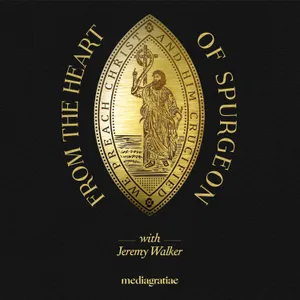
We are on a journey working through the sermons of Charles Haddon Spurgeon. Join our conversation as we discuss the sermons, week by week, to see the truth he preached about Jesus Christ and Him crucified come from Spurgeon’s heart to ours.
Latest Episodes
The most recent episodes — sign up to get AI-powered summaries of each one.
- Yesterday34 min
Joy, Joy for Ever (s2146)
This is a searching but stimulating sermon, exploring both the nature and the cause or source of Christian joy. Rooted in Psalm 5:11, Spurgeon considers the relation of joy to trust in the Lord, and the reality of holiness, and how that faith not only rests in God as revealed in Christ, but explores his goodness and interprets his dealings and delights in his promises and looks to his coming. One wonders what lies behind his consideration of those who accuse Christians of lacking joy? Have church members been so accused? Is the grief of the Downgrade being held up as a demonstration that these are sour saints? Whatever the case, Spurgeon looks at those who are qualified to judge, and considers some of the reasons why false professors will have no really joy, or why even true believers may not always manifest true joy. Finally, he argues us toward joy, pressing into our souls not only the realities of the text, but also the happy consequences, for ourselves and for others, of a sustained spiritual joy. It may not be an easy sermon to take to heart, especially if we do not understand joy properly or express it easily, but its rebukes and its reasonings are held together by the truth of the text, and spoken from the heart of a man who knows his fair share of real distresses and of lasting and substantial joys. Read the sermon here: https://www.mediagratiae.org/resources/joy-joy-for-ever Check out the new From the Heart of Spurgeon Book! British: https://amzn.to/48rV1OR American: https://amzn.to/48oHjft Connect with the Reading Spurgeon Community on Twitter! https://twitter.com/ReadingSpurgeon Sign up to get the weekly readings emailed to you: https://www.mediagratiae.org/podcasts-1/from-the-heart-of-spurgeon. Check out other Media Gratiae podcasts at www.mediagratiae.org Download the Media Gratiae App: https://subsplash.com/mediagratiae/app
- 1 weeks ago34 min
A Homily for Humble Folks (s2140)
Have you heard of Agur? He was the son of Jakeh, and he had wise words for Ithiel and Ucal, recorded in Proverbs 30. His opening gambit is to acknowledge his shortcomings: “Surely I am more stupid than any man, and do not have the understanding of a man.” Was this hyperbole? Is he fishing for compliments? No, suggests Spurgeon, he is an honest man and this is his honest assessment of himself. This did not prevent firm belief in his God, did not stop him being an earnest student of the truth, did not hold him back from being a willing worker in the Lord’s cause, and did not undermine his joyful trust in the Almighty. Neither should our own shortcomings prevent us from following in Agur’s footsteps. Our littleness in ourselves, our true feebleness, our consciousness of our need, do not hinder our closeness to the Lord, but call forth his tenderest compassions. “Thus will you find your sphere of usefulness, and in it you will earn to yourselves a good degree. Though, like Agur, you feel more brutish than any man, you will so live that nobody would have thought so if you had not told them; and few will believe it when you do tell them.” Read the sermon here: https://www.mediagratiae.org/resources/a-homily-for-humble-folks Check out the new From the Heart of Spurgeon Book! British: https://amzn.to/48rV1OR American: https://amzn.to/48oHjft Connect with the Reading Spurgeon Community on Twitter! https://twitter.com/ReadingSpurgeon Sign up to get the weekly readings emailed to you: https://www.mediagratiae.org/podcasts-1/from-the-heart-of-spurgeon. Check out other Media Gratiae podcasts at www.mediagratiae.org Download the Media Gratiae App: https://subsplash.com/mediagratiae/app
- 2 weeks ago35 min
The Rough Hewer (s2134)
What will the Lord do to bring his people to himself? Whatever it takes! This is a painful and needful mercy, by which the Lord roughly hews those who will not respond to his gentler measures. Spurgeon is dealing sternly with the souls of men in this sermon from Hosea 6, all the while having in the background the desire to see people return to the Lord. With uncompromising honesty he looks at the vain promise which disappoints divine love, as people give some indication of interest or appetite before fading away. Then he considers some of those fearful cuts which the Lord makes to bring down those sinners who resist his more outwardly tender overtures, such as particular providences, or humbling ministries, or inward troubles of soul. When you might hope that he is going to relieve the pressure, he ramps it up, reminding his hearers that to resist the Lord is to be exposed to his judgments, not least when you come before the living God at the great day. But he ends on a hopeful, pleading note. This is one of those sermons in which he loads himself into the sermonic cannon and applies the match, pleading with all who hear to come to the Lord, and urging them to take his hand, or the hand of some other Christian, and follow them to the cross where sin is atoned and peace is made. The sermon reaches a crescendo of earnest desire, and it is hard to imagine anyone not being moved by such a tender and earnest expression of evangelical affection. Read the sermon here: https://www.mediagratiae.org/resources/the-rough-hewer Check out the new From the Heart of Spurgeon Book! British: https://amzn.to/48rV1OR American: https://amzn.to/48oHjft Connect with the Reading Spurgeon Community on Twitter! https://twitter.com/ReadingSpurgeon Sign up to get the weekly readings emailed to you: https://www.mediagratiae.org/podcasts-1/from-the-heart-of-spurgeon. Check out other Media Gratiae podcasts at www.mediagratiae.org Download the Media Gratiae App: https://subsplash.com/mediagratiae/app
- 3 weeks ago31 min
The Deceitfulness of Sin (s2130)
Spurgeon hates sin, and rightly so. It is, in part, a reflection of his love to Christ, and his love to Christ only increases as he considers the sinfulness of sin. This is a profoundly insightful sermon, with shades of John Owen’s books on temptation and the mortification of sin, a sort of anatomy of sin, at least in the way that it tries to draw us into darkness and wickedness. So first we think about the way in which sin deceives, given that its very nature is to assault the truth of God and the God of truth. Spurgeon spends a large proportion of the sermon telling us the kinds of lies which sin whispers in our ears and to our hearts. If we have never thought about this, then the sermon will shock us and teach us. Then we think about the way in which this deceit tends to harden the heart, and again we are in the realm of spiritual experience, and the gradual coarsening of the conscience, the increasing carelessness with regard to conduct, that comes when we listen to sin’s lying tongue and begin to act accordingly. Finally, branching out a little from the text, we are urged to fight against deceiving sin by faith, by confession, by tenderness of heart, and by exhorting one another daily—and that means a willingness both to receive and to give appropriate exhortation. We are not a pack of barking dogs, nipping at each other constantly and unkindly, but we are to look out for each other, both as we commit sins and omit duties. Loaded with pastoral wisdom, here is an outstanding reminder of our susceptibility to sin, and our need to be on guard against it. Read the sermon here: https://www.mediagratiae.org/resources/the-deceitfulness-of-sin Check out the new From the Heart of Spurgeon Book! British: https://amzn.to/48rV1OR American: https://amzn.to/48oHjft Connect with the Reading Spurgeon Community on Twitter! https://twitter.com/ReadingSpurgeon Sign up to get the weekly readings emailed to you: https://www.mediagratiae.org/podcasts-1/from-the-heart-of-spurgeon. Check out other Media Gratiae podcasts at www.mediagratiae.org Download the Media Gratiae App: https://subsplash.com/mediagratiae/app
- 4 weeks ago31 min
The Keynote of the Year (s2121)
This sermon was first delivered on a Thursday evening in the March of the previous year, and then repurposed for reading on the first Lord’s day of the year 1890. It is a delight to think that Spurgeon would preach something so sweet and substantial at an ordinary midweek service, and no surprise to find such a topic so well suited to the opening of a year. Here he develops the sermon with us, moving us on from point to point, thinking about the wonder of man blessing the God who blesses, the spirit in which we go about that happy work, the God whom we bless—that Jehovah who has made himself known to us in mercy—, and the self-awareness that we ought to exercise, as we address ourselves in the face of all discouragements within and without, to go on blessing the God of our salvation. Here is a preacher marked by simplicity of speech, plainness of address, and warmth of tone. Here we are stirred not just to think about what it means to bless the Lord, but to get involved with the business, and to get on with it, that the Lord shall not lack a witness to his majesty and mercy from us. Read the sermon here: https://www.mediagratiae.org/resources/the-keynote-of-the-year Check out the new From the Heart of Spurgeon Book! British: https://amzn.to/48rV1OR American: https://amzn.to/48oHjft Connect with the Reading Spurgeon Community on Twitter! https://twitter.com/ReadingSpurgeon Sign up to get the weekly readings emailed to you: https://www.mediagratiae.org/podcasts-1/from-the-heart-of-spurgeon. Check out other Media Gratiae podcasts at www.mediagratiae.org Download the Media Gratiae App: https://subsplash.com/mediagratiae/app
- Oct 16, 202634 min
Podcast 307: Peace: How Gained, How Broken (s2112)
While Spurgeon is probably typecast as a classic three-pointer, his sermons actually show quite a variety in structure. This is a simple two-headed sermon, reflected in the title itself. How can peace be gained? How can peace be broken? Under the first heading, Spurgeon insists that true peace, the only peace worth having, is God’s own gift, spoken to his people who are holy. He celebrates the certainty of it and explores something of the beauty of it. Then he comes down from the heights and considers the loss of our peace. Here the preacher shows himself the pastor. The text emphasises that we can lose our peace by turning back to folly, and while that is a proper consideration, Spurgeon takes a few moments to consider some of the other ways in which peace can be lost, not all of them through the sins and failings of true believers. His intention is not to offer us excuses, but not to lay the wrong burden on the wrong heart. The ground cleared, he asks very bluntly about the kinds of sins which lurk in our souls, and which can be the reason why we lose the peace which the Lord speaks. The probing is painful, the speech being plain, and a sensitive heart will find good reason to lament its own folly. Spurgeon concludes with exhortation, giving us a brief barrage of reasons to turn our backs upon folly once and for all, and not to go back to the paths which, because of grace, we have left. Read the sermon here: https://www.mediagratiae.org/resources/peace-how-gained-how-broken Check out the new From the Heart of Spurgeon Book! British: https://amzn.to/48rV1OR American: https://amzn.to/48oHjft Connect with the Reading Spurgeon Community on Twitter! https://twitter.com/ReadingSpurgeon Sign up to get the weekly readings emailed to you: https://www.mediagratiae.org/podcasts-1/from-the-heart-of-spurgeon. Check out other Media Gratiae podcasts at www.mediagratiae.org Download the Media Gratiae App: https://subsplash.com/mediagratiae/app
- Oct 9, 202631 min
Perseverance in Holiness (s2108)
This sermon is comfort with a little kick—rich in its consolations but not feeble in its applications. It begins with God’s everlasting covenant, rooted in his own unchanging being, and the promises which cannot be broken, with all the assurance of unending good to those upon whom he sets his love. Spurgeon explores the certainty and security of the covenant, never straying far from Christ’s finished work, whether he is speaking of the covenant itself, or the God who makes the covenant with his people. Then he turns to the promise, “I will put my fear in their hearts so that they will not depart from me” (Jer 32:40). Here he considers how God fulfils that promise, not by a twisting or emptying of certain spiritual realities, but by God’s gracious and sovereign work in the soul, granting his people a holy awe, a filial fear, and a sense of grateful obligation. He considers the work of the Holy Spirit in this connection, giving us a trinitarian perspective on the whole, and uses the guarantee of a people united to God in holy fear to draw sinners to Christ to find certain peace and life everlasting. Read the sermon here: https://www.mediagratiae.org/resources/perseverance-in-holiness Check out the new From the Heart of Spurgeon Book! British: https://amzn.to/48rV1OR American: https://amzn.to/48oHjft Connect with the Reading Spurgeon Community on Twitter! https://twitter.com/ReadingSpurgeon Sign up to get the weekly readings emailed to you: https://www.mediagratiae.org/podcasts-1/from-the-heart-of-spurgeon. Check out other Media Gratiae podcasts at www.mediagratiae.org Download the Media Gratiae App: https://subsplash.com/mediagratiae/app
- Oct 2, 202638 min
“The Marriage of the Lamb” (s2096)
During this period, Spurgeon is locked in combat, contending for the honour and glory of Christ. This sermon is situated both in the overall battle he is fighting, but also in the context of a pastoral ministry in which he is conscious of the need to feed and encourage the flock of Christ. So, having previously preached on the Lamb in glory (the previous sermon in this volume, number 2095, if you want to read it for yourself) he now wants to emphasise that this Lamb is the Bridegroom of the church, and that all our hope and happiness centres in him not only in this life but also in the life which is to come. He therefore steps through the prospect that lies before us, noting from Revelation 19 some of the events which precede the moment of marriage. He turns our attention to the marriage itself, asking how it has been brought about and what it involves. He fixes our eye upon the Bridegroom of our hearts, Jesus Christ, in his character as the Lamb of God, pushing us to recognise that this is essential to the union. Finally, he allows us to see the wife of the Lamb as she approaches her Beloved, prepared by him, for him, clothed in the white linen of her righteousnesses. It is a beautiful picture, and one which the preacher would have us ponder, not only to stir up love and faith and hope, but also to ensure that we will, through trust in the Lamb, participate in that glorious consummation. Read the sermon here: https://www.mediagratiae.org/resources/the-marriage-of-the-lamb Check out the new From the Heart of Spurgeon Book! British: https://amzn.to/48rV1OR American: https://amzn.to/48oHjft Connect with the Reading Spurgeon Community on Twitter! https://twitter.com/ReadingSpurgeon Sign up to get the weekly readings emailed to you: https://www.mediagratiae.org/podcasts-1/from-the-heart-of-spurgeon. Check out other Media Gratiae podcasts at www.mediagratiae.org Download the Media Gratiae App: https://subsplash.com/mediagratiae/app
Get From the Heart of Spurgeon summaries in your inbox
Free AI-powered daily recaps. Key takeaways, quotes, and mentions — in a 5-minute read.
Get Free Summaries →Free forever for up to 3 podcasts. No credit card required.
You Might Also Like
Listeners also like.

Light + Truth
Sermons by John Piper exploring Christian theology and the supremacy of Christ, hosted by Dan Cruver.

Heartbeat of Faith
Pray.com

Revive Our Hearts Daily
Biblical teaching and interviews for women seeking to follow Christ in a counter-cultural way.

Insight for Living Daily Broadcast
Biblical teachings applied to everyday life with practical insight and humor.
Bishop Barron’s Sunday Sermons - Catholic Preaching and Homilies
Bishop Robert Barron delivers weekly homilies through this podcast produced by Word on Fire Catholic Ministries.

Susie Larson Live
Conversations on living out Christian faith with practical applications of Scripture.

White Horse Inn
Discusses core Christian doctrines and theological questions through conversations with believers from diverse traditions.

Unshaken Saints
Explores scripture, doctrine, and faith challenges to help listeners build a resilient, informed religious belief.

Jack Hibbs Podcast
A pastor addresses contemporary cultural issues and theological errors from a biblical perspective to strengthen listeners' Christian faith.

Lisa Harper's Back Porch Theology
Conversations about faith, theology, and everyday life from a Christian perspective, exploring biblical truth with warmth and authenticity.

Elevation with Steven Furtick
Sermons and teachings from Pastor Steven Furtick and Elevation Church.

Don't Miss This Study
Grace Freeman Smith & David Butler
About From the Heart of Spurgeon
We are on a journey working through the sermons of Charles Haddon Spurgeon. Join our conversation as we discuss the sermons, week by week, to see the truth he preached about Jesus Christ and Him crucified come from Spurgeon’s heart to ours.
Customized Recaps
AI-powered recaps with compact key takeaways, quotes, and insights.
Straight to Your Inbox
Get key takeaways from From the Heart of Spurgeon in a 5-minute read.
Save Hours Every Week
Stay current on your favorite podcasts without falling behind.
Frequently Asked Questions
What is Podzilla's From the Heart of Spurgeon daily summary?
It's a free AI-powered email that summarizes new episodes of From the Heart of Spurgeon as soon as they're published. You get the key takeaways, notable quotes, and links & mentions — all in a quick read.
How does the From the Heart of Spurgeon podcast summary work?
When a new episode drops, our AI transcribes and analyzes it, then generates a personalized summary tailored to your interests and profession. It's delivered to your inbox every morning.
Is this an official From the Heart of Spurgeon product?
No. Podzilla is an independent service that summarizes publicly available podcast content. We're not affiliated with or endorsed by Jeremy Walker.
Can I get summaries of other podcasts too?
Absolutely! The free plan covers up to 3 podcasts, any in the catalog. Basic raises that to 15, Pro to 40 and Max to 100. Browse our full catalog at /podcasts.
What topics does From the Heart of Spurgeon cover?
From the Heart of Spurgeon covers topics including Religion & Spirituality, Spirituality, Christianity. Our AI identifies the specific themes in each episode and highlights what matters most to you.
Start getting From the Heart of Spurgeon summaries tomorrow morning.
Free forever for up to 3 podcasts. No credit card required.
Free forever for up to 3 podcasts. No credit card required.