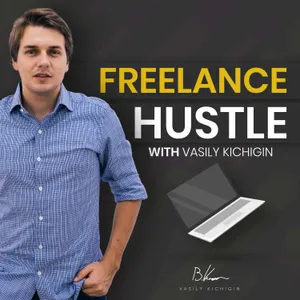
Free Daily Podcast Summary
FreelanceHustle Podcast: Daily Summaries Delivered
by Vasily Kichigin
Get key takeaways, quotes, and insights from FreelanceHustle Podcast in a 5-minute read. Delivered straight to your inbox.
Latest Episodes
The most recent episodes — sign up to get AI-powered summaries of each one.
- Jul 31, 202541 min
Making Money on Fiverr While Travelling – with Luke Baillie
Luke’s Fiverr ProfileStarting Out on FiverrQ: Luke, when did you first get involved with Fiverr?Luke: Technically, about eight years ago—I was just helping a friend manage his Fiverr messages. But things did not work out there. You were actually the one who pushed me to give Fiverr a real shot, back when we were in Russia in 2021. I started my own account, and the first few months went well until I got a 4-star review, which kind of threw me off. I stopped for a while… then picked it up again last year in Belgrade.Q: What happened after you restarted?Luke: From August to November, it was great. I reached Level 2 Seller, which was a big milestone for me. Then I got a mediocre review—nothing terrible, but enough to drop me back to Level 1. And last month, I dropped again to Level 0.Riding the Ups and DownsQ: That sounds frustrating. Are you still getting orders?Luke: Surprisingly, yes. Last month, I still made $1,000 on Fiverr—even on Level 0 with no promoted gigs. My best week ever was $3.5K, just before I lost my promoted status.Q: Why not launch a UGC gig? You are a native English speaker from the UK.Luke: I actually did one as my first Fiverr order—it was $500. But I have been hesitant to go all-in. Part of it is that I want to be selective. I do not want to be the face of products I do not believe in. Especially if I go into politics someday, I do not want old videos resurfacing of me promoting some crypto scam or questionable supplement.The Travel LifestyleQ: You have visited over 80 countries now. Where did that passion come from?Luke: I used to watch Top Gear with my dad. Those road trips and adventures they filmed just fascinated me. I always dreamed of seeing the world like that. Fiverr gives me the freedom to travel while I work—I just need decent internet to deliver videos.Q: What are the most memorable countries you have visited?Luke: Russia was definitely one of the best—I ended up staying for three months instead of three weeks. Afghanistan was eye-opening too, even though I visited in winter and had the coldest shower of my life. It is hard to pick just one place. Every country teaches you something different.Mental Growth Through StrugglesQ: Has all this travel changed your perspective on life?Luke: Massively. A few years ago, I hit rock bottom. I was broke, homeless for a few nights, just walking around cities until morning. But those experiences teach you what really matters. You stop caring about being judged. You realize how little you actually need—and how much freedom matters.Direct Clients and Building a BusinessQ: You recently started getting direct clients too, right?Luke: Yeah. In December, I launched a video editing subscription service—mainly short-form content like reels. One client found me through email and reached out at 1:00 a.m. Vietnam time. I took the call outside with mosquitoes buzzing around me, and they are still with me today.Q: How are you finding more clients now?Luke: Some cold email outreach and a lot of referrals. I am up to seven private clients now. It is not stable, but I work hard, stay up till 4:00 or 5:00 a.m. if needed, and meet all deadlines. Clients come back when you deliver well.Plans for Personal BrandQ: What are your plans for Instagram and YouTube?Luke: I want to build my personal brand—travel content, business lessons, maybe even motivation. I posted 24 travel reels in February and started seeing results. But then I went to Turkmenistan and lost internet for a while… and just never got back to it. I need to be consistent.Q: What is holding you back from posting?Luke: Overthinking. I get so many ideas that I end up doing nothing. I confuse myself. I know I need to just start and figure it out along the way. That is what I am working on now.Advice to Aspiring CreatorsQ: What would you say to someone who wants to live with more freedom like you?Luke: Start by connecting with people. Almost every opportunity I have had came from conversations—not from job boards. And do not wait until you are ready. Just start. My first real job came after 120 rejections. You need to take big steps, be willing to move, and be open to change. And if you have a skill, build on it for a few years. That experience will always give you levera
- Jul 16, 20251h 40m
From Oxford to Fiverr Pro: Denis's Cybersecurity Journey
Denis’s Fiverr ProfileEarly Passion for TechQ: Denis, how did your journey in cybersecurity begin?Denis: My interest started when I was a teenager in the 90s. I was programming in BASIC, Turbo Pascal, and Visual Basic on Windows 3.1 and 95. I fixed computers at school, sometimes better than my computer science teacher. I even created some automated test systems for teachers to save grading time. That was my first exposure to practical IT.Breaking into CybersecurityQ: How did you transition into cybersecurity professionally?Denis: Around 2005, I started working with banks like HSBC, Barclays, and Lloyds as a security engineer. I was securing ATMs, implementing cryptography, and hardening systems. It was the early stage of what we now call cybersecurity.The Oxford DreamQ: What inspired you to study at Oxford?Denis: As a child, I saw the word "Oxford" in science books at home. My grandmother was a paleontologist, and we had many academic books around. That name stayed with me. Years later, after building experience and earning certifications, I applied and was admitted to Oxford for a master’s in Software and System Security.Was Oxford Worth It?Q: Looking back, was it the right decision?Denis: Definitely. It took five years to complete while working, running a company, and raising two children. I passed my CISSP after failing once, got my ISO 27001 Lead Auditor certification, and later added CRISC and CISM. Oxford was tough, but it helped me level up my career.Working with Big Banks & Launching His CompanyQ: What was it like working with major corporations?Denis: I worked with seven international banks. At Fujitsu, I was a Principal Security Solutions Architect, reporting to the CISO and signing off on multi-million-pound security solutions. But the pressure was huge. Even while skiing in the Alps, I had to take work calls. That’s why I eventually launched my own limited company—to gain flexibility and balance.Discovering FiverrQ: With all that experience, why try Fiverr?Denis: I had known about Fiverr through a friend but only gave it a serious look in late 2024. Initially, I thought it was not for me, but then I started analyzing the platform. I spent two months watching videos—especially yours—and created around 17 gigs covering different cybersecurity services.First Sales and Niche FocusQ: How did your Fiverr sales begin?Denis: Real traction started in January 2025 after polishing my gigs for a few months. My services cover everything from GDPR to ISO 27001, PCI-DSS, and risk management. Because I worked across many domains in my career, I could confidently offer consultations in all of them.Gig Structure & PricingQ: How do you structure your offers?Denis: Most gigs are one-hour consultations with three tiers:* Basic: Delivery within 30 days* Standard: Delivery within 5 business days* Premium: Delivery within 2 days for urgent casesIn some cases, clients book multiple hours or even larger bundles. I am also preparing to launch subscription-based services for companies that need ongoing support but cannot afford a full-time Chief Information Security Officer.Pro Seller & Top Rated StatusQ: How did you become a Fiverr Pro and Top Rated Seller so fast?Denis: I applied for Pro Seller status shortly after joining. I had all the credentials—Oxford, industry certs, real-world experience—and got approved in about a month. I hit Top Rated Seller status within three months of consistent sales, maintaining a 100% response rate and success score of 10.Fiverr Project InsightsQ: What kind of clients and requests do you get on Fiverr?Denis: Most clients are small businesses, though I have worked with billion-dollar companies through Fiverr too. Some requests are strange—people asking me to hack systems or recover stolen accounts. I report those immediately. But overall, the platform has allowed me to serve a wide range of serious clients.Tips, Tools & WorkflowQ: Do you use any tools or have a team helping you?Denis: I work closely with a trusted colleague—one of the top technical cybersecurity specialists I know. He helps with the more technical engagements.
- Jul 7, 20251h 19m
How Marko Made $50,000+ Selling on Fiverr
Marko’s Fiverr ProfileDiscovering FiverrQ: Marko, how did you first hear about Fiverr?Marko: Back in college, I was looking up ways to make money online and came across Fiverr through a simple Google search. I had a passion for music production and knew how to use FL Studio, so I thought, why not turn that into a service? That is how it all started.Early Gigs & the First OrderQ: What was your first Fiverr order like?Marko: It took about a month to land my first order. It came from an Eastern European client who wanted a basic remix for $5. That feeling of earning money online for the first time was incredible—I could not believe someone would pay me just through a computer.Building MomentumQ: How did things progress from that first order?Marko: The first few months were up and down. I got a few orders, then one month was dead, then it picked up again. But I kept experimenting—testing new thumbnails, creating multiple gigs in niches like meditation music, lo-fi, podcast intros. That helped me learn what worked.Transition to Full-Time Music ServicesQ: At your peak with music gigs, what were you earning?Marko: Around $2,500/month. A lot of that came from creating original meditation music for faceless YouTube channels. They needed custom audio to stay monetized on YouTube, and I filled that gap.Realizing It Was Time to PivotQ: Why did you shift from music to Webflow websites?Marko: I stopped enjoying music when it became “work.” I even tried automating music generation, but it felt wrong—I originally loved music because it was fun. I wanted to move to something more scalable, more high-ticket. That is when I discovered Webflow. It allowed more customization, and I saw potential for higher-value services.Learning & RebrandingQ: How did you teach yourself Webflow?Marko: I started by creating projects for myself—most of them were terrible at first. I learned on the go, and whenever I got stuck, I turned to YouTube and ChatGPT. Slowly I built confidence.Q: Did you create a new Fiverr profile for Webflow?Marko: No. I decided to keep my original profile and rebrand it completely—new gig titles, new descriptions, new thumbnails. I was worried it might confuse buyers since my reviews were music-related, but it turned out to help.Getting First Website OrdersQ: How did you land your first Webflow orders?Marko: I reached out to some of my old music clients, offering website design instead. Most said no, but a few said yes. That kickstarted my transition. Then promoted gigs started bringing in more organic leads.Order Growth & WorkflowQ: How did orders grow in the first few months of Webflow?Marko: It started slow—1 order, then 3, then 2 the next month. It was not instant, especially since I was still learning. Promoted gigs made a big difference, accounting for about 80–90% of orders.Q: What tools and systems do you use to manage everything?Marko: I work solo. I used to use Notion but now prefer Airtable to manage clients and projects. For scheduling calls, I use a tool called Setmore, which does not send emails (important to avoid Fiverr’s terms violations). And for video calls, I use Fiverr’s Zoom integration—it helps when clients need handholding or walkthroughs.Fiverr Strategy & InsightsQ: What pricing strategy did you start with?Marko: Fiverr does not allow Webflow gigs to be under $80. So I priced one page at $80, then upsold extra pages. That helped build momentum.Q: Do you offer unlimited revisions?Marko: I did early on. One project took six months because of unlimited revisions and slow client responses. Never again. It taught me to set clear limits and expectations.Q: What about Fiverr Promoted Gigs?Marko: Game-changer. I once spent $100 and earned over $2,000. Most of my orders come from them. If you are not using promoted gigs, you are invisible—half of Fiverr search results are ads now.Personal Website & BrandingQ: Does having a portfolio website help on Fiverr?Marko: Definitely. Unlike audio, where clients can just listen, website buyers want to see. A personal website builds credibility and makes you stand out. I even used Vasily’s website as inspiration for my own.Exploring Direct Clients
- Jul 2, 20251h 16m
How Filip Built a $13K/Month Fiverr Agency With His Team
Filip’s Fiverr ProfileDiscovering FiverrQ: Filip, how did you first discover Fiverr?Filip: Everything started in 2021. I was studying animation and 3D design in Serbia, after switching from a physics degree that did not work out. I always had the feeling I was meant for more, and after discovering Fiverr, I was drawn to the idea of setting up a storefront instead of constantly applying for gigs like on Upwork.To create my first gig, I used projects I built during a bootcamp and personal pieces, like a stylized character of my wife. I priced my basic gig at $50 and analyzed other sellers to position myself competitively.First Orders & Key LessonsQ: What was your first Fiverr order like?Filip: It took one month to land my first order—a hair salon owner wanted 3D models for an AR app. I did not even know what AR meant at the time, but I figured it out and delivered. That project led to more work with the same client.My second project got canceled after 7 days, and I felt defeated. But it taught me a key lesson: miscommunication kills projects. From then on, I created pre-written macros, PDF style guides, and asked for references upfront.Going Full-TimeQ: When did you realize Fiverr could become your full-time business?Filip: After just 2–3 months, I went from earning $500/month to $5K/month. That was when I knew Fiverr could be more than a side hustle. I could either keep freelancing solo or start scaling. I chose the second path.Team BuildingQ: How did you start building your team?Filip:* I started locally—Facebook groups and university classmates* My first hire, Dan, is now the technical lead* We are now a team of 9 (including my wife, currently on maternity leave)Hiring was not easy. Some people only lasted a few months, while others like Dan grew with me. Now I am working on building proper processes to train new team members more efficiently.Shifting to Agency ModelQ: You turned your Fiverr profile into an agency. Why?Filip: Because it reflects reality. Clients often prefer working with certain team members based on their visual style. I wanted to be transparent and also attract higher-ticket projects by showing we are a professional studio.Studio OperationsQ: What systems do you use to run your studio?Filip:* Discord – for internal communication* Notion – for project tracking (may switch to Asana)* Google Drive → internal server (32TB) – for file sharing* On-site office in Novi Sad – creative collaboration is better in personI believe in building a physical office culture, especially for creative work. It is not the trendiest thing right now, but it helps grow a strong team and better results.Frustrations with Fiverr ToolsQ: What do you think about Fiverr’s tools?Filip: FiverrGo (AI Assistant)* Cannot read images or interpret links* Sends too many messages that feel spammy* Often underprices projects without understanding complexityFiverr Ads* Too basic—needs better targeting, keyword control, and higher budget optionsThese features feel underdeveloped compared to other ad platforms or AI tools like ChatGPT.Becoming a Fiverr ProQ: How did you become a Fiverr Pro?Filip: I applied several months in and got accepted on my first try. I submitted portfolio work from clients like Decathlon and Kipling, along with side projects and personal animation work.Using Seller PlusQ: What about Seller Plus—what features do you use?Filip:* Priority customer support* Success manager feedback* Buyer insights (order volume, average spend)* I do manual follow-ups instead of using automationEarnings and WorkflowQ: What is your current Fiverr income?Filip: Right now, we average $12K–13K/month. We focus on high-ticket work—each project is usually $1K to $5K. We take on about 5–6 clients per month.Client CollaborationQ: How do clients respond to working with your team?Filip: Most still message me directly
- Apr 27, 202558 min
From Freelancing on Fiverr and Upwork to Building a 6-Figure Marketing Agency
👋 Meeting Again, Years LaterBack in 2019, I hosted a small Instagram marketing event in London. One of the people who showed up was Pascu — a talented videographer, fitness enthusiast, and aspiring entrepreneur.Fast forward to 2025:We reconnected again, this time in Belgrade.Since that event, Pascu’s journey has been anything but linear — moving from fitness, to freelancing, to agency-building, and to building a strong personal brand online.📸 From Fitness to Freelancing to Agency OwnerAfter graduating in London, Pascu was working odd jobs, filming events, weddings, and slowly building a portfolio.But when the pandemic hit in 2020, all his videography work disappeared overnight.Instead of giving up, he pivoted:* Started a podcast* Took on podcast management clients* Transitioned into remote video editing* Later, worked for one of London’s fastest-growing agencies, learning how video must sell — not just look goodEventually, he realized he wanted to run his own business.That decision pushed him to leave London, move back to Romania, and double down on building something that truly fit his lifestyle and values.🛫 Leaving London: Why Geography Does Not Matter AnymoreIn the early days, London gave Pascu opportunities, clients, and perspective.But once he built his skills and network, being physically based in London no longer made sense. The expenses were high. The opportunities were shifting online. The need to "be in the city" was fading.Today, he works fully remotely, building his brand and client base while living in Eastern Europe — proof that geography matters less than ever if you know how to position yourself.🎯 Reinventing His Offer: From Videographer to Creative StrategistPascu realized early that being "just a videographer" would not be enough.He evolved into a Creative Strategist, combining his skills in:* Video production* Paid advertising knowledge* Direct-response marketing principlesToday, he helps DTC brands (direct-to-consumer companies) improve their creative assets and advertising strategies, driving real results in highly competitive markets.And he found his niche by blending his past passions — not abandoning them.🔥 Building a Real Sales FunnelInstead of relying on Fiverr or Upwork forever, Pascu built a real funnel:* Personal branding on LinkedIn and X (Twitter)* A clean, simple landing page that builds trust immediately* Direct booking into discovery calls* Diagnosing client needs before offering solutionsToday, his sales cycle includes discovery, audits, custom proposals, and long-term client relationships — not one-off gigs.🧠 Lessons on Personal Brand and AuthorityIf you are trying to build a serious freelancing or agency career today, personal brand is non-negotiable.As Pascu put it perfectly:If someone Googles your name and only finds your Upwork profile, you are just another freelancer.If they find your YouTube videos, interviews, articles, and real content — you become an authority.In a world flooded with AI-generated content, real personality and depth will stand out more than ever.📚 Learning by Doing, Not WaitingPascu’s early career was built by learning the hard way:* Buying a camera before he knew how to use it* Learning videography on YouTube* Editing obsessively, spending 20+ hours on 1-minute clips* Reaching out directly to businesses when platforms were too competitiveThe key was never being afraid to start imperfectly — and figuring things out on the way.📞 Sales Calls vs. No-Calls: What Works Best?For higher-ticket clients, Pascu still believes in sales calls:* Building human connection matters* Understanding client pain points personally* Setting clear expectations before starting a projectInstead of pushing for immediate sales, he focuses on diagnosis first — analyzing ad accounts, spotting real issues, and only offering solutions when it makes sense.📈 Client Retention Over Client ChurnPascu’s agency focuses on long-term relationships, not quick wins.* His average client stay is 9–10 months* Some clients have been with him for 2+ years* Delivering consistent results builds loyalty — and referralsIn contrast to platforms where clients come and go quickly, direct relationships offer much higher LTV (lifetime value) and stability.🏆 Thinking About Coaching and MastermindsWe also discussed the idea of Pascu eventually coaching others.His view is refreshing:* No fake promises of "10K months in 90 days"* No mas
- Apr 7, 20255 min
Which Social Media Platform Should You Pick (and Actually Stick To)?
❄️ One Cold Evening, One Familiar QuestionIt is the end of a workday here. Snow started falling outside the office — one of those days that suddenly feels quieter, slower. And as I was wrapping things up, something Mila said stuck with me.She told me she wants to start running her social media. Simple statement, but it triggered something.Because, this question of where to post and what to focus on has been bouncing around for years.🤹♂️ The Pressure To Be EverywhereEverywhere you look, creators are dominating on multiple platforms:* Someone tweets 5 times a day on X* Another person’s LinkedIn carousels are going viral* Reels, Threads, newsletters, podcasts — it is nonstopAnd then you ask yourself:Where do I go? What should I focus on?I have asked myself that a thousand times. And even after almost 10 years of creating, I still come back to the same answer.🎥 Why I Keep Choosing YouTubeFor me, it is YouTube. I am not sure why exactly — but the rhythm just works.* I record a video* I send it to Nikolay or Luke* They edit it* I add the title and description* It goes liveThat system makes creating feel easy. More than that — I actually enjoy doing it.YouTube lets me deliver real value. I can sit down, talk through an idea, and share a message that lasts longer than a tweet or a Reel.✍️ X, AI, and the Strange World of "Consistency"I still use X. I like it. I write thoughts there.But something about the platform has shifted — and I know I am not the only one noticing it.You can see when people are using AI.Sometimes, it is fine. I even use ChatGPT myself.I’ll transcribe my YouTube audio, feed it into GPT, and get ideas for posts.And I will be honest — some of the results are decent. But they still do not sound like me.🔁 What Actually Wins Is RepetitionLet us be real — on X, nobody remembers what you posted yesterday.It is all about the next post. The next impression.You win by showing up consistently, not by going deep.But YouTube?That content sticks. Someone might watch a video from a year ago and still take something valuable from it.That is the difference.And that is why I keep coming back to YouTube.🎯 The Real Answer: Pick One PlatformHere is what I have learned:Pick one platform and go all in.* Choose the one that feels natural* The one that works with your workflow* The one that fits your message* The one you actually enjoy usingYou will only stay consistent if you enjoy the process.That is what makes it sustainable.👋 Final ThoughtsThis is not a growth hack or content plan.It is just a real reminder from someone who is also figuring it out.You do not need to be everywhere.You just need to be somewhere — and show up consistently.So take a moment.Think about what platform feels right for you.And then… go all in.See you next time,Vasily This is a public episode. If you would like to discuss this with other subscribers or get access to bonus episodes, visit www.freelancehustle.com
- Apr 3, 202525 min
Is Fiverr Still Worth It in 2025? My $2.4M+ Journey So Far
March 2025 closed out at just over $38,000 in earnings from Fiverr.That number still surprises me. Last year, most of my months were below $30K. The key takeaway is this: Fiverr can still work if you treat it like a real business.I am not just sitting back waiting for orders. I am building, experimenting and adapting. The platform is changing and if we want to grow, we need to grow with it.🛠 What Fiverr Is Doing Right NowYes, there have been updates. Fiverr Go, AI tools, new features — all rolling out.I know some sellers feel uncertain about these changes. I have had mixed feelings too.That said, Fiverr is still investing in growth. They are running commercials in the U.S., including during major events like March Madness. That tells me they are still focused on bringing in high-quality buyers.This gives me a sense of optimism.Not every update will feel right immediately. Some might seem unclear or out of place. But Fiverr has made adjustments in the past and they will probably continue evolving based on feedback.❗ The Old Way of Waiting on Fiverr Search Is OverIf you are still depending only on Fiverr's search to send you traffic, it is going to be tough.Some of my gigs get just 1,000 to 2,000 impressions per day — sometimes even less. That is not where the revenue comes from.I bring in my own traffic.* I reach out to past clients* I promote my services through YouTube* I link to my Fiverr profile from X and Instagram* I talk about what I do and share results regularlyThis is what works now. Not waiting. Not hoping. Showing up and building momentum.📱 You Need to Be on Social Media (But Not Everywhere)Pick one platform. Make it your home base. Post consistently.Here are my top 4 choices:* LinkedInGreat for building credibility and a professional brand. Easy to set up and good reach potential.* YouTubeIf you're comfortable speaking on camera, this is one of the most valuable platform. Just from my own channel, I consistently get 5 to 10 new newsletter subscribers per day. That kind of long-term traffic and connection is powerful.* InstagramIdeal for visual content like design, branding, or social media work. Share behind-the-scenes, client work, or updates in stories and DMs.* X (Twitter)Probably my favorite right now. Super fast. Great for posting results, screenshots and personal thoughts.You do not need to post everywhere. Just pick one, stick with it and start showing what you are working on and learning.🧠 You Do Not Need Perfect English or a Polished VoiceI am not a native English speaker. I still make mistakes sometimes.But people know it is me. They can tell it is real — and that is more valuable than sounding perfect.Use tools like ChatGPT to check grammar or spark ideas, but try to write in your own voice. You will improve quickly and people will connect with you more.🔍 Look for Underrated Gigs and Niche AnglesThere are still services on Fiverr that most sellers overlook — but buyers are actively searching for them.For example, I saw someone offering social media profile setup for $250. He had 3 orders in queue at the time I recorded my video.If you are offering services like logo design, website development, or social media, try to niche down early. Instead of saying:I will create a logo for your businessSay something like:* I will create a logo for your restaurant business.* I will create a logo for your real estate agency.* I will create a logo for your med spa business.This approach helps you stand out more clearly and face less competition in Fiverr's search results.📈 What I Am Focusing On Right NowHere is what I am currently working on in my business:* Posting results and updates on X.* Sharing behind-the-scenes agency work on Instagram.* Publishing consistently here on Substack.* Driving traffic to Fiverr through YouTube.* Promoting my new Instagram Strategy gig.* Preparing to launch a platform in April to help sellers reply faster, track leads and manage communication more efficiently.I will share more abou
- Mar 11, 20251h 6m
How Lambros Makes $12,000+ Per Month on Fiverr With 20+ Gigs
Lambros’s Fiverr ProfileAdvice for FreelancersQ: Lambros, how did you first discover Fiverr?Lambros: Initially, I was studying law in Newcastle, UK, and during my third year, I started looking for ways to earn extra income. I did some research work for the New York Times and also used a site called Prolific for online surveys, which paid small amounts but helped with pocket money.Then, COVID hit in 2020. I was supposed to move to London for my master’s degree in international business, but I ended up staying in Cyprus and studying online. That was when I lost access to Prolific since it only worked in certain countries.While looking for ways to replace that income, I came across a CNBC Make It article about freelancing platforms like Upwork, Freelancer.com, and Fiverr. I first created an account on Freelancer.com but did not get any work. I also applied to business consulting roles and internships at firms like KPMG.One major inspiration for me was Chris Sacca, a venture capitalist from Shark Tank. He also had a law degree but later shifted into business. His transition was a blueprint for me, and I decided to put myself on Fiverr, thinking I could offer contract-related services.Getting Started on FiverrQ: What was your first experience like selling on Fiverr?Lambros: I created my Fiverr account in June 2020, and it took me about two months to land my first order in August. Funny enough, I actually missed the first message from a buyer and saw it a day later. Thankfully, they still went ahead with the order.I had no prior experience drafting contracts, but I figured it out by researching for a few days. The client left a 5-star review, and I even received a tip. That was the moment I realized, "Wow, I can actually make money online!"In September, I got no orders. But in October, I received eight, in December, I got 15, and by January 2021, I had 50 orders in a single month. At that point, I was balancing Fiverr with my master’s degree.Scaling Beyond ContractsQ: You started with legal contracts, but now you offer a variety of services. When did you decide to expand beyond law?Lambros: While I enjoyed my law degree, I realized my real passion was business. I was already considering switching into business consulting.I started diversifying my Fiverr gigs not just because I wanted to try new things but also because it turned out to be a great business model. Many of my clients who bought legal services came back for other services, like Twitter management.For example, I worked with a transportation company on their terms and conditions and privacy policy. Later, they saw my Twitter management gig and purchased that service too. Because I built trust with them through communication and quality service, they were comfortable ordering from me again.Building a Team on FiverrQ: You have multiple gigs now. How do you manage everything?Lambros: Once I became a Top Rated Seller in 2022, I realized I had the credibility to scale further. I started opening more gigs and involved people from my circle to help.* My brother helps with travel itinerary gigs because he loves researching travel destinations.* Nicolas, my right-hand man, is amazing at graphic design and helps manage our social media services.* I also have a few freelancers on a flexible basis for different projects.At first, my idea was to use my account to bring in leads and refer them to my friends. But we found that some clients preferred working directly with me, so I built a system where my team handles delivery, while I manage communication and quality control.Dominating X (Twitter) on FiverrQ: Your Twitter (X) management gig is one of your most successful. How did that happen?Lambros: Originally, Nicolas wanted to showcase his designs on Twitter. While engaging with the Fiverr community there, we built an audience.One day, a Top Rated Seller who offers book publishing services messaged us and asked if we could manage his Twitter for $500 per month. We jumped on a call, set up the service, and realized this could be a viable offering.Since then, our Twitter gig has gained momentum and consistently ranks at the top of Fiverr’s search results.Fiverr’s AI ChangesQ: What do you think about Fiverr’s AI Assistant and the Fiverr Go program?Lambros:<
Get FreelanceHustle Podcast summaries in your inbox
Free AI-powered daily recaps. Key takeaways, quotes, and mentions — in a 5-minute read.
Get Free Summaries →Free forever for up to 3 podcasts. No credit card required.
You Might Also Like
Listeners also like.
100k Freelancer Club
100k Freelancer Club

Freeality: What It’s Actually Like to Be a Freelancer & How to Succeed as One
Shelby Stephens
The Freelancers' Show
Charles M Wood
The 6-Figure Freelancer Podcast | Freelancing | Entrepreneurship | Clients | Finances | Motivation | Personal Development | Mindset
Avani Miriyala
Freelance Freedom
Margaret Reffell
Being Freelance
Steve Folland
Freelance to Founder
Millo
The Growth Equation
Tristan Wright
6 Figure Creative
Brian Hood
The Opportunity Podcast
Empire Flippers
Creator Method Podcast
Gary Lipovetsky

Side Hustle Podcast
SideHustle
About FreelanceHustle Podcast
The Growth Marketer's Guide: Master Freelancing on Fiverr, Build Thriving Businesses, and Skyrocket Your Career in the Digital Economy. www.freelancehustle.com
Customized Recaps
AI-powered recaps with compact key takeaways, quotes, and insights.
Straight to Your Inbox
Get key takeaways from FreelanceHustle Podcast in a 5-minute read.
Save Hours Every Week
Stay current on your favorite podcasts without falling behind.
Frequently Asked Questions
What is Podzilla's FreelanceHustle Podcast daily summary?
It's a free AI-powered email that summarizes new episodes of FreelanceHustle Podcast as soon as they're published. You get the key takeaways, notable quotes, and links & mentions — all in a quick read.
How does the FreelanceHustle Podcast podcast summary work?
When a new episode drops, our AI transcribes and analyzes it, then generates a personalized summary tailored to your interests and profession. It's delivered to your inbox every morning.
Is this an official FreelanceHustle Podcast product?
No. Podzilla is an independent service that summarizes publicly available podcast content. We're not affiliated with or endorsed by Vasily Kichigin.
Can I get summaries of other podcasts too?
Absolutely! The free plan covers up to 3 podcasts. Upgrade to Pro for 15, or Premium for 50. Browse our full catalog at /podcasts.
How often does FreelanceHustle Podcast release new episodes?
FreelanceHustle Podcast publishes biweekly. Our AI generates a summary within hours of each new episode.
What topics does FreelanceHustle Podcast cover?
FreelanceHustle Podcast covers topics including Business, Entrepreneurship. Our AI identifies the specific themes in each episode and highlights what matters most to you.
Start getting FreelanceHustle Podcast summaries tomorrow morning.
Free forever for up to 3 podcasts. No credit card required.
Free forever for up to 3 podcasts. No credit card required.