Free Daily Podcast Summary
FOMO Investing: Daily Summaries Delivered
by Brian and Mik
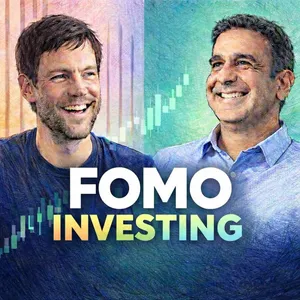
Brian and Mik explore the world of investing through real-world examples and behavioral economics principles.
Latest Episodes
The most recent episodes — sign up to get AI-powered summaries of each one.
- Aug 12, 202632 min
Buffett, Abel, and the Ham Sandwich Test
Berkshire Hathaway is entering its next chapter: Warren Buffett has handed the keys to Greg Abel, but the playbook still looks familiar — buy great businesses, stay patient, keep dry powder, and swing hard only when the fat pitch arrives. We unpack Berkshire’s massive cash balance, its surprising new Alphabet position, what Buffett’s move into Google says about updating your beliefs, and why the real lesson for FOMO investors may be the least exciting one: patience, position sizing, and the discipline to do nothing until the opportunity is obvious.
- Jul 22, 202650 min
Intuitive Surgical: The Quiet Robotics Compounder
A note before listening: We recorded this conversation on May 15, 2026, when Intuitive Surgical was trading at roughly $420 per share. As of July 21, the stock is trading around $354—approximately 16% lower. If we found the business compelling at $420, it is certainly worth another look at today’s price.Intuitive Surgical is one of the great zero-to-one business stories of the past 30 years.The company helped create robotic surgery, built a dominant ecosystem around its da Vinci platform, and quietly became one of the world’s most successful medical-technology companies. Today, it has thousands of systems installed around the world, millions of annual procedures, and a recurring-revenue engine built around instruments, accessories, and service.But is the next chapter already priced into the stock?In this episode, we trace Intuitive Surgical’s evolution from a Stanford research project into the leader in robotic surgery. We explore the company’s competitive advantages—including surgeon training, clinical evidence, hospital workflows, regulatory approvals, and decades of procedural data—and ask whether those advantages can withstand growing competition.We also discuss the potential beyond Intuitive’s traditional surgical markets. Could its Ion platform, expansion into cardiac procedures, international growth, and AI-powered surgical assistance turn Intuitive into something much larger than a medical-device company?The central question: Is Intuitive Surgical simply an expensive, high-quality compounder—or an underappreciated robotics and AI platform approaching another inflection point?
- Jul 7, 202639 min
Abivax, an investing lesson in thinking slow, acting fast
Abivax became one of June 2026's wildest biotech stories: a potential best-in-class drug to treat ulcerative colitis, a scary “cancer” headline, a violent selloff, and then a dramatic rebound after Part 2 safety data helped reframe the risk. We unpack how the market may have misread the cancer risk and why deep context matters in biotech investing and taking advantage of wild swings.References:-Brian's X poll on the part 2 safety data-Brian's practical approach to using cash-secured puts to get paid while waiting.
- Jun 10, 202645 min
Critics weigh in on SpaceX's IPO
Is SpaceX's $1.75 Trillion IPO more like Project Hail Mary or Interstellar? We unpack the SpaceX IPO from a valuation lens. We synthesize the highly varied perspectives from the ultra bulls (Gavin Baker), the bears (Jim Chanos, Nicolas Owens, and Suryansh Sharma - Morningstar), and the astute observers (Ashwath Damodaran, aka "the dean of valuation").
- May 11, 202636 min
Michael Burry Unchained and His Newsletter Gang
Michael Burry is back, and this time the newsletter gang is paying monthly. We explore his shift from hedge fund manager to Cassandra Unchained newsletter writer, the ideas that stood out to us, and his bearish take on Nvidia and Palantir in the middle of a very frothy AI market.
- Jan 22, 202639 min
Jeremy Raper goes for extra credit at the Humm Group
Brian and Mik unpack a live activist situation at Humm Group, a small Australian non-bank lender now facing public pressure from investor Jeremy Raper, who owns ~6% of the company and is pushing for a vote on board change ahead of a February shareholder meeting.They walk through the competing narratives: a founder-led board defending its strategy versus an activist arguing the company is undervalued due to poor governance and capital allocation. Along the way, they discuss downside protection, third-party bids, and special situations.Rather than a stock pitch, this is a case study in pattern recognition: how governance disputes, excess cash, and strategic activist pressure can create asymmetric outcomes.
- Jan 13, 202620 min
🥂 2 More FOMO — Holiday Special 2025
In this year-end episode, Brian and Mik reflect on FOMO Investing—its origins, how the podcast has evolved, and where they hope to take it in 2026. They revisit key themes from the past year, including quantum computing and GLP-1 biotechs, and share plans for the year ahead.
- Dec 26, 202517 min
R2 - Rivian Reset?
After the post-IPO drawdown, we review whether Rivian is worth another look. Rivian's software-first design, the Volkswagen JV, the R2, as well as its own autonomous driver investments, seem to indicate it may be more than just another EV manufacturer.
Customized Recaps
AI-powered recaps with compact key takeaways, quotes, and insights.
Straight to Your Inbox
Get key takeaways from FOMO Investing in a 5-minute read.
Save Hours Every Week
Stay current on your favorite podcasts without falling behind.
Frequently Asked Questions
What is Podzilla's FOMO Investing daily summary?
It's a free AI-powered email that summarizes new episodes of FOMO Investing as soon as they're published. You get the key takeaways, notable quotes, and links & mentions — all in a quick read.
How does the FOMO Investing podcast summary work?
When a new episode drops, our AI transcribes and analyzes it, then generates a personalized summary tailored to your interests and profession. It's delivered to your inbox every morning.
Is this an official FOMO Investing product?
No. Podzilla is an independent service that summarizes publicly available podcast content. We're not affiliated with or endorsed by Brian and Mik.
Can I get summaries of other podcasts too?
Absolutely! The free plan covers up to 3 podcasts. Upgrade to Pro for 15, or Premium for 50. Browse our full catalog at /podcasts.
What topics does FOMO Investing cover?
FOMO Investing covers topics including Business, Investing. Our AI identifies the specific themes in each episode and highlights what matters most to you.
Start getting FOMO Investing summaries tomorrow morning.
Free forever for up to 3 podcasts. No credit card required.
Free forever for up to 3 podcasts. No credit card required.