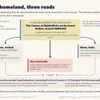
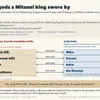
The first of the Atlas journeysI introduced you to the Atlas series of Finding Manuland in five podcasts, published over the last while. This is the very first of the Atlas journeys proper. I saved one of the best for it. Radiating out of this one is a series of pathways through the Anatolian side of Manuland. We will use them to show the method, the linguistics and the organising focus for the journeys still to come.Someone posted on Substack today that their mind was being blown by this series. That is a wonderful thing to hear. My own mind is, frankly, blown by it too.Today I also gained beta access to one of the first world models open to early adopters. I saw a month or two ago that it would come out in beta, and that people were invited to send in their use cases. I made mine about Finding Manuland and the Atlas papers.A world model is a neural network that builds spatial images and camera-controlled video, up to a minute long, from photographs, films or drawings. The very first proper vision network depended on ImageNet. The creator of ImageNet is the person behind this new world model, made by World Labs.I am very excited about it. Over the weekend I will play with it. The first thing I will try is a journey around Mykhailivka, the village on the Dnipro from which all living Indo-European languages set out. I have the archaeologists’ drawings of the excavations there, and I will test World Labs on them. There are conditions attached to the beta, so I will have to be careful about what I post. But we will see what I can do. So stay tuned.Where the crossroads isSo, the crossroads. Bring your mind to the modern state of Türkiye.Many of you will have been there on holiday, probably on the westernmost coast, near Smyrna, or Kaş. I spent two wonderful weeks camping down in Cilicia, opposite Cyprus. That is not where we are going. We are going east.You may not have a mental model of this part of the world. I certainly did not, before I began all of this work a few years ago. So if you have a chance, now or later, open Google Maps or Apple Maps, or an atlas if you have one in your library. Look at Türkiye and go east. You will find Lake Van. It is always big on the map, on any depiction of Anatolia from ancient times onwards, because it is a huge saltwater lake. Just below it is the place I am calling the crossroads.Each episode of Finding Manuland has three parts. There is the M-N- sound. There is the linguistics. And there is the journey, the itinerary. Calling these episodes an Atlas does not mean giving up any of the three.The roads that crossThe Ukrainian Yamna steppe inheritance did not only run east, to India or to Tajikistan. Picture a wheel with spokes radiating out of it. At the great crossroads of the ancient world, just south of Lake Van, the Indo-European family’s deepest sounds crossed too.This is where a treaty swore the Vedic gods centuries before the Rigveda. The Rigveda is the oldest surviving holy book in Indo-European culture. Modern scholars believe its poems, songs and prayers were settled into their form around 1200 BCE. Centuries before that, we have this treaty, sworn under the moon-god of Harran.I visited Harran last January. I had to hurry through it, unfortunately. It was late in the day, and I had been in the Tektek Mountains looking for another ancient shrine to the moon-god. We will return to Harran, on the podcast and on the ground.This is also where a monarch named Menua built his realm, at Ararat. Its own people called it Biainili. It was based at the modern city of Van. You may remember the video I filmed there last January, on an amazing blue-sky, snowy day. I was the first to go up to Van Castle that morning.In biblical times the Biainili people were known as Urartians. Menua, with the M-N- in his name, was the son of one of its founders and a founding figure himself. Just south of Van is Menua’s Canal, still called by his name today. That is where the crossroads begins, the roundabout this episode is about. And all of these things are caught together on one clay tablet, before the East had written any of them. By the East I mean Iran, and India.In earlier episodes I followed the road east to India and Iran. We will travel that road again. This road turns south-west, to the place where all the roads cross. It is the upland where Anatolia, Mesopotamia
Podzilla Summary coming soon
Sign up to get notified when the full AI-powered summary is ready.
Free forever for up to 3 podcasts. No credit card required.
Listen to This Episode

Get summaries like this every morning.
Free AI-powered recaps of Finding Manuland and your other favorite podcasts, delivered to your inbox.
Free forever for up to 3 podcasts. No credit card required.