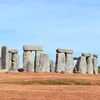
Stonehenge, where I am standing this Saturday morning, is the answer to a question I have been carrying since May 2021 - and it has taken me five years and three thousand kilometres to carry the question back to these stones. I want to say something at the outset that will only be fully earned by the end: I feel Ukraine’s presence here. Not as metaphor. As ancestry, as language, as the later courses of this very monument. By the close of this piece I intend to have shown you exactly where to look for her.The coach parks are already filling. Jackdaws are working the wind above the lintels. Several hundred people are filing along the rope walkway, photographing the most famous stone circle on earth, and nearly every one of them - I have been listening - is doing so in a daughter language of a mother tongue first spoken on the steppe of what is now Ukraine. They do not know that. Most of them also do not know that when the great sarsens in front of us were being raised, a stone circle beside the Dnipro river had already been buried, deliberately, under a mound of earth, for something like a thousand years.I have touched that older circle. This post is about who built it, who buried it, and why the answer runs in a single thread through three monuments: Stonehenge on Salisbury Plain, Tara in County Meath, and the cromlech at Novooleksandrivka, fourteen kilometres south of Dnipro. What I have noticed - and it is a pattern I keep testing, not a verdict I am handing down - is that all three circles were raised by Old Europeans; that the people who buried the third one were, in the most literal genetic sense, their own descendants; and that the burying itself may have been the wisest thing anyone ever did for it. The wisest people I met in Ukraine thought so. We will get to them.Let me take you to the Dnipro first.The Uncovered CircleIn May 2021 a five-thousand-year-old burial mound was torn apart by housing developers in Novooleksandrivka, a wealthy suburban hromada south of Dnipro, Ukraine’s third city. News of the vandalism found a global audience - it made the front page of the New York Times, and Ukraine’s chief mound guardian told that paper: “It’s genocidal. Erasing our culture like that.” Residents blocked a road in protest.After the kurgan - as such mounds are known in Ukraine; Mane, as I have come to call them, for reasons that will surface below - was removed, a much older stone circle was, unexpectedly, discovered underneath. Five thousand years for the mound; five and a half for the circle beneath it. Hold that five-hundred-year gap; it is very important, and it is in the contemporaneous record, not just in my memory.At that time I was an Irish peacekeeping diplomat serving with the OSCE’s Special Monitoring Mission to Ukraine, posted to Dnipro, in my final year before compulsory retirement, watching for early warnings of Russia’s meddling in a war then already seven years old. Anything that made international front pages in my city was my professional business, so I crossed the Sura River to investigate. What I found rearranged my mental furniture, and eventually my life.Sixty-four stone boulders, set in a ring. Touching them felt like caressing the Delphic Omphalos - except that this rondel was older than any material reminder we have of the oracle at Greece’s cultic centre. Through that summer and early winter, as Russian forces massed beyond every one of Ukraine’s borders, I kept going back. I photographed each of the sixty-four stones, carefully, on every visit - it was the one thing I could do, since a minor Irish diplomat has no mana with which to counteract a property developer. And the stones began to resolve themselves into human-like forms. Stelae. The deities they had represented to the people who levered them into position. I had a favourite: a broad-shouldered stone god. Sometimes, when I arrived, there were fresh flowers in the centre of the circle.Inside the mound that had covered the stones, the bulldozing archaeologist working for the developer had found the bodies of twenty-seven people, buried there between roughly 3,500 BCE and 1932. Many were covered in red ochre. Most were crouched, knees bent. One was mummified. The 1932 interment was the manager of the Soviet collective farm that the Muscovite colonisers of Ukraine had planted on the site - a functionary laid down where the high kings of the area had lain five thousand years before him, in the very year Moscow’s engineered famine began killing millions of Ukrainians. Talk about delusions of grandeur! And, in a darker key, about continuity: the mound never stopped doing what m
Podzilla Summary coming soon
Sign up to get notified when the full AI-powered summary is ready.
Free forever for up to 3 podcasts. No credit card required.
Listen to This Episode



Get summaries like this every morning.
Free AI-powered recaps of Finding Manuland and your other favorite podcasts, delivered to your inbox.
Free forever for up to 3 podcasts. No credit card required.