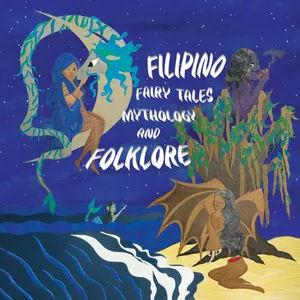
Free Daily Podcast Summary
Filipino Fairy Tales, Mythology and Folklore: Daily Summaries Delivered
by Nathalie De Los Santos
Filipino fairytales for the whole family. I retell Philippine fairy tales, myths, folk tales, folklore from different islands.Stories (re)written and performed by Nathalie De Los Santos.I dedicate this entire podcast to my five-year-old nephew, Winston.Follow me at @pilipinxpages (IG/TW/FB)Art: S1: Kiligraphy Co. (IG: @kiligraphyco) and S2: Nicole Buensuceso (@nikbuens.art), Diyosa Mata Art by Naomi King (@naomikingofficial)Sound edit: S1: Brad Dyck (TW: @Brad_Dyck) S2: Nathalie DLS
Latest Episodes
The most recent episodes — sign up to get AI-powered summaries of each one.
- Jun 16, 20268 min
Filipino Fairy Tales, Mythology and Folklore - Episode 66 - The Creation of the Earth
This new season of Filipino Fairy Tales, Mythology, and Folklore begins with "The Creation of the Earth," a Philippine folktale about the ocean, the sky, a kite bird, bamboo, and the beginning of humanity. In this episode, Nathalie reflects on Philippine sky stories, oral tradition, and the ways our ancestors used myth to understand the natural world. The episode also includes the tale in both English and Tagalog, with a Tagalog translation by K.S. Villoso and a reading by Mikhail. If you'd like to share a fairy tale, myth, or folktale in your native language for a future episode, please email pilipinxpages@gmail.com.
- Jul 9, 20255 min
Filipino Fairy Tales, Mythology and Folklore - Episode 65 - You're Already Beautiful
Today I'm sharing "You're Already Beautiful"—a folk-fantasy tale I wrote in the middle of an £D relapse, when my body d*$m0rph1@ felt louder than my own heartbeat. Crafting this story was my way of whispering back to that voice: magic doesn't ask for beauty; it asks to be believed. This was inspired by the tale "How the Town of Marikina Got Its Name". In this story (and in my own journey) I found that every time the wind touched my face, every time I felt a river-stone underfoot, the earth carried medicine. Reconnecting with the land—letting cold water hold me, letting birdsong rewrite the script in my head—showed me that nature mirrors back wholeness long before we can see it in ourselves. The forest doesn't call us flawed; it calls us home. 🌱💛 If you have been at odds with your body, this one is for you. Let the forest remind you: marikit ka na—you are already beautiful, right here, right now.
- Jun 15, 20251 min
Filipino Fairy Tales, Mythology and Folklore - Episode 64 - the white key
This poem is based on my experience working in a non-profit, and working under a boss who did not understand how racist she actually truly was. If you've experienced the subtle ways white supremacy crushes your spirit at work, this poem is for you. This first appeared in the ROOTed Rhythms Colours of Culture Exhibition, and you can read it here https://www.rootedrhythms.ca/exhibitions/2025-exhibition/the-white-key
- Jun 6, 20255 min
Filipino Fairy Tales, Mythology and Folklore - Episode 63 - Lady of the Nightbloom
When brilliance meets community pressure, what blossoms—and what withers? This episode retells the Filipino folk-inspired myth of Evangelina, a prodigious artist who withdraws from the glittering buzz of social expectations. Gifted but suffocated by gossip, envy, and "crab mentality," Evangelina seeks solace in solitude, only to transform into the nocturnal bloom known as Dama de Noche. This retelling of the "The Legend of the Flower Dama Noche" is a cultural commentary and a reflection on how modern creatives navigate praise, pressure, and personal peace. This episode explores how talent, communal politics, and the quest for authentic selfhood intertwine—illuminating why some flowers choose to open only after sunset.
- Jun 12, 20241h 0m
Filipino Fairy Tales, Mythology and Folklore - Episode 62 - Warrior Spirit Through Sacred Kali and Mayari - Interview with Imee
Imee Dalton (she/her) understands what it's like to walk the world as someone disconnected from her roots. She has been dedicated to her own healing and remembrance journey for decades. Known as "the Mayari Moon", Imee is a kali instructor, content creator and one of the hosts of the Babaylan Bruha Book Club Podcast. She lives on the ancestral lands of the mound builders that are the Hopewell and Adena. I interview her today on the podcast! Seven years ago, she started training in kali, a Filipino martial art (FMA). Since then, it has ignited a passion within her to help others like herself to start to gain the confidence they need to walk the world without fear, remembering their truest selves. Kali is an ancient martial art form from the Philippines, that involves bamboo sticks, swords, knives and empty hand techniques. Kali, arnis, and escrima are different names for the practice of Filipino Martial Arts. What Imee offers in her kali circles has been given to her by her guides, ancestors and the Tagalog and Kapampangan goddess of the moon, Mayari. Imee uses the energy of kali to heal from colonial trauma. She asks her students to sit with their shadow and confront where colonization still lives within them. Her book club podcast focuses on Filipinx spiritual books which are also inclusive of diverse spiritual practices across cultures, world history and lived experiences. "I started practicing kali 7 years ago. My partner, who is half Filipino, had been training for a few years already. He kept asking me to join the gym where he was training FMA, saying I'd really like it. At the time, physical hobbies weren't my thing, so I kept declining his invitations," Imee recollects. "Finally, on a whim, I decided to come to the FMA gym. I fell in love immediately. Once I picked up kali sticks, I never put them down." The first step of decolonization is remembering who you are and to look to the past so you can move into the future. One life lesson I learned in joining Imee's class is not to leave half of yourself at the door. There is a constant you across all energies, from the ages of your life and to the shapes of your body. The exploration of solar and lunar practices in her class set me on this unique path of healing. "One of my main inspirations is Mayari. Looking back, both the moon and the lunar goddess have always been on the edges of my life calling to me," says Imee. "It wasn't until I started training in kali that I stumbled across Mayari's story. She was a moon goddess who looked like me and had kali sticks like me! The representation healed something in me from childhood. With her being the goddess of the moon and a warrior, it called to a deep place in me that felt disempowered and disconnected." In a modern tale, the Tagalog worshiped Mayari, who had two sisters, Hanan, the goddess of the morning, and Tala, goddess of the stars. They were daughters of the supreme god, Bathala. Mayari also had a brother named Apo Laki, the god of the sun and war. He is a part of Tagalog, Pangasinan and Kapampangan mythology. In a Kapampangan myth, Mayari fought against her brother for equal rulership over the world. During the battle, Apo Laki strikes Mayari and blinds her in one eye. He immediately regrets his violence upon his sister and the two rule equally together. Mayari rules the night and her brother rules the day.
- Jun 1, 20245 min
Filipino Fairy Tales, Mythology and Folklore - Episode 61 - Bathala, Bathalismo and the Infinite God
I am back with a new podcast season! In my first episode of the new season, let's uncover the ancient tale of Infinito Dios, the Infinite God. Bathala is the supreme deity in Tagalog mythology, but he was turned into 'God' when the Spanish came. One story that has endured is the story behind the Bathalismo, the Infinite God, who refused to be baptized. Please read 'Back from the Crocodile's Belly'. The essay I reference is: "Bathala is Anting-Anting or why Bathala Hides inside the Stone by Nenita Pambid Domingo".
- Dec 31, 20239 min
Filipino Fairy Tales, Mythology and Folklore - Episode 60 - Mindanao - Mandaya and Subanun - The Children of the Limokon - The Sun and the Moon - The Widow's Son
Hello all! This is my last episode of the year. I perform more Mindanao tales, from Mandaya and Subanun. The stories are: The Children of the Limokon, The Sun and the Moon, and The Widow's Son.
- Dec 23, 20234 min
Filipino Fairy Tales, Mythology and Folk Tales - Episode 59 - Mindanao - Bilaan - The Story of the Creation - In the Beginning
I'm back with more fairy tales from Mindanao, from Bilaan. I perform The Story of the Creation and In the Beginning. Y'all, please please look into the history of Mindanao if you can. Their issues are underreported by the news. I chose to tell these tales as a prayer this past month for those affected by the earthquake in Mindanao; and those who have been affected by the ongoing regional issues, including the war in Cotobato City.
Get Filipino Fairy Tales, Mythology and Folklore summaries in your inbox
Free AI-powered daily recaps. Key takeaways, quotes, and mentions — in a 5-minute read.
Get Free Summaries →Free forever for up to 3 podcasts. No credit card required.
You Might Also Like
Listeners also like.
Cuentos for Kiddos! - A Bilingual Storytelling Podcast
Bilingual English-Spanish storytelling for toddlers and preschoolers featuring screen-free versions of favorite children's stories.
Myths and Legends
Retells global myths and legends, from Arthur to Aladdin, with origins and tales reimagined for modern listeners.
Mythology & Fiction Explained
Explores myths and fictional stories from around the world, breaking down their origins and meanings.
Stories Podcast: A Bedtime Show for Kids of All Ages
Retold fairy tales, classic stories, and original adventures performed weekly for children of all ages.

Kids Short Stories: a Bedtime Show By Mr Jim
Original stories based on ideas from children, brought to life in audio adventures about space, magic, underwater worlds, and more.
Storyland | Kids Stories and Bedtime Fairy Tales for Children
Enchanting audio stories for children featuring magical adventures and imaginative characters in a family-friendly format.
Disney Magic of Storytelling
Actors perform classic Disney children's stories designed to spark imagination for young listeners.
Nat Theo Nature Lessons Rooted in the Bible
Children learn biblical lessons by exploring nature and discovering spiritual truths in the natural world.
Short Stories for Kids: Bedtime ~ Car Time ~ Downtime
Magical short stories for children, created from listener ideas and released weekly.

Night Falls: Bedtime Story, Sleep Story, Sleep Podcast
A narrator guides listeners through calming, imaginative bedtime stories designed to ease adult minds into sleep.

The Saints
Dramatized stories of saints’ lives, told with professional acting and cinematic sound to inspire faith and virtue in families.
¡Hola Nature! A Spanish Learning Adventure for Kids
A nature-themed Spanish learning podcast for kids featuring stories, poems, and facts to foster language skills and environmental curiosity.
About Filipino Fairy Tales, Mythology and Folklore
Filipino fairytales for the whole family. I retell Philippine fairy tales, myths, folk tales, folklore from different islands.Stories (re)written and performed by Nathalie De Los Santos.I dedicate this entire podcast to my five-year-old nephew, Winston.Follow me at @pilipinxpages (IG/TW/FB)Art: S1: Kiligraphy Co. (IG: @kiligraphyco) and S2: Nicole Buensuceso (@nikbuens.art), Diyosa Mata Art by Naomi King (@naomikingofficial)Sound edit: S1: Brad Dyck (TW: @Brad_Dyck) S2: Nathalie DLS
Customized Recaps
AI-powered recaps with compact key takeaways, quotes, and insights.
Straight to Your Inbox
Get key takeaways from Filipino Fairy Tales, Mythology and Folklore in a 5-minute read.
Save Hours Every Week
Stay current on your favorite podcasts without falling behind.
Frequently Asked Questions
What is Podzilla's Filipino Fairy Tales, Mythology and Folklore daily summary?
It's a free AI-powered email that summarizes new episodes of Filipino Fairy Tales, Mythology and Folklore as soon as they're published. You get the key takeaways, notable quotes, and links & mentions — all in a quick read.
How does the Filipino Fairy Tales, Mythology and Folklore podcast summary work?
When a new episode drops, our AI transcribes and analyzes it, then generates a personalized summary tailored to your interests and profession. It's delivered to your inbox every morning.
Is this an official Filipino Fairy Tales, Mythology and Folklore product?
No. Podzilla is an independent service that summarizes publicly available podcast content. We're not affiliated with or endorsed by Nathalie De Los Santos.
Can I get summaries of other podcasts too?
Absolutely! The free plan covers up to 3 podcasts. Upgrade to Pro for 15, or Premium for 50. Browse our full catalog at /podcasts.
How often does Filipino Fairy Tales, Mythology and Folklore release new episodes?
Filipino Fairy Tales, Mythology and Folklore publishes weekly. Our AI generates a summary within hours of each new episode.
What topics does Filipino Fairy Tales, Mythology and Folklore cover?
Filipino Fairy Tales, Mythology and Folklore covers topics including Arts, Books, Kids & Family, Family. Our AI identifies the specific themes in each episode and highlights what matters most to you.
Start getting Filipino Fairy Tales, Mythology and Folklore summaries tomorrow morning.
Free forever for up to 3 podcasts. No credit card required.
Free forever for up to 3 podcasts. No credit card required.