Free Daily Podcast Summary
Fault Lines: Daily Summaries Delivered
by National Security Institute
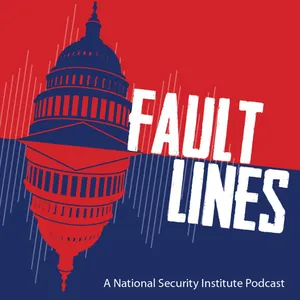
Fault Lines, the National Security Institute’s flagship podcast, gets you quickly up to speed, three-times-a-week, on the national security and foreign policy debates shaking up America.Our regular cast of foreign policy experts includes NSI Founder and Executive Director Jamil N. Jaffer, NSI Advisory Board Member Lester Munson, and NSI Senior Fellows Morgan Viña, and Jessica Jones. Tune in to learn more about the issues dominating headlines and the news stories you may have missed. Hosted on Acast. See acast.com/privacy for more information.
Latest Episodes
The most recent episodes — sign up to get AI-powered summaries of each one.
- Today16 min
Fault Lines Episode 649: Cracks in the Coalition: The Fight Over Who Ends the War
Today, Les, John, Andrew, and Andy examine a fast-moving moment in the Iran conflict as diplomatic and domestic pressures converge. The Prime Minister of Qatar, a key intermediary in ceasefire talks, is meeting with Trump, and markets are already reacting to speculation of a possible settlement. Simultaneously, Israel's president has tasked Gadi Eisenkot with forming the next government — potentially ending Netanyahu's tenure as Prime Minister — while Vice President Vance has publicly called for the war to end and Democrats on Capitol Hill are signaling they will use the December 11 government funding deadline as leverage to cut off support for the fight.With Vance arguing the war cost Republicans the midterms and Trump attributing losses to gas prices rather than the conflict itself, who is actually driving U.S. war policy? If Iran believes it has successfully shaped political outcomes in both Washington and Jerusalem, does that perception harden or soften its position at the negotiating table? As the battlefield settles into a grinding cycle of tit-for-tat strikes and sanctions, what does a realistic path out actually look like?Check out the answers to these questions and more in this episode of Fault Lines.@lestermunson@JohnCLipsey@AndrewBorene@AndyKeiserLike what we're doing here? Be sure to rate, review, and subscribe. And don't forget to follow @faultlines_pod and @masonnatsec on Twitter!We are also on YouTube; watch today's episode here: https://youtu.be/7qrwKo10tqo Hosted on Acast. See acast.com/privacy for more information.
- 3 days ago18 min
Fault Lines Episode 648: Vance, Iran, and the Race for 2028
Today, John, Les, and Algene break down a striking tweet from Vice President J.D. Vance pinning Republican midterm losses squarely on the Iran War — and what it signals about the road to 2028. Vance argued it wasn't low turnout that hurt the party, but Trump-Vance voters actively switching sides because of the war. Trump responded by agreeing with the war’s political impact, but holding firm on his decision and the war’s necessity to prevent Iran from getting a nuclear weapon.Is Vance's midterm autopsy an honest reckoning or a carefully staged departure from Trump's legacy? What happens when a vice president critiques his own administration's signature foreign policy decision? How have Vance’s remarks positioned him for a political run in 2028?Check out the answers to these questions and more in this episode of Fault Lines.@lestermunson@JohnCLipsey@AlgeneSajeryLike what we're doing here? Be sure to rate, review, and subscribe. And don't forget to follow @faultlines_pod and @masonnatsec on Twitter!We are also on YouTube; watch today's episode here: https://youtu.be/XEFEMlsy3do Hosted on Acast. See acast.com/privacy for more information.
- 5 days ago20 min
Fault Lines Episode 647: New Congress, New Calculus
Today, Jess, Les, John, and Andrew break down a strong midterm night for Democrats, with a blue wave sweeping across the country, delivering historic victories and surprising upsets. Voters cast ballots primarily on economic concerns, though AI, data centers, and Iran hovered in the background as the emerging issues of the cycle. With Democrats poised to gain oversight leverage in key committees, the question now turns to what a divided or shifted Congress means for a foreign policy landscape still defined by active wars, rising Chinese pressure, and an unresolved Iran strategy.Will Democratic gains in Congress bring greater oversight of Trump’s foreign policy on Iran, Ukraine, and beyond? With the president's last-minute announcement ending U.S. aid to Israel, how will a new Congress shape — or simply react to — American posture in the Middle East? And what do voter concerns about AI and data centers reveal about the growing intersection of technology, politics, and national security?Check out the answers to these questions and more in this episode of Fault Lines.@lestermunson@NotTVJessJones@JohnCLipsey@AndrewBoreneLike what we're doing here? Be sure to rate, review, and subscribe. And don't forget to follow @faultlines_pod and @masonnatsec on Twitter!We are also on YouTube; watch today's episode here: https://youtu.be/fGadEo3BU18 Hosted on Acast. See acast.com/privacy for more information.
- 1 weeks ago16 min
Fault Lines Episode 646: Poland's Judicial Showdown
Today, Les, Jess, John, and Amy dig into the political crisis unfolding in Poland after President Nawrocki was forced to cut short a state visit to Senegal and return home over a standoff surrounding the Constitutional Tribunal. At the center of the dispute is a long-running power struggle over who controls Poland's highest court — including the president's authority to swear in new judges — and whether the prime minister's office has effectively seized control of the body meant to check it. The crisis has drawn sharp criticism from European partners and raised deeper questions about what happens when constitutional norms break down and institutions lose their credibility.Is Poland's judicial standoff a symptom of a broader democratic unraveling, or a messy but legitimate political dispute best resolved from within? How does the Polish crisis compare to norm-breaking episodes in the United States, from court-packing debates to January 6? When institutional credibility collapses, can prosecutions and political pressure actually restore it — or do they only deepen the wound?Check out the answers to these questions and more in this episode of Fault Lines.@lestermunson@NotTVJessJones@JohnCLipsey@amykmitchellLike what we're doing here? Be sure to rate, review, and subscribe. And don't forget to follow @faultlines_pod and @masonnatsec on Twitter!We are also on YouTube; watch today's episode here: https://youtu.be/VpIR_5U6M-U Hosted on Acast. See acast.com/privacy for more information.
- 1 weeks ago14 min
Fault Lines Episode 645: Warp Speed to Tehran: Talks, Strikes, and Trump’s Legacy
Today, John, Jess, Les, and Andrew take stock of where the United States and Iran are headed — and how fast. Vice President Vance delivered a Trump-approved letter to Iran's National Security Council proposing direct talks, emphasizing the nuclear program as a non-negotiable agenda item. Meanwhile, the U.S. has been repositioning forces away from vulnerable bases, and the administration appears to be running a deliberate operational clock — sprint to diplomacy, or face a short, intense military campaign.Is there a genuine diplomatic window left, or has Washington already made its decision? If strikes resume, what would they actually accomplish beyond another round of mowing the lawn? With the midterms behind him, how much will Trump's concern for his legacy and Vice President Vance's future shape his appetite for escalation? How can we follow in Captain Picard’s footsteps as we move ahead?Check out the answers to these questions and more in this episode of Fault Lines.@lestermunson@NotTVJessJones@JohnCLipsey@AndrewBoreneLike what we're doing here? Be sure to rate, review, and subscribe. And don't forget to follow @faultlines_pod and @masonnatsec on Twitter!We are also on YouTube; watch today's episode here: https://youtu.be/MoLaXeFBKo8 Hosted on Acast. See acast.com/privacy for more information.
- 1 weeks ago13 min
Fault Lines Episode 644: Ballots and Battles: Israeli Elections and the Future of U.S.-Israel Ties
Today, Jess, Les, John, and Andy break down Israel's first election since the October 7 attacks, with no clear winner yet emerging and multiple outcomes still in play. Security, accountability, and the legacy of the attacks are driving voter sentiment, even as the parliamentary system makes coalition-building the decisive factor. With support for Israel increasingly contested in Washington, the stakes for the bilateral relationship extend well beyond who forms the next government in Jerusalem.How will Israel's electoral outcome shape its ability to prosecute the war and manage the postwar political reckoning? Could a sanctions campaign from Washington — extending beyond weapons restrictions to trade and financial penalties — fundamentally reorder the U.S.-Israel relationship? If Israel can no longer take bipartisan support in Washington for granted, what does that mean for its security—and where else can it turn?Check out the answers to these questions and more in this episode of Fault Lines.@lestermunson@NotTVJessJones@JohnCLipsey@AndyKeiserLike what we're doing here? Be sure to rate, review, and subscribe. And don't forget to follow @faultlines_pod and @masonnatsec on Twitter!We are also on YouTube; watch today's episode here: https://youtu.be/Xy2Uduq0HYE Hosted on Acast. See acast.com/privacy for more information.
- 2 weeks ago17 min
Fault Lines Episode 643: Shifting South: Democracy, Elections, and Alignment in Latin America
Today, Les, Jess, John, and Andrew take stock of a turbulent electoral moment across Latin America. Lula's victory in Brazil marks a leftward shift in the region's largest economy at a time when recent Latin American elections have swung conservative — driven by economic frustration and deteriorating security conditions. Meanwhile, in Venezuela, a quiet diplomatic revolution is underway: following the arrest of Maduro, Delcy Rodríguez is now coordinating with Washington on oil flows, and U.S.-led talks in Caracas last week produced a framework that includes political reforms installing a new supreme court. This development accompanies the return of popular opposition leader, María Corina Machado, to Venezuela after nearly 10 months in exile.What does Lula's victory mean for U.S. national security interests in the region, and is the so-called Donroe Doctrine delivering results? Is the broader conservative wave in Latin America a durable ideological shift or simply anti-incumbent backlash? With Venezuela's political future now hinging on a fragile U.S.-backed transition, what is a realistic timeline for credible elections? Check out the answers to these questions and more in this episode of Fault Lines.@lestermunson@NotTVJessJones@JohnCLipsey@AndrewBoreneLike what we're doing here? Be sure to rate, review, and subscribe. And don't forget to follow @faultlines_pod and @masonnatsec on Twitter!We are also on YouTube; watch today's episode here: https://youtu.be/NsL4BYH4oL0 Hosted on Acast. See acast.com/privacy for more information.
- 2 weeks ago19 min
Fault Lines Episode 642: AI vs AI: Cybersecurity, Disruption, and the New National Security Economy
Today, John, Les, and Jess dig into the accelerating collision between artificial intelligence and cybersecurity as businesses scramble to respond to a wave of attacks over the last 48 hours. From AI agents operating autonomously inside U.S. bank accounts to unpatched vulnerabilities quietly spreading through critical systems, the threat environment may be growing faster than institutions can adapt. Meanwhile, AI companies are rapidly becoming essential economic and national security infrastructure, and the foreign policy implications are only beginning to surface.Are governments and the private sector moving fast enough to get ahead of these cybersecurity risks before they cause systemic economic damage? As AI firms grow indispensable to U.S. economic and security interests, will politics constrain their ability to generate the revenue needed to sustain that role? Are militarized labradoodles the future of national security?Check out the answers to these questions and more in this episode of Fault Lines.@lestermunson@NotTVJessJones@JohnCLipseyLike what we're doing here? Be sure to rate, review, and subscribe. And don't forget to follow @faultlines_pod and @masonnatsec on Twitter!We are also on YouTube; watch today's episode here: https://youtu.be/VIEeq7KMft0?si=JGWHkWeJzpQWV951 Hosted on Acast. See acast.com/privacy for more information.
Get Fault Lines summaries in your inbox
Free AI-powered daily recaps. Key takeaways, quotes, and mentions — in a 5-minute read.
Get Free Summaries →Free forever for up to 3 podcasts. No credit card required.
You Might Also Like
Listeners also like.

NatSec Matters
Former national security officials interview top leaders on critical security challenges and U.S. policy responses.

The Lawfare Podcast
Discussions with experts on national security, law, and policy covering foreign policy, intelligence, cybersecurity, and governance.

Sources & Methods
A weekly deep dive into national security news with NPR correspondents and interviews with military, intelligence, and diplomatic leaders.

The Lawfare Podcast: Patreon Edition
Experts and policymakers discuss national security, law, and policy issues including foreign policy, intelligence, and cybersecurity.
The Just Security Podcast
Expert analysis of national security, foreign policy, and rights from practitioners, academics, and affected individuals.

The Truth of the Matter
Breaks down complex global policy issues through informed, balanced discussions without spin or sensationalism.

The DSR Daily
Daily news coverage of foreign policy and national security developments from global media sources.

One Decision
Former intelligence leaders and journalists examine high-stakes decisions that shaped global events.

The Prevailing Narrative with Matt Bilinsky
Analyzes news and current events through interviews with experts and innovators.

The Steady State Sentinel
Former national security professionals analyze threats to democracy and the Constitution with expert guests.

The Long Game with Jake Sullivan and Jon Finer
A national security podcast offering insider perspectives on global events and decision-making from top Biden administration officials.
Global Security Briefing
Expert analysis on global security issues, focusing on UK foreign and defense policy in a changing international landscape.
About Fault Lines
Fault Lines, the National Security Institute’s flagship podcast, gets you quickly up to speed, three-times-a-week, on the national security and foreign policy debates shaking up America.Our regular cast of foreign policy experts includes NSI Founder and Executive Director Jamil N. Jaffer, NSI Advisory Board Member Lester Munson, and NSI Senior Fellows Morgan Viña, and Jessica Jones. Tune in to learn more about the issues dominating headlines and the news stories you may have missed. Hosted on Acast. See acast.com/privacy for more information.
Customized Recaps
AI-powered recaps with compact key takeaways, quotes, and insights.
Straight to Your Inbox
Get key takeaways from Fault Lines in a 5-minute read.
Save Hours Every Week
Stay current on your favorite podcasts without falling behind.
Frequently Asked Questions
What is Podzilla's Fault Lines daily summary?
It's a free AI-powered email that summarizes new episodes of Fault Lines as soon as they're published. You get the key takeaways, notable quotes, and links & mentions — all in a quick read.
How does the Fault Lines podcast summary work?
When a new episode drops, our AI transcribes and analyzes it, then generates a personalized summary tailored to your interests and profession. It's delivered to your inbox every morning.
Is this an official Fault Lines product?
No. Podzilla is an independent service that summarizes publicly available podcast content. We're not affiliated with or endorsed by National Security Institute.
Can I get summaries of other podcasts too?
Absolutely! The free plan covers up to 3 podcasts, any in the catalog. Basic raises that to 15, Pro to 40 and Max to 100. Browse our full catalog at /podcasts.
What topics does Fault Lines cover?
Fault Lines covers topics including News, Government, Politics. Our AI identifies the specific themes in each episode and highlights what matters most to you.
Start getting Fault Lines summaries tomorrow morning.
Free forever for up to 3 podcasts. No credit card required.
Free forever for up to 3 podcasts. No credit card required.