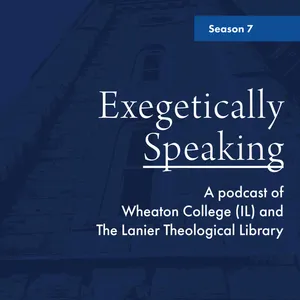
Free Daily Podcast Summary
Exegetically Speaking: Daily Summaries Delivered
by Wheaton College
Get key takeaways, quotes, and insights from Exegetically Speaking in a 5-minute read. Delivered straight to your inbox.
Latest Episodes
The most recent episodes — sign up to get AI-powered summaries of each one.
- Yesterday10 min
Evoking Penelope's Suitors, with Alex Loney: Luke 15:30
When, in one of Jesus' most well-known parables, the "prodigal son" returns, his older brother feels wronged by the warm reception accorded by their father. The charges he lays against his younger brother may be even stronger than often realized if we perceive echoes of a key scene in Homer's Odyssey. Dr. Alexander Loney is Associate Professor of Classical Languages and the Coordinator of the Classical Languages program at Wheaton College. His publications include The Ethics of Revenge and the Meanings of the Odyssey and (co-editor) The Oxford Handbook of Hesiod. He has contributed several episodes to our podcast. Check out related programs at Wheaton College: B.A. in Classical Languages (Greek, Latin, Hebrew): https://bit.ly/4er2T9Y M.A. in Biblical Exegesis: https://bit.ly/4d1iSJD
- 1 weeks ago14 min
A Failure to Intercede, with Ellie Paley: Job 42:7
In a recent episode, Dr. Ellie Paley walked us through Job 42:6, Job's final response to God's answer from the whirlwind. The very next verse, Job 42:7, presents the conundrum of how Job, who was just rebuked by God, is now commended by God in contrast to his three friends. The Hebrew wording suggests that the key difference between Job and his friends lies in the direction of their speaking: To God about Job or to Job about God? Dr. Paley has taught courses at Duke Divinity School and Jerusalem University College, and is transitioning to a postdoctoral position at Bar-Ilan University near Tel Aviv. Her doctoral research on Divine-Human Dialogue and Resolution in the Book of Job is forthcoming with Brill. Check out related programs at Wheaton College: B.A. in Classical Languages (Greek, Latin, Hebrew): https://bit.ly/48GQoDD M.A. in Biblical Exegesis: https://bit.ly/3RjAzww
- 2 weeks ago9 min
Not a Road Less Traveled By, with Ken Gore: Psalm 23:1-3
Though most often cited at funerals or in times of greatest difficulty, Psalm 23 has a profound message for the whole of life. A close reading of the Hebrew of the opening verses bears out some of this. Dr. Kenneth Gore is Professor of Biblical Studies at Mary C. Crowley College of Christian Faith, Dallas Baptist University. He wrote the column "Baptists Ask," for the Arkansas Baptist News from October 2001 to March 2020, and recently contributed a series of articles on The Psalms for GC2 Press. Check out related programs at Wheaton College: B.A. in Classical Languages (Greek, Latin, Hebrew): https://bit.ly/4cFzZld M.A. in Biblical Exegesis: https://bit.ly/4t3bZ04
- 3 weeks ago13 min
Only Begotten God, with Michael Bird: John 1:18
For the 350th episode of this podcast, Dr Michael Bird reviews the ways in which John's Gospel presents Jesus as equal to God, and then concentrates on the language of 1:18. Is the idea that of Jesus as the "only begotten" of the Father, what would that mean, and how would later theological terminology express what John is teaching? Dr. Bird is Deputy Principal and Academic Lecturer in Theology at Ridley College (Melbourne, Australia). His many publications include What Christians Ought to Believe: An Introduction to Christian Doctrine through the Apostles' Creed and Jesus among the gods: Early Christology in the Greco-Roman World. Check out related programs at Wheaton College: B.A. in Classical Languages (Greek, Latin, Hebrew): https://bit.ly/4mAwEY0 M.A. in Biblical Exegesis: https://bit.ly/41Duai0
- 4 weeks ago13 min
Crushed, Contrite, Cagey, or Consoled?, with Ellie Paley: Job 42:6
Following Job's sufferings, mourning, arguments with his friends, and God's own speech to him, Job makes his final response in Job 42. But the Hebrew of Job 42:6 has been hotly contested in scholarship, with its interpretation bearing significant implications for how this afflicted God-fearer has emerged from his long-awaited encounter with God. Dr. Ellie Paley has taught courses at Duke Divinity School and Jerusalem University College, and is transitioning to a postdoctoral position at Bar-Ilan University near Tel Aviv. Her doctoral research on Divine-Human Dialogue and Resolution in the Book of Job is forthcoming with Brill. Check out related programs at Wheaton College: B.A. in Classical Languages (Greek, Latin, Hebrew): https://bit.ly/4vrZZaV M.A. in Biblical Exegesis: https://bit.ly/480BQ1j
- Apr 13, 202613 min
Pray Regularly, with Jeff Peterson: 1 Thessalonians 5:17
Two of the shortest verses in the Bible are 1 Thess. 5:16 and 17: "Rejoice always, pray without ceasing" (NRSV). Dr. Jeff Peterson argues that that these verses are directed to leaders of the Thessalonian church, along with all of vv. 14-22, and he zeroes in on the Greek adverb translated "without ceasing." Concretely, what was Paul asking the recipients of his letter to do? Dr. Jeff Peterson is Professor of New Testament at Harding School of Theology, Harding University. His publications include (co-editor), Marcan Priority Without Q: Explorations in the Farrer Hypothesis. Check out related programs at Wheaton College: B.A. in Classical Languages (Greek, Latin, Hebrew): https://bit.ly/3NUCXJ0 M.A. in Biblical Exegesis: https://bit.ly/4diWywK
- Apr 6, 202612 min
The Messiah Is Jesus, with David Ritsema: John 20:31
John 20:31 is usually translated as John's purpose statement: "that you may believe that Jesus is the Christ, the Son of God" (ESV). But could the clause also be understood as, "that you may believe that the Christ, the Son of God, is Jesus"? What difference would this make for how we read John's Gospel as a whole? In this episode, David Ritsema discusses the grammatical question behind this translation and its implications for John's presentation of Jesus as the Messiah. Dr. David Ritsema is Assistant Dean and Assistant Professor of New Testament at B. H. Carroll Theological Seminary, East Texas Baptist University. His book, The Divine Messiah: A Portrait of Jesus in the Johannine Literature, is forthcoming with Wipf & Stock. Check out related programs at Wheaton College: B.A. in Classical Languages (Greek, Latin, Hebrew): https://bit.ly/4tfjeTr M.A. in Biblical Exegesis: https://bit.ly/4lYiJuC
- Mar 30, 202613 min
Who is I?, with Ben Witherington III: Romans 7:7-25
Rom. 7:7-25 has attracted more attention from commentators than any other biblical passage. All readers feel some sympathy with the struggle with sin that is voiced, though elements of what Paul writes make neat identifications difficult. Who is the "I" who is speaking in vv. 7-13 and then the "I" in 7:14-25? Prof. Witherington, who has been on this podcast before, is the Jean R. Amos Professor of New Testament for Doctoral Studies at Asbury Theological Seminary and is an emeritus professor of New Testament at St. Andrews University, Scotland. He has published widely, including commentaries on every book of the New Testament; of relevance to this episode is Paul's Letter to the Romans: A Socio-Rhetorical Commentary. His most recent book is Rethinking Biblical and Systematic Theology. Check out related programs at Wheaton College: B.A. in Classical Languages (Greek, Latin, Hebrew): https://bit.ly/4uziQR4 M.A. in Biblical Exegesis: https://bit.ly/4sP9NJY
Get Exegetically Speaking summaries in your inbox
Free AI-powered daily recaps. Key takeaways, quotes, and mentions — in a 5-minute read.
Get Free Summaries →Free forever for up to 3 podcasts. No credit card required.
You Might Also Like
Listeners also like.
The Biblical Languages Podcast (brought to you by Biblingo)
Biblingo
The Bible Explained with Jenn Kokal
Jenn Kokal
Working for the Word - a Bible translation podcast
Andrew Case
Bible Talk — A podcast by 9Marks & Southern Seminary
9Marks

Simply Put
Ligonier Ministries
OnScript
Matthew Bates, Matthew Lynch, Erin Heim, Dru Johnson, Amy Brown Hughes, & Chris Tilling
The Bible Sojourner
Peter Goeman
Greek for the Week
Greek for the Week
The Westminster Podcast
Westminster Media

Tough Texts
1517. Podcasts

Scripture and Life
David Watts
Issues, Etc.
Lutheran Public Radio
About Exegetically Speaking
"Exegetically Speaking" is a weekly podcast of the friends and faculty of Wheaton College, IL and The Lanier Theological Library. Hosted by Dr. David Capes, it features language experts who discuss the importance of learning the biblical languages—Hebrew, Aramaic, and Greek—and show how reading the Bible in the original languages "pays off." Each podcast lasts between seven and eleven minutes and covers a different topic for those who want to read the Bible for all it is worth. Click on the ⓘ symbol below for each episode to read the description.If you're interested in going deeper, learn more about Wheaton's undergraduate degree in Classical Languages (Greek, Hebrew, and Latin) and our MA in Biblical Exegesis.
Customized Recaps
AI-powered recaps with compact key takeaways, quotes, and insights.
Straight to Your Inbox
Get key takeaways from Exegetically Speaking in a 5-minute read.
Save Hours Every Week
Stay current on your favorite podcasts without falling behind.
Frequently Asked Questions
What is Podzilla's Exegetically Speaking daily summary?
It's a free AI-powered email that summarizes new episodes of Exegetically Speaking as soon as they're published. You get the key takeaways, notable quotes, and links & mentions — all in a quick read.
How does the Exegetically Speaking podcast summary work?
When a new episode drops, our AI transcribes and analyzes it, then generates a personalized summary tailored to your interests and profession. It's delivered to your inbox every morning.
Is this an official Exegetically Speaking product?
No. Podzilla is an independent service that summarizes publicly available podcast content. We're not affiliated with or endorsed by Wheaton College.
Can I get summaries of other podcasts too?
Absolutely! The free plan covers up to 3 podcasts. Upgrade to Pro for 15, or Premium for 50. Browse our full catalog at /podcasts.
What topics does Exegetically Speaking cover?
Exegetically Speaking covers topics including Religion & Spirituality, Spirituality, Christianity. Our AI identifies the specific themes in each episode and highlights what matters most to you.
Start getting Exegetically Speaking summaries tomorrow morning.
Free forever for up to 3 podcasts. No credit card required.
Free forever for up to 3 podcasts. No credit card required.