Free Daily Podcast Summary
Evidence → Cognition → Discernment️ - Your Pathway to AI Leadership: Daily Summaries Delivered
by Greg Twemlow
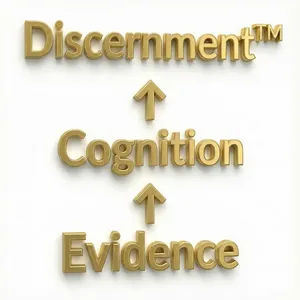
Fusion Bridge — Pathway to AI Leadership explores how people can collaborate with AI without outsourcing judgment. The spine is a three-step method: Evidence → Cognition → Discernment — a bridge from what’s scattered to what’s chosen. Through essays, reflections, and practical examples, I show how the Context & Critique Rule™ keeps thinking visible, decisions explainable, and responsibility human.
Latest Episodes
The most recent episodes — sign up to get AI-powered summaries of each one.
- 2 days ago22 min
Context and Critique, AI Slop and Human Discovery
This source examines the risks of cognitive flatness in artificial intelligence, arguing that treating these systems as simple answer engines leads to the production of intellectual "slop". Author Greg Twemlow introduces the Context & Critique Rule™ as a necessary framework for maintaining human agency and accountability during high-stakes digital collaborations. By intentionally applying cognitive friction, users can move beyond superficial machine fluency to achieve genuine discovery and innovation. The text emphasises that while AI can manage middle-layer operations like data synthesis, humans must remain responsible for the origination and moral consequences of the work. Ultimately, the article advocates for a sovereign remix approach where practitioners use AI as an associative partner rather than a replacement for critical thinking. This method ensures that the final output is a governed piece of human judgment that can withstand public scrutiny. Read the article.About the Author - Greg Twemlow writes and teaches at the intersection of technology, education, and human judgment. He works with educators and businesses to make AI explainable and assessable in classrooms and boardrooms — to ensure AI users show their process and own their decisions. His cognition protocol, the Context & Critique Rule™, is built on a three-step process: Evidence → Cognition → Discernment — a bridge from what’s scattered to what’s chosen. Context & Critique → Accountable AI™. © 2025 Greg Twemlow. “Context & Critique → Accountable AI” and “Context & Critique Rule” are unregistered trademarks (™).
- 3 days ago34 min
Why Concentrated Capital Is the 21st Century’s Greatest Vulnerability
In this article, Greg Twemlow argues that the long-standing industrial preference for centralised infrastructure has transformed from an economic strength into a dangerous security vulnerability. He explains that modern advancements in cheap, precision technology, such as drone swarms, allow adversaries to easily disable massive assets by merely targeting their unhardened external connectors. This shift has created a cost-exchange inversion where the financial burden of defending monolithic power grids, naval fleets, and AI clusters far outweighs the cost of attacking them. Consequently, the financial insurability of these concentrated systems is collapsing as risk models struggle to account for such asymmetric threats. To survive, Twemlow suggests that society must pivot toward distributed redundancy, embracing cellular energy grids, localised computing, and adaptive education systems. He concludes that true resilience in the twenty-first century requires dismantling the monolith in both our physical architecture and our institutional thinking. Read the article.About the Author - Greg Twemlow writes and teaches at the intersection of technology, education, and human judgment. He works with educators and businesses to make AI explainable and assessable in classrooms and boardrooms — to ensure AI users show their process and own their decisions. His cognition protocol, the Context & Critique Rule™, is built on a three-step process: Evidence → Cognition → Discernment — a bridge from what’s scattered to what’s chosen. Context & Critique → Accountable AI™. © 2025 Greg Twemlow. “Context & Critique → Accountable AI” and “Context & Critique Rule” are unregistered trademarks (™).
- 5 days ago18 min
Why Humanity Should Adopt the Voyager Playbook
Greg Twemlow’s essay explores the Voyager space mission as a masterclass in long-term vision and intergenerational stewardship. Although originally designed for a five-year task, the spacecraft have endured for nearly half a century because the engineers planned for possibilities far beyond their initial mandate. Twemlow introduces the "Voyager Playbook," a set of principles that prioritise adaptability and purpose over rigid adherence to original plans. He also highlights the role of "Discerner Architects," those capable of managing complex systems by distinguishing enduring goals from outdated methods. Ultimately, the text serves as a metaphor for humanity's future, arguing that while artificial intelligence may help us navigate, humans must retain the sovereign authority to define our own destination. Read the article.About the Author - Greg Twemlow writes and teaches at the intersection of technology, education, and human judgment. He works with educators and businesses to make AI explainable and assessable in classrooms and boardrooms — to ensure AI users show their process and own their decisions. His cognition protocol, the Context & Critique Rule™, is built on a three-step process: Evidence → Cognition → Discernment — a bridge from what’s scattered to what’s chosen. Context & Critique → Accountable AI™. © 2025 Greg Twemlow. “Context & Critique → Accountable AI” and “Context & Critique Rule” are unregistered trademarks (™).
- 1 weeks ago15 min
AI Workflow Redesign as the New Apprentice Proving Ground
The provided text argues that artificial intelligence is currently dismantling the traditional developmental rungs where junior workers once learned professional judgement. To solve this, author Greg Twemlow proposes a new apprenticeship model focused on AI workflow redesign, where novices act as systems interrogators rather than mere production clerks. By mapping organisational processes using ANSI syntax, apprentices identify where machines can handle high-volume tasks while ensuring human discernment remains the final decision gate. This approach addresses the mapping problem—the difficulty firms face in integrating AI effectively—by leveraging the fresh perspective of the beginner under the expert guidance of a mentor. Ultimately, the framework transforms potential job displacement into a generational alliance, creating a structured pathway for students and new employees to develop accountable leadership in a technology-driven landscape. Read the article.About the Author - Greg Twemlow writes and teaches at the intersection of technology, education, and human judgment. He works with educators and businesses to make AI explainable and assessable in classrooms and boardrooms — to ensure AI users show their process and own their decisions. His cognition protocol, the Context & Critique Rule™, is built on a three-step process: Evidence → Cognition → Discernment — a bridge from what’s scattered to what’s chosen. Context & Critique → Accountable AI™. © 2025 Greg Twemlow. “Context & Critique → Accountable AI” and “Context & Critique Rule” are unregistered trademarks (™).
- 1 weeks ago15 min
Why an AI World Needs a 2,400-Year-Old Philosopher
In an age dominated by artificial intelligence, Greg Twemlow argues that we must adopt the Socratic method to maintain our intellectual independence. He warns that relying on the effortless fluency of machine-generated answers leads to a dangerous state of cognitive passivity and unearned certainty. To counter this, individuals should treat AI as a challenging interlocutor rather than a definitive oracle, using rigorous cross-examination to expose hidden biases and logical contradictions. By embracing epistemic humility—the honest admission of what we do not know—we create the necessary friction for genuine understanding. Ultimately, the text suggests that our sovereignty as thinkers depends on our courage to pause, interrogate consensus, and look past the polished rhetoric of automated systems. Read the article.About the Author - Greg Twemlow writes and teaches at the intersection of technology, education, and human judgment. He works with educators and businesses to make AI explainable and assessable in classrooms and boardrooms — to ensure AI users show their process and own their decisions. His cognition protocol, the Context & Critique Rule™, is built on a three-step process: Evidence → Cognition → Discernment — a bridge from what’s scattered to what’s chosen. Context & Critique → Accountable AI™. © 2025 Greg Twemlow. “Context & Critique → Accountable AI” and “Context & Critique Rule” are unregistered trademarks (™).
- 1 weeks ago21 min
The Formation Debt We Cannot See
Greg Twemlow explores the concept of formation debt, which occurs as artificial intelligence increasingly automates the entry-level tasks once performed by human novices. This shift creates an immediate productivity dividend for companies, but it simultaneously removes the essential "apprenticeship" through which young workers develop professional judgment and expertise. By replacing junior roles with automated systems, the text argues that society is losing the developmental infrastructure required to produce the next generation of leaders and specialists. The consequences are often hidden because they result from a lack of hiring rather than sudden layoffs, leaving graduates stranded between education and adulthood. Ultimately, the author suggests that knowledge professions must adopt the deliberate apprenticeship models seen in the trades to ensure human capability is renewed. This growing liability threatens the future stability of organisations and communities by hollowing out the long-term supply of experienced professionals. Read the article.About the Author - Greg Twemlow writes and teaches at the intersection of technology, education, and human judgment. He works with educators and businesses to make AI explainable and assessable in classrooms and boardrooms — to ensure AI users show their process and own their decisions. His cognition protocol, the Context & Critique Rule™, is built on a three-step process: Evidence → Cognition → Discernment — a bridge from what’s scattered to what’s chosen. Context & Critique → Accountable AI™. © 2025 Greg Twemlow. “Context & Critique → Accountable AI” and “Context & Critique Rule” are unregistered trademarks (™).
- 2 weeks ago23 min
The Reading Crisis Is Also a Crisis of Formation
Greg Twemlow explores the reading crisis as a fundamental failure in human formation, arguing that literacy is essential for developing personal agency and judgment. He introduces the Expression-to-Agency Pathway, which uses storytelling, peer rehearsal, and public presentation to help students gain confidence through lived experience. While artificial intelligence did not cause these educational issues, it can conceal the problem by producing high-quality work that masks a person's lack of true understanding. Twemlow contends that without mastering literacy, individuals risk becoming dependent on technology, ultimately losing their cognitive sovereignty. To prevent this, he advocates for educational methods that ensure humans remain the source of meaning and take full accountability for their work. Read the article.About the Author - Greg Twemlow writes and teaches at the intersection of technology, education, and human judgment. He works with educators and businesses to make AI explainable and assessable in classrooms and boardrooms — to ensure AI users show their process and own their decisions. His cognition protocol, the Context & Critique Rule™, is built on a three-step process: Evidence → Cognition → Discernment — a bridge from what’s scattered to what’s chosen. Context & Critique → Accountable AI™. © 2025 Greg Twemlow. “Context & Critique → Accountable AI” and “Context & Critique Rule” are unregistered trademarks (™).
- 2 weeks ago17 min
The Machine Wants Your Compliance
In this essay, Greg Twemlow explores the intersection of human agency and technological systems by synthesising the philosophies of Albert Camus and Joseph Campbell. He argues that modern society acts as an impersonal machine that demands compliance through algorithms, bureaucracy, and a focus on efficiency over empathy. By examining Campbell’s mythic monomyth alongside Camus’s concept of the absurd, the author presents a framework for maintaining personal integrity against dehumanising forces. While Campbell provides the internal psychological spine to face one’s own fears and ego, Camus offers an ethical shield to resist systemic injustice and abstraction. Ultimately, the text suggests that meaning is not a gift from the universe but a deliberate act of human creation that requires individuals to remain consciously awake and sovereign. Read the article.About the Author - Greg Twemlow writes and teaches at the intersection of technology, education, and human judgment. He works with educators and businesses to make AI explainable and assessable in classrooms and boardrooms — to ensure AI users show their process and own their decisions. His cognition protocol, the Context & Critique Rule™, is built on a three-step process: Evidence → Cognition → Discernment — a bridge from what’s scattered to what’s chosen. Context & Critique → Accountable AI™. © 2025 Greg Twemlow. “Context & Critique → Accountable AI” and “Context & Critique Rule” are unregistered trademarks (™).
About Evidence → Cognition → Discernment️ - Your Pathway to AI Leadership
Fusion Bridge — Pathway to AI Leadership explores how people can collaborate with AI without outsourcing judgment. The spine is a three-step method: Evidence → Cognition → Discernment — a bridge from what’s scattered to what’s chosen. Through essays, reflections, and practical examples, I show how the Context & Critique Rule™ keeps thinking visible, decisions explainable, and responsibility human.
Customized Recaps
AI-powered recaps with compact key takeaways, quotes, and insights.
Straight to Your Inbox
Get key takeaways from Evidence → Cognition → Discernment️ - Your Pathway to AI Leadership in a 5-minute read.
Save Hours Every Week
Stay current on your favorite podcasts without falling behind.
Frequently Asked Questions
What is Podzilla's Evidence → Cognition → Discernment️ - Your Pathway to AI Leadership daily summary?
It's a free AI-powered email that summarizes new episodes of Evidence → Cognition → Discernment️ - Your Pathway to AI Leadership as soon as they're published. You get the key takeaways, notable quotes, and links & mentions — all in a quick read.
How does the Evidence → Cognition → Discernment️ - Your Pathway to AI Leadership podcast summary work?
When a new episode drops, our AI transcribes and analyzes it, then generates a personalized summary tailored to your interests and profession. It's delivered to your inbox every morning.
Is this an official Evidence → Cognition → Discernment️ - Your Pathway to AI Leadership product?
No. Podzilla is an independent service that summarizes publicly available podcast content. We're not affiliated with or endorsed by Greg Twemlow.
Can I get summaries of other podcasts too?
Absolutely! The free plan covers up to 3 podcasts. Upgrade to Pro for 15, or Premium for 50. Browse our full catalog at /podcasts.
How often does Evidence → Cognition → Discernment️ - Your Pathway to AI Leadership release new episodes?
Evidence → Cognition → Discernment️ - Your Pathway to AI Leadership publishes every few days. Our AI generates a summary within hours of each new episode.
What topics does Evidence → Cognition → Discernment️ - Your Pathway to AI Leadership cover?
Evidence → Cognition → Discernment️ - Your Pathway to AI Leadership covers topics including Technology, Education, Business, Management, Self-Improvement. Our AI identifies the specific themes in each episode and highlights what matters most to you.
Start getting Evidence → Cognition → Discernment️ - Your Pathway to AI Leadership summaries tomorrow morning.
Free forever for up to 3 podcasts. No credit card required.
Free forever for up to 3 podcasts. No credit card required.