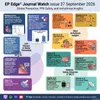
EP Edge Journal Watch 37: LAAO vs DOACs, PFA Stroke Risk, Wearable AF Monitoring, PVC Localization, and SGLT2 Sudden Death
In EP Edge® Journal Watch Issue 37, September 2026, Dr. Sharma reviews 13 important studies in cardiac electrophysiology, with a focus on what the data actually mean for clinical practice. This episode goes beyond abstracts and headline results to examine why each study was performed, the clinical question investigators were trying to answer, the methodology used, the statistics behind the major findings, important limitations, and what the results may mean for electrophysiologists going forward.This episode begins with a major theme in contemporary atrial fibrillation care: left atrial appendage occlusion and stroke prevention.First, we examine the mechanistic study “Left Atrial Appendage Thrombosis in Patients With Atrial Fibrillation” from Ji Zhou and colleagues. Histologic examination of surgically removed appendages from LAAOS III participants identified microscopic thrombi in the trabecular crypts, raising important questions about persistent local thrombogenicity despite anticoagulation and providing biological context for why mechanical left atrial appendage exclusion may provide additional protection in selected patients.We then turn to two important meta-analyses comparing left atrial appendage occlusion with medical therapy. The contemporary randomized evidence suggests that LAAO may substantially reduce nonprocedural bleeding, but the possibility of a modest increase in ischemic stroke remains unresolved. The discussion focuses on why LAAO should be viewed as a trade-off between procedural risk, long-term bleeding exposure, and stroke protection rather than simply as an equivalent replacement for direct oral anticoagulation.The episode then examines the ADVANCE LAA study, led by Dhanunjaya Lakkireddy, evaluating Amulet implantation in patients who failed Watchman anatomical screening. Despite more challenging left atrial appendage anatomy, Amulet implantation remained highly successful, reinforcing an important practical concept: failure of one device geometry does not necessarily mean failure of the LAAO strategy.Next, we review randomized evidence comparing direct oral anticoagulants versus dual antiplatelet therapy after left atrial appendage closure. The pooled data showed markedly lower device-related thrombus with DOAC-based therapy and, perhaps surprisingly, less major and minor bleeding than with DAPT. The clinical question is no longer simply whether anticoagulation can be stopped, but what antithrombotic strategy provides the safest bridge through the early device-healing period.The second major theme is pulsed field ablation safety and lesion durability.A major Circulation study led by Enrico Ferro compared neurological outcomes after pulsed field ablation and radiofrequency ablation. Although absolute stroke and TIA rates remained low, PFA was associated with a higher 30-day neurovascular event rate in this observational registry. Dr. Sharma discusses the difference between relative and absolute risk, why propensity adjustment cannot eliminate residual confounding, and why rapid adoption of PFA makes rigorous post-market safety surveillance essential.We then examine “Transmurality and Autonomic Effects of Pulsed Field Ablation on the Mitral Isthmus” by Apoor Patel and colleagues. Using direct vein of Marshall recordings, investigators demonstrated that apparent endocardial mitral isthmus block frequently concealed persistent epicardial conduction. PFA alone achieved complete block in fewer than half of patients, while vein of Marshall ethanol infusion substantially increased block rates. The study also demonstrated that PFA generally spared local parasympathetic innervation, whereas ethanol infusion produced denervation. The findings raise important questions about how we define lesion completeness in the PFA era.The episode then moves to atrial fibrillation detection and prediction.The PAVA score, developed by Baptiste Maille and colleagues, attempts to identify patients at lower likelihood of AF detection after cryptogenic stroke using premature atrial contractions, age, significant valvular disease, and left atrial enlargement. The score performed well in internal validation but less strongly in external validation, highlighting why prediction models should be judged by more than their best AUC.We also discuss the study “Wearable smartwatches for atrial fibrillation detection and burden estimation after ablation: comparison with continuous monitoring.” Using continuous implantable cardiac monitor data from CIRCA-DOSE, investigators simulated Apple Watch and Fitbit AF-detection algorithms. Smartwatch strategies detected substantially more recurrence than conventional short Holter monitoring, while wearable-estimated AF
Podzilla Summary coming soon
Sign up to get notified when the full AI-powered summary is ready.
Free forever for up to 3 podcasts. No credit card required.
Listen to This Episode
More from EP Edge Journal Watch: Cardiac Electrophysiology Research

EP Edge Journal Watch 39 | October 2026: PIFPAF-PFA, Ablation Durability and Left Bundle Area ICD Leads
EP Edge Journal Watch Issue 38 September 2026 with Heart Rhythm Society at HRX: AI ECG Interpretation, Wearable-Detected Ventricular Tachycardia, and LBBAP vs Deep Septal Pacing
EP Edge Journal Watch 36: ESC 2026, AF Ablation and Sham Trials | PVI-SHAM-AF, PFA-SHAM, SHAM-PVI, FlexPulse, NEXAF, IDEAL-AF, ENRICH-AF

EP Edge Journal Watch Issue 35: ESC 2026 Munich Special Edition | SINGLE-AF, CMR GUIDE, New HF Guidelines & Fifth Universal Definition of MI
Get summaries like this every morning.
Free AI-powered recaps of EP Edge Journal Watch: Cardiac Electrophysiology Research and your other favorite podcasts, delivered to your inbox.
Free forever for up to 3 podcasts. No credit card required.