Free Daily Podcast Summary
EMS One-Stop: Daily Summaries Delivered
by emsonestop
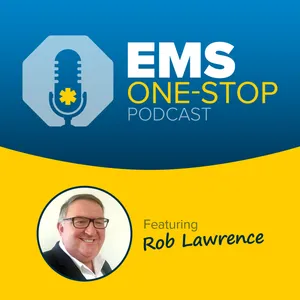
Explore the forefront of EMS leadership with Rob Lawrence on the ”EMS One-Stop” Podcast. Tackling critical issues like staffing, service delivery and operational challenges, each episode delves into the latest in patient care enhancement, EMS technology advancements; and emerging trends like AI, telehealth, quality improvement and alternate destinations with industry experts. Rob Lawrence brings to the table his extensive expertise from decades of service spanning the American Ambulance Association, AIMHI, Richmond Ambulance Authority, Pro EMS, Prodigy EMS Education and the East Anglian Ambulance NHS Trust. Stay informed with the latest EMS industry news, organizational updates and inspiring agency success stories. Tune in to the ”EMS One-Stop” Podcast for a deep dive into the challenges and triumphs of EMS leadership in today’s dynamic prehospital care landscape.
Latest Episodes
The most recent episodes — sign up to get AI-powered summaries of each one.
- 2 days ago25 min
From combat medic to physician: Meet the 2026 NAEMT Paramedic of the Year
In this episode of EMS One-Stop, host Rob Lawrence sits down with Oscar Monterrosa, the 2026 NAEMT Paramedic of the Year, whose career has taken him from Army combat medic to street paramedic, medical student and now an emergency medicine-internal medicine resident at Hennepin County Medical Center. Yet despite the white coat and demands of residency, Monterrosa continues to work on the ambulance, including in rural Minnesota, and remains closely connected to the profession that shaped his approach to medicine. The conversation also returns to one of the defining moments of Monterrosa’s career: the Oct. 1, 2017, mass shooting in Las Vegas. Working an overtime special-event shift, Monterrosa was already inside the medical tent when gunfire began and casualties started arriving. He describes slipping into “work mode,” drawing on his experience as an Army combat medic in Iraq as he and others triaged and treated patients while the shooting was still underway. Beyond that extraordinary night, the discussion explores rural EMS, critical care and ECMO, education, mentorship and the long road from paramedic to physician. Monterrosa’s message to other EMS clinicians considering further education is straightforward: the road may be difficult and it may take longer than expected, but it is possible. Key quotes from Oscar Monterrosa “We have that critical call or whatever, somebody that's crashing right in front of you and you just kind of get into work mode.” “Even though there's still gunfire going on, you try to be as safe as you can and take cover, but ultimately all that is really out of your control.” “A lot of these experiences in the cornfields has been very rewarding, just seeing this different culture, like meeting a lot of different people.” “It just takes hard work and just not giving up.” “I was an undergrad for 9 years because I was working full time on the streets.” Additional resources National Association of Emergency Medical Technicians (NAEMT) NAEMT National EMS Awards of Excellence Hennepin Healthcare Las Vegas Metropolitan Police Department: October 1 / Las Vegas mass shooting – After-Action Report Episode timeline 00:52 – Rob introduces the 2026 NAEMT Paramedic of the Year 01:34 – Oscar 101: paramedic and emergency medicine-internal medicine resident 02:05 – Oscar hears what his colleagues wrote about him in his award nomination 04:04 – His reaction to being named National Paramedic of the Year 05:00 – The journey into EMS, military medicine and becoming a paramedic 07:20 – From the desert Southwest to rural Minnesota EMS 09:00 – The realities of rural 911 response and long interfacility transports 10:15 – Critical access hospitals and managing high-acuity patients 12:30 – The conversation turns to October 1, 2017, in Las Vegas 13:17 – What began as a routine special-event EMS shift 13:55 – Reports of gunfire and the first shooting victims reaching the medical tent 14:24 – What happens mentally when a mass-casualty incident suddenly unfolds 15:00 – Combat medic training, triage and functioning while gunfire continues 17:00 – Reflections on the Las Vegas response and its lasting impact 18:00 – From paramedic to physician: why Oscar continued his education 19:30 – Rural critical care, cardiac arrest and mobile ECMO 21:00 – Remaining connected to EMS while completing medical residency 23:00 – Advice for paramedics considering college or medical school 23:42 – Nine years as an undergraduate while working full time on the streets 24:00 – Perseverance, education and why the path is still achievable Closing – Looking ahead, mentorship and what being NAEMT Paramedic of the Year means to Oscar Enjoying the show? Email editor@ems1.com to share feedback.
- 1 weeks ago1h 14m
What ‘never forget’ means 25 years later
FDNY Chief of Department John Esposito recounts FDNY’s devastating losses, the decisions that saved thousands of lives and why honoring 9/11 means preparing the next generation to meet the moment Twenty-five years after Sept. 11, 2001, FDNY Chief of Department John Esposito joins podcast hosts Jim Dudley, Rob Lawrence and Aaron Zamzow of Police1’s Policing Matters, EMS1's EMS One-Stop and FireRescue1’s Better Every Shift for a deeply personal conversation about 9/11, its enduring impact and the lessons that continue to shape fire, EMS and law enforcement. Esposito was a newly promoted FDNY lieutenant on Sept. 11, 2001. He recalls returning to the city after the towers fell, the collapse of command and communications, the desperate effort to account for missing members, and the realization that FDNY had suffered unimaginable losses. The discussion moves beyond remembrance to examine what emergency services learned: stronger accountability, controlling self-deployment, incident management teams, interoperable communications, interagency cooperation, intelligence sharing and peer support. Esposito also reflects on the continuing toll of World Trade Center-related illness and explains why “never forget” must mean more than remembering 343 names. For him, it means remembering the decisions responders made, the conditions they faced and the thousands of lives their actions helped save. His challenge to today’s generation is simple: know your job, keep learning, take care of your people and ask whether you are prepared to “measure up” to those who came before. Key quotes from FDNY Chief of Department John Esposito “Never forget is not just their names and who they were, how they lived their lives, and most importantly, the decisions that they made that day and the actions that they took.” “They're like, ‘No, we think we lost everybody.’ And that was when it started to sink in that no, this is gonna be as bad as it could be.” “If we never showed up and we had no losses that day, the loss of civilians is in the tens of thousands.” “This is your legacy. This is our legacy, this is what we do, and these are the people that did this before us.” “I believe that some of them knew that they were not going to make it home that night. And they still did their job.” “September twelfth came, the doors of the firehouse went up, people got on fire trucks, and they went out and did their job.” “It was like an all-star team that we lost. Some of the best people to ever do this job we lost that day.” “I see my job here and our job in this building and headquarters is to take care of the people that take care of the city.” “We have no idea. We're in a firehouse or an ambulance one second and in five minutes we could be in the worst situation we've ever been in.” “It's our job to make sure that the people in the field are prepared and when they need something, it's our job to get it for them.” Episode timeline 00:27 – Introduction: EMS1, FireRescue1 and Police1 come together to reflect on 25 years since September 11 02:28 – Introduction: FDNY Chief of Department John Esposito 03:23 – Chief Esposito recalls Sept. 11, 2001 as a newly promoted lieutenant with a day off and plans to study for the captain’s exam 04:28 – Chief Esposito details arriving in lower Manhattan and finding command structures and communications devastated 05:04 – The desperate process of identifying who was alive, missing or lost 07:00 – Chief Esposito describes his initial response and why he never imagined the towers could collapse 09:00 – “We think we lost everybody.” When the magnitude of FDNY's losses began to become clear 09:30 – Accountability and self-deployment emerge as major lessons from 9/11 10:00 – How FDNY now wants off-duty members to report to firehouses and EMS stations rather than directly to an incident 10:30 – Modern digital accountability, riding lists and identifiable radio transmissions compared with 2001's paper systems 12:00 – The human factor: firefighters desperate to get aboard apparatus headed toward the World Trade Center 12:30 – Leadership decisions that removed extra firefighters from overloaded apparatus ultimately saved lives 14:00 – The continuing human toll: FDNY's memorial walls and deaths from World Trade Center-related illness 16:30 – How FDNY will commemorate the 25th anniversary 17:30 – Why September 11 remembrance is intensely personal for individual firefighters and families 21:00 – Chief Esposito discusses the emotional effect September 11 continues to have on him 22:00 – “Never forget” means remembering actions and decisions, not merely name
- 2 weeks ago37 min
Data versus Darwin with Todd Stout
AI may feel like the newest revolution in EMS, but the industry's relationship with data has been evolving for decades. In this episode of EMS One-Stop, Rob Lawrence sits down with FirstWatch founder Todd Stout, whose 28 years working with EMS data gives him a particularly long view of where the industry has been and where it is heading. Todd traces the journey from an era when monthly reports printed on green-bar paper were considered normal, to today's world of real-time dashboards, cloud-based systems and enormous volumes of operational and clinical information. The challenge has changed: EMS no longer suffers primarily from a lack of data; leaders now need technology that can identify what matters, separate signal from noise and turn information into decisions. That makes AI extraordinarily promising — and potentially dangerous. Todd explains why he is more excited about the next 3-5 years than at any point in his career, while simultaneously being more concerned about the next 8-10 months. Rob and Todd discuss unreliable AI outputs, data security, HIPAA and privacy, the risks associated with startups and what EMS leaders should ask before entrusting vendors with organizational or patient data. They also examine the urgent need for EMS agencies to establish AI policies and train their workforce on responsible use. Todd concludes with a preview of FirstWatch's next generation of AI-enabled tools and a broader message for EMS leaders: the organizations that thrive through this technology shift will not necessarily be those with the newest technology, but those capable of adapting, learning and using it responsibly. Additional resources: EMS1 Leadership Institute: 2026 Spotlight on AI in EMS: On-demand: Smart tools, strategic choices: EMS puts AI into action Why EMS must measure the human side of care: What patients remember No rulebook is coming: EMS must take control of AI now: Why EMS must govern AI locally as adoption accelerates Hyper-turbulent times: EMS economics and AI guardrails with Matt Zavadsky and Dr. Shannon Gollnick: Why EMS needs AI guardrails and Medicare reform today Memorable quotes "I'm more excited about the next 3-5 years than I've ever been, I am also more scared about the next 8-10 months for our industry than I've ever been because it's so messy." — Todd Stout "Nobody gets into EMS to be excellent data enterers." — Todd Stout "AI well formed — with the proper bumpers, guidelines, rules around it — is astonishingly good at processing through lots of data." — Todd Stout "If you're not paying for the thing that you're using, you are the product." — Todd Stout "AI to many people seems like magic. And it's the opposite of magic almost. It's a lot of work and plumbing to get it right." — Todd Stout Episode timeline 00:27 – Rob introduces the episode and the evolution of EMS data, information and AI 01:54 – Twenty-eight years of FirstWatch: from Stout Solutions to today's real-time data environment 03:57 – Looking back at EMS's early adoption of real-time operational data 05:18 – Why immediate data can improve individual performance and expose problems with systems and protocols 06:24 – The "ah, buts:" gut instinct versus what the data actually shows 07:19 – Dirty data, disconnected systems and why organizations sometimes don't believe their own numbers 09:45 – EMS has moved from too little information to information overload 10:31 – How AI can sift through enormous amounts of data and identify what leaders actually need to know </l
- 2 weeks ago55 min
Liz Harney on the human side of EMS
This week on EMS One-Stop, I sit down with Liz Harney, almost a year after I first walked into a classroom at EMS World Expo looking for another session to report on and found what I later described as “the keynote I didn’t know I needed.” Liz’s presentation was built around a part of EMS education we routinely acknowledge but rarely give equal billing: the affective domain — empathy, communication, professionalism, self-awareness and the ability to connect with another human being in what may be the worst moment of their life. But the real power came from Liz herself. Before she was a paramedic, educator and EMS leader, she was the patient. At the lowest point of a decade-long struggle with addiction, one paramedic looked beyond the overdose, the circumstances and the judgement, and treated her as a person who still mattered. Liz credits that interaction not simply with helping save her clinically, but with changing the trajectory of her life. She recovered, entered EMS and ultimately became the kind of paramedic she had encountered that day. It is a remarkable journey from patient to paramedic, and in this conversation, Liz explains why that experience now sits at the heart of everything she teaches about the human side of EMS. | MORE: Liz Harney — the affective domain is the heart of EMS, so why aren’t we teaching it? Our discussion also catches up with where Liz’s thinking has evolved since. In her recent EMS1 article, “Shiny Happy People,” she takes that same belief in people and applies it to EMS leadership, challenging professionals that is exceptionally good at identifying everything that might go wrong not to let that instinct extinguish every new idea before it gets moving. Together, we connect those themes: the provider who changed one patient’s life, the importance of deliberately teaching the affective domain, turning cynics into champions, recognizing burnout through QA and QI, and creating leadership teams with enough optimism and emotional intelligence (EI) to make change happen. At a time when EMS is increasingly consumed by another form of intelligence (AI), the conversation comes back to a proposition I think matters more and more: if we are going to get good at AI, we first need to get much better at EI. Additional resources: Liz Harney: Shiny happy people. The leadership power of optimism Rob Lawrence: The affective domain is the heart of EMS — so why aren’t we teaching it? Inside EMS: Tactical empathy: The leadership tool you’re not using enough Colby Davis: Can emotional intelligence be taught? Shannon L. Gollnick: The paradox of progress — emotional intelligence as the differentiator in an AI-augmented workforce Key quotes “It truly was a paramedic that not only saved me in a clinical sense, but she saved me in a human sense.” — Liz Harney “Everybody has a story and they’re all a little the same, but they’re all very different at the same time.” — Liz Harney “It’s our role as educators and program directors to be able to ensure that we are instilling, improving the affective domain, just as we are the cognitive and the psychomotor.” — Liz Harney “You created from the cynic, turned them into the champion, and then the champion then took that back to their own service.” — Rob Lawrence “I am the dreamer, probably because I have forged myself out of the depths of hell.” — Liz Harney “Look at me, anything is possible. Like there is never a ‘no’ in my language.” — Liz Harney “In order to build, in order to make change, in order to move the needle, you have to have folks that are strong in EI to make that happen.” — Liz Harney “There’s always room for improvement.” — Liz Harney “I may not be able to teach everyone to care, but I absolutely think you can teach people what caring looks like in practice.” — Liz Harney “No one’s ever complained about the gauge of needle that we used, but they’ve certainly complained that the me
- Aug 21, 202636 min
EMS One-Stop: The EMS research every clinician should be reading
EMS research has grown rapidly, but finding the studies that truly matter to everyday clinical practice remains a challenge. In this edition of EMS One-Stop, Rob Lawrence is joined by Dr. Christopher Richards, EMS and emergency physician at the University of Cincinnati; and Dr. Christian Martin-Gill, chief of the Division of EMS at the University of Pittsburgh and former president of the Prehospital Guidelines Consortium, to discuss the recently published EMS research reading list and the effort to identify the most important evidence EMS clinicians and medical directors should know about. The discussion explores how the reading list was created; why a significant gap remains between publication and implementation; and how EMS can better translate research into education, protocols and patient care. Richards and Martin-Gill explain the mix of evidence-based guidelines, position statements, systematic reviews and original research included in the project, while highlighting major gaps in behavioral emergencies, pediatrics, obstetrics, workforce wellness and EMS operations. The message is clear: EMS practitioners should not wait for new research to appear in their protocols. They should read it, discuss it, question current practice and, where evidence is lacking, consider contributing to research that closes the gap. Additional resources: Richards CT, Cash RE, Crowe RP, et al. 2026. “Developing an emergency medical services research reading list for emergency medical services practitioners.” Prehospital Emergency Care, 1-6. https://doi.org/10.1080/10903127.2026.2693158 EMS1 Research Center. A central access point for critical research that can help drive operational and policy changes Understanding research and its impact on patient care. David Page, MS; Hezedean Smith, DM; and Ayanna Walker, MD, share best practices for evaluating and interpreting prehospital research Key quotes “With EMS research, there's always something missing. There's always more that we can do.” — Dr. Christian Martin-Gill “What we're seeing here, particularly over the last decade, is these organizations working less as silos and moving more towards working together when it makes sense to do that.” — Dr. Christian Martin-Gill “We didn't go in actually feeling like we needed to identify 10 primary research or professional statements that complemented the guidelines that were already identified through the systematic review. But there was just a natural break point there.” — Dr. Christopher Richards “There are a number of position statements that are published by national and international organizations that are key scientific literature out there that people need to be paying attention to.” — Dr. Christian Martin-Gill “Still there is research lacking in what the EMS clinicians themselves experience as part of the workforce — safety on scene, wellness, these sort of questions.” — Dr. Christopher Richards “The behavioral emergency space I think is really important right now.” — Dr. Christian Martin-Gill Episode timeline 01:09 – Rob introduces the episode and welcomes Drs. Christopher Richards and Christian Martin-Gill 02:16 – Dr. Richards introduces his EMS, emergency medicine and research background 03:18 – Dr. Martin-Gill discusses his role at the University of Pittsburgh, UPMC and the Prehospital Guidelines Consortium 04:15 – Why does EMS need a dedicated research reading list? 07:11 – Where can EMS practitioners currently go to identify the research that really matters? 09:13 – Moving research into protocols, practice and clinical care 11:15 – Can the Prehospital Guidelines Consortium help align the many organizations producing EMS clinical guidance? 13:41 – Breaking down the different categories
- Aug 16, 202639 min
Knoxville’s Mission District model takes EMS beyond the 911 call
In this episode of EMS One-Stop, Rob Lawrence speaks with Wesley Brookshear, critical care paramedic and FTO program supervisor with AMR in Knoxville, Tennessee, about a community-led effort that is changing how EMS responds to the city’s Mission District. What began as an attempt to understand unusually high 911 utilization has evolved into a multidisciplinary outreach program bringing EMS, public health, addiction services, shelter providers, clinicians and other community organizations directly to Knoxville’s unhoused population. By concentrating on relationships, consistency and basic human needs, the initiative has produced a reported 32% reduction in traditional EMS call volume while dramatically expanding access to wound care, food, addiction treatment, mental health support, nurse navigation and other services. Wesley explains why the program’s success is less about creating another specialized EMS unit and more about connecting people to the resources that already exist. The team initially arrived without uniforms, handed out fruit, listened and built trust before attempting to provide care. Two years later, the program has recorded thousands of encounters, helped more than 140 people enter treatment or sober living and generated remarkably few ambulance transports from its outreach activity. The conversation explores how other EMS systems can identify high-utilization areas, develop community partnerships, protect the mental health of outreach staff and start small—even with a single motivated employee. Above all, Wesley argues that EMS has an opportunity to move beyond simply transporting patients and instead become the connector that gets people to the care and resources they actually need. Additional resources: Global Medical Response - AMR Mission District Medical Team Program Sees 32 Percent Decline in 911 Calls eBook: How to fund community paramedicine Very high EMS utilizers: 7 strategies for local action From sirens to solutions: Guiding paramedics to a patient-centered mindset Public health at the front door: An MIH model to emulate Key quotes “We did go down without our EMS uniforms on. We went in black t-shirts, blue jeans and started making connections.” — Wesley Brookshear “We have noticed a 32% reduction in our normal call volume down at the mission since we started this program 2 years ago.” — Wesley Brookshear “MIH, mobile integrated healthcare, isn't a title; it's actually a list. It's mobile, it's integrated and it's healthcare.” — Rob Lawrence “This is not Wesley Brookshear, this is not AMR, this is an entire community of Knox County citizens that are coming together to support.” — Wesley Brookshear “We talk about the homeless or the unhoused, and I do use both terms, but the unhoused, and we act like it's those individuals; it's never those individuals, those are humans within your community.” — Wesley Brookshear “My mission wasn't admission avoidance, it was arrival avoidance.” — Rob Lawrence “Our folks are wrapping their own wounds now. We are providing supplies. We are giving education.” — Wesley Brookshear “Do not go down with the idea that you're going to cure this idea that homelessness is going to go away.” — Wesley Brookshear Episode timeline 00:49 –
- Aug 7, 202631 min
Grant funding demystified with Anya Otterson
Finding grant funding can feel overwhelming, particularly for smaller EMS and fire agencies where one person often wears multiple hats. In this episode of the EMS One-Stop podcast, host Rob Lawrence is joined by Lexipol Grant Writer and Colorado Firefighter-Paramedic Anya Otterson to demystify the grant-writing process. From identifying funding priorities and locating grant opportunities, to building a compelling case backed by data, Anya provides a practical roadmap for agencies looking to secure funding for equipment, staffing and operational improvements. She explains why success starts with clearly defining organizational needs, understanding grant priorities, and assembling evidence that demonstrates both community impact and operational necessity. The discussion explores the complete grant lifecycle, from preparing competitive applications, through to post-award reporting and compliance. Anya emphasizes that strong grant applications combine hard data with real patient stories, while Rob shares lessons learned from managing successful Assistance to Firefighters Grants (AFG) and transportation safety grants. They also discuss how AI tools such as ChatGPT can accelerate research when used appropriately — but caution against relying on AI to write narratives outright. The episode concludes with encouragement for agencies to not be discouraged by unsuccessful applications, reminding listeners that grant writing is an iterative process where persistence and continual improvement often lead to success. Additional resources EMS1 GrantFinder: Our suite of solutions gives agencies direct access to seasoned grant professionals—backed by over 500 years of combined experience—along with a comprehensive tailored grant database Assistance to Firefighters Grants: Meeting firefighting and emergency response needs On-demand webinar: Grants Day — Your funding playbook. Get the insights, expert advice and tools to help your agency score big on grants Key quotes "The data and statistics are incredibly important when writing grants, but to try to set yourself apart, I do like to have a little bit more of a personal touch." — Anya Otterson "Figure out what kinds of things you want funding for and prioritize it." — Anya Otterson "You've got to be in it to win it." — Rob Lawrence "Give yourself enough time. This is not a day-before kind of thing." — Anya Otterson "Making sure that everybody's on the same page is critical because this is not something you can really do in a silo." — Anya Otterson "Never be afraid to reach out to the funding agency with questions. Their job is to help you through the process." — Anya Otterson "ChatGPT should not be writing your narratives for you." — Anya Otterson "If you don't get funded the first time, keep trying." — Anya Otterson "The juice is worth the squeeze." — Rob Lawrence Episode timeline 00:00 – Introduction and why so many EMS leaders struggle to know where to begin with grants 01:30 – Meet Firefighter-Paramedic and Lexipol Grant Writer Anya Otterson 03:00 – The first step: identifying and prioritizing organizational funding needs 04:00 – Where to find grants, including GrantFinder, ChatGPT, state resources and direct outreach 05:45 – Overview of FEMA's Assistance to Firefighters Grant (AFG) program 07:00 – Understanding funding priorities and why high-priority requests have the greatest chance of success 09:00 – Building a compelling grant narrative using statistics, research and patient stories 12:30 – Grant writing bes
- Jul 24, 202632 min
Why EMS can’t sing along with this Anthem
Matt Zavadsky explains how a commercial insurer’s reimbursement proposal — and looming Medicaid changes — could reshape EMS funding In this week’s episode of EMS One-Stop, we examine two major financial threats facing EMS reimbursement. Host Rob Lawrence is joined by Matt Zavadsky to analyze the recent Elevance (Anthem) Health Public Policy Institute paper, which argues that commercial insurers should reimburse ambulance services at approximately 160% of the Medicare fee schedule. Zavadsky, EMS/mobile healthcare consultant with PWW | Advisory Group, explains why this paper is significant, noting that Medicare already reimburses below the actual cost of providing ambulance services. If policymakers adopt or even believe Elevance's recommendations, commercial reimbursement could fall dramatically, removing one of the few revenue sources that currently offsets chronic underpayments from Medicare and Medicaid. The discussion highlights the growing influence of commercial insurers in state legislatures and stresses the need for EMS leaders to counter policy proposals with credible cost and operational data rather than anecdotal arguments. The conversation then shifts to CMS's proposed Medicaid supplemental payment rule (GEMT), where Matt predicts that most of the proposed changes are likely to survive into the final rule despite industry opposition. Both hosts discuss their review of the public comments, noting differing impressions of stakeholder sentiment but agreeing that agencies should begin financial planning now for a potential reduction in supplemental Medicaid revenue beginning in 2029. Throughout the episode, the recurring theme is that EMS must become far more effective at explaining both the cost of readiness and the consequences of underfunding. The episode concludes on a more positive note by highlighting the newly released What Paramedics Want in 2026 report as a practical roadmap for improving workforce satisfaction while the industry continues addressing long-term reimbursement challenges. Additional resources The 160% mirage: Why every EMS leader should read the Elevance Ambulance Report When the spreadsheet meets the siren: How CMS’s Proposed GEMT Rule could reshape EMS funding What Paramedics Want in 2026 Key quotes "The commercial insurance industry is creating a story that elected officials may perceive as reasonable. We need to combat that story with facts." — Matt Zavadsky "Medicare reimbursement is already below cost, so using it as the benchmark automatically discounts ambulance services." — Matt Zavadsky "We do a great job telling stories about the lives we save. We do a poor job telling the story of what it costs to provide that service." — Matt Zavadsky "The balance billing issue is going to be the No. 1 issue in the next 12 months." — Matt Zavadsky "The first time local elected officials hear there's a problem is usually when the sky is already falling. We need to tell the story before the sky falls." — Matt Zavadsky "Know your costs; know your costs at different service levels, and begin educating your local community." — Matt Zavadsky "This isn't necessarily good news, but it's something we need to understand and all work together to deal with." — Rob Lawrence Episode timeline 00:00 – Introduction and the Elevance Health Public Policy Institute report 02:00 – Matt explains who Elevance Health is and why the report should be viewed as a commercial insurer's policy position 03:30 – Discussion of state balance billing legislation and how commercial insurers are successfully pushing lower reimbursement benchmarks 06:15 – Breakdown of what percentages of Medicare actually mean using national EMS financial data 08:30 – Why using Medicare as the reimbursement benchmark is fundamentally flawed because Medicare itself pays below cost 10:30 – Discussion on the political influence of insurers and why EMS must counter with data-driven messaging 12:30 – Why EMS has historically struggled to tell its financial story despite being effective
About EMS One-Stop
Explore the forefront of EMS leadership with Rob Lawrence on the ”EMS One-Stop” Podcast. Tackling critical issues like staffing, service delivery and operational challenges, each episode delves into the latest in patient care enhancement, EMS technology advancements; and emerging trends like AI, telehealth, quality improvement and alternate destinations with industry experts. Rob Lawrence brings to the table his extensive expertise from decades of service spanning the American Ambulance Association, AIMHI, Richmond Ambulance Authority, Pro EMS, Prodigy EMS Education and the East Anglian Ambulance NHS Trust. Stay informed with the latest EMS industry news, organizational updates and inspiring agency success stories. Tune in to the ”EMS One-Stop” Podcast for a deep dive into the challenges and triumphs of EMS leadership in today’s dynamic prehospital care landscape.
Customized Recaps
AI-powered recaps with compact key takeaways, quotes, and insights.
Straight to Your Inbox
Get key takeaways from EMS One-Stop in a 5-minute read.
Save Hours Every Week
Stay current on your favorite podcasts without falling behind.
Frequently Asked Questions
What is Podzilla's EMS One-Stop daily summary?
It's a free AI-powered email that summarizes new episodes of EMS One-Stop as soon as they're published. You get the key takeaways, notable quotes, and links & mentions — all in a quick read.
How does the EMS One-Stop podcast summary work?
When a new episode drops, our AI transcribes and analyzes it, then generates a personalized summary tailored to your interests and profession. It's delivered to your inbox every morning.
Is this an official EMS One-Stop product?
No. Podzilla is an independent service that summarizes publicly available podcast content. We're not affiliated with or endorsed by emsonestop.
Can I get summaries of other podcasts too?
Absolutely! The free plan covers up to 3 podcasts. Upgrade to Pro for 15, or Premium for 50. Browse our full catalog at /podcasts.
How often does EMS One-Stop release new episodes?
EMS One-Stop publishes weekly. Our AI generates a summary within hours of each new episode.
What topics does EMS One-Stop cover?
EMS One-Stop covers topics including Government, Medicine, Fitness, Health & Fitness. Our AI identifies the specific themes in each episode and highlights what matters most to you.
Start getting EMS One-Stop summaries tomorrow morning.
Free forever for up to 3 podcasts. No credit card required.
Free forever for up to 3 podcasts. No credit card required.