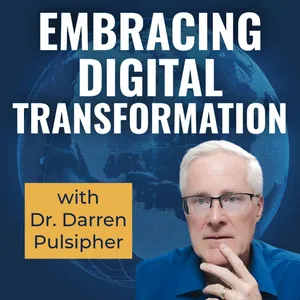
Free Daily Podcast Summary
Embracing Digital Transformation: Daily Summaries Delivered
by Dr. Darren Pulsipher
Dr. Darren Pulsipher, Chief Enterprise Architect for Public Sector, author and professor, investigates effective change leveraging people, process, and technology. Which digital trends are a flash in the pan—and which will form the foundations of lasting change? With in-depth discussion and expert interviews, Embracing Digital Transformation finds the signal in the noise of the digital revolution. Workers are at the heart of many of today’s biggest digital transformation projects. Learn how to transform public sector work in an era of rapid disruption, including overcoming the security and scalability challenges of the remote work explosion. Building an innovative IT organization in the public sector starts with developing the right processes to evolve your information management capabilities. Find out how to boost your organization to the next level of data-driven innovation. From the data center to the cloud, transforming public sector IT infrastructure depends on having the right technology solutions in place. Sift through confusing messages and conflicting technologies to find the true lasting drivers of value for IT organizations.
Latest Episodes
The most recent episodes — sign up to get AI-powered summaries of each one.
- 3 days ago42 min
#386 AI Transformation Fails Without Context: What Enterprise Leaders Need to Know
Check out my new book AI Augmented Teams on Amazon or on my website paidar.ai/books.AI transformation fails when teams skip the most important ingredient: context. Host Dr. Darren welcomes Artem Koren, Chief Product Technology Officer at Sembly AI, to unpack why enterprise AI success depends on clear intent, quality standards, and better requirements—not just buying a platform. They explore digital transformation, AI workflow redesign, and how to make AI actually useful in the real world. ## Key Takeaways - **AI is changing transformation from automation to reimagining work.** Many workflows are no longer just faster—they’re fundamentally different. - **Context is the missing layer.** AI performs best when it understands the business problem, the user, the brand, and the operating environment. - **“Intent technology” needs stronger requirements.** Unlike traditional software, AI outputs can vary, so leaders must define what good looks like up front. - **Large organizations face a bigger challenge.** Tribal knowledge, consistency, and brand standards make enterprise AI harder to deploy well. - **ROI requires a specific use case.** Don’t ask whether your company “uses AI”; ask whether AI improves a measurable business outcome. - **Presentation formats may need to evolve.** AI can help teams move beyond traditional slide decks and create more effective, audience-specific communication. ## Chapters - **00:00** Introduction: Why AI transformation fails without context - **02:00** Artem Koren’s background in technology, consulting, and AI - **07:10** How digital transformation has changed in the AI era - **12:40** Functional software vs. intent technology - **17:30** Why AI requires richer requirements and quality standards - **23:05** The role of context, culture, and tribal knowledge in enterprise AI - **29:10** Why “we use AI” is not a real ROI strategy - **35:20** Defining success for AI-powered workflows and presentations - **42:00** Reimagining slides, presentations, and communication with AI - **47:15** Sembly AI, the new product release, and how to connect with Artem
- 5 days ago32 min
#385 AI-Augmented Organizations
Check out my new book AI Augmented Teams on Amazon or on my website paidar.ai/books.AI governance is no longer a side project—it’s becoming an enterprise operating model. Doctor Darren and guest host Paige Pulsipher sit down with coauthor Jeremy Harris to unpack the new AI Augmented book for executives, exploring why responsible AI adoption, privacy, and clear measurement matter more than speed alone. ## Key Takeaways - **Adoption is not the same as value.** Measuring AI success by usage or spend misses the real question: is AI improving outcomes? - **Executives need an AI governance operating model.** C-suite leaders should define ownership, controls, and standards before scaling AI. - **Human judgment still matters.** AI should support decision-making, not replace accountability, expertise, or ethics. - **Shadow AI is a real risk.** If employees are already using AI tools, organizations need visibility, policy, and guardrails. - **The best AI strategy is deliberate.** Responsible AI implementation can reduce risk, improve speed, and strengthen business performance. - **AI augmentation is about amplifying people.** The goal is to free teams from repetitive work so they can focus on higher-value thinking and creativity. ## Chapters - **00:00** Introduction to AI governance for the enterprise - **02:05** Jeremy Harris’s background in law, privacy, and healthcare - **05:00** Why Darren brought Jeremy in as coauthor - **08:15** Writing the AI Augmented book as a collaboration - **12:10** What the new book covers: enterprise AI operating models - **16:05** Measuring AI success: ROI, KPIs, and adoption myths - **20:20** Who the book is for: CIOs, CEOs, legal, privacy, and executive leaders - **23:10** Fictional healthcare scenarios and field reports in the book - **27:00** Are Darren and Jeremy still friends after writing together? - **30:10** The AI Augmented Institute and the future of education - **35:05** AI, ethics, and concerns about dehumanization - **40:00** Why deliberate governance beats reactive AI adoption - **44:10** Final thoughts and call to action
- 1 weeks ago36 min
#384 Why Great Teachers May Have the Best AI Strategy
Check out my new book AI Augmented Teams on Amazon or on my website paidar.ai/books.The real AI literacy challenge isn’t learning the tool — it’s protecting human judgment while using it well. Dr. Darren sits down with Casey Cooney, California Teacher of the Year, to explore how AI in education can deepen learning, sharpen feedback, and keep curiosity, domain expertise, and empathy at the center of digital transformation. ## Key Takeaways - AI should **augment human thinking**, not replace it. The goal is better judgment, not faster shortcuts. - The pandemic showed the limits of putting learning entirely on screens; **human connection remains essential**. - In the classroom, AI can supercharge **formative assessment** by helping teachers spot misconceptions and adjust instruction in real time. - Students and workers need more than speed: they need **metacognition** (thinking about how you think) and **inquiry** (asking better questions). - Beautiful output is not the same as deep work — **domain expertise still matters** when using AI for writing, design, and research. - The future belongs to people who become **AI-augmented**: curious, adaptable, and confident enough to keep learning. ## Chapters - **00:00** AI, Human Judgment, and Why This Matters Now - **01:05** Casey Cooney’s Background Story - **05:40** Becoming a Teacher After Business and Cancer Survival - **09:15** What COVID and Remote Learning Taught Educators - **13:10** How AI Can Improve Formative Assessment - **17:20** Raising the Bar: Expect More From Students With AI - **21:10** AI Fakers vs. Real Domain Expertise - **25:05** Creativity, Writing, and Why Humans Still Matter - **29:00** Careers, Anxiety, and the Changing Job Market - **33:15** The Two Skills Students Need Most: Metacognition and Inquiry - **37:20** Leading With Empathy in the AI Era - **40:30** Casey’s AI Teaching App, Wit - **43:10** Closing Thoughts: AI Literacy and the Future of Learning
- 1 weeks ago42 min
#383 Sovereign AI Starts With Data Control, Not Bigger Models
Check out my new book AI Augmented Teams on Amazon or on my website paidar.ai/books.Sovereign AI is moving from a policy buzzword to a boardroom risk question, and Dr. Darren sits down with Usman Khalid to unpack why. Together they explore how data sovereignty, model governance, and AI accountability are reshaping enterprise AI strategy, especially for leaders balancing innovation, jurisdiction, and sensitive data protection. ## Key Takeaways - Sovereign AI is about control: owning the data, infrastructure, model behavior, and governance needed to keep systems running under your rules. - Many organizations can start with existing open-source or commercial models instead of building from scratch. - Clean, structured data is the first step; master data management and strong data classification create the foundation for trustworthy AI. - Annotation quality matters because AI outcomes depend on how data is labeled and reviewed. - Human-in-the-loop oversight remains essential for high-stakes decisions, especially in regulated industries. - RAG and agentic workflows are useful entry points, but they are not substitutes for true sovereign AI. ## Chapters - 00:00 Sovereign AI and why control matters - 02:10 Usman Khalid’s global background and perspective - 05:18 What sovereign AI really means - 09:42 Data sovereignty, jurisdiction, and trust - 14:10 Culture, morality, and multiple versions of truth - 19:05 Building sovereign AI without starting from scratch - 24:18 Why data annotation is the real bottleneck - 29:30 RAG, workflows, and enterprise AI maturity - 35:40 Human accountability and decision-making - 40:12 Practical first steps for organizations - 44:20 Closing thoughts and how to connect
- 2 weeks ago26 min
#381 How to Use AI for Fall Detection Without Breaking Privacy
Check out my new book AI Augmented Teams on Amazon or on my website paidar.ai/books.A fall can change everything in a second — and that’s exactly why host Dr. Darren sits down with Mike Link to explore how AI fall detection is helping senior care teams respond faster without turning aging in place into surveillance. They dig into privacy, predictive health signals, and what the future of elder care technology could look like. ## Key Takeaways - AI in senior care is shifting from reactive alerts to proactive risk management and prevention. - Fall detection systems can notify staff quickly, even when a resident is unconscious or can’t call for help. - “Silent falls” matter too — AI can identify incidents people don’t report, reducing missed events. - Privacy-first design is essential: blurred verification clips and anonymous detection help preserve dignity. - The future of aging in place is multi-sensor, combining fall detection, vitals, wearables, and behavior patterns. - The best elder care technology balances safety, accuracy, affordability, and real-world deployment support. ## Chapters - 00:00 Why fall detection matters in senior care - 01:10 Meet Mike Link - 03:00 From neuroscience to elder care AI - 05:20 How AI detects falls in nursing homes - 07:45 Silent falls, mobility decline, and predictive insights - 10:10 Aging in place vs. assisted living - 12:30 Privacy, dignity, and blurred verification clips - 15:10 Accuracy, human review, and trust - 17:20 The future of multi-sensor elder care - 20:00 AI beyond senior care: retail and operations - 22:10 How AI is boosting productivity for teams - 24:00 Where to connect with Mike Link
- 3 weeks ago33 min
#380 How to Reskill Teams for AI Without Losing Institutional Knowledge
Check out my new book AI Augmented Teams on Amazon or on my website paidar.ai/books.Reskilling isn’t just a response to layoffs anymore—it’s becoming the real strategy for surviving AI disruption. Host Dr. Darren sits down with Sarah from General Assembly to unpack how leaders can reskill teams for AI, protect institutional knowledge, and build a workforce that adapts without losing its best people. ## Key Takeaways - Reskilling should be treated as a proactive workforce strategy, not just a reaction to layoffs. - The smartest organizations start with an honest audit of current skills, future gaps, and AI-driven role changes. - Keeping employees preserves institutional knowledge, culture, and the cost savings of hiring from scratch. - Effective AI training should be role based: executives, finance, legal, creative, and data teams all need different skills. - Human skills like communication, critical thinking, collaboration, and judgment are becoming more valuable as AI becomes baseline. - Open communication from leadership reduces fear and improves adoption—people need to see a plan, not just a mandate. ## Chapters - 00:00 Introduction to reskilling in the age of AI - 01:02 Sarah’s origin story and path into workforce development - 05:10 Why reskilling is more than a layoff response - 08:08 Why companies often choose layoffs over retraining - 10:29 How to audit skills and identify workforce gaps - 13:43 Leading with transparency and reducing fear around AI - 16:25 Building a practical AI reskilling plan - 18:44 Human skills that will matter most in an AI-driven workplace - 22:12 Why role-based training beats generic AI courses - 26:05 How General Assembly delivers live, customized training - 29:10 Closing thoughts and where to learn more
- 3 weeks ago48 min
#379 How to Govern AI Before It Spreads
Check out my new book AI Augmented Teams on Amazon or on my website paidar.ai/books.AI is forcing CEOs to confront a new kind of risk, and Dr. Darren and guest Dennis O'Shea dig into what enterprise leaders need to do before it spreads. From AI governance and data security to Gen Z workarounds, agent management, and AI spend control, this conversation explores why readiness matters more than speed—and how to build an AI strategy that scales safely. ## Key Takeaways - AI doesn’t level the playing field—it exposes weak data, broken workflows, and missing governance. - Most organizations are not ready to deploy AI at scale because use cases aren’t clearly defined. - Data sprawl creates real risk when employees upload sensitive files, emails, or HR documents into public LLMs. - Gen Z is especially likely to bypass friction, making shadow AI and unsanctioned tools a growing governance challenge. - AI rollout works best when leaders classify data, add guardrails, and train frontline workers—not just office staff. - Three emerging enterprise problems to watch: AI spend management, agent lifecycle ownership, and identity/security for AI agents. ## Chapters - 00:00 AI fear, urgency, and why governance matters now - 02:05 Catching up with Dennis: pickleball and AI services - 04:10 Why AI exposes weak processes instead of fixing them - 06:30 The enterprise AI readiness gap and lack of use-case planning - 09:15 Data sprawl, sensitive files, and privacy risk - 13:20 Gen Z, shadow IT, and unsanctioned AI tools - 16:40 Locked-down enterprises and the challenge of secure collaboration - 20:05 Structured AI rollout: data classification and DLP - 23:10 Frontline workers, training, and adoption gaps - 26:15 Mid-market pressure and the role of automation - 30:00 New AI challenges: spend management, agents, and identity - 35:20 The AI-augmented operating system and the book project - 41:00 AI slop, integrity packets, and authentic outputs - 47:10 Using multiple models for critique and validation - 50:00 Where to find the survey and more resources
- Aug 11, 202637 min
#375 AI Is Turning Tacit Knowledge Into Executable Process
Check out my new book AI Augmented Teams on Amazon or on my website paidar.ai/books.Every company says knowledge is power, but what happens when that knowledge lives in people’s heads? Host Dr. Darren explores AI in digital transformation with Erich Hugunin and Italo Belandria, showing how AI can capture tribal knowledge, speed onboarding, improve customer handoffs, and turn tacit expertise into repeatable business process. ## Key Takeaways - AI can help organizations surface tacit knowledge hidden in conversations, documents, and systems. - Faster onboarding and reduced ramp time are major wins for sales, engineering, and support teams. - Trust matters: employees adopt AI more readily when they see it as coaching and enablement, not surveillance. - AI magnifies existing strengths and weaknesses, making good processes more scalable and bad ones more visible. - Human judgment still matters; the best results come when people review, correct, and improve AI outputs. - Leaders should focus on execution, standardization, and reusable knowledge—not just experimentation. ## Chapters - 00:00 Intro and guest welcome - 01:10 Superhero background stories - 03:05 How AI is changing SaaS and scaling teams - 04:40 Tribal knowledge and slow onboarding - 06:20 Capturing tacit knowledge with AI - 08:10 Employee concerns, trust, and hallucinations - 10:05 AI, human interaction, and communication skills - 12:00 Magnifying strengths, weaknesses, and siloed data - 14:10 Turning data into usable business information - 16:00 Closing thoughts and where to connect
Get Embracing Digital Transformation summaries in your inbox
Free AI-powered daily recaps. Key takeaways, quotes, and mentions — in a 5-minute read.
Get Free Summaries →Free forever for up to 3 podcasts. No credit card required.
You Might Also Like
Listeners also like.

Digital Disruption with Geoff Nielson
Industry leaders and innovators discuss how to adapt to and leverage digital transformation in an era of intelligent technologies.

Technology Now
A podcast exploring cutting-edge technology trends and innovations through interviews with industry leaders and HPE experts.

The Digital Executive
A daily tech podcast exploring emerging technologies through interviews with Silicon Valley CEOs, influencers, and celebrities.

The AI in Business Podcast
Executives discuss practical AI adoption in business through interviews focused on strategy, use-cases, and ROI.

Me, Myself, and AI
AI leaders from top companies share real-world strategies for turning artificial intelligence into measurable business results.
Expert Intelligence with Paul Estes
Examines how AI and human expertise are reshaping work, freelancing, and workplace dynamics through expert conversations.

The Signal
Explores human-centered innovation in higher education through interviews on AI, enrollment, student success, and institutional change.

The AI XR Podcast.
Industry insiders interview top founders and executives on AI, spatial computing, VR/AR, and synthetic media.

Artificial Intelligence Masterclass
Examines the impact of advanced artificial intelligence on ethics, society, and the future of human labor.

Tomorrow, Today
Explores the societal and personal impacts of emerging technologies through conversations with experts and cultural thinkers.

Total Disruption Podcast
Entrepreneurs discuss mindset, business growth, and operational frameworks to move beyond hustle culture and build scalable companies.

TED Tech
Experts examine how technology reshapes society, science, design, and business through ethical, cultural, and human lenses.
About Embracing Digital Transformation
Dr. Darren Pulsipher, Chief Enterprise Architect for Public Sector, author and professor, investigates effective change leveraging people, process, and technology. Which digital trends are a flash in the pan—and which will form the foundations of lasting change? With in-depth discussion and expert interviews, Embracing Digital Transformation finds the signal in the noise of the digital revolution. Workers are at the heart of many of today’s biggest digital transformation projects. Learn how to transform public sector work in an era of rapid disruption, including overcoming the security and scalability challenges of the remote work explosion. Building an innovative IT organization in the public sector starts with developing the right processes to evolve your information management capabilities. Find out how to boost your organization to the next level of data-driven innovation. From the data center to the cloud, transforming public sector IT infrastructure depends on having the right technology solutions in place. Sift through confusing messages and conflicting technologies to find the true lasting drivers of value for IT organizations.
Customized Recaps
AI-powered recaps with compact key takeaways, quotes, and insights.
Straight to Your Inbox
Get key takeaways from Embracing Digital Transformation in a 5-minute read.
Save Hours Every Week
Stay current on your favorite podcasts without falling behind.
Frequently Asked Questions
What is Podzilla's Embracing Digital Transformation daily summary?
It's a free AI-powered email that summarizes new episodes of Embracing Digital Transformation as soon as they're published. You get the key takeaways, notable quotes, and links & mentions — all in a quick read.
How does the Embracing Digital Transformation podcast summary work?
When a new episode drops, our AI transcribes and analyzes it, then generates a personalized summary tailored to your interests and profession. It's delivered to your inbox every morning.
Is this an official Embracing Digital Transformation product?
No. Podzilla is an independent service that summarizes publicly available podcast content. We're not affiliated with or endorsed by Dr. Darren Pulsipher.
Can I get summaries of other podcasts too?
Absolutely! The free plan covers up to 3 podcasts. Upgrade to Pro for 15, or Premium for 50. Browse our full catalog at /podcasts.
How often does Embracing Digital Transformation release new episodes?
Embracing Digital Transformation publishes 2x weekly. Our AI generates a summary within hours of each new episode.
What topics does Embracing Digital Transformation cover?
Embracing Digital Transformation covers topics including Technology, Business. Our AI identifies the specific themes in each episode and highlights what matters most to you.
Start getting Embracing Digital Transformation summaries tomorrow morning.
Free forever for up to 3 podcasts. No credit card required.
Free forever for up to 3 podcasts. No credit card required.