Free Daily Podcast Summary
Economics Matters with Laurence Kotlikoff: Daily Summaries Delivered
by Economics Matters
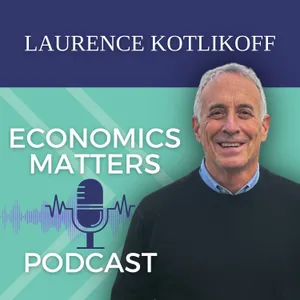
Economics Matters is a podcast hosted by Professor Laurence Kotlikoff, one of the most influential economists in the world, a Global Economics Advisor, NY Times Best Selling Author, President of Economic Security Planning, Inc., and Director of the Fiscal Analysis Center. In each episode, Professor Kotlikoff talks to experts about the power of economics in our modern day society. From personal finance and fiscal policy, to social security and income inequality, Economics Matters delves into much of the economic challenges of modern society.
Latest Episodes
The most recent episodes — sign up to get AI-powered summaries of each one.
- 5 days ago1h 8m
The Harvard Genius Mapping the Death of the American Dream — Zip Code by Zip Code
What if the single strongest predictor of whether a poor kid rises into the middle class has nothing to do with intelligence, work ethic, or even education, and everything to do with who happens to be in their classroom in third grade?Raj Chetty grew up in New Delhi, came to the US in fourth grade, emailed 15 Harvard professors his first week on campus, was working as a research assistant for Marty Feldstein within weeks, graduated college a year early, and became one of the youngest tenured professors in Harvard's history. He has since used anonymized tax records covering virtually every American to build the most detailed picture ever assembled of who gets ahead in this country, why, and what we could actually do about it.In this episode, Professor Kotlikoff sits down with his MacArthur Genius Fellow and John Bates Clark Medal-winning colleague for a conversation covering the grocery store experiment that upended tax theory, the kindergarten classroom that changes your earnings for life, the Facebook data revealing why Iowa produces more upward mobility than Atlanta, and a brand-new private capital market proposal that could finally align financial incentives with the American dream.What You'll Learn:[00:17:23] The grocery store experiment: do people respond differently to a price hike versus a tax hike of the same dollar amount, and what the answer reveals about policy design[00:18:28] Why your true marginal tax rate is nearly impossible to calculate, and why that matters enormously for how much people work and save[00:36:20] The key insight behind the kindergarten teacher paper: linking the 1980s Tennessee STAR experiment to adult tax records 25 years later[00:39:25] How kindergarten classroom assignment by coin flip changed the course of children's lives[00:40:09] One excellent teacher versus one average teacher: a 2 to 3% annual earnings gain per grade, compounding to a 20 to 25% lifetime wage difference[00:41:25] Why teacher quality beats class size as a policy lever, and why Finland and Switzerland get this right while the US does not[00:44:44] The Opportunity Atlas: type in your zip code and see what the American dream looks like in your own neighborhood[00:48:00] Why Dubuque, Iowa, produces more upward mobility than almost anywhere on earth while Charlotte and Atlanta rank below many developing countries for poor kids rising up[00:50:00] The single strongest predictor of economic mobility: not schools, not income, but cross-class friendship[00:53:00] The causal proof: kids randomly assigned to classrooms with more high-income peers go on to earn more and rise higher[00:56:00] The inventor gap[01:00:11] The digital twins method[01:03:31] The private capital market for opportunity: how a $10,000 investment in job training could generate double-digit investor returns while reducing inequalityFeatured Guest:Raj Chetty is the William A. Ackman Professor of Economics at Harvard University and Director of Opportunity Insights. He received his BA and PhD from Harvard and became one of the youngest tenured professors in the university's history. He is the recipient of a MacArthur Genius Fellowship, the John Bates Clark Medal, and the Harvard George Ledley Prize.Resources:Opportunity Insights: opportunityinsights.orgThe Opportunity Atlas: opportunityatlas.orgThe Social Capital Atlas: socialcapital.org"Social Capital I" (Nature, 2022): nature.com"Social Capital II" (Nature, 2022): nature.com"Where Is the Land of Opportunity?" (QJE, 2014): opportunityinsights.orgRaj Chetty's publications: rajchetty.com/publicationsEconomics Matters Substack: larrykotlikoff.substack.comEconomics Matters: The Podcast is hosted by Larry Kotlikoff, Professor of Economics at Boston University.Disclaimer:
- 1 weeks ago58 min
Dead Men Are Running America's Budget, and Their Policies Are Bankrupting Your Kids
What does it mean when the co-founder of America's premier nonpartisan fiscal policy institution tells you that both parties have systematically abandoned the working class, the young, and the American Dream. Not by accident, but by design?Eugene Steuerle co-founded the Urban-Brookings Tax Policy Center, earned a Bronze Star in Vietnam, taught himself economics via correspondence course while serving in the Army, and has spent five decades at the center of every major U.S. fiscal debate. He has testified to Congress roughly two dozen times, received the Paul Samuelson Award for Dead Men Ruling, and has now followed it up with Abandoned, a damning account of how both political parties locked in spending for the elderly and wealthy while leaving everyone else behind.In this episode, Professor Kotlikoff sits down with his longtime friend and intellectual ally for an unsparing conversation about the structural forces driving America's fiscal crisis, who is getting hurt, and what it would actually take to fix it.What You'll Learn:[00:01:01] Why the Social Security shortfall is far worse than the headlines: a 31% immediate cut for all 71 million beneficiaries, or a payroll tax hike from 12.4% to 18.1%[00:14:54] The core thesis of Dead Men Ruling: how permanently baked-in entitlement spending has eliminated Congress's ability to do anything new[00:16:24] Why Social Security, Medicare, and interest on the debt already grow faster than total revenue over the next decade[00:17:07] The difference between financing consumption and financing upward mobility, and why that distinction explains the working class rebellion[00:32:00] Gene's CBO data: the elderly have gone from most likely to be poor in 1979 to least likely today, while non-elderly families moved in the opposite direction[00:35:03] What Gene would do as fiscal dictator: force real entitlement growth to require annual congressional authorization[00:39:56] The two trends dominating 50 years of policy: runaway retirement and healthcare spending, plus cuts to capital income taxes, driving wealth inequality and government dependence simultaneously[00:41:59] Why the national saving rate has collapsed from 15% in the 1950s to 1.48% today, and what that means for who will own America's future[00:44:00] The Jamaica scenario: capital-rich but foreign-owned, with most Americans as servant workers rather than asset owners[00:51:26] Who is the least subsidized group in the entire US healthcare system: moderate-income workers whose employers offer insurance[00:54:37] Why Congress is wrong to think AI will save the budget, and what we should be building insteadResources:Abandoned by Eugene Steuerle: amazon.comDead Men Ruling by Eugene Steuerle: amazon.comThe Government We Deserve (Substack): governmentwedeserve.substack.comEugene Steuerle's website: steuerle.orgUrban-Brookings Tax Policy Center: taxpolicycenter.orgEconomics Matters Substack: larrykotlikoff.substack.comFeatured Guest:Eugene Steuerle is an Institute Fellow and Richard B. Fisher Chair at the Urban Institute and co-founder of the Urban-Brookings Tax Policy Center. He holds a PhD from the University of Wisconsin-Madison and has served as Deputy Assistant Secretary of the Treasury for Tax Analysis. Author of 20 books and over 1,600 articles and congressional testimonies, his most recent book is Abandoned. He publishes the Substack The Government We Deserve.Economics Matters: The Podcast is hosted by Larry Kotlikoff, Professor of Economics at Boston University.Disclaimer: Any opinions expressed on Economics Matters are those of the authors and guests. These are not the opinions of Boston University or Economic Security Planning, Inc.
- 2 weeks ago1h 3m
The Race Against Time: Can Argentina's Economy Recover Before the Election Kills the Reform?
What if solving Argentina's inflation crisis required nothing more than a single televised announcement — and the government is still not making it?Emilio Ocampo advised President Milei during his 2023 presidential campaign, spent decades as a managing director at Morgan Stanley, and has spent the better part of his career making the case for Argentina to do the one thing almost everyone agrees would work, and almost no one in power is willing to do: dollarize.In this episode, Professor Kotlikoff, who visited Buenos Aires in November and published his own dollarization proposal in the Financial Times, sits down with Ocampo for a frank insider conversation on where Argentina actually stands, why the Milei reform is in a race against the electoral calendar, and exactly what it would take, mechanically and politically, to end Argentina's century-long cycle of inflation, default, and despair.This is not theory. Both men have been inside the government and believe the window is closing.What You'll Learn:[00:03:00] Where Argentina's inflation stands today: down from 200% to 30% annually, but the hard part is still ahead[00:05:08] The K-shaped recovery: energy and mining are booming while manufacturing and construction, the biggest employers, are stagnant[00:06:00] What Peronist corporatism actually is, and why half of Argentina's economy still runs on a philosophy lifted from Mussolini's Italy[00:15:42] Why Argentina's debt ratio is technically manageable but still pays 420 basis points over US Treasuries: the price of a bad reputation[00:18:54] Larry's Financial Times proposal: the US funds dollarization via a contingent loan, Argentina gets monetary stability, and the loan disappears unless a future government undoes the reform[00:41:16] The Ecuador precedent: dollarized by presidential announcement in January 2000, survived a coup 10 days later, two sovereign defaults, COVID, and oil price collapses...and is still dollarized today[00:45:00] Why Argentina is already de facto dollarized: surgeries paid in $100 bills, apartments priced in dollars, roughly four times more physical dollars than pesos in circulation[00:48:00] The mechanics of how to actually do it: set the exchange rate at market, declare the dollar legal tender, keep the peso for small change[00:51:32] Why December 2025, after Milei's election win and with full US Treasury support, was the optimal moment to dollarize, and why that window may be narrowing[01:00:00] Why Ocampo says do it today: with elections 18 months away, the probability math favors moving now instead of betting on a recovery that may not arrive in timeFeatured Guest:Emilio Ocampo is an Argentine economist, author, and professor at UCEMA in Buenos Aires. He served as economic advisor to President Milei during Argentina's 2023 presidential campaign and is internationally recognized for his work on monetary institutions, dollarization, and Latin American economic history. He previously held senior positions at Chase Manhattan Bank, Salomon Brothers, and Morgan Stanley, where he was a managing director. He is co-author of Dolarización: Una Solución para la Argentina and a regular contributor to La Nación.Resources:Dolarización: Una Solución para la Argentina by Ocampo and Cachanosky: amazon.comProfessor Kotlikoff's FT article summary (Ocampo Substack): dolarizacionargentina.substack.comProfessor Kotlikoff's earlier dollarization piece: larrykotlikoff.substack.comSargent, "The Ends of Four Big Inflations" (1982): ideas.repec.org2025 US-Argentina currency swap background: wikipedia.orgEmilio Ocampo's Substack: dolarizacionargentina.substack.comEconomics Matters Substack: <a href="https://lar
- 3 weeks ago56 min
34% of Gen Z Is Gambling Online. They Think It's Investing
What if the single biggest financial threat facing young Americans right now isn't student debt or housing prices, but a $22% credit card rate on one side and an online gambling habit disguised as investing on the other?Beth Kobliner has been writing about personal finance since she ghostwrote Sylvia Porter's syndicated column at age 22. She spent eight years at Money Magazine, appeared with Elmo on Sesame Street to teach kids about money, served on the President's Advisory Council on Financial Capability for Young Americans, and has now published five editions of her New York Times bestseller Get a Financial Life, the definitive money guide for people in their 20s and 30s, over 30 years and still going.In this episode, Professor Kotlikoff sits down with Beth for a wide ranging conversation that covers compound interest, credit card debt, the rent vs. buy decision, online gambling statistics that should alarm every parent, and the timeless financial principles that have quietly made thousands of readers wealthy over three decades.What You'll Learn:[00:33:04] Why starting early is the single most powerful financial move you can make: the compound interest case in plain language[00:38:13] Why credit card debt is worse now than it has ever been: the average rate has hit 22%, and even good credit gets you 18%[00:39:01] Paying off a 22% credit card is the equivalent of earning 22% guaranteed after taxes: there is nowhere else that math works[00:37:23] The index fund case: Fidelity at .015%, Vanguard at .03%, and you can start with as little as a dollar[00:41:42] When the stock market is the wrong place for your savings: the down payment scenario and the high-yield savings account alternative[00:50:48] 34% of Gen Z gambles online regularly, and one in four young people believe prediction markets are a form of investing[00:52:38] Two-thirds of prediction market winnings go to one-tenth of 1% of accounts: who is actually winning, and who is losing[00:43:09] The "different selves" framework: why your current self is the fiduciary for your middle-aged and retired self, whether you like it or not[00:49:17] State and local housing programs most young buyers have never heard of: the National Council of State Housing Agencies and what it offers[00:29:03] Why connections are not cheating: how Beth landed every major career opportunity, and why her father's approach still works in 2026Featured Guest:Beth Kobliner is a personal finance journalist, author of two New York Times bestsellers, and a member of the President's Advisory Council on Financial Capability for Young Americans. She has written for Money Magazine, The NY Times, The Wall Street Journal, PBS NewsHour, CNN, and MSNBC. She is currently working with the Heckscher Foundation to create a financial literacy curriculum for New York City high school students.Resources Mentioned:Get a Financial Life: Personal Finance in Your Twenties and Thirties (5th Edition) by Beth Kobliner, the definitive guide now over half a million copies sold across 30 years:https://www.amazon.com/Get-Financial-Life-Personal-Twenties/dp/1668095351Make Your Kid a Money Genius (Even If You're Not): A Parents' Guide for Kids 3 to 23 by Beth Kobliner, translated into nine languages:https://www.amazon.com/Make-Your-Money-Genius-Youre/dp/1476766819Beth Kobliner's website — resources, recommendations, and updates:https://bethkobliner.comNational Council of State Housing Agencies — state and local homebuyer assistance programs:https://www.ncsha.orgEconomics Matters Substack (Larry Kotlikoff):https://larrykotlikoff.substack.comEconomics Matters: The Podcast is hosted by Larry Kotlikoff, Professor of Economics at Boston University.Disclaimer: Any opinions expressed on Economics Matters are those of the authors and guests. These are not the opinions of Boston University or Economic Security Planning, Inc.
- Aug 20, 20261h 18m
Is AI the End of Mathematics, or Its Most Exciting New Beginning?
What does it feel like to watch an AI solve a problem in a single prompt that you've spent years working on, and produce a stronger result than your own published papers?Professor Kotlikoff grew up academically alongside two economists, Yuri Dadush and Michael Pomerleano, who were his classmates when he began his PhD at Harvard in 1973. In this episode, he sits down with their sons: Daniel Dadush, a professor of mathematics and optimization at Utrecht University, and Daniel Pomerleano, a professor of pure mathematics at UMass Boston, both of whom are watching AI upend their fields in real time.This is a conversation about what's actually happening inside mathematics right now: which problems AI has solved, how it solved them, what those solutions reveal about the limits of human specialization, and whether the next generation of mathematicians will bother showing up at all.What You'll Learn:[00:17:39] The moment ChatGPT produced a stronger result than two of Daniel Dadush's published conference papers: what happened in a single prompt session[00:31:13] The Erdos Distance Problem: open for 60+ years, solved by AI in a few pages, and why the ideas inside it cracked other problems too[00:35:39] The cycle double cover conjecture: an open problem with a short proof human mathematicians simply overlooked[00:36:26] Why AI proofs tend to be strikingly short: what that reveals about how differently machines approach mathematics[00:41:46] Why AI companies used math as their benchmark: what solving long chains of abstract reasoning was really designed to prove[01:00:39] The PhD thesis problem: how Daniel P. generated what would have been a strong thesis three years ago, in an afternoon, with a problem list and ChatGPT[01:08:46] Why pure mathematics may become a less attractive field for the next generation: and what's lost if that happens[01:09:23] The conference room scenario: an audience member spinning up 20 AI agents during a talk to answer the speaker's own research question before the talk ends[01:11:42] The policy question: NSF funding going to zero for economics while $200 billion flows to AI, and what hollowing out academic talent actually costs usFeatured Guests:Daniel Dadush is a professor of mathematics at Utrecht University and leader of its Networks and Organizations Group. He completed his PhD in Algorithms, Combinatorics, and Optimization at Georgia Tech and held a Simons Postdoctoral Fellowship at the Courant Institute at NYU. He specializes in theoretical computer science and mathematical optimization.Daniel Pomerleano is a professor of mathematics at UMass Boston. He completed his PhD at UC Berkeley and has held positions at Imperial College London. His research focuses on mirror symmetry, symplectic topology, and non-commutative Hodge theory.Resource Links:Fermat's Last Theorem by Simon Singh: the popular mathematics history book Larry recommends for non-mathematicians, available in multiple editions:https://www.amazon.com/Fermats-Last-Theorem-Simon-Singh/dp/1841157910The Man Who Knew Infinity (2016): the biographical film about Srinivasa Ramanujan, starring Dev Patel and Jeremy Irons, available to rent or buy on Amazon Prime Video:https://www.amazon.com/Man-Who-Knew-Infinity/dp/B01HRX0T8KEconomics Matters Substack (Larry Kotlikoff): https://larrykotlikoff.substack.comEconomics Matters: The Podcast is hosted by Larry Kotlikoff, Professor of Economics at Boston University.Disclaimer: Any opinions expressed on Economics Matters are those of the authors and guests. These are not the opinions of Boston University or Economic Security Planning, Inc.
- Aug 19, 20261h 9m
Your Medicare Premium Is Rising Twice as Fast as Your Social Security Check — Here's What to Do About It
What if the Medicare premium increases heading your way aren't just a number, they're a signal that the entire system is heading somewhere most retirees aren't prepared for?Phil Moeller has co-written a New York Times bestseller on Social Security, authored the definitive consumer guide to Medicare, and spent decades covering personal finance for US News, PBS NewsHour, and Money Magazine. He's also a Medicare enrollee with strong opinions about what's working, what isn't, and what you should do before your next open enrollment window.In this episode, Professor Kotlikoff sits down with his longtime friend and co-author for a conversation that starts with the nuts and bolts of Medicare: Medigap, Part D strategy, Medicare Advantage trade-offs, the birthday rule — and ends somewhere bigger: a frank discussion of whether America's healthcare and retirement trajectory is fixable at all.What You'll Learn:[00:03:45] Why Phil chose traditional Medicare with Plan G Medigap — and why he still thinks it's right for people of means[00:05:42] The $1 million hospital bill story — how a $3,500 Medigap premium produced zero out-of-pocket cost[00:06:38] The $5-a-month Part D strategy — and when to stop caring about the deductible[00:09:48] Why the Part B premium is rising at roughly twice the Social Security cost-of-living rate[00:15:23] When Medicare Advantage makes sense — and where it breaks down when you need it most[00:18:23] The birthday rule most people have never heard of[00:19:39] What the One Big Beautiful Bill means for Medicaid in your state[00:27:45] The hidden $600-$700 billion annual subsidy inside Parts B and D — and who's really paying[00:35:32] How seniors went from the poorest to the wealthiest generation — and what that data looks like[00:44:51] What Phil Moeller would do as healthcare czar[00:59:10] Why 35 cents of every healthcare dollar goes to administration[01:00:42] The purple billionaire argument — why Larry thinks an independent candidate is the only path to real reformFeatured Guest:Philip Moeller is a veteran personal finance journalist and author of Get What's Yours for Medicare and co-author of the New York Times bestseller Get What's Yours: The Secrets to Maxing Out Your Social Security. He publishes the Substack Aging in America.Larry Kotlikoff is a Professor of Economics at Boston University and one of the country's foremost experts on Social Security, Medicare, and generational fiscal policy.Referenced Links:Get What's Yours (Revised): amazon.comGet What's Yours for Medicare (Revised): amazon.comAging in America Substack: philmoeller.substack.comWe've Got You Covered by Einav & Finkelstein: amazon.comGerontocracy in America by Samuel Moyn: amazon.comCost Plus Drugs: costplusdrugs.comMedicare Extra Help: medicare.govEconomics Matters Substack: larrykotlikoff.substack.comEconomics Matters: The Podcast is hosted by Larry Kotlikoff, Professor of Economics at Boston University.Disclaimer: Any opinions expressed on Economics Matters are those of the authors and guests. These are not the opinions of Boston University or Economic Security Planning, Inc.
- Aug 6, 20261h 8m
Why Putin Can't Win, China Won't Fold, and Trump Is Running Out of Options
What if the three most dangerous regimes on earth — Russia, China, and Iran — are all weaker than they appear, and yet America is still losing ground to all three at once?Sir Niall Ferguson has spent a career studying how empires rise, overreach, and fall. He watched the Soviet Union collapse from the inside out while everyone in Washington assumed it would last forever. He's been warning about China's hidden fragility for years while the consensus said otherwise. Currently, he's watching the United States make the most conventional mistake of Donald Trump's entire political career: getting bogged down in the Middle East on the side of Israel, just like George W. Bush before him.Professor Kotlikoff and his old friend have a wide-ranging, rapid-fire conversation covering the real state of the Iran conflict, why a Taiwan semiconductor crisis is the single biggest threat to the world economy in the next two years, why Putin cannot win in Ukraine and knows it, why nuclear weapons won't be used, what Ferguson would actually tell Trump to do right now, and whether American universities brought the current backlash on themselves.What You'll Learn:[00:11:45] Why this is not World War III[00:13:50] The "American Suez" framework[00:17:00] Why there is no great military option left[00:19:15] The desalination plant vulnerability[00:22:00] The missile economics problem[00:25:00] The authoritarian axis[00:31:53] How the regime change in Iran already happened[00:34:15] Ferguson's actual policy prescription[00:45:11] Why Ferguson doesn't think China will overtake the United States[00:45:33] Cold War II and the Cuban Missile Crisis parallel [00:47:01] Why Russia is no longer a great power[00:48:00] Why Putin won't use nuclear weapons[00:53:35] The optimistic scenario[00:56:29] The university debate [01:01:26] The 75% to 35% collapse Sir Niall Ferguson is the Milbank Family Senior Fellow at the Hoover Institution at Stanford University and Senior Faculty Fellow at the Belfer Center at Harvard. He holds a DPhil from Oxford University and has taught at Oxford, Cambridge, Harvard, and Stanford. He is the author of 16 books including The Ascent of Money, Civilization: The West and the Rest, The Great Degeneration, Doom: The Politics of Catastrophe, and the two-volume biography Kissinger (volume two forthcoming). He was knighted in 2023. He writes regularly for The Free Press and Bloomberg.Resources Mentioned:The Ascent of Money: A Financial History of the World — Ferguson's recommended starting point for an economics audience, now in a 10th anniversary edition:https://www.amazon.com/Ascent-Money-Financial-History-World/dp/0143116177The Great Degeneration: How Institutions Decay and Economies Die — the book most directly influenced by Kotlikoff's generational accounting work:https://www.amazon.com/Great-Degeneration-Institutions-Decay-Economies/dp/1594205450Doom: The Politics of Catastrophe:https://www.amazon.com/Doom-Politics-Catastrophe-Niall-Ferguson/dp/0593297377Kissinger: 1923-1968: The Idealist — volume one of the biography Ferguson is still completing:https://www.amazon.com/Kissinger-1923-1968-Idealist-Niall-Ferguson/dp/0143109758Full Niall Ferguson book catalog:https://www.amazon.com/Niall-Ferguson/e/B000APQ8G0"How to Stop Iran from Winning the War" by Ferguson, Haass, and Zelikow — the Strait of Hormuz Authority proposal referenced in the episode, published in The Free Press, April 13, 2026:<a href="https://www.thefp.com/p/how-to-stop-iran-fro
- Aug 2, 20261h 16m
The Illiquid Jenga Tower: Inside the Private Credit Timebomb Nobody's Talking About
What if the passive investing revolution (the idea that just buying the index and holding is the smartest thing most people can do) has quietly turned into something that no longer resembles the efficient market it was designed to track?Every month, $33 billion flows automatically from 401(k) contributions into U.S. equity index funds. That money doesn't stop to ask whether Nvidia is fairly valued. It doesn't check whether 50% of the S&P 500 being tied to AI makes sense. It just buys, systematically and relentlessly, concentrating more and more capital into fewer and fewer companies — and in doing so, may be inflating the very market it's supposed to passively reflect.Professor Kotlikoff sits down with Jack Schibli, principal at Lane Generational, for a wide-ranging conversation about the structural changes quietly reshaping the U.S. stock market. From the mechanics of passive investing to the fragility of private credit, the vulnerability of the insurance industry, and the real competitive threat of Chinese AI to the trillion-dollar data center build-out Wall Street is betting on.This is original, ground-level analysis from an investor who's doing the work most institutional researchers aren't.What You'll Learn:[00:08:06] The "Illiquid Jenga Tower" — Jack's original deep dive into the fragility of private credit[00:12:20] Why the insurance industry could be the next AIG[00:15:01] The redemption gate hiding in plain sight inside private credit funds[00:19:19] What would actually need to happen for a systemic market event[00:35:33] The illusion of diversification inside your index fund[00:37:30] Why China is winning the AI cost war[00:42:56] The IP transfer problem nobody's discussing[00:46:49] How passive investing mechanically inflates valuations[00:47:44] Apple's $1.46 trillion buyback problem[00:51:18] The inelasticity trap — and why it only gets worse[00:54:35] The pod shop dynamic: 440% leverage and no long-term thinking[00:58:25] How retail investors became 20% of daily trading volume[01:02:51] Palantir at 310x earnings — and Lululemon's collapse in reverse[01:10:28] The causal chain that's flipped: the market is now running the economy[01:12:05] The Bessent paradox — criticizing Yellen for exactly what he's now doingFeatured GuestJack Schibli is a principal at Lane Generational, an independent registered investment advisor accessible through Fidelity Investments. He studied economics with a minor in computer science at Middlebury College, trained as a competitive ski racer, and began his career working with Lane Generational co-founder Fred Lane at Raymond James. He writes a quarterly investment research blog at lanegenerational.com/insights, known for its original structural analysis of market dynamics, private credit, and AI-driven disruption. His recent pieces include "Poker Face," "The Illiquid Jenga Tower," and several widely circulated posts on passive investing mechanics.Resources MentionedLane Generational — Jack Schibli and Fred Lane's independent RIA, accessible through Fidelity Investments: lanegenerational.comLane Generational Insights Blog — Jack's quarterly research pieces, including "Poker Face" and "The Illiquid Jenga Tower": lanegenerational.com/insightsDisclaimer: Any opinions expressed on Economics Matters are those of the authors and guests. These are not the opinions of Boston University or Economic Security Planning, Inc.Lane Generational is an SEC Registered Investment Advisor. The information provided is for educational and informational purposes only and does not constitute investment advice, and it should not be relied on as such. It should not be considered a solicitation to buy or an offer to sell a security. I, Larry Kotlikoff, am an investor with Lane Generational. This is not an endorsement, and I am not compensated by Lane Generational.
About Economics Matters with Laurence Kotlikoff
Economics Matters is a podcast hosted by Professor Laurence Kotlikoff, one of the most influential economists in the world, a Global Economics Advisor, NY Times Best Selling Author, President of Economic Security Planning, Inc., and Director of the Fiscal Analysis Center. In each episode, Professor Kotlikoff talks to experts about the power of economics in our modern day society. From personal finance and fiscal policy, to social security and income inequality, Economics Matters delves into much of the economic challenges of modern society.
Customized Recaps
AI-powered recaps with compact key takeaways, quotes, and insights.
Straight to Your Inbox
Get key takeaways from Economics Matters with Laurence Kotlikoff in a 5-minute read.
Save Hours Every Week
Stay current on your favorite podcasts without falling behind.
Frequently Asked Questions
What is Podzilla's Economics Matters with Laurence Kotlikoff daily summary?
It's a free AI-powered email that summarizes new episodes of Economics Matters with Laurence Kotlikoff as soon as they're published. You get the key takeaways, notable quotes, and links & mentions — all in a quick read.
How does the Economics Matters with Laurence Kotlikoff podcast summary work?
When a new episode drops, our AI transcribes and analyzes it, then generates a personalized summary tailored to your interests and profession. It's delivered to your inbox every morning.
Is this an official Economics Matters with Laurence Kotlikoff product?
No. Podzilla is an independent service that summarizes publicly available podcast content. We're not affiliated with or endorsed by Economics Matters.
Can I get summaries of other podcasts too?
Absolutely! The free plan covers up to 3 podcasts. Upgrade to Pro for 15, or Premium for 50. Browse our full catalog at /podcasts.
What topics does Economics Matters with Laurence Kotlikoff cover?
Economics Matters with Laurence Kotlikoff covers topics including Education. Our AI identifies the specific themes in each episode and highlights what matters most to you.
Start getting Economics Matters with Laurence Kotlikoff summaries tomorrow morning.
Free forever for up to 3 podcasts. No credit card required.
Free forever for up to 3 podcasts. No credit card required.