Free Daily Podcast Summary
Dronecast: Rethinking Public Safety, One Drone at a Time: Daily Summaries Delivered
by DroneSense
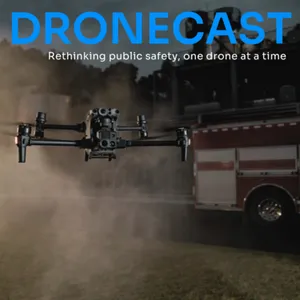
Welcome to Dronecast: Rethinking Public Safety, One Drone at a Time, a podcast by DroneSense. We explore real-world applications of drones in emergency response, offering a close examination of evolving trends in drone technology and its impact on public safety.
Latest Episodes
The most recent episodes — sign up to get AI-powered summaries of each one.
- 1 weeks ago34 min
From the Archives: The Role of Drones in Medicolegal Death Investigations with Philip Miller
In this episode of DroneCast: Rethinking Public Safety, One Drone at a Time, host John McLeod speaks with Philip Miller, Medicolegal Death Investigator at the Oklahoma Office of the Chief Medical Examiner. They discuss the pioneering use of drones in medicolegal death investigations, how aerial mapping drastically cuts scene processing time, enhances team safety, and improves interagency collaboration, as well as the importance of community engagement to demystify drone operations.
- 3 weeks ago31 min
From the Archives: Drones for Small Communities with Chris Baker, Oswego’s Drone & Robotics Coordinator
In this episode of DroneCast: Rethinking Public Safety, One Drone at a Time, host John McLeod sits down with Chris Baker, Drone and Robotics Coordinator for the City of Oswego, New York. They explore how Oswego consolidated its public safety drone operations under the municipal IT department, the practical advantages of deploying Drone as a First Responder (DFR) in tight-knit, smaller communities, and key strategies for building political and public support.
- Aug 11, 202640 min
From the Archives: The Role of Drones in Aerial Surveillance with Matt Rowland of FWPD
In this episode of DroneCast: Rethinking Public Safety, One Drone at a Time, host John McLeod sits down with Matt Rowland, a retired 21-year veteran of the Fort Wayne Police Department and Administrator of its Air Support Unit. They discuss the tactical evolution of public safety drone operations—from physical HDMI cords in 2017 to citywide public safety drone deployments, AI integrations, and proactive community engagement.
- Jul 28, 202637 min
From the Archives: Beyond Flight Currency: Pilot Proficiency, Drone Legislation, and Community Trust with Jason Burnside
In part two of this conversation on DroneCast: Rethinking Public Safety, One Drone at a Time, host John McLeod sits down with Jason Burnside, Program Manager for the Austin Fire Department RED Team. They dive deep into practical pilot proficiency strategies, navigating complex foreign-drone legislation, innovative program funding through leasing, and building deep community trust through absolute operational transparency.
- Jul 14, 202630 min
How to Train Fleet Drone Operators for High-Stake Lifesaving Missions with Elsa Klarich
In Part 2 of this deep dive, Elsa Klarich, Aviation Director at Light and Earth, LCC returns to discuss the critical intersection of elite pilot training, public safety, and drone fleet management. Drawing from her intense background as an East African bush pilot, Elsa breaks down how to build an unyielding "safety always" culture, the reality of managing complex communication in shared airspaces, and why treating a drone with the full responsibility of a manned aircraft is the only path forward for lifesaving operations.
- Jun 30, 202633 min
How to Bypass Universal Red Tape for Fast Emergency Drone Deployment with Elsa Klarich
In Part 1 of this conversation, Elsa Klarich, a pioneering figure in aviation and drone technology, shares how uncrewed systems are transforming global relief work and humanitarian missions. Drawing from her experience as a bush pilot in East Africa and a UAS operator in high-stakes environments, Elsa breaks down the critical regulatory hurdles facing civil aviation authorities, the reality of quick-launch logistics, and why thinking five years ahead is essential to building a safe drone ecosystem.
- Jun 16, 202633 min
From the Archives: How Austin Fire Department Built a Pioneer Drone Program with Jason Burnside
In this special "From the Archives" re-release of Dronecast: Rethinking Public Safety, One Drone at a Time, Jason Burnside, Program Manager for the Austin Fire Department's Robotics Emergency Deployment (RED) Team, originally recorded on January 2, 2024, he discussed the foundational principles of how drones enhance public safety, make firefighters' jobs easier and safer, the ongoing challenges of integrating drones into fire departments, and early predictions regarding the future of augmented reality and autonomous launching that remain deeply relevant today.
- Jun 2, 202627 min
Eyes in the Sky: Scaling Drone Programs Without Losing Public Trust
In Part 2 of this deep-dive conversation, UAS instructor and tactical operations expert David Naranjo continues his discussion on DroneCast to explore the friction between advanced drone capabilities and community expectations. From breaking down advanced tactical maneuvers like the "360-degree punch clear" to addressing the massive wave of AI integration on the horizon , this episode provides a realistic roadmap for agencies looking to scale their fleets responsibly without losing public trust.
About Dronecast: Rethinking Public Safety, One Drone at a Time
Welcome to Dronecast: Rethinking Public Safety, One Drone at a Time, a podcast by DroneSense. We explore real-world applications of drones in emergency response, offering a close examination of evolving trends in drone technology and its impact on public safety.
Customized Recaps
AI-powered recaps with compact key takeaways, quotes, and insights.
Straight to Your Inbox
Get key takeaways from Dronecast: Rethinking Public Safety, One Drone at a Time in a 5-minute read.
Save Hours Every Week
Stay current on your favorite podcasts without falling behind.
Frequently Asked Questions
What is Podzilla's Dronecast: Rethinking Public Safety, One Drone at a Time daily summary?
It's a free AI-powered email that summarizes new episodes of Dronecast: Rethinking Public Safety, One Drone at a Time as soon as they're published. You get the key takeaways, notable quotes, and links & mentions — all in a quick read.
How does the Dronecast: Rethinking Public Safety, One Drone at a Time podcast summary work?
When a new episode drops, our AI transcribes and analyzes it, then generates a personalized summary tailored to your interests and profession. It's delivered to your inbox every morning.
Is this an official Dronecast: Rethinking Public Safety, One Drone at a Time product?
No. Podzilla is an independent service that summarizes publicly available podcast content. We're not affiliated with or endorsed by DroneSense.
Can I get summaries of other podcasts too?
Absolutely! The free plan covers up to 3 podcasts. Upgrade to Pro for 15, or Premium for 50. Browse our full catalog at /podcasts.
How often does Dronecast: Rethinking Public Safety, One Drone at a Time release new episodes?
Dronecast: Rethinking Public Safety, One Drone at a Time publishes biweekly. Our AI generates a summary within hours of each new episode.
What topics does Dronecast: Rethinking Public Safety, One Drone at a Time cover?
Dronecast: Rethinking Public Safety, One Drone at a Time covers topics including Leisure, Technology, Government, Aviation. Our AI identifies the specific themes in each episode and highlights what matters most to you.
Start getting Dronecast: Rethinking Public Safety, One Drone at a Time summaries tomorrow morning.
Free forever for up to 3 podcasts. No credit card required.
Free forever for up to 3 podcasts. No credit card required.