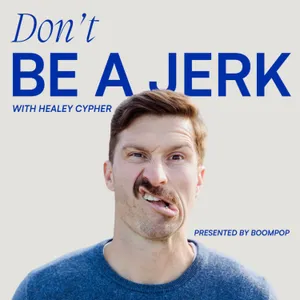
Free Daily Podcast Summary
Don't Be a Jerk: Daily Summaries Delivered
by Healey Cypher
👋 Hey there, Healey Cypher here. My brother once said all CEOs are inherently bad, and I get it. Headlines glamorize ruthless success, but there’s another story: leaders who win because they’re good people. “Don’t Be a Jerk” explores real-world examples and tactical insights proving kindness and integrity aren’t just nice; they’re strategic advantages. Each episode reveals actionable lessons to build success without compromising values. Let’s rewrite the narrative of leadership, one story at a time.
Latest Episodes
The most recent episodes — sign up to get AI-powered summaries of each one.
- Oct 6, 202614 min
How to Win In Life (And Business) Without Being a Jerk | Best of Year 1 on DBAJ
A year ago, Healey Cypher started Don't Be a Jerk as a personal quest to prove that being a jerk isn't the way to get ahead. Twelve guests later, the evidence keeps pointing the same way: most people are fundamentally good, and the jerks just get more airtime.For the show's one-year anniversary, Healey pulls together his favorite moments from year one. The guests include the Stanford psychologist behind The No Asshole Rule, an 11-year-old who produces his own podcast, negotiation coaches, a VC, founders, and leading researchers on empathy and happiness from Stanford and UC Berkeley.You'll hear why yelling means you've already lost, what happens to people who lead with leverage once the leverage runs out, and why the science says the "me or them" mindset doesn't hold up.Highlights- Why Bob Sutton says you can win in business and still lose as a human being- 11-year-old Sam Schwartz on the difference between being nice and being kind- The VC line Derek Blazensky never forgot, and why deals built on leverage don't last- How Brianne Kimmel's generosity keeps coming back to her- Why Ilana Nankin says kindness buys leaders back time- Bing Chen on the screamers at Google and making people feel bigger- Jamil Zaki and Emiliana Simon-Thomas on the science of our social natureSubscribe on YouTube and follow Don't Be a Jerk on Spotify and Apple Podcasts. Have a guest, topic, or hard question you want Healey to take on? Drop it in the comments.CHAPTERS00:00 One year of Don't Be a Jerk01:10 Bob Sutton on winning vs. being a good human03:00 Sam Schwartz on nice vs. kind04:15 Faith Cohen on leaning into discomfort05:45 Derek & Todd on leverage and payback07:30 Brianne Kimmel on generosity that comes back09:15 Ilana Nankin on kindness buying back time10:40 Carolina García Jayaram on leading with love12:35 Alan Ross on gratitude vs. kindness14:05 Bing Chen on why yelling means you lost16:05 Emiliana Simon-Thomas on the me-or-them myth18:05 Jamil Zaki on our true nature19:50 What's next for year two
- Sep 29, 202633 min
He Hires the People Everyone Else Screens Out | Keba Konte, Red Bay Coffee
In 1994 Keba Konte flew to South Africa to photograph the first election where everyone could vote. He had no press credential, so when Mandela appeared, the fifty accredited photographers had the front position and Keba was stuck in the stands with the crowd. Then Mandela turned his back on the press, faced the people, and raised his fist. Keba got the frame.He has been standing on that side ever since. Twenty years later he started Red Bay Coffee in Oakland, roasting at home on a popcorn popper after the bank declined his loan. He was in his late forties with two careers already behind him, photojournalist and exhibited artist, and he built the company around a question most founders never ask out loud: how do you open a coffee shop in a neighborhood you grew up near without becoming the front edge of its gentrification.The hiring is where it gets specific. Keba went out to re-entry programs and recruited returning citizens on purpose, and he can tell you both halves of what happened. They worked twice as hard. They also came in with real trust issues, and he leaned on counselors from those same programs to work through it. Healey brings him a 2018 study of a million applicants across eleven firms that found the same performance and 13% lower turnover. Keba already knew.The rest is the stuff you only get from someone who has run the thing for twelve years. Where you find talent for an industry that never trained anyone who looks like your customers. Why his farmers get paid more than fair trade to pick only the red cherries. How a tagline got flagged by the Black Panther Party's IP holders and why that ended well. And what he would put on a billboard in front of a billion people, which nobody saw coming.In this episode:- What a day behind the press line taught him about where to stand- Why he refused to build a coffee company that would speed up gentrification- Recruiting out of re-entry programs, and the part he will not sugarcoat- The study that says the risky hire is the one who stays- Mercenary employees, missionary employees, and which one is the founder's fault- Hiring from chocolate, wine, kitchens and bars when your industry has no bench- Where "beautiful coffee to the people" came from, and who had to approve it- Why the red in Red Bay is about ripeness, and what that costs- Naming coffee blends after protest anthems in the middle of a political crisis- Coffee is a fruitSubscribe for more conversations about doing well without being a jerk.New episodes on YouTube, Spotify, and Apple Podcasts.Timestamps:00:00 Intro01:19 South Africa, 1994, and no press credential03:15 Stay with the people, not the VIP section04:30 Starting Red Bay, and gentrification in Oakland06:27 Roasting at home after the bank said no07:48 Going out to re-entry programs on purpose08:15 Working twice as hard, and the part he will not sugarcoat08:58 A million applicants, eleven firms, 13% lower turnover10:36 Mercenary vs. missionary, and the purpose part11:53 Building a team for an industry that never trained one15:30 Where “beautiful coffee to the people” came from16:58 The Black Panther Party trademark flag19:02 Coffee is a fruit21:41 Why Red Bay is called Red26:23 The Hero Collection and the protest anthems28:51 Red Bay as a piece of art32:10 The billboard
- Sep 22, 202654 min
Why Kind CEOs Actually Make More Money | Emiliana Simon-Thomas @ UC Berkeley
When Emiliana Simon-Thomas was a teenager in Berkeley, a man named Mr. Charles stood on a street corner every morning and told strangers they were beautiful. Decades later she ran a study with tens of thousands of people across more than 200 countries to find out whether small acts like that actually change anything.Emiliana is the Science Director of UC Berkeley's Greater Good Science Center and one of the researchers behind the Big Joy Project. She and Healey get into what seven days of tiny, deliberate acts of kindness did to people's mood, their sense of agency, and their willingness to sacrifice for others. Then they follow the same thread into leadership, where a study of 3,500 CEOs found that pro-social leaders ran companies that objectively performed better.This one runs on evidence, and most of it points the same direction: the thing that makes you happier is the thing that makes you better to be around.In this episode:- What the Big Joy Project found after just seven days of micro acts- Why the people who need well-being research most are the least likely to sign up- The arrival fallacy, and why the next milestone won't fix it- What Emiliana says to do with a spare $100 if happiness is the goal- Why power quietly erodes the skills that earned it- The case for forgiveness as a performance advantage- Collective effervescence, and why walking beside someone resolves conflict faster than facing themSubscribe to Don't Be a Jerk on YouTube, Spotify, and Apple Podcasts. Try the Big Joy Project and explore the research at greatergood.berkeley.edu.Episode Chapters:0:00 Mr. Charles on the corner1:50 Seven days, 200 countries8:20 When the world feels too big to fix12:05 The arrival fallacy21:35 Why happy teams close more deals23:05 What to do with a spare $10028:50 We stopped practicing friendship32:55 The punishment we now choose39:00 The paradox of power43:35 Forgiveness as a performance advantage
- Sep 15, 20266 min
How to Build Willpower (hint: it’s NOT what you think) with Healey Cypher
Most of your day already happened without you. The drive to work, the meeting you walked into cold, the ten minutes after you got home. You didn't decide how any of it would go, so it went however it went.Healey Cypher has a fix that takes about ten seconds, and it's older than every productivity book on your shelf. It's called segment intending: you break the day into small pieces, and before each one you say what you want out of it. In this solo episode he walks through the practice, why he thinks of willpower as a muscle rather than a trait, and what changed in his calendar and his marriage once he started running it every day.He also does the unglamorous part: two concrete examples, one from a boardroom and one from his own living room, so you can try it before your next meeting.In this episode:- The 10-second practice Healey uses before meetings, drives, and walking through his own front door- Why he treats willpower as a muscle you can train, and how he trains it- The one sentence to open a meeting with so nobody wastes an hour- How he segments and grades his weeks, and why most of them now come back green- What setting an intention before seeing his wife did for a 14-year marriage- The reframe of "let there be light" that changed how he thinks about wanting thingsTry it this week and tell Healey how it went, he actually wants to hear it.Subscribe for new episodes of Don't Be a Jerk every Wednesday.Listen on YouTube, Spotify, and Apple Podcasts.Timestamps:00:00 Intro01:37 Willpower, creation, and “let there be light”02:10 What segment intending actually is02:38 The drive, the kids, the front door02:56 How much of the day runs on autopilot03:20 Why willpower grows the more you use it04:08 Doing it daily, and grading the week04:46 Writing out what a successful meeting looks like05:09 Saying it out loud, and the side benefit05:37 A 14-year marriage, and his number one goal06:16 Try it and tell him how it went
- Sep 1, 202639 min
How This Ethics Professor Launched a $1,000-a-Month Kindness Award | Alan Ross @ UC Berkeley
There's an award for everything in our society. The Emmys give awards for giving awards. Nobody gives one for kindness.Alan Ross noticed that during Covid, on a walk in the Berkeley Hills, when he passed a girl handing out free cookies because she thought everyone seemed sad. Four years later he writes a $1,000 check every month, out of his own pocket, to a stranger who did something quietly extraordinary: a gas station attendant, a locker room attendant, an 86-year-old who's folded origami at Children's Hospital every Thursday for a decade. Most of them try to give the money back.Alan has taught at Berkeley Haas for 36 years and has been the business school's only ethics teacher for 25 of them, which means every Haas graduate has passed through his classroom. He opens each semester by asking how many students would be there if the class weren't required. His record answer is ten out of 240. He tells Healey about it laughing.In this episode:- Why Alan says he could never win his own award, and means it- The case against gratitude, and what he'd replace it with- What the New York banker making seven figures told him about "just $100K more"- How to gamify kindness with your kids at the drive-through window- Why nobody has ever faked their way to the $1,000 in four years- The student whose entire Harvard interview became about a kindness award- What Alan would put on a billboard a billion people could seeSubscribe for more conversations about doing well without being a jerk.New episodes on YouTube, Spotify, and Apple Podcasts.Learn more or nominate someone at chriskindnessaward.orgTimestamps:00:00 Intro01:39 What the Chris Kindness Award actually is02:46 The cookie stand that started it03:11 An award for everything in our society except kindness04:02 Who Chris was05:25 Why handing over the check is the best day of his month05:50 The origami volunteer at Children's Hospital07:05 Why he says he could never win his own award09:48 What spending money on others does to happiness10:41 Abstraction, and how people become numbers12:20 The New York banker and just a hundred thousand more14:44 Writing down his real top ten goals15:51 The hours you don't get back19:39 The ripple effect21:34 The fifth grader on why the news is all bad26:34 The interview that starts with how you treat the waiter27:45 Gamifying kindness at the drive-through30:32 The ethics class, and why nobody has faked it in four years31:24 The student whose Harvard interview became about the award38:40 What he'd put on a billboard
- Aug 18, 202649 min
"The No A**hole Rule” and When The Rule Can Be Broken | Bob Sutton @ Stanford
Bob Sutton has spent twenty years being asked to prove that decency pays. He can do it: the productivity data, the health data, the turnover math, all of it. He mostly refuses to.His actual argument is harder to shrug off. Sutton is a Stanford professor emeritus who got the idea for the most famous management book with a swear word in its title from his father, at the San Diego Zoo, when he was about four years old. He also once flew across the country for heart surgery, past a hospital two miles from his house, in part because the Cleveland Clinic's CEO told him something Stanford's wouldn't: you reward a**hole heart surgeons, and I fire them.Healey and Bob get into the moral case, the business case, and the uncomfortable middle where jerks really do win. It's the rare conversation about workplace behavior that never once sounds like an HR training.In this episode:- Why Sutton has given up arguing decency on ROI, and what he says instead- The one sentence that tells you everything about a company's culture- The hidden-tape-recorder study on coaches who lose it at halftime, and why the nice ones get results- How to tell whether you're the difficult person in the room- Why calling someone a jerk is the most reliable way to turn them into one- What Google did to cut interviews from 25 rounds to four- The Kurt Vonnegut poem Sutton wrote a letter to get permission to use, and the postcard he got backSubscribe for new episodes of ‘Don’t Be a Jerk’ every week. Watch on YouTube, listen on Spotify and Apple Podcasts. Find Bob at bobsutton.net or on LinkedIn.
- Aug 4, 202655 min
How the Wrong Incentives Can Kill Your Team | Amy Gershkoff Bolles
Charlie Munger said "show me the incentive and I'll show you the outcome." Dr. Amy Gershkoff Bolles has spent an entire career proving it from the inside. She built the media operation for Obama's 2012 campaign, served as a C-level executive at companies including Zynga, Ancestry, and Levi Strauss & Co., and sits on public and private company boards. The throughline: most bad behavior at work isn't malice. It's good people responding rationally to a broken system.In this conversation with Healey Cypher, Amy turns that lens on the everyday problems leaders misdiagnose: the sales team fighting the support team, the "cost center" incentivized to hang up on customers, the marketing budget spread too thin to work. She shares the exact fixes that sent revenue "through the roof," why she asks every new hire what they want in twelve months (not five years), and why a Princeton Ph.D's real value was learning how to learn, a skill she argues matters more than ever now that AI can write the code while you sleep.She also makes the case for the generalist, the discipline of saying "I will find out," the campaign trick of going broke on purpose, and why, after 20 years in big tech, she's betting on Main Street.In this episode:- The one change that erased the war between a sales team and its support staff- Why customer-support incentives quietly destroy customer loyalty, and how to balance them- The marketing budget mistake ("love all your children equally") that starves your best products- The question Amy asks every new hire to unlock "exponential" performance- Why AI can hand you the answer but never the fortitude to act on it- The hidden penalty generalists pay, and why the boardroom finally rewards it- How to sound confident when you don't know the answer- The Obama-campaign discipline of being "bankrupt by election day"Subscribe to Don’t Be a Jerk for more conversations on leadership, incentives, and building companies worth working at.
- Jul 21, 202642 min
How to Engineer a Sense of Agency in Any Young Person with Alex Funkhouser @ GetMyIntern
It's harder to place a 16-year-old intern than a $200,000 software engineer. Alex Funkhouser learned that the hard way: his firm SherlockTalent places senior engineers for a living, but when he volunteered to find internships for Miami high schoolers, a full year of work placed exactly eight kids. So he built the machine himself. GetMyInterns has now launched over 40,000 student careers, and this summer alone put more than 3,000 Miami-Dade teenagers into paid, insured internships that cost employers nothing.Healey sits down with Alex to unpack his central claim: agency can be engineered. Give a young person a real mission, a learning contract they write themselves, actual decision-making authority, and real consequences, and the switch can flip in a single day. Alex has watched it happen 40,000 times, starting with a timid student who was raised not to talk to strangers and ended her first day of cold-calling glowing.Highlights:- Why placing a 16-year-old is harder than placing a $200K engineer, and what Alex built to fix it- The "learning contract" that hands ownership to kids who've never had it- How Hard Rock Stadium turns 1,000 interns into its full-time hiring pipeline- Alex's contrarian take on AI: kids don't need jobs, they need missions- The one human skill he says you can't outsource to a model- What employers actually ask for from Gen Z hires (it's not technical)- The 1966 Mustang he bought at 15 with lawn-mowing money and rebuilt nut by nutSubscribe to Don't Be a Jerk for more proof that good people finish first.Watch on YouTube, or listen on Spotify and Apple Podcasts.
About Don't Be a Jerk
👋 Hey there, Healey Cypher here. My brother once said all CEOs are inherently bad, and I get it. Headlines glamorize ruthless success, but there’s another story: leaders who win because they’re good people. “Don’t Be a Jerk” explores real-world examples and tactical insights proving kindness and integrity aren’t just nice; they’re strategic advantages. Each episode reveals actionable lessons to build success without compromising values. Let’s rewrite the narrative of leadership, one story at a time.
Customized Recaps
AI-powered recaps with compact key takeaways, quotes, and insights.
Straight to Your Inbox
Get key takeaways from Don't Be a Jerk in a 5-minute read.
Save Hours Every Week
Stay current on your favorite podcasts without falling behind.
Frequently Asked Questions
What is Podzilla's Don't Be a Jerk daily summary?
It's a free AI-powered email that summarizes new episodes of Don't Be a Jerk as soon as they're published. You get the key takeaways, notable quotes, and links & mentions — all in a quick read.
How does the Don't Be a Jerk podcast summary work?
When a new episode drops, our AI transcribes and analyzes it, then generates a personalized summary tailored to your interests and profession. It's delivered to your inbox every morning.
Is this an official Don't Be a Jerk product?
No. Podzilla is an independent service that summarizes publicly available podcast content. We're not affiliated with or endorsed by Healey Cypher.
Can I get summaries of other podcasts too?
Absolutely! The free plan covers up to 3 podcasts, any in the catalog. Basic raises that to 15, Pro to 40 and Max to 100. Browse our full catalog at /podcasts.
How often does Don't Be a Jerk release new episodes?
Don't Be a Jerk publishes weekly. Our AI generates a summary within hours of each new episode.
What topics does Don't Be a Jerk cover?
Don't Be a Jerk covers topics including Business, Management. Our AI identifies the specific themes in each episode and highlights what matters most to you.
Start getting Don't Be a Jerk summaries tomorrow morning.
Free forever for up to 3 podcasts. No credit card required.
Free forever for up to 3 podcasts. No credit card required.