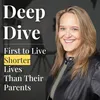
The First Generation to Live Shorter Lives Than Their Parents | Deep Dive on Ep. 276
What if the documentaries no streaming platform will buy are the ones that could save your kid's life?Today's children may be the first generation in American history to live shorter lives than their parents. That's the central argument of The 100-Year Effect, a documentary I watched at the Julian Dubuque International Film Festival the same weekend I watched two other films that turned out to be telling me the same urgent story.In this Deep Dive on Documentary First Episode 276 with Robin Canfield, host Christian Taylor unpacks what three independent documentaries (The 100-Year Effect, Ali Eats America, and Déjà Vu) reveal about what corporations have done to our food, our farms, and our bodies. And she makes the case that purpose-driven documentaries are doing for our culture what investigative journalism has always done for our democracy. They shine a light into the dark places. They show us where we are sick. And right now, they are fighting for survival.Anchored in Robin Canfield's framework from his book Purpose Driven Documentaries: A Field Guide to Creating Impact, this episode features a C.S. Lewis sermon delivered in Oxford in June 1941, a Bourdain-style culinary road trip born in a hospital room at Walter Reed, and an argument for why what we choose to watch is now a civic act.In this episode, Christian explores:Why today's children may be the first generation in American history to live shorter lives than their parentsWhat three independent documentaries have in common, and what they're trying to wake us up toHow childhood radiation treatment connects to Ali Allouche's second cancer diagnosis at 17How Robin Canfield's framework of purpose-driven documentary anchors all three filmsWhy investigative journalism and purpose-driven documentary serve the same civic functionWhat C.S. Lewis preached in Oxford in June 1941, while bombs were falling on LondonHow Anthony Bourdain's spirit lives on in a sick teenager's restaurant mapWhat corporate consolidation has done to American small family farms over the last four decadesWhy the streaming algorithm is burying exactly the films we need mostWhat you can do, in less than five minutes, to help these films find an audienceCHAPTERS:0:00 The first generation to live shorter lives than their parents1:45 Show open1:58 Robin Canfield, Actuality Abroad, and the spine of this episode3:31 Film 1. The 100-Year Effect: what corporations have done to our bodies4:25 Film 2. Ali Eats America: a sick kid, a map, and a Bourdain-style road trip9:22 Film 3. Déjà Vu: American small family farmers and the slow consolidation10:39 Three films, one story11:24 C.S. Lewis on mud pies and the holiday at the sea12:37 Documentaries as the immune system of a free culture14:15 What you can do, and why it matters15:11 We are far too easily pleasedFrequently Asked Questions:What is the central argument of The 100-Year Effect?The 100-Year Effect, directed by Bill Stuart, argues that today's children will be the first generation in American history to live shorter lives than their parents. The film features OHSU medical scientist Dr. Kent Thornburg, who traces this trend to corporate impacts on our food supply, prenatal nutrition, and environment over the last several decades. Six in ten American adults have a chronic disease, and the film argues this is not primarily a lifestyle problem.What is purpose-driven documentary filmmaking?Purpose-driven documentary is a term popularized by filmmaker Robin Canfield in his textbook Purpose Driven Documentaries: A F
AI Summary coming soon
Sign up to get notified when the full AI-powered summary is ready.
Free forever for up to 3 podcasts. No credit card required.
Listen to This Episode
More from Documentary First

Ep. 276 I Robin Canfield on Teaching iPhone Documentary in 20 Countries

They Wanted My Voice to Train AI - What Thoreau Knew About Living Deliberately in a Revolution: Deep Dive on Ep. 275

Ep. 275 I Erik & Chris Ewers on PBS Funding, AI & Directing Goldblum, Clooney & Streep
Erik & Chris Ewers: Quiet Desperation—Competence vs Self-Knowledge: Deep Dive on Episode 274
Get summaries like this every morning.
Free AI-powered recaps of Documentary First and your other favorite podcasts, delivered to your inbox.
Free forever for up to 3 podcasts. No credit card required.