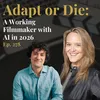
Adapt or die. What does that actually look like for a working filmmaker?Chicago documentary filmmaker Armin Korsos has a working filmmaker's answer to the question every documentarian is wrestling with right now. If you're not using AI, you will be losing work to people who do. In this conversation, Armin walks through how he turned 20 hours of pre-production paperwork into 30 minutes, how he uses AI image generation to send 40 pitches in the time it used to take to send 8, and why he believes the only currency that still matters in this industry is original ideas.In Episode 278, Christian sits down with Armin Korsos, founder of the Chicago production company Caymanite and co-founder of Filmmaker Friday Chicago, a film community event series that grew from 50 people at its first event to over 1,700 unique attendees in its first year.Born in the Cayman Islands to Hungarian parents, raised in the Chicago suburbs, and trained at Columbia College Chicago, Armin uses commercial production work to fund the documentary and narrative projects he cares about. He has a working filmmaker's take on AI (use it now or lose work to the people who do), a hard-earned theory about original ideas as the only currency that still matters, and a community he built for filmmakers who know the work can be a lonely process.In this episode, you'll learn:Why Armin says "if you're not using AI, you will be losing work to people who do"How a Hungarian-born, Cayman-Islands-raised, Chicago-trained filmmaker built a production company that funds his passion projectsWhat the Nvidia CEO said that changed how Armin thinks about original ideas when everyone has access to AIWhy Armin believes "you must be the creator if you want the IP" when working with AI toolsHow Armin found a local approaching age 90 on Cayman Brac with no phone number, no email, and no addressHow a former Premier of the Cayman Islands recorded the narration for Brac in an airport parking lotWhy an old-fashioned, boots-on-the-ground approach still beats the algorithm when looking for authentic voicesHow Filmmaker Friday Chicago grew from 50 people to 1,700 unique attendees in its first yearWhether film school is still worth it in 2026, and what to ask yourself before goingWhy Armin says luck is preparation meeting opportunity, and what that has to do with documentary filmmakingChapters0:00 If you're not using AI, you will lose work1:45 Why filmmaking can be a lonely process3:00 From the Cayman Islands to Hungary to Chicago6:00 Where are the Cayman Islands? Grand Cayman vs Cayman Brac7:18 Why the ceiling for artists in Hungary is lower than the US12:19 Is film school worth it in 2026?18:45 Building a production company that funds your passion projects23:00 How working filmmakers are using AI in 202628:33 What the Nvidia CEO said about original ideas and AI32:27 Why you must be the creator if you want the IP34:03 Brac: a 15-minute conservation documentary on a Caribbean island40:00 How to find a documentary subject with no phone, no email, no address44:00 Recording the narration with the former Premier in an airport parking lot46:30 Filmmaker Friday Chicago: from 50 to 1,700 attendees in one yearFrequently Asked QuestionsHow are working filmmakers actually using AI in 2026?Chicago filmmaker Armin Korsos uses AI to automate pre-production paperwork (location releases, talent releases, non-disclosure agreements, call sheets, invoicing) so the time saved can go to creative work that requires human attention. He also uses AI image generation for pitch decks, allowing him to send 40 pitches in the time it used to take to send 8. He spends 15 to 20 minutes every night learning new AI tools and updates.What did the CEO of Nvidia say about original ideas and AI?Jensen Huang, CEO of Nvidia, has argued that AI has equalized the playing field by removing the gatekeeping of technical knowledge. In Armin Korsos's words, paraphrasing Huang: the differentiator between who is successful and who is not in the future is who has the best original ideas. The technical skill barriers are falling. What remains scarce is the original creative input.Can AI own the intellectual property of work
Podzilla Summary coming soon
Sign up to get notified when the full AI-powered summary is ready.
Free forever for up to 3 podcasts. No credit card required.
Listen to This Episode
More from Documentary First

Ep. 279 I She Was Here: The Responsibility of Telling Someone Else's Story
The Two Kinds of “Alone” Every Filmmaker Knows I Deep Dive on Ep. 278
Anthropic's $1.5B Mistake. Yours Could Cost More. I Deep Dive on Ep. 277
Ep. 277 I Why Does One Documentary Clip Cost $70,000? Music Licensing and Fair Use
Get summaries like this every morning.
Free AI-powered recaps of Documentary First and your other favorite podcasts, delivered to your inbox.
Free forever for up to 3 podcasts. No credit card required.