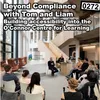
Hosted by Sean Lynch and Akshara Jonna. In this episode, the Design Thinking class talk with Liam Brady and Thomas Hamill from the UCD Estate Services team about the complexities of modern campus design, focusing on accessibility features that go "beyond compliance" and how these lessons are applied to the wider campus day-to-day.We take a look inside the design process for the new O’Connor Centre for Learning on UCD’s Belfield campus, from the preliminary brief to the final commissioning.· On to the subject for today, the new O’Connor Centre for Learning. Can you walk us through the story of this building ‘as a project’, the "Before, During, After"?· Would you say that buildings like the Moore Centre (where we are right now) and the O’Connor are high-tech buildings? In what way? How?· Going Beyond Part M: You’ve talked about how building regulations (Part M) provide a baseline for accessibility. How did you move from simple compliance to a design that truly fosters "belonging" for all users?· You mentioned a distinction between "features" and "design elements". How do we ensure accessibility is baked into the architecture rather than just bolted on as an afterthought?· Does user feedback from the wider campus influence the "Fixes" and "Audits" of new projects?· The Logistics of Mobility (MOB): From toilets and doors to steps and lighting - what are the small details that make the biggest difference in a student's daily experience?· In class we have heard that designers should focus on the "smile" (the U-shaped curve) rather than the "sad face" (the standard bell curve). In the context of the O’Connor Centre, how did you practically shift the team's focus toward the extremes of the population rather than just the "average" student?· The Paradox of Safety: A significant portion of your work involves "features we hope are never used," like fire refuge points, emergency intercoms, and smoke-filled space lighting. How can we ensure these features work, are intuitive and accessible during a high-stress emergency?· Curb cutouts and retrofitting the "Smile": It’s one thing to build the O’Connor Centre from scratch with these curves in mind, but how do you apply the "smile curve" logic to the "day-to-day" maintenance and "fixes" of older, more "complicated" UCD buildings?· Audit to Action: Can you talk about how "Audits" can be used as productive levers to rebalance our design focus?· Any questions from the audience?Thank you both for taking the time to talk with us today.Notes:UCD Estate Services project page - https://www.ucd.ie/estates/operations/ucdoconnorcentreforlearning/RKD profile page for the UCD O’Connor Centre for Learning - https://rkd.ie/work/ucd-centre-for-future-learning/From the Government of Ireland, Department of Housing, Local Government and Heritage - Building Regulations Part M: Access and Use requirementsOHAC - O’Herlihy Access Consultancy - https://www.accessconsultancy.ie AcknowledgementsMusic Title: StoryArtist: MeydänSource: https://bit.ly/2P5CSCvLicense: CC BY Cover Art Title: Teleport into O’ConnorArtist: Allen Higgins. Photos prompt merged with Gemini. Classroom in sharp focus overlaid into the O’Connor atrium space in bokeh effect.Source: TomLiam-seminar.pptxLicense: CC BY-NC-SA 4.0Podcast LicenseDesign Talk (dot IE) CC BY-NC-SA 4.0 The license can be viewed at https://creativecommons.org/licenses/by-nc-sa/4.0By taking part, you give permission for your voice to be recorded, for the recording to be edited, and for it to be posted and published as a podcast. Hosted on Acast. See acast.com/privacy for more info
Podzilla Summary coming soon
Sign up to get notified when the full AI-powered summary is ready.
Free forever for up to 3 podcasts. No credit card required.
Listen to This Episode
More from Design Talk (dot IE)

0276 - The 4Rs of Research with Pamela Abbott
0275 - Talking about reading groups with Adam Kelly
0274 - Techno-colonization with Simeon Vidolov and Stefan Klein
0273 - The Sanctuary Hypothesis by Jean-Fabrice Lebraty
Get summaries like this every morning.
Free AI-powered recaps of Design Talk (dot IE) and your other favorite podcasts, delivered to your inbox.
Free forever for up to 3 podcasts. No credit card required.