Free Daily Podcast Summary
Death in The Garden: Daily Summaries Delivered
by Jake Marquez and Maren Morgan
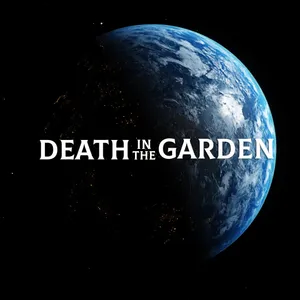
“Death in The Garden” is a multimedia project that explores the complex intersection of the cycle of life and death, holism, climate change, civilization, ecology, and health from the perspective of two incredibly curious millennials on a journey to make sense of a very complicated world. In addition to those listed above, our podcast highlights topics like regenerative agriculture, food, psychology, spirituality, politics, society, and our overall relationship with Nature and the ecosystems we are part of.
Latest Episodes
The most recent episodes — sign up to get AI-powered summaries of each one.
- 4 days ago20 min
Circumambulating the Food System | BONUS EPISODE
This is a free preview of a paid episode. To hear more, visit deathinthegarden.substack.comOn this bonus episode, we are joined by Alex Leff of Human Nature Odyssey to discuss the food system and the strange incentives that perpetuate a system that is at once convenient and destructive. Alex was also thinking about food, as he had just released a podcast entitled The Forest and Forager before this conversation, where he takes the listener on a journey through the Garden of Eden and the grocery store, trying to understand ourselves as a foraging creature who once lived in the hands of the gods. We were interested in speaking about food because we had just finished editing this film at the time of recording: Ever wondered why going to the farmers market is more expensive than going to the supermarket, buying food that was shipped all over the world? Ever wondered why it’s so difficult for small-scale farmers to make a living in this economy? Ever wondered why corporations are given carte blanche to destroy the world, while your local regenerative farmer is being over-regulated and squeezed out of the sector altogether?We were hired by Local Futures to make a film explaining some of the mechanisms that explain why this system seems so upside-down. In this conversation, we explore this topic from many more angles, going deeper into the history and civilizational-level analysis of the food system, discussing immediate return, convenience, and the trap of comparative advantage. This conversation might be more interesting if you’ve watched the video and listened to the podcast, so consider doing that first before diving a bit deeper.As always, this entire conversation is available in its entirety for our paid subscribers only. If you’d like to support the project and gain full access to these bonus episodes, consider becoming a paid subscriber today!
- Jul 23, 202615 min
The Odyssey: An Ancient Story with Modern Implications | BONUS EPISODE
This is a free preview of a paid episode. To hear more, visit deathinthegarden.substack.comAs people who were willing to drive 3.5 hours one-way to see The Odyssey projected on 70mm IMAX, it’s safe to say we are fans of Christopher Nolan and we love the art of cinema. In this bonus episode with Alex Leff of Human Nature Odyssey, we discuss Nolan’s latest epic and all of the implications that his surprising retelling has today. We discuss the importance of myth and storytelling, and the need for us to engage consciously with stories. We ask, what is the line between adaptation and appropriation? Retelling and perversion? And who gets to decide? We also delve deep into the civilizational analysis that is embedded within The Odyssey, as well as it’s literal and spiritual predecessor (Maren’s favorite Nolan film) Oppenheimer.We talk about responsibility, consequences, the role of the gods, animism, and what it means when people refuse to engage with genuine art based on culture war controversies.We hope you’ll ignore the haters and go see this movie. As always, this entire conversation is available in its entirety for our paid subscribers only. If you’d like to support the project and gain full access to these bonus episodes, consider becoming a paid subscriber today!
- May 22, 202617 min
The Score: How Quantification Has Shaped Society | BONUS EPISODE
This is a free preview of a paid episode. To hear more, visit deathinthegarden.substack.comOn this bonus episode of Death in The Garden with Alex Leff of Human Nature Odyssey, Alex takes us along on a deep-dive into The Score by game philosopher C. Thi Nguyen.In this episode we discuss all things quantification and gamification, and the ways that our civilization has prioritized what can be measured at the expense of almost everything else. W…
- Jan 12, 202624 min
28 Years Later: Embracing Zombies, Death, and the Gilmore Girls | BONUS EPISODE
This is a free preview of a paid episode. To hear more, visit deathinthegarden.substack.comOn this bonus episode of Death in The Garden with Alex Leff of Human Nature Odyssey, we talk about the strangely beautiful, gore-filled sequel to Danny Boyle’s genre-defining film, 28 Days Later — 28 Years Later. Set 28 years after the rapid spread of the “rage virus” across Britain, we follow a group of survivors who have managed to create a small, insular, and seemingly egalitarian society on an island off the coast of the mainland, protected from the zombies roaming the mainland. What follows is an incredibly earnest story of love, of growing up, and what it means to know you must die. While these movies are incredibly violent (and also hilariously bizarre), this series is one of our very favorites. 28 Years Later: The Bone Temple comes out this Friday, so be sure to check that out as well!This full-length episode is only available for paid subscribers, so if you’d like to listen to the whole thing, consider upgrading your subscription. We are so grateful to our paid subscribers for helping us keep this project going. We hope you enjoy this conversation about 28 Years Later.
- Dec 10, 20251h 56m
#65 Allan Savory - Our Collective Need to See the World Holistically
On this episode of Death in The Garden, we’re sharing the interview we did with Allan Savory, president and co-founder of the Savory Institute, an organization created to regenerate grasslands by training and connecting global practitioners in how to holistically manage their land to restore biodiversity. Last April, we had the opportunity to travel to Zimbabwe to film promotional material for Allan’s memoir. You can sign up for the pre-sale list to be notified when the book comes out. We had the opportunity to read a proof copy before our trip, and it was absolutely fascinating to have a window into the life and context that birthed holistic management. In this interview, we discuss the basic ideas around a holistic context, ecological concepts such as desertification, and the ways that we misunderstand ecology by imposing human concepts, such as competition, on the natural world. We also discuss some fascinating critiques of conservation, and the importance of human beings in environments. We discuss the role of death and killing in the continuation of life, and the importance of moral courage. We also tackle issues such as honesty in science, the fallibility of scientists and the problems of academia, bureaucracy, and institutional science. Most importantly, we talk about our desperate need to change our management strategies from reductionistic to holistic.If you haven’t seen Allan’s TedTalk, we really can’t recommend it enough. This video was probably the single biggest impetus for beginning our journey into the creation of Death in The Garden. Holistic management, and the idea of holism in general, inspired us to see the world as one whole ecosystem that we are inextricably connected to, entangled in a web of relationships. This radically shifted our view of life after being enculturated in the Western, reductionist, mechanical worldview that the dominant culture presents as fact. You can learn more about Allan’s work at the Savory Institute’s website, and you can contribute to their end-of-year campaign if you have the means.Thank you as always to our paid subscribers who continue to make this project possible, and for Allan Savory and Jody Butterfield for giving us the opportunity to come out to Zimbabwe and work on this project. This is a public episode. If you'd like to discuss this with other subscribers or get access to bonus episodes, visit deathinthegarden.substack.com/subscribe
- Nov 20, 202527 min
Starting a Cosmic Commune: Inside Spaceship Earth and Biosphere 2 | BONUS EPISODE
This is a free preview of a paid episode. To hear more, visit deathinthegarden.substack.comOn this bonus episode of Death in The Garden with Alex Leff of Human Nature Odyssey, we’re talking about a strange little documentary that came out in 2020 called Spaceship Earth. When Jake and I first saw this film, we were impacted in a surprising way. Beyond the project of Biosphere 2, the film ultimately depicted the power of a group of people who r…
- Oct 20, 202520 min
Andor, Star Wars, Rebellion, and the Reality of Our Global Empire | BONUS EPISODE
This is a free preview of a paid episode. To hear more, visit deathinthegarden.substack.comMASSIVE SPOILER WARNING! Do not listen to this podcast if you haven’t watched Andor. Close the post! Don’t risk spoiling this show for yourself. If you’re thinking to yourself, “Psht, they’re talking about a Disney Star Wars show? Sounds dumb! I don’t care if that’s spoiled for me!” please be advised that you are wrong and have been warned! Watch the sh…
- Sep 30, 20251h 23m
#64 Helena Norberg-Hodge - Resisting the Machine World and Turning Toward Life
On this episode of Death in The Garden, we’re sharing our most recent interview with Helena Norberg-Hodge that we did while we were in Ladakh, India. Helena is the director of Local Futures, the organization leading the global localization movement. This interview was recorded following the events of the Planet Local Summit, which was a profoundly inspiring event that brought brilliant people from all over the world to discuss the most pressing issues of the day. We learned so much from our time at this summit, and are filled with a renewed sense of common humanity and inspiration, knowing that there are people all over the world resisting the machinification of the world, and turning toward life.In this episode, we discuss the problems of globalization, the global monoculture, and the breakdown of our relationships with each other and the living economy. We discuss how localization is an antidote to many of the complex problems we face in modernity, as localization prevents the invisibilization of negative externalities that has become commonplace since the creation of the global economy. We discuss how localization brings people back into contact with communities, with nature, and what it means to be a human being, allowing people to return to a life of meaning once again. We also talk about the relationship between cultural diversity and ecological diversity, and how protecting biodiversity is inextricably linked to protecting cultural diversity. We also discuss “big picture activism” and the importance of resisting the myth of a mechanical world. Near the end, we discuss the invention of greed under our modern economy and the artificial scarcity in engenders.Be sure to check out the films Ancient Futures and The Economics of Happiness, and also we absolutely encourage you to read Helena’s book, Ancient Futures: Lessons from Ladakh for a Globalizing World.* Thank you as always to our paid subscribers who continue to make this project possible, and thank you to Local Futures for enabling us to be part of the Planet Local Summit. It was such an honor and privilege to be part of such a powerful event. * This is an affiliate link. If you purchase the book through this link, we get a small kickback. This is a public episode. If you'd like to discuss this with other subscribers or get access to bonus episodes, visit deathinthegarden.substack.com/subscribe
Get Death in The Garden summaries in your inbox
Free AI-powered daily recaps. Key takeaways, quotes, and mentions — in a 5-minute read.
Get Free Summaries →Free forever for up to 3 podcasts. No credit card required.
You Might Also Like
Listeners also like.
How i Died
A forensic pathologist who can talk to the dead investigates mysterious murders in a strange town while hiding his own secrets.

Alive Again
People who survived life-threatening events share how their perspectives and lives changed afterward.

This Podcast Will Kill You
Two epidemiologists explore the biology, history, and science of diseases and medical mysteries, one deadly topic at a time.

Live Like the World is Dying
Explores how to survive and prevent the end of the world through preparation and collective action.

Inquiring Minds
Explores the intersection of science and society through critical thinking and in-depth analysis.
Noble
A journalist investigates the 2002 discovery of over 300 bodies at a Georgia crematory and the family behind the scandal.

Death, Sex & Money
A podcast about the intimate, difficult conversations around love, loss, money, and identity.

The Dan Buettner Podcast
Shares practical habits and insights from the world’s longest-lived populations to improve longevity and well-being.
Good Life Project
Explores meaningful living through conversations with experts in science, culture, and the arts.

The Emerald
Explores myth, story, and imagination to reframe modern discourse on society, science, art, and the human experience.
SuperLife with Darin Olien
Conversations on nutrition, mental health, and sustainable living that explore everyday habits harming people and the planet.

Body Bags with Joseph Scott Morgan
A forensic expert examines real American death cases, analyzing crime scenes and autopsies to explain the science behind each investigation.
About Death in The Garden
“Death in The Garden” is a multimedia project that explores the complex intersection of the cycle of life and death, holism, climate change, civilization, ecology, and health from the perspective of two incredibly curious millennials on a journey to make sense of a very complicated world. In addition to those listed above, our podcast highlights topics like regenerative agriculture, food, psychology, spirituality, politics, society, and our overall relationship with Nature and the ecosystems we are part of.
Customized Recaps
AI-powered recaps with compact key takeaways, quotes, and insights.
Straight to Your Inbox
Get key takeaways from Death in The Garden in a 5-minute read.
Save Hours Every Week
Stay current on your favorite podcasts without falling behind.
Frequently Asked Questions
What is Podzilla's Death in The Garden daily summary?
It's a free AI-powered email that summarizes new episodes of Death in The Garden as soon as they're published. You get the key takeaways, notable quotes, and links & mentions — all in a quick read.
How does the Death in The Garden podcast summary work?
When a new episode drops, our AI transcribes and analyzes it, then generates a personalized summary tailored to your interests and profession. It's delivered to your inbox every morning.
Is this an official Death in The Garden product?
No. Podzilla is an independent service that summarizes publicly available podcast content. We're not affiliated with or endorsed by Jake Marquez and Maren Morgan.
Can I get summaries of other podcasts too?
Absolutely! The free plan covers up to 3 podcasts. Upgrade to Pro for 15, or Premium for 50. Browse our full catalog at /podcasts.
How often does Death in The Garden release new episodes?
Death in The Garden publishes monthly. Our AI generates a summary within hours of each new episode.
What topics does Death in The Garden cover?
Death in The Garden covers topics including Science, Nature, Documentary, Culture, Society & Culture. Our AI identifies the specific themes in each episode and highlights what matters most to you.
Start getting Death in The Garden summaries tomorrow morning.
Free forever for up to 3 podcasts. No credit card required.
Free forever for up to 3 podcasts. No credit card required.