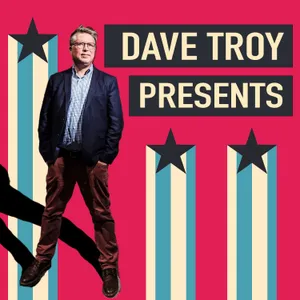
Free Daily Podcast Summary
Dave Troy Presents: Daily Summaries Delivered
by David Troy
Get key takeaways, quotes, and insights from Dave Troy Presents in a 5-minute read. Delivered straight to your inbox.
Latest Episodes
The most recent episodes — sign up to get AI-powered summaries of each one.
- Mar 21, 20251h 9m
The Nerd Reich with Gil Duran
Journalist and political communications specialist Gil Duran joins Dave for a discussion of The Network State, the latest in a long line of Libertarian Exit ideologies. Based on the ideas of people like Patri Friedman, Balaji Srinavasan, and Curtis Yarvin, the movement ultimately aims to dismantle the American government in favor of a network of federated states, all competing for citizens. The ideology has found a home in the second Trump administration and is gaining momentum quickly. Dave and Gil discuss what it is, where it came from, and how to go about stopping its spread. Interview starts at 02:47 00:00 Introduction and Guest Welcome 00:05 Exploring the Network State Concept 02:47 Mainstream Media's Reluctance 03:40 Historical Context and Silicon Valley's Influence 04:42 Local Politics and Billionaire Influence 05:22 Acceleration of Network State Ideologies 07:54 Freedom Cities and Corporate Dystopias 11:59 Exit vs. Voice: Libertarian Ideals 17:36 Cultish Movements and Apocalyptic Visions 22:48 Autocracy Inc. and Global Implications 33:12 Bitcoin and Right-Wing Politics 34:02 Network State and Democracy 34:29 Media and Political Awareness 35:37 Democrats and Cryptocurrency 43:51 Technocracy and Historical Parallels 51:43 Substack vs. Ghost Platform 55:00 Future Political Landscape 01:02:45 Grassroots Movements and Conclusion Links: https://thenerdreich.com https://x.com/gilduran76 https://theframelab.org
- Feb 25, 20251h 6m
Henry Wallace and the World that Wasn't with Benn Steil
Donald Trump wasn't the first presidential candidate to be groomed by the KGB to advance Russian interests. That dubious honor belongs to Henry A. Wallace, who ran for president in 1948. Dave interviews Benn Steil, an economist and historian from the Council on Foreign Relations. They discuss his latest book, 'The World That Wasn't, Henry Wallace and the Fate of the American Century.' The conversation explores Wallace's intriguing political and personal life, his contributions as Agriculture Secretary under FDR, his mystical beliefs, and his controversial political career. The discussion includes the impact of Wallace's policies, his interactions with and influence from historical figures like Nicholas Roerich, and his eventual fall from political grace leading up to the 1944 Democratic Convention. The guest also draws parallels between Wallace's complex legacy and contemporary political narratives, including potential influences on modern American politics. Links: https://america2.news/donald-trump-isnt-the-first-presidential-candidate-groomed-by-the-kgb/ https://www.foreignaffairs.com/united-states/genuine-case-collusion?ref=america2.news https://www.cfr.org/expert/benn-steil https://x.com/bennsteil https://www.nytimes.com/2022/09/14/nyregion/nyc-911-calls-riverside-drive.html https://www.roerich.org/ Interview begins at 02:47. 00:00 Introduction and Guest Background 00:20 Henry Wallace: A Counterfactual History 02:27 Henry Wallace's Early Life and Agricultural Innovations 06:39 Wallace's Mystical Pursuits and Political Controversies 12:39 Wallace's Political Ideologies and Economic Views 23:25 Wallace's Vice Presidency and Political Challenges 29:06 Wallace's Diplomatic Missions and Downfall 33:51 Manipulating Visits: The Russian Blueprint 34:30 The DNC's Maneuvering for a New VP 37:47 The 1944 Democratic Convention Chaos 41:02 Wallace's Downfall and Truman's Rise 45:50 Wallace's Post-VP Career and Conflicts 48:43 Wallace's 1948 Presidential Run and Communist Ties 54:40 Parallels Between Wallace and Trump 58:38 The Masonic Dollar Bill Redesign 01:00:49 Conclusion and Future Prospects
- Feb 20, 202550 min
Money, Lies, and God with Katherine Stewart
Dave interviews Katherine Stewart about her new book 'Money, Lies, and God,' which explores extremist movements in the United States, particularly focusing on the rise of anti-democratic sentiment and Christian nationalism. Katherine shares her background in reporting over the past 16 years and discusses how she began investigating these movements after a 'Good News Club' appeared at her daughter's school. She categorizes the key players in these movements into 'funders,' 'thinkers,' and 'foot soldiers' and discusses how their interactions threaten the foundations of American democracy. The interview also touches on the disinformation campaigns, the international dimension of these extremist networks, and the importance of engaging in local politics and voting to sustain democracy. 00:00 Introduction and Book Overview 00:19 Katherine's Background and Initial Interest 00:38 The Good News Club and Its Impact 02:57 Researching the Legal Advocacy Groups 04:03 The Larger Agenda and War on Public Education 04:59 Categorizing the Networks: Funders, Thinkers, and Foot Soldiers 07:45 Christian Nationalism and Its Political Machine 12:51 The Role of Spirit Warriors and Spiritual Warfare 16:56 Influence of Thinkers: Leo Strauss and Carl Schmitt 22:02 The Concept of a Red Caesar 31:24 Global Reactionary Movements and Religious Nationalism 37:38 The Role of Funders and Money in Politics 42:19 Pro-Democracy Initiatives and Individual Actions 46:38 Conclusion and Final Thoughts
- Jan 30, 20251h 5m
Russia's Third Empire with Dina Khapaeva
Dave interviews Dina Khapaeva, Russian culture expert at Georgia Tech, about the book "Third Empire: Russia as it ought to be," written by Mikhail Yuriev, one of the authors of Project Russia, which we have also covered in the last two episodes. Dina specializes in Russian historical memory and contemporary issues. She provides an in-depth background on her research and her personal history, including her family's experience with Stalinist terror. The discussion focuses on the troubling, far-right ideologies that have been shaping Russia's political strategy, particularly explored through the lens of Mikhail Yuryev's novel 'Third Empire, The Russia That Ought To Be' and the Project Russia texts. Dr. Penkrmanova explains how these narratives, rooted in neo-Eurasianist ideology and medieval Russian history, inform Putin's geopolitics and expansionist aims. The conversation also touches on the implications of these ideologies for Western policymakers and the political landscape, emphasizing the urgent need to recognize and respond to these Russian ambitions. The Utopian Russian Novel that Predicted Putin's War Plan, March 26, 2022 The West Doesn't Realize How Much Danger It's In, August 24, 2022 Putin's Dark Ages, 2023 Dina Khapaeva website 00:00 Introduction and Guest Background 00:17 Early Career and Shift to Sociology 01:00 Focus on Historical Memory 02:24 Current Role at Georgia Tech 02:59 Discussion on Mikhail Yuryev's Book 03:49 Yuryev's Influence and Political Connections 07:05 Fortress Russia and Far-Right Ideology 10:18 Neo-Eurasianism and Western Perception 19:57 Summary of 'Third Empire' Plot 23:07 Implications of Yuryev's Vision 32:04 The Devastation of War: Casualties and Destruction 32:58 Russian Ideology: Antichrist and Apocalypse 33:42 Western Perception and Putin's Strategy 34:34 The Primakov Doctrine and Nuclear Threats 38:14 Yuriev's Vision: A New Social Order 45:58 The Role of Memory Politics in Russia 51:49 Yuriev's Influence in the United States 57:21 The Patriarchal Society and Gender Issues 01:00:41 The Urgency of Recognizing the Russian Threat 01:03:10 Conclusion: The Future of Russia and Global Implications
- Jan 30, 20251h 19m
The Geopolitics of the Russian Orthodox Church with Lucy Ash
Dave interviews noted British journalist and documentarian Lucy Ash about her new book, The Baton and the Cross: Russia's Church from Pagans to Putin. They discuss intricate relationship between the Russian Orthodox Church and the modern Russian state. The interview explores the history of Orthodoxy in Russia, tracing its origins from medieval times through periods of upheaval, including the Bolshevik Revolution and the Stalinist era. Lucy discusses the personal connections that inspired her to write the book, her early perceptions of the church's potential for good, and how current events are influenced by historical precedents. The conversation examines key figures such as Patriarch Kirill and President Vladimir Putin, highlighting how orthodoxy has been used to underpin Russian nationalism and policy. The dialogue also touches on the broader social impacts of this relationship, including attitudes towards LGBTQ+ issues and women's rights. The interview concludes with reflections on Putin's personal religiosity and his regime's strategic use of the church to consolidate power. The Baton and the Cross Lucy Ash on X Lucy Ash Website 00:00 Introduction and Personal Connection to Russia 03:55 Historical Background of the Orthodox Church in Russia 08:27 Ivan the Terrible and the Oprichniki 11:40 Peter the Great and Catherine the Great's Influence 29:13 The Bolshevik Revolution and Its Impact on the Church 40:54 Smuggling Bibles into Eastern Europe 42:33 Religion and State in Russia 44:06 Russian Mysticism and Superstition 46:09 Orthodoxy and Russian Identity 47:44 LGBTQ Issues and Russian Orthodoxy 50:49 Pussy Riot and Church-State Relations 53:03 Domestic Violence and the Church 57:01 Putin's Spirituality and the Church 01:00:45 The Military Cathedral 01:06:47 Conclusion and Final Thoughts
- Dec 13, 202456 min
Project Russia and the Kremlin's War on the West
You've heard of Project 2025, but there's another framework that may be even more important for understanding the current assault on Western democracies. "Project Russia" is a series of books published between 2005 and 2010, and it outlines a strategic vision for total war on the West, against democracies, and against the US dollar and other fiat currencies. Nearly unknown to Western analysts, the concepts described in Project Russia increasingly reflect the events we see playing out on a daily basis: a war over competing worldviews with capture of media, the use of podcasts and other alternative media to challenge the mainstream press, and the emergence of a new class of unelected 'elite' demagogues who seem to be taking control of global affairs. This episode analyzes the four original Project Russia books with the help of Google's NotebookLM, and offers 'deep dives' into specific areas of the texts. More on Project Russia from Dave Troy: https://washingtonspectator.org/project-russia-reveals-putins-playbook/ Keywords: Project Russia, conservatism, nationalism, religion, Orthodoxy, geopolitics, ideology, Antichrist, apocalypse, conspiracy, collapse, future, prediction, The Idea, world order, West, elites, manipulation, control, change, modernity, post-modernity, capitalism, consumerism, society, state, power, authority, history, monarchy.
- Nov 26, 202453 min
The Tech Coup with Marietje Schaake
Big tech companies are playing an outsized role in our world and are increasingly involved in creating policy that has negative impacts on democracies. In her book The Tech Coup, Marietje Schaake argues that companies need to be reined in, and that democracies need to organize themselves in ways that can withstand the challenges posed by these companies and their increasingly imperious owners. Marietje joins Dave for a spirited post-election conversation about how the Tech Coup is playing out right now, and what we can do about it. MarietjeSchaake (X, Bluesky, Mastodon) "The Tech Coup: How to Save Democracy from Silicon Valley" https://press.princeton.edu/books/hardcover/9780691241173/the-tech-coup Keywords: Tech Coup, Democracy, Elon Musk, Regulation, Cryptocurrencies, Bitcoin, Global Governance, Public Stack, Resilience, Alternative Platforms, Geopolitics, Cybersecurity, Social Inequality, Ukraine War, Authoritarianism, Disinformation, Digital Infrastructure, Data Centers, Procurement, Investments, AI, Cables, Data Centers
- Oct 31, 202443 min
How to Win an Information War with Peter Pomerantsev
In this special bonus episode, Dave interviews author Peter Pomerantsev about his new book "How to Win an Information War: The Propagandist Who Outwitted Hitler." The book explores the work of Sefton Delmer, a journalist who developed unique ways to destabilize Hitler's propaganda programming. Their conversation was recorded on October 28, 2024, at Bird In Hand Books in Baltimore, Maryland. Pomerantsev is the author of two other books on disinformation and propaganda, "Nothing Is True and Everything is Possible," and "This Is Not Propaganda." He is currently based at the SNF Agora Institute at Johns Hopkins University. Pomerantsev also delivered a TED Talk at TEDxMidAtlantic in Washington, D.C. in June 2024. Links: TED Talk (2024) How To Win an Information War (2024) This Is Not Propaganda (2019) Nothing Is True and Everything Is Possible (2014)
Get Dave Troy Presents summaries in your inbox
Free AI-powered daily recaps. Key takeaways, quotes, and mentions — in a 5-minute read.
Get Free Summaries →Free forever for up to 3 podcasts. No credit card required.
You Might Also Like
Listeners also like.

The Nerd Reich
nerdreich
Dave VS Goliath
Dave
Geopolitics & Empire
Geopolitics & Empire
The David Knight Show
David Knight
Part Of The Problem
GaS Digital Network

The REAL David Knight Show
David Knight

Danny Jones Podcast
Danny Jones | Daylight Media
Hacking State
Alex Murshak

Geek Speak with Lyle Troxell
Lyle Troxell

Click Here
Recorded Future News

Dangerous INFO Podcast
Jesse Jaymz
Dr Reality - Dave Champion
Dr Reality
About Dave Troy Presents
Dave Troy is a technologist, historian, and researcher who has studied disinformation and extremism online since the earliest days of the internet.
Customized Recaps
AI-powered recaps with compact key takeaways, quotes, and insights.
Straight to Your Inbox
Get key takeaways from Dave Troy Presents in a 5-minute read.
Save Hours Every Week
Stay current on your favorite podcasts without falling behind.
Frequently Asked Questions
What is Podzilla's Dave Troy Presents daily summary?
It's a free AI-powered email that summarizes new episodes of Dave Troy Presents as soon as they're published. You get the key takeaways, notable quotes, and links & mentions — all in a quick read.
How does the Dave Troy Presents podcast summary work?
When a new episode drops, our AI transcribes and analyzes it, then generates a personalized summary tailored to your interests and profession. It's delivered to your inbox every morning.
Is this an official Dave Troy Presents product?
No. Podzilla is an independent service that summarizes publicly available podcast content. We're not affiliated with or endorsed by David Troy.
Can I get summaries of other podcasts too?
Absolutely! The free plan covers up to 3 podcasts. Upgrade to Pro for 15, or Premium for 50. Browse our full catalog at /podcasts.
How often does Dave Troy Presents release new episodes?
Dave Troy Presents publishes monthly. Our AI generates a summary within hours of each new episode.
What topics does Dave Troy Presents cover?
Dave Troy Presents covers topics including News, True Crime, Politics, Commentary. Our AI identifies the specific themes in each episode and highlights what matters most to you.
Start getting Dave Troy Presents summaries tomorrow morning.
Free forever for up to 3 podcasts. No credit card required.
Free forever for up to 3 podcasts. No credit card required.