Free Daily Podcast Summary
Conversations with Bill Kristol: Daily Summaries Delivered
by Bill Kristol
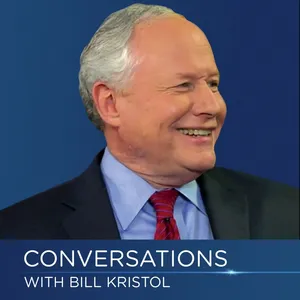
Conversations with Bill Kristol features in-depth, thought-provoking discussions with leading figures in American public life.
Latest Episodes
The most recent episodes — sign up to get AI-powered summaries of each one.
- 2 days ago56 min
David Axelrod on the 2026 Midterms: How Big a Wave?
We are less than seven weeks away from Election Day, and early voting already has begun in some states. To discuss where things stand and where American politics might go after the midterms, we are joined again by David Axelrod, chief strategist for Barack Obama’s presidential campaigns in 2008 and 2012. Axelrod shares his perspective on how the election might play out when Trump “is in a deep hole and keeps on digging.” He explains how the fundamentals point toward a historically bad year for Republicans—with a war and tariffs, unmistakably the president's own doing, felt acutely by voters through rising energy costs. Kristol and Axelrod also discuss how the Democratic Party is dealing with the rise of economic populism, and where both parties might go in terms of ideology and character of candidates as we look toward the presidential race in 2028.
- 3 weeks ago1h 7m
Doug Sosnik on Two Different Elections: 2026 and 2028
"We're 60 days away from a completely different political environment. And I think people are underestimating how different it's going to be, and how volatile it's going to be without really any moorings for either party." So argues Doug Sosnik, former political director for Bill Clinton, one of the shrewdest analysts of American politics, and the author of an indispensable new Substack. In this detailed and wide-ranging Conversation on the midterms, 2028, and the instability of American politics, Sosnik explains what polls and historical precedents can and cannot capture about our volatile electorate. Sosnik and Kristol discuss the the strength of populist forces, the challenges facing both parties in the lead up to 2028, and why 2029 may be the beginning of a new era in American political history.
- Aug 7, 20261h 6m
Eric Edelman: Trump and the American Military
Where do things stand with the military in Trump’s Second Term? What are the consequences of a shortage of munitions in the conduct of the Iran War? What should we make of the firings of senior military leaders? In this Conversation, Eric Edelman, former Under Secretary of Defense and former ambassador to Turkey and Finland, shares his perspective on what he describes as increasing dysfunction in the military and its civilian leadership. Edelman points to the consequences of Trump’s departure from the military decision-making processes typical of past administrations. Edelman also reflects on the politicization of promotion and other military procedures. As he puts it: “It takes a lot of time and effort to build the kind of military that we have had, that we’ve grown used to having since the 1980s-1990s…. It doesn’t take long to tear it down.”
- Jul 24, 20261h 1m
Don Kettl: The Trump Administration and the Politicization of the Civil Service
"Am I worried? A lot. Why? Because they’re not done yet. And it’s not just the president, but the efforts of those around him and on the outside supporting him who have a very huge and fundamental and reshaping ideology, driving an effort to … increase the president’s power even further. And this dramatically weakens the power of Congress." So argues the distinguished political scientist and leading authority on the workings of American government, Don Kettl. According to Kettl, Trump in his second term has tried to make "loyalty to the president" the ultimate litmus test for government service. He argues that, by ignoring standards of merit and competence, Trump mostly has had the effect of gutting government rather than reforming it—with dangerous consequences for the country.
- Jul 9, 20261h 2m
Ryan Goodman: The Trump Administration, the Supreme Court, and the Rule of Law
A year and a half into the second Trump administration, is the Supreme Court meeting the moment? What are the broader implications of recent Court decisions and the conduct of lower courts? What might the next years look like? To discuss these questions we are joined, again, by Ryan Goodman, a law professor at New York University, former special counsel in the Department of Defense, and co-editor of the online publication Just Security. In a bracing Conversation, Goodman argues that the Supreme Court has treated rampant non-compliance with law by the Executive Branch in a “business-as-usual” fashion, even as the administration is "engaging in actions toward the Court that very much threaten the checks and balances.” Goodman also shares his perspective on how lower courts, the media, and citizens are responding—and might better respond—to threats to the rule of law.
- Jun 26, 202655 min
Harvey Mansfield on Rational Control and Liberalism
What makes Niccolò Machiavelli the founder of modern politics? How did liberal thinkers like Locke, Montesquieu, and the American founders modify Machiavelli’s inventions? How did later thinkers like Kant and Hegel attempt to save reason? How stands rational control today? How stands the case for liberalism? Is there a path forward for a revived liberalism? Drawing on his recent book The Rise and Fall of Rational Control—based on lectures given for over fifty years at Harvard—Mansfield discusses liberalism, reason in politics, and forms of rational and irrational control. This conversation is altogether a tour-de-force introduction to the history of modern political philosophy.
- Jun 11, 20261h 5m
Ron Brownstein: What’s Going To Happen in 2026?
“This election looks like a classic collision between the irresistible force and the immovable object. The irresistible force is the elevated share of Americans who disapprove of Trump’s performance as president, which has increased since last December and is now running consistently around 60%.... The immovable object is that this election, in both the House and the Senate, is going to be fought out primarily on Republican-leaning terrain.” What’s going to happen in the House? What’s going to happen in the Senate? What should we be watching for in the months ahead? Ron Brownstein, Bloomberg Opinion columnist and senior CNN political analyst, and a leading student of American elections, presents a tour-de-force look at the polls, data, and what indicators will matter most as we head toward November.
- May 20, 202648 min
Aaron Friedberg on Fallout from the China Summit
“China is aiming to enhance its power with respect to the United States in particular, and eventually to emerge as the dominant player in the international system, and it’s working towards that goal…. It is not clear to me at this point what our strategy is, or even if we have one.” So argues Princeton Professor Aaron Friedberg in a new Conversation assessing the state of US-China relations in the wake of President Trump’s China summit and the ongoing Iran War. While the Iran War does not represent a decisive shift in US-China relations, Friedberg explains that it is viewed from Beijing as a “net positive” because it has weakened US relations with its traditional allies. In a bracing synopsis, Friedberg presents China as working diligently to overtake the US as the dominant power on the world stage, while the Second Trump administration has failed to counter with a coherent strategy.
About Conversations with Bill Kristol
Conversations with Bill Kristol features in-depth, thought-provoking discussions with leading figures in American public life.
Customized Recaps
AI-powered recaps with compact key takeaways, quotes, and insights.
Straight to Your Inbox
Get key takeaways from Conversations with Bill Kristol in a 5-minute read.
Save Hours Every Week
Stay current on your favorite podcasts without falling behind.
Frequently Asked Questions
What is Podzilla's Conversations with Bill Kristol daily summary?
It's a free AI-powered email that summarizes new episodes of Conversations with Bill Kristol as soon as they're published. You get the key takeaways, notable quotes, and links & mentions — all in a quick read.
How does the Conversations with Bill Kristol podcast summary work?
When a new episode drops, our AI transcribes and analyzes it, then generates a personalized summary tailored to your interests and profession. It's delivered to your inbox every morning.
Is this an official Conversations with Bill Kristol product?
No. Podzilla is an independent service that summarizes publicly available podcast content. We're not affiliated with or endorsed by Bill Kristol.
Can I get summaries of other podcasts too?
Absolutely! The free plan covers up to 3 podcasts. Upgrade to Pro for 15, or Premium for 50. Browse our full catalog at /podcasts.
How often does Conversations with Bill Kristol release new episodes?
Conversations with Bill Kristol publishes monthly. Our AI generates a summary within hours of each new episode.
What topics does Conversations with Bill Kristol cover?
Conversations with Bill Kristol covers topics including News, Government, Politics, Culture, Society & Culture. Our AI identifies the specific themes in each episode and highlights what matters most to you.
Start getting Conversations with Bill Kristol summaries tomorrow morning.
Free forever for up to 3 podcasts. No credit card required.
Free forever for up to 3 podcasts. No credit card required.