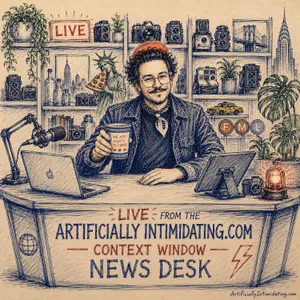
Free Daily Podcast Summary
Context Window: AI Daily News Brief: Daily Summaries Delivered
by Nicholas Rhodes | ArtificiallyIntimidating.com
The 4-minute daily AI news brief that makes artificial intelligence make sense. Every morning, five stories in plain English — no hype, no doom-scrolling, just the signal. artificiallyintimidating.com
Latest Episodes
The most recent episodes — sign up to get AI-powered summaries of each one.
- Today4 min
A Talking Typewriter Fits in 32MB -- AI Brief November 7
Good day %%first_name%%. A talking typewriter that fits in 32 megabytes leads a Saturday brief that also has Amazon opening a text line for shopping right after blocking Meta’s Muse, Meta pausing the business terms that alarmed publishers, a pile of benchmarks saying most AI design skills do nothing, and a Brookings economist’s name for the job market AI might build.A Talking Typewriter Fits in 32MB TechCrunch* What happened: Startup Underdog released a browser game to show off Woof, a voice model it says is only 32MB, TechCrunch reports. The game is a retro room with a typewriter, a CRT monitor and a desk lamp: type on the typewriter and it speaks your words back, turn the tuner and it generates music. The company says the 31-million-parameter model can run on most devices with no internet connection, and it’s open for anyone to download.* Why it matters: Most AI news is about bigger models and bigger data centers. This goes the other way: a voice small enough to live on the device you already own. If the company’s claim holds, a voice like that never has to send your words anywhere to be spoken.* What everyone’s saying: TechCrunch is measured: such a small model “likely won’t replace bigger models,” but it may be enough to drive local assistant experiences or personalized podcasts. Founder Sigil Wen told TechCrunch he started building after deciding he’d rather make his own notetaker from on-device models than use one like Granola, so users own their data. His forecast: “I think we will be able to run most capable models of today on the devices you already own within months.”* My read between the lines: The game is the pitch. Its intro casts “intrusive” cloud providers as the villain, so the demo doubles as a manifesto with a typewriter in it. It’s also the friendly front door: Underdog says it recently shipped Bark, a 167MB speech-to-text model, plus a 27-billion-parameter model for laptops and a waitlisted app pitched as a local alternative to Muse and Instinct. We haven’t played the game, so treat the offline claim as the company’s until someone does.📖 Further reading: VoiceStudio: The Free ElevenLabs Alternative Whose Default Voice Model Is Non-Commercial — a free voice app that runs on your own computer, and the licence fine print that decides whether you can sell what it makes.A typewriter makes one promise: your words, on the page, nothing in between. For a small business, the words that never get typed are the blog posts and the search work that slide to next quarter. Marblism sells AI employees that work inside the tools you already use, and Penny is the one who handles SEO and blog posts. No prompting skills needed: describe your business and goals, and the employees check in when they need your approval. New users get 10% off for life through this link, and there’s a 7-day money-back guarantee. Meet Penny →Amazon Blocked Muse, Then Built Its Own TechCrunch* What happened: On Friday Amazon said customers can text its Alexa AI agent to shop, TechCrunch reports. Select US customers get a text asking them to switch it on; from there you can search, add to cart and buy in plain language, track prices, compare products, check an order, or send a photo of an item or outfit to find similar listings. A broader rollout is coming in the next few weeks, with a waitlist for everyone else.* Why it matters: It lands just before holiday shopping, and after Amazon blocked Meta’s Muse from querying its site in September. Amazon isn’t rejecting shopping agents. It’s choosing which one gets to stand between you and the store.* What everyone’s saying: TechCrunch calls texting “the currently most popular bandwagon” for talking to AI agents. The reality check comes from DoorDash, which said last month that third-party agents had placed only hundreds of orders in total on its platform, and that it will concentrate on its own text-based agent.* My read between the lines: The fight over shopping agents is really about whose name is on the receipt. An outside agent gets the rope; the house agent gets the customer, the cart and the preferences Alexa says it will learn over time. And “hundreds of orders” is the number to keep in your pocket the next time someone calls autonomous shopping inevitable.📖 Further reading: <a target="_blank" href
- 2 days ago4 min
Google Ties Student Search to AI Access -- AI Brief November 5
Good day %%first_name%%. Google is tying student search to an AI opt-in, Anthropic signed its first news licensing deal (with the AP), and a school turned a first-grader’s drawing into an AI portrait. Plus Muse’s bathroom test and Pangram’s new AI video detector.Google Ties Student Search to AI Access ABC7 (AP)* What happened: Google said Tuesday that Gemini, Gemini Notebook, Gemini in Classroom and Google Search will be off for K-12 student accounts until school administrators “explicitly turn them on,” per Google’s blog post. The AP reports the practical effect: students using Google software in class lose Google search unless their school also opts in to AI tools.* Why it matters: Google says 150 million students and teachers use Google Classroom worldwide. The AP notes Google switched Gemini on for many K-12 students in August, after allowing it only for students 18 or older until then, and got an outcry. Google’s post says it will share specifics “in the coming months ahead of the changes rolling out,” so there is no switch-over date yet.* What everyone’s saying: Former FTC chair Lina Khan wrote: “Google is using its search monopoly to coerce schools into adopting AI.” Fairplay’s Josh Golin said the attempt to “strong-arm schools into using its AI products is likely to backfire,” and urged schools to turn off Google entirely and find “more privacy-protective alternatives for search.”* My read between the lines: The default flipped from on to off, which is the concession. The price tag is the product everyone already uses to look things up. Google calls it control; critics call it leverage; the AP’s own reading supports both. The same blog post pilots a Guided Learning feature in Search for select US schools later this month, which hands administrators a friendlier-sounding reason to flip the switch.📖 Further reading: Google’s Invisible Axe: The Silent Killer of Small Businesses — what it looks like when Google’s gate decides you don’t exist and no human answers the appeal. We lived it with one of our own businesses.Google just made search a switch a school has to flip. If you run a business, you know the feeling: the way people find you sits behind somebody else’s gate, so the place you talk to customers directly matters more, and it eats hours. Marblism sells AI employees that work inside the tools you already use, and Sonny is the social media one: it watches trends, writes posts in your tone and posts for you. No prompting skills needed. New users get 10% off for life, and there’s a 7-day money-back guarantee. Meet Sonny →Anthropic Signs First News Licensing Deal Adweek* What happened: Adweek’s Mark Stenberg reports, citing two people familiar, that Anthropic struck a content and data licensing deal with the Associated Press just before the midterms. On Election Night, Claude users asking for polling data saw “up-the-minute information, provided by and attributed to the Associated Press.” Neither side disclosed terms or length; Anthropic didn’t respond and the AP gave no on-record comment.* Why it matters: Until Tuesday, Stenberg writes, Anthropic had no licensing deal with any digital publisher, while OpenAI has “more than a dozen,” including Axel Springer, News Corp. and The Atlantic. In August, media executives told him Anthropic believes its use of publisher content is legal under fair use. Yesterday we covered the OpenAI and Anthropic election war rooms; this is the data feed side of Anthropic’s election week.* What everyone’s saying: Stenberg’s read: premium publishers block AI crawlers, so Claude could only cite low-credibility sites that “cannot tell a user which politician won a Senate seat 10 minutes ago.” He calls the blocking “effectively a digital embargo,” and writes that “in this limited instance, the strategy worked.”* My read between the lines: The AP is the safest first date: licensing and wire deals are most of its revenue, it was the first publisher to sign with both Google and OpenAI, and it’s nonpartisan. Stenberg expects Anthropic to use the experiment to decide whether to sign more, and notes the co
- 3 days ago4 min
A Meta Bot Hit an Artist’s Website 550,000 Times -- AI Brief November 4
Good day %%first_name%%. A Meta bot got stuck pressing “remove from cart” on one artist’s shop, a vibe-coded AO3 clone lasted a single day, and OpenAI and Anthropic ran election war rooms. Plus Mamdani on Sam Altman and how workers across Asia and Africa really use AI.Meta Bot Hits Artist’s Shop 550,000 Times Business Insider* What happened: San Diego children’s author and illustrator Chelsea Paulus told Business Insider that a Meta bot hit her website more than 550,000 times and overwhelmed her hosting. Fast Company reports the bot, Meta-ExternalAgent, got stuck in a loop on her site’s “remove from cart” function, making more than a hundred hits a minute. After she blocked it, a second Meta bot, Meta-WebIndexer, pushed her CPU to 100% and crashed the site.* Why it matters: Paulus told Business Insider she edited her robots.txt file and put up a firewall, but “those can also take 24 hours to take effect, and I needed to stop the bots immediately.” The fix that finally worked was code from her host, pasted into a hidden file on her site. Paulus, who used to work in web design, called it “an incredibly stressful week, even with some of my technical knowledge.”* What everyone’s saying: Meta’s answer: “website managers can decide how our crawlers interact with their sites through tools like robots.txt,” a spokesperson told Business Insider, adding that the company respects “the preferences site owners set.” Fast Company ties the episode to the scrutiny Meta faces over announced changes to its terms that, in its words, “essentially, allow AI crawlers to run wild across business accounts.” Three days ago we covered the one robots.txt line four labs will honor.* My read between the lines: “Just use robots.txt” is true the way “just lock your door” is true: it helps, and it works after the thing has already walked in. The machine built to read the whole internet got trapped by a shopping cart button, and the cost landed on a woman with four websites on one hosting plan. On Monday we covered Amazon’s stance on Meta’s Muse. Small shops don’t have Amazon’s bouncers.📖 Further reading: AI Agents Can’t Find Your Business. I Tested Mine. — the other side of the bot problem: why the big sites are blocking agents, and what a bot actually sees when it visits a small business’s website.Chelsea Paulus is a working artist who got dragged into server logs and hosting tickets when she should have been drawing. The same thing happens to every small business: the unglamorous stuff piles up while you’re busy doing the work you’re actually good at. Marblism sells AI employees that work inside the tools you already use, and Eva is the executive assistant: your inbox, your calendar and your meeting notes, checking in with you when she needs an approval. No prompting skills needed. New users get 10% off for life, and there’s a 7-day money-back guarantee. Meet Eva →Vibe-Coded AO3 Clone Dies in One Day 404 Media* What happened: ao3.life, a vibe-coded site that scraped fanfiction from Archive of Our Own, reposted it and charged for AI-generated audiobook versions, went down Monday evening. Its creator said it received more than 2,000 takedown requests in the single day it was up, and that “a swarm of AI Agents controlling 40 virtual machines” did the scraping, 404 Media’s Samantha Cole reports.* Why it matters: The clone appeared after AO3 itself went down Thursday following a security incident. The Organization for Transformative Works, which runs AO3, says it could be down for as long as four weeks, with no data lost. AO3 hosts nearly 18.5 million works. Authors who had “archive locked” their stories to keep out bots reported the lock didn’t stop it: “I had everything archive locked on ao3 and it’s still all here,” one wrote on Bluesky.* What everyone’s saying: Readers and authors responded with widespread backlash on social media. The creator, who signed the apology “a 17 year old from India that thought they were doing something goo
- 4 days ago5 min
AI Chatbots Are Giving Voters Wrong Dates -- AI Brief November 3
Good day %%first_name%%. It’s Election Day, and a new audit found AI chatbots botching basic voting questions. Plus OpenAI’s test for everyday chores, an AI that rewrites another AI’s weights, Anthropic’s amended S-1, and why Postgres 19 is late.Chatbots Botch Voting Rules on Election Day NPR* What happened: In October, the nonprofit Innovating for the Public Good (IFPG) tested major chatbots on election questions, and NPR reports that 13.9% of their answers to voting-logistics questions were outdated or inaccurate. In 5.9% of answers the error could cost a voter: a missed deadline, the wrong day, or a skipped step.* Why it matters: Today is Election Day, Tuesday, November 3, and these tools are where a lot of people now ask how to vote. NPR says accuracy depended more on the chatbot than the question: Claude and Copilot produced three-quarters of the clear errors, and on voting questions Claude was wrong or outdated about one time in three, Copilot one in four, ChatGPT one in 10. Earlier this week we covered ChatGPT trusting fake local news. This is the same weakness, with a deadline on it.* What everyone’s saying: IFPG’s Chambers called the error rates “extremely troubling” and said the “legions of errors” make you wonder how much more there is to find. Anthropic spokesperson Michael Aciman told NPR that because IFPG used an API, some of Claude’s key safeguards may not have been active. IFPG says its own comparison of API and web answers found them comparable.* My read between the lines: The wrong answer is half the problem; the confidence is the other half. NPR also found every chatbot tested commonly pointed to betting sites like Polymarket and Kalshi when asked who’s winning. Betting odds dressed up as polling is a new way to be wrong. Check your state’s official election site before you trust any of them.📖 Further reading: AI Is a Trust Problem, Not a Tech Problem — My notes from the Chamber of Commerce AI + Work Summit, where the word under every panel was trust, the gap a confidently wrong answer opens.A chatbot that guesses with total confidence makes a terrible coworker. Viktor is an AI agent that lives in your Slack and connects to 3,000+ tools, then does the work: reports, dashboards, code and campaigns. A coworker, not a chatbot. New readers get $50 off their first month. Hire Viktor →OpenAI’s LifeVal Grades AI on Chores OpenAI* What happened: On Monday OpenAI published LifeVal, a test of how well AI handles everyday tasks like shortlisting kindergartens after a move, organizing flood-prep volunteers, or building a meal plan for a parent newly diagnosed with diabetes. OpenAI says GPT-6 Astra scored 93.1%, 98% and 90.4% on those three, and CNN reports it scored 80% overall versus 49.3% for GPT-5.2 from December 2025.* Why it matters: Benchmarks steer what labs build. OpenAI says it has used LifeVal for the past year to track and drive progress on everyday tasks, because it wants ChatGPT to “take actions that actually get things done,” not just chat. The tasks came from a 3,995-person survey, and about 100 users wrote their own tasks and grading rubrics, per CNN.* What everyone’s saying: CNN frames it as a move in the race for personal AI agents against Meta, Anthropic and Google, noting Meta’s Muse hit 10 million U.S. downloads in its first 40 days, per Sensor Tower. OpenAI researcher Jenny Yang told CNN the goal is to learn “what are the things that we’re not so good at yet?”* My read between the lines: OpenAI built the test, picked the tasks and graded its own model, and the model did great. The 100% scores in OpenAI’s table are labeled “best recorded,” which is not the same as typical. The number that matters is how an average run handles your Tuesday, and that one isn’t in the chart.📖 Further reading: OpenAI Made Its New Agent Adorable. That’s the Part That Worries Me. — Dots is the always-on agent running on GPT-6 Astra, the model LifeVal grades, and my read on what happens when a chore-doing agent is cute.The daily Brief is free and always will be. M
- 5 days ago5 min
Musk Says Grok Bot Costs More Than It Earns -- AI Brief November 2
Good day %%first_name%%. Elon Musk says Grok Bot costs more to serve than it earns, Anthropic is asking job candidates how they would feel if its stock went to zero, and Amazon’s CEO has an opinion about Meta’s shopping agent. Plus free Adobe clones built with Claude, and photographers vibe coding their old DSLRs.Musk Says Grok Bot Costs More Than It Earns Startup Fortune* What happened: A user asked Elon Musk on Sunday whether xAI could reset Grok Bot’s weekly usage pool after paying users burned through it early. Musk replied that “the cost of serving Grok Bot was unsustainably high relative to revenue,” Startup Fortune reports. He gave no dollar figure and no timeline for a fix.* Why it matters: Grok Bot keeps working on its own virtual computer after you close the tab, so one run can burn far more compute than a chat reply. Startup Fortune says it has no standalone price, rides along with SuperGrok plans from $30 a month, and that xAI has never published the weekly allowance. Yesterday we covered OpenAI folding ChatGPT and Codex into one usage bucket. Today’s version of the same squeeze comes with a quote.* What everyone’s saying: Startup Fortune calls it an unusual confession, since labs usually say demand is outrunning supply, not that the thing people use most is the thing costing them most. It cites Teslanorth for roughly 800,000 paid weekly users within about two months of launch.* My read between the lines: The meter is the business model, and Musk just read it out loud. Earlier this year he floated ads inside Grok to pay for “those expensive GPUs,” and an agent that can’t cover its own compute makes that idea look less like a joke. Growth you can’t afford is a fast way to find your limit.📖 Further reading: What is Grok Bot? The answer is in the fine print — Written two days after launch, it flagged the product’s always-on cloud computer and a meter nobody capped.Grok Bot just showed what an agent that never clocks out can do to a budget. Viktor is an AI agent that lives in your Slack and connects to 3,000+ tools, then ships the work: reports, dashboards, code and campaigns. A coworker, not a chatbot. New readers get $50 off their first month. Hire Viktor →Anthropic Asks Hires About Stock at Zero Fortune* What happened: Fortune reports that Anthropic is asking job candidates in culture interviews how they would feel if the company dropped its AI ambitions for safety reasons and the stock fell to zero, according to Axios. The piece lands as Anthropic targets a November IPO at a $1.5 trillion to $2 trillion valuation.* Why it matters: More than 2,500 employees could get rich from the listing, and Fortune says Dario Amodei has reportedly worried that the money could pull staff away from the mission. Anthropic’s S-1, filed Oct. 26, calls competition for talent “exceptionally intense,” and Fortune lists staff software engineer base salaries of $350,000 to $850,000. Last week we covered Anthropic opening its books. This is the human side of the same filing.* What everyone’s saying: One candidate wrote on the anonymous workplace site Blind: “I was honest and said no, I would not be happy if the stock went to 0.” Fortune also notes that Amodei and his six co-founders pledged to give away 80% of their wealth, and that about 400 current and former SpaceX employees saw stakes pass $100 million after that IPO.* My read between the lines: It is a loyalty test with a price tag attached, and the honest answer is the one the candidate gave. A culture screen works until the shares vest. Asking early is smart, but an interview question is not a lockup.The daily Brief is free and always will be. When a headline leaves you asking how you would actually use the thing, that is what the paywalled deep-dives are for. Members get those plus the full archive. Become a member →Amazon’s CEO Shrugs at Meta’s Muse <a target="_
- 6 days ago5 min
OpenAI Puts ChatGPT and Codex in One Bucket -- AI Brief November 1
Good day %%first_name%%. OpenAI is about to make ChatGPT and Codex draw from the same usage allowance, DeepSeek published a blueprint for an agent that never goes offline, and four AI labs agreed to honor one robots.txt line that tells them to keep out. Also today: a viral post about an Anthropic talk that doesn’t hold up, and OpenAI raising less money than it wanted.ChatGPT and Codex Will Share One Usage Bucket OpenAI Help Center* What happened: OpenAI says that starting in December, the usage allowance on Plus, Pro and Business plans will be shared across ChatGPT and Codex, its coding agent. Usage will be measured in tokens, and “instant chat will not draw from your usage.” OpenAI hasn’t given a start date or allowance sizes by plan, TokenPost reports.* Why it matters: Chatting and coding used to be two separate habits. Soon a long Codex session will leave less room for everything else you do in ChatGPT, and the reverse. You’ll see your combined remaining usage under Settings → Usage, and at the limit you can wait, upgrade or buy credits. On Friday we covered OpenAI scrapping its ChatGPT Pro cut. This is the next chapter.* What everyone’s saying: The Hacker News thread is running hot, with 106 points and 48 comments when I read it. One commenter says Claude is already ahead on coding and that the merge will push non-coders to switch too. A researcher says the thing he pays OpenAI for is that Pro-tier chat and Codex are billed separately, which suits long math reasoning, and that he’ll “see once this transition actually happens.”* My read between the lines: OpenAI says it expects most users won’t wait for resets more often than they do now. That sentence is carrying the whole announcement, because there are no allowance numbers to check it against. The stated reason is bringing Work’s agent features into the main ChatGPT experience, which makes ChatGPT an agent product with a chat window, billed like one.📖 Further reading: OpenAI Codex: Apache-2.0, 120,183 Stars, and the Bill That Isn’t in the Repo — Our Codex breakdown: the client is free, and what you can actually run depends on the plan, including an April cut OpenAI announced itself.If your week now includes rationing one shared AI allowance, here is a thought: hand the grunt work to a coworker instead. Viktor is an AI agent that lives in your Slack and plugs into 3,000+ tools, then does the work: reports, dashboards, code and campaigns. Not a chatbot, a coworker. New readers get $50 off their first month. Hire Viktor →DeepSeek Sketches an Agent That Never Logs Off BigGo Finance* What happened: On Saturday evening, DeepSeek’s Harness team published an article describing a “Super-agent”: one assistant that stays online, takes in messages from group chats, GitHub and email, and hands the work to separate worker agents. It also put an MIT-licensed prototype plugin on GitHub. BigGo Finance notes this is an engineering exploration, not a formal DeepSeek product.* Why it matters: The team’s argument is that agents are no longer limited by the model but by you: a person can usually follow only three to five active agent sessions at once. So a lightweight router sorts incoming work, workers keep their own context and tools, and a separate watchdog checks for tasks that stall or loop. DeepSeek says an internal instance already helps reproduce bugs and respond to code reviews.* What everyone’s saying: Coverage so far mostly relays DeepSeek’s own numbers. In its simulated tests, the 95th-percentile task time was 15.7 minutes against 29.5 for a conventional single-session setup, with cache-read tokens up about 37%. The team lists long-term memory, security and privacy, and human oversight as unsolved.* My read between the lines: Look at the test: about 300 simulated messages per run, roughly 20 of them real work requests, five runs each. That shows the plumbing keeps up, not that the fixes are any good. The detail I like is the watchdog. BigGo calls it an AI supervisor, so the system built to save human at
- 1 weeks ago5 min
ChatGPT Trusted Fake Local News -- AI Brief October 31
Good day %%first_name%%. It’s Halloween, and the scariest thing in today’s Brief is a “local newspaper” with 16 stories, all about one candidate, that ChatGPT cited as a source. Also: Google’s Genie 4 builds worlds with sound that last about two minutes, a Harvard professor says middle managers have more to fear than juniors, and Cal Newport and Tim Ferriss each warn that AI can make work faster and worse at the same time.ChatGPT Cited Fake Local News Sites NPR* What happened: NPR ran 37 questions about 10 competitive U.S. House races through ChatGPT and Gemini. In 19 of ChatGPT’s answers, about half, it cited at least one site from a network of look-alike “local news” outlets, and in 17 of those it was an outlet posing as local news. One of them, the Kalamazoo Beacon, has published 16 stories, all about one Democratic candidate, and ChatGPT put his affordability plan at the top of its answer.* Why it matters: The sites are thinly veiled political ads. The security firm VisionHeight counted 37 of them, all set up on September 15, all but one within an eight-minute window, and no one has identified the operator. They welcome AI crawlers, publish in question-and-answer form, and ship llms.txt files, which most sites don’t. Chatbot answers are now an advertising target.* What everyone’s saying: Georgetown’s Renée DiResta told NPR that disclosing who is behind the sites would be “obviously the ethical thing to do.” OpenAI said ChatGPT’s search tools “cite from a range of sources so people can explore and make their own judgements.” Gemini cited none of the sites, and Google said it took “swift action” after detecting a policy violation.* My read between the lines: Nobody hacked anything. The sites look like exactly what a chatbot is built to trust: local, newsy, question-shaped, and up against thin competition, a gap researchers call a data void. The telling detail is that the Kalamazoo Beacon was still cited every time in five re-runs after NPR flagged it to OpenAI. NPR ran each query once, so treat the 19 as a snapshot. The playbook works for any party, which should worry everyone.📖 Further reading: AI Agents Can’t Find Your Business. I Tested Mine. — The flip side of today’s story: what an AI agent can and can’t read about a business, tested on a real one.Tim Ferriss says AI multiplies whatever you hand it, so hand it work worth multiplying. Viktor is an AI agent that lives in your Slack and plugs into 3,000+ tools, then does the work: reports, dashboards, code and campaigns. Think coworker, not chatbot. New readers get $50 off their first month. Hire Viktor →Google’s Genie 4 Adds Sound to Its Worlds Ars Technica* What happened: Google DeepMind announced Genie 4 on October 27, a research preview of a world model that generates interactive scenes with native audio and more realistic physics and people, Ars Technica reports. You steer it with text mid-simulation, like changing the weather or moving the camera, and Gemini 3.8 Flash acts as a guiding agent. It is in the hands of trusted testers now, per DeepMind, with Google AI Ultra subscribers next.* Why it matters: DeepMind’s pitch is endless training environments for robots and agents. In one demo, Genie 4 and Gemini 4 Argon simulated Apptronik’s Apollo humanoid playing checkers. Earlier this week we covered Google handing Gemini 4 Carbon to cyber defenders first. This is the other side of the Gemini family, the one that builds pretend worlds.* What everyone’s saying: TechCrunch frames it as a crowded race. It arrives a couple of months after Runway’s second world model, while Fei-Fei Li’s World Labs is being acquired by AMD, Amazon is in talks to buy Decart, and Rivian just bought Third Dimension.* My read between the lines: The caveat is the part to remember: DeepMind says Genie 4 worlds stay consisten
- 1 weeks ago5 min
Anthropic Is SpaceX’s Biggest Customer, For Now -- AI Brief October 30
Good day %%first_name%%. Anthropic turns out to be SpaceX’s biggest customer, and it can leave on 90 days’ notice. OpenAI backed off a price cut, a bank runs its own coding model, and Google and Microsoft are splitting on how to charge for agents. But first, a quick plug for the new podcast episode below.New on the podcast, episode 3: novelist Justin Feinstein wrote Your Behavior Will Be Monitored, a novel about an ad guy hired to teach a bot how to market to people inside a company where the bots watch the employees. He figured that world was five to ten years away. Then it started happening before the book was out. We get into the cookie data that knows too much (including the custom Oreo ads that showed up 15 minutes after an email), why he drives differently around Waymos, how to spot AI writing, and the wave of AI-powered crime he is writing about next. Listen to episode 3 → Follow the show in any app: pod.link/6785740580.Anthropic Is SpaceX’s Biggest Customer, For Now Bloomberg* What happened: Bloomberg reports that “Customer B,” the unnamed client behind about 34.5% of SpaceX’s third-quarter revenue, is Anthropic, citing a person familiar with the matter. The money flows to SpaceX’s AI division, now called Super Intelligence, which supplies computing power. Bloomberg’s headline puts the deal at $3 billion a month.* Why it matters: Anthropic’s IPO filing, which Yahoo Finance covered, says it agreed to spend up to $120.5 billion with SpaceX’s AI arm over terms into 2029, about $3.1 billion a month once all the capacity arrives in December. Once the initial non-cancelable periods end in early 2027, either side can cancel with 90 days’ notice, Gizmodo notes. Earlier this week we covered Anthropic opening its books. This is the next chapter.* What everyone’s saying: Yahoo Finance reads the deal as proof that SpaceX’s AI compute business is durable. Gizmodo’s angle is the size: the filing shows the SpaceX agreement is tens of billions of dollars bigger than the $84.5 billion earlier reports had suggested.* My read between the lines: “Durable” and “cancel on 90 days’ notice” are doing a lot of work in the same story. SpaceX’s biggest customer can leave in a quarter, and the landlord also builds Grok, a rival to Claude. Colossus is a very expensive apartment building with one big tenant and a very short notice clause.Microsoft wants to put a meter on your AI, and your Friday still has a to-do list. Viktor is an AI agent that lives in your Slack and plugs into 3,000+ tools, then does the work: reports, dashboards, code and campaigns. Think coworker, not chatbot. New readers get $50 off their first month. Hire Viktor →OpenAI Scraps Its ChatGPT Pro Cut The Decoder* What happened: OpenAI doubled the Work and Codex usage quotas on its Pro 100 and Pro 500 plans. On Pro 200 it doubled the lower quota and reversed a planned cut after user pushback, The Decoder reports. The Plus plan stays the same, and new and existing subscribers get the new quotas automatically.* Why it matters: On these plans the usage allowance is the real price. The $200 sticker never moved, but what you got for it changed, and then changed back. OpenAI’s own caveat: doubling a quota does not mean twice as many finished tasks, because consumption varies by model, task type and settings.* What everyone’s saying: The Decoder frames it as a race with Anthropic, which is preparing its IPO, with both companies competing hard for business customers. OpenAI says it will keep shipping efficiency gains and points to its new 6.1 models, Terra and Sol, which The Decoder says are much more efficient while matching or beating their predecessors.* My read betw
Get Context Window: AI Daily News Brief summaries in your inbox
Free AI-powered daily recaps. Key takeaways, quotes, and mentions — in a 5-minute read.
Get Free Summaries →Free forever for up to 3 podcasts. No credit card required.
You Might Also Like
Listeners also like.

The AI Daily Brief: Artificial Intelligence News and Analysis
A daily analysis of artificial intelligence news, exploring its creative potential, industry impacts, and ethical challenges.

Last Week in AI
Summarizes significant AI news on a weekly basis.
The Anthropic AI Daily Brief
Breaks down Anthropic's latest AI advancements and their real-world implications in clear, accessible language.

Learn AI
Learn AI

The AI Podcast
Explores artificial intelligence advancements, trends, and ethics for enthusiasts and professionals.

Global News Podcast
Global News Podcast AI

AI Daily: Claude News
Daily news on Claude AI, Anthropic updates, and advances in artificial intelligence, including models, research, and industry competition.

AI For Humans: Weekly AI News, Tools & Trends
A weekly breakdown of major AI news, tools, and breakthroughs for both newcomers and seasoned enthusiasts.

The AI Power Podcast
Explores AI policy, regulation, and global power dynamics shaping artificial intelligence’s impact on security, economy, and geopolitics.

Everyday AI Podcast – An AI and ChatGPT Podcast
Covers practical uses of AI tools like ChatGPT and Midjourney to help people work more efficiently and advance their careers.

This Week in AI
Four AI experts analyze the latest news and trends in artificial intelligence each week.

Sources with Alex Heath
A podcast offering insider interviews with influential tech leaders and rising entrepreneurs shaping Silicon Valley's future.
About Context Window: AI Daily News Brief
The 4-minute daily AI news brief that makes artificial intelligence make sense. Every morning, five stories in plain English — no hype, no doom-scrolling, just the signal. artificiallyintimidating.com
Customized Recaps
AI-powered recaps with compact key takeaways, quotes, and insights.
Straight to Your Inbox
Get key takeaways from Context Window: AI Daily News Brief in a 5-minute read.
Save Hours Every Week
Stay current on your favorite podcasts without falling behind.
Frequently Asked Questions
What is Podzilla's Context Window: AI Daily News Brief daily summary?
It's a free AI-powered email that summarizes new episodes of Context Window: AI Daily News Brief as soon as they're published. You get the key takeaways, notable quotes, and links & mentions — all in a quick read.
How does the Context Window: AI Daily News Brief podcast summary work?
When a new episode drops, our AI transcribes and analyzes it, then generates a personalized summary tailored to your interests and profession. It's delivered to your inbox every morning.
Is this an official Context Window: AI Daily News Brief product?
No. Podzilla is an independent service that summarizes publicly available podcast content. We're not affiliated with or endorsed by Nicholas Rhodes | ArtificiallyIntimidating.com.
Can I get summaries of other podcasts too?
Absolutely! The free plan covers up to 3 podcasts, any in the catalog. Basic raises that to 15, Pro to 40 and Max to 100. Browse our full catalog at /podcasts.
What topics does Context Window: AI Daily News Brief cover?
Context Window: AI Daily News Brief covers topics including News, Technology. Our AI identifies the specific themes in each episode and highlights what matters most to you.
Start getting Context Window: AI Daily News Brief summaries tomorrow morning.
Free forever for up to 3 podcasts. No credit card required.
Free forever for up to 3 podcasts. No credit card required.