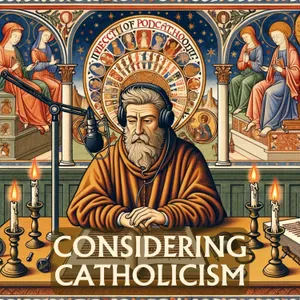
Free Daily Podcast Summary
Considering Catholicism: Daily Summaries Delivered
by Greg Smith
The Catholic Church, its faith, culture, and history are explained clearly and simply for anyone curious about historic Catholicism. Faithful to the Catechism of the Catholic Church.
Latest Episodes
The most recent episodes — sign up to get AI-powered summaries of each one.
- 4 days ago37 min
The Catholic Bogeyman, Part 2: Responding with Love (#483)
A myth does not want a conversation. It wants you on defense: ten charges in a minute, each one cheap to shout and expensive to answer. This episode is about refusing that game without refusing the person. Love runs both ways — toward the critic, and toward the Catholic who has been worn down by family, forwards, and the pressure to win dinner. You may walk away. You may pray and keep the relationship. You may live a life in Christ that the plot cannot cast as a dupe, and leave the rest to time and the Holy Spirit. Not every baptized person is called to be an apologist. Faithfulness is not the same thing as answering every shot. SUPPORT THIS SHOW Considering Catholicism is 100% listener-supported. If this podcast has helped you on your journey, please become a patron today! For as little as $5/month you get: • Every regular episode ad-free and organized into topical playlists • Exclusive bonus content (extra Q&As, Deep-Dive courses, live streams, and more) • My deepest gratitude and a growing community of like-minded listeners ➡️ Join now: https://patreon.com/consideringcatholicism (or tap the Patreon link in your podcast app) One-time gift: Donate with PayPal! CONNECT WITH US • Website & contact form: https://consideringcatholicism.com • Email: consideringcatholicism@gmail.com • Leave a comment on Patreon (I read every one!) RATE & REVIEW If you enjoy the show, please leave a rating (and even better, a review) on Apple Podcasts, Spotify, or wherever you listen — it really helps new listeners find us. SHARE THE SHOW Know someone who’s curious about Catholicism? Send them a link or share an episode on social media. Thank you! Christus vincit, Christus regnat, Christus imperat.
- 1 weeks ago35 min
The Catholic Bogeyman, Part 1: A Myth, Not an Argument (#482)
Anti-Catholic propaganda is not a pile of arguments waiting to be answered one by one. It is a story: a pure church, a theft, a long night, a remnant, a monster with a face. That story has kept the same shape for five hundred years. It works by emotion, not evidence. Once the plot is in place, facts become scenery and you cannot fact-check a myth. This episode is about recognizing that narrative for what it is. The next episode is about how to respond. SUPPORT THIS SHOW Considering Catholicism is 100% listener-supported. If this podcast has helped you on your journey, please become a patron today! For as little as $5/month you get: • Every regular episode ad-free and organized into topical playlists • Exclusive bonus content (extra Q&As, Deep-Dive courses, live streams, and more) • My deepest gratitude and a growing community of like-minded listeners ➡️ Join now: https://patreon.com/consideringcatholicism (or tap the Patreon link in your podcast app) One-time gift: Donate with PayPal! CONNECT WITH US • Website & contact form: https://consideringcatholicism.com • Email: consideringcatholicism@gmail.com • Leave a comment on Patreon (I read every one!) RATE & REVIEW If you enjoy the show, please leave a rating (and even better, a review) on Apple Podcasts, Spotify, or wherever you listen — it really helps new listeners find us. SHARE THE SHOW Know someone who’s curious about Catholicism? Send them a link or share an episode on social media. Thank you! Christus vincit, Christus regnat, Christus imperat.
- 2 weeks ago27 min
Ed the Candidate, Part 2 (#481)
In the second conversation, Ed turns from his own story to the people who write in every week and say they are exactly where he was two or three years ago. He talks about the things that actually help: treating your relationship with God as the most important thing in your life, finding a few trustworthy voices and ignoring the rest, asking yourself honestly what is holding you back (usually authority or the demand that every last question be answered first), and accepting that the process takes longer than you want. He tells the annulment story—the mailbox checks, the dark nights, the moment he stood in front of a crucifix and had to decide whether he would follow or not—and why he now tells people to start praying the Rosary every day even if they still think they are “just looking.” He is honest about family tension, the difference between rushing and never moving, and the quiet way timing finally lined up. If you are on the same road, this is Ed speaking directly to you. SUPPORT THIS SHOW Considering Catholicism is 100% listener-supported. If this podcast has helped you on your journey, please become a patron today! For as little as $5/month you get: • Every regular episode ad-free and organized into topical playlists • Exclusive bonus content (extra Q&As, Deep-Dive courses, live streams, and more) • My deepest gratitude and a growing community of like-minded listeners ➡️ Join now: https://patreon.com/consideringcatholicism (or tap the Patreon link in your podcast app) One-time gift: Donate with PayPal! CONNECT WITH US • Website & contact form: https://consideringcatholicism.com • Email: consideringcatholicism@gmail.com • Leave a comment on Patreon (I read every one!) RATE & REVIEW If you enjoy the show, please leave a rating (and even better, a review) on Apple Podcasts, Spotify, or wherever you listen — it really helps new listeners find us. SHARE THE SHOW Know someone who’s curious about Catholicism? Send them a link or share an episode on social media. Thank you! Christus vincit, Christus regnat, Christus imperat.
- 3 weeks ago27 min
Ed the Candidate, Part 1 (#480)
Ed is no longer just considering. After four-plus years of conversations on this show, he is now a candidate in the mid-year OCIA cohort at our parish and will enter the Church on the Feast of Christ the King. Sitting at the secret compound (earth-movers optional), he talks about what it actually feels like to walk into Sunday Mass as a newbie: the missed genuflection, the missed missal, the Laurel-and-Hardy choreography in the back pew, and the sudden realization that Catholic liturgy demands active participation instead of following words on a screen. He describes the unexpected emotion at the Sign of Peace and the elevation of the Host among people who are clearly serious, then gets to the harder part: obedience as a feature rather than a bug, reordering weekends around Mass when his wife is not interested, walking away from the old music network, and staring down an examination of conscience and confession. This is the update longtime listeners have been waiting for—the difference between studying Catholicism and beginning to live it. SUPPORT THIS SHOW Considering Catholicism is 100% listener-supported. If this podcast has helped you on your journey, please become a patron today! For as little as $5/month you get: • Every regular episode ad-free and organized into topical playlists • Exclusive bonus content (extra Q&As, Deep-Dive courses, live streams, and more) • My deepest gratitude and a growing community of like-minded listeners ➡️ Join now: https://patreon.com/consideringcatholicism (or tap the Patreon link in your podcast app) One-time gift: Donate with PayPal! CONNECT WITH US • Website & contact form: https://consideringcatholicism.com • Email: consideringcatholicism@gmail.com • Leave a comment on Patreon (I read every one!) RATE & REVIEW If you enjoy the show, please leave a rating (and even better, a review) on Apple Podcasts, Spotify, or wherever you listen — it really helps new listeners find us. SHARE THE SHOW Know someone who’s curious about Catholicism? Send them a link or share an episode on social media. Thank you! Christus vincit, Christus regnat, Christus imperat.
- 3 weeks ago46 min
When Catholicism Becomes a Wedge (#479)
The hardest part of becoming Catholic is often not the doctrine. It is the moment a friendship, a marriage, or a family table starts to feel the strain. In this episode, Greg talks about recent conversations with listeners and people in OCIA whose families experience their interest in the Church as a rupture—and about his own long friendships with Protestant and evangelical colleagues, some of them thirty or forty years old, that have never quite recovered from his conversion. The usual peace offering is kind, and it is tempting: you found a deeper spirituality, the beauty, the smells and bells, a style that works for you. Greg names why that olive branch can still feel like a rewrite of the real reason, and why Chesterton’s old sentence still seems the only adequate one: because it is true. This is not a guide to winning the argument at dinner. It is about telling the truth without hurling anathemas, and loving people without agreeing to a smaller story about why you left. For an earlier conversation on the same strain, see episode 238, “When Friends and Family Don’t Understand.” SUPPORT THIS SHOW Considering Catholicism is 100% listener-supported. If this podcast has helped you on your journey, please become a patron today! For as little as $5/month you get: • Every regular episode ad-free and organized into topical playlists • Exclusive bonus content (extra Q&As, Deep-Dive courses, live streams, and more) • My deepest gratitude and a growing community of like-minded listeners ➡️ Join now: https://patreon.com/consideringcatholicism (or tap the Patreon link in your podcast app) One-time gift: Donate with PayPal! CONNECT WITH US • Website & contact form: https://consideringcatholicism.com • Email: consideringcatholicism@gmail.com • Leave a comment on Patreon (I read every one!) RATE & REVIEW If you enjoy the show, please leave a rating (and even better, a review) on Apple Podcasts, Spotify, or wherever you listen — it really helps new listeners find us. SHARE THE SHOW Know someone who’s curious about Catholicism? Send them a link or share an episode on social media. Thank you! Christus vincit, Christus regnat, Christus imperat.
- 3 weeks ago37 min
Why Not "Mere Christianity?" (#478)
In this re-release of one of our earliest conversations, Greg and Ed sit down on the podcast’s first anniversary to explain why this show is called Considering Catholicism—and not something more generic. Drawing on C.S. Lewis’s own hallway analogy in Mere Christianity, they make the case that the “mere” version of the faith can get you through the front door, but it cannot answer the real questions that come next: what the Church is, how we are saved, what the sacraments are for, how we live, and what happens when life falls apart. In a Christian world that has largely lost any shared answers to those questions, hovering in the foyer is no longer enough. This episode remains the clearest statement of why the podcast exists and what it is trying to do—serving as a natural frame for the questions we will be taking up in the episodes ahead. SUPPORT THIS SHOW Considering Catholicism is 100% listener-supported. If this podcast has helped you on your journey, please become a patron today! For as little as $5/month you get: • Every regular episode ad-free and organized into topical playlists • Exclusive bonus content (extra Q&As, Deep-Dive courses, live streams, and more) • My deepest gratitude and a growing community of like-minded listeners ➡️ Join now: https://patreon.com/consideringcatholicism (or tap the Patreon link in your podcast app) One-time gift: Donate with PayPal! CONNECT WITH US • Website & contact form: https://consideringcatholicism.com • Email: consideringcatholicism@gmail.com • Leave a comment on Patreon (I read every one!) RATE & REVIEW If you enjoy the show, please leave a rating (and even better, a review) on Apple Podcasts, Spotify, or wherever you listen — it really helps new listeners find us. SHARE THE SHOW Know someone who’s curious about Catholicism? Send them a link or share an episode on social media. Thank you! Christus vincit, Christus regnat, Christus imperat.
- Aug 19, 202635 min
Sacraments: You Can’t Unring the Bell (#477)
You cannot unring a bell. Once it has sounded, you can leave the room or cover your ears, but you cannot reach backward and make the ringing not have happened. That is the Catholic claim about the sacraments: they are not snapshots of a spiritual mood, and they are not memorials of a decision you once made. They are acts of Christ that do something real. Baptism, Confirmation, and Holy Orders leave a mark that cannot be erased. Valid marriage creates a bond that lasts until death. Absolution actually wipes out the sins named. The Eucharist is a gift you can later walk away from, but not a token that failed to stick. This episode is about why that permanence makes the Church careful, and why it also means no one who has received these gifts is ever starting from zero. SUPPORT THIS SHOW Considering Catholicism is 100% listener-supported. If this podcast has helped you on your journey, please become a patron today! For as little as $5/month you get: • Every regular episode ad-free and organized into topical playlists • Exclusive bonus content (extra Q&As, Deep-Dive courses, live streams, and more) • My deepest gratitude and a growing community of like-minded listeners ➡️ Join now: https://patreon.com/consideringcatholicism (or tap the Patreon link in your podcast app) One-time gift: Donate with PayPal! CONNECT WITH US • Website & contact form: https://consideringcatholicism.com • Email: consideringcatholicism@gmail.com • Leave a comment on Patreon (I read every one!) RATE & REVIEW If you enjoy the show, please leave a rating (and even better, a review) on Apple Podcasts, Spotify, or wherever you listen — it really helps new listeners find us. SHARE THE SHOW Know someone who’s curious about Catholicism? Send them a link or share an episode on social media. Thank you! Christus vincit, Christus regnat, Christus imperat.
- Aug 10, 202639 min
Why Don't We Just Dedicate Babies? (#476)
Why don’t Catholics just dedicate babies the way so many evangelical churches do? In this episode we look carefully at the difference between a sincere baby dedication and the Catholic sacrament of baptism. Dedication is a beautiful public commitment by parents and the church to raise a child in the faith—but it leaves the child’s spiritual state unchanged. Catholic baptism claims something more: that Christ acts first, remitting original sin, conferring sanctifying grace, and incorporating the child into His Body before the child can answer for himself. We examine the theology that produces dedication, the scriptural and historical reasons the Church has always baptized infants, and why the order of God’s action matters for both the child and the parents. SUPPORT THIS SHOW Considering Catholicism is 100% listener-supported. If this podcast has helped you on your journey, please become a patron today! For as little as $5/month you get: • Every regular episode ad-free and organized into topical playlists • Exclusive bonus content (extra Q&As, Deep-Dive courses, live streams, and more) • My deepest gratitude and a growing community of like-minded listeners ➡️ Join now: https://patreon.com/consideringcatholicism (or tap the Patreon link in your podcast app) One-time gift: Donate with PayPal! CONNECT WITH US • Website & contact form: https://consideringcatholicism.com • Email: consideringcatholicism@gmail.com • Leave a comment on Patreon (I read every one!) RATE & REVIEW If you enjoy the show, please leave a rating (and even better, a review) on Apple Podcasts, Spotify, or wherever you listen — it really helps new listeners find us. SHARE THE SHOW Know someone who’s curious about Catholicism? Send them a link or share an episode on social media. Thank you! Christus vincit, Christus regnat, Christus imperat.
Get Considering Catholicism summaries in your inbox
Free AI-powered daily recaps. Key takeaways, quotes, and mentions — in a 5-minute read.
Get Free Summaries →Free forever for up to 3 podcasts. No credit card required.
You Might Also Like
Listeners also like.

The Counsel of Trent
Teaches practical ways to defend and share the Catholic faith in response to common objections.

Godsplaining
Dominican friars explore Catholic tradition through philosophical and theological reflections on modern life.
The Catechism in a Year (with Fr. Mike Schmitz)
Fr. Mike Schmitz explains the Catechism of the Catholic Church in 365 daily episodes, covering Catholic doctrine and tradition.

The Word on Fire Show - Catholic Faith and Culture
A weekly exploration of Catholic faith and its intersection with contemporary culture, hosted by Bishop Robert Barron.
Standard of Truth
Explores Latter-Day Saint history to deepen understanding and strengthen faith, hosted by a BYU professor of Church History and Doctrine.
Pints With Aquinas
Discussions and teachings on the Catholic faith inspired by the works of Thomas Aquinas.
Church History Matters
Explores the complexities and significance of Latter-day Saint Church history through detailed discussions.

Issues, Etc.
Discusses a wide range of topics with experts, centered on Christian faith and teachings.

Breakpoint
Daily analysis of culture, politics, and media from a Christian worldview perspective.
Catholic Sprouts: Daily Podcast for Catholic Kids
Daily short episodes teaching Catholic kids about faith, saints, sacraments, and morality in a family-friendly way.

Ask NT Wright Anything
A weekly podcast exploring theology and biblical questions through discussions with NT Wright, hosted by Mike Bird.
Bishop Barron’s Sunday Sermons - Catholic Preaching and Homilies
Weekly homilies from Bishop Robert Barron.
About Considering Catholicism
The Catholic Church, its faith, culture, and history are explained clearly and simply for anyone curious about historic Catholicism. Faithful to the Catechism of the Catholic Church.
Customized Recaps
AI-powered recaps with compact key takeaways, quotes, and insights.
Straight to Your Inbox
Get key takeaways from Considering Catholicism in a 5-minute read.
Save Hours Every Week
Stay current on your favorite podcasts without falling behind.
Frequently Asked Questions
What is Podzilla's Considering Catholicism daily summary?
It's a free AI-powered email that summarizes new episodes of Considering Catholicism as soon as they're published. You get the key takeaways, notable quotes, and links & mentions — all in a quick read.
How does the Considering Catholicism podcast summary work?
When a new episode drops, our AI transcribes and analyzes it, then generates a personalized summary tailored to your interests and profession. It's delivered to your inbox every morning.
Is this an official Considering Catholicism product?
No. Podzilla is an independent service that summarizes publicly available podcast content. We're not affiliated with or endorsed by Greg Smith.
Can I get summaries of other podcasts too?
Absolutely! The free plan covers up to 3 podcasts. Upgrade to Pro for 15, or Premium for 50. Browse our full catalog at /podcasts.
How often does Considering Catholicism release new episodes?
Considering Catholicism publishes every few days. Our AI generates a summary within hours of each new episode.
What topics does Considering Catholicism cover?
Considering Catholicism covers topics including History, Religion & Spirituality, Spirituality, Christianity, Philosophy, Culture, Society & Culture. Our AI identifies the specific themes in each episode and highlights what matters most to you.
Start getting Considering Catholicism summaries tomorrow morning.
Free forever for up to 3 podcasts. No credit card required.
Free forever for up to 3 podcasts. No credit card required.