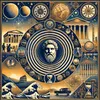
Everyone Quotes Montesquieu Almost Nobody Reads Past the First Page
Montesquieu and the Separation of Powers: The Spirit of the Laws Explained.In 1748 a retired criminal magistrate from the wine country south of Bordeaux published two volumes and thirty-one books in Geneva, without his name on the title page. Within three years the Church had placed it on the Index. Within forty, Americans on both sides of the ratification fight were quoting it at each other, because neither side could make its case without it.This episode goes into the sixth chapter of the eleventh book — the most quoted passage of political writing produced in the eighteenth century, and among the least accurately remembered. Read to the halfway mark it says what everyone thinks it says: three powers, three sets of hands, keep them apart. Read past that point and Montesquieu dismantles both prohibitions. He does not want a permanent judiciary at all. He wants occasional tribunals of ordinary men, assembled for the business and dissolved when it is done, judging as the mouth that pronounces the words of the law. Then he calls the power of judging “in some measure next to nothing” and drops it out of the analysis entirely. Whatever that describes, it is not England, which in 1748 had a permanent salaried bench and a court of last resort sitting inside the House of Lords — a fact he knew and recorded privately.We follow the argument through the parts that actually traveled: the sorting of governments by nature and by principle, the passions that move each one, the small-republic doctrine the Anti-Federalists used as their first objection, and the confederate republic in the ninth book that Hamilton used to answer them. Madison concedes the maxim completely in Federalist 47, names Montesquieu “the oracle who is always consulted,” and then proves from the British constitution itself that pure separation was never the doctrine. We also take the reckoning honestly: the climate theory of books fourteen through seventeen, the concession on slavery in the fifteenth, the private notebooks in which he called the English no longer worthy of their liberty, and the fact that those notes were not printed until 1818 — long after the Convention had used the published version.And the hardest part, which the Liberty Test puts to you directly: dividing a government restrains who exercises authority. It does not restrain how much authority there is. The anti-tyranny argument and the limited-government argument are two different arguments, and a tradition that treats the first as though it delivered the second has not noticed the gap.Did it leave people more free, or more governed?⏱️ CHAPTERS0:00:00 The 1721 Sensation and The Persian Letters0:03:26 Episode Intro: Montesquieu and the Architecture of Liberty0:05:25 Montesquieu’s Early Life and the French Parlement0:10:27 Judicial Torture, The Parisian Letters, and The Study of Rome0:13:13 The Spirit of the Laws: Publication and Church Backlash0:14:25 The Method: Adapting Laws to the People and Climate0:18:27 The Scottish Connection: Adam Ferguson and Adam Smith0:23:27 Sorting Governments: Republics, Monarchies, and Despotism0:30:33 Montesquieu in England: Observing the Constitution0:33:13 Defining Political Liberty as a Tranquility of Mind0:34:55 The Three Powers and the “Invisible” Judiciary0:42:16 Distribution of Powers vs. Separation of Powers0:46:35 James Madison, Federalist 47, and Parchment Barriers0:52:24 The Anti-Federalists, Small Republics, and the Confederate Republic0:56:45 The Most Cited Secular Author of the American Founding0:58:11 Building a Portable Model: Stripping the Corruption1:02:39 Climate Theory and Montesquieu’s Contradictions on Slavery1:06:29 The Skeptic’s Case: Elitism and the Intermediate Ranks1:09:51 The Gap in the Doctrine: Limiting the Scope of Government1:15:26 The Liberty Test: Applying the Mechanism Today1:20:24 Conclusion, Follow Information, and Preview for Episode 15📚 Companion reading — Article 14, “The Spirit of Laws: Montesquieu and the Architecture of Liberty.” Goes deeper on the Notes on England, the venality of judicial office, the fifth chapter of the fifteenth book, and Lutz’s citation counts, with full endnotes: https://www.consequentialactions.com/post/the-spirit-of-laws-montesquieu-and-the-architecture-of-liberty📖 Read it yourself, free — The Spirit of Laws in the 1777 London edition, the eighteenth-century English text the founding generation was working from, in the public domain at the Online Library of Liberty: https://oll.libertyfund.org/titles/montesquieu-complete-works-4-vols-1777Self-Evident: The Road to 1776 — Episode 14 of 22. Next Saturday, Episode 15, “The Fork in the Road”: two more Frenchmen writing in the same decad
Podzilla Summary coming soon
Sign up to get notified when the full AI-powered summary is ready.
Free forever for up to 3 podcasts. No credit card required.
Listen to This Episode
More from Consequential Actions Podcast

Socialist Calculation Debate Explained: Menger, Mises, Hayek and "I, Pencil" in 2026

Adam Smith and Adam Ferguson: The Wealth of Nations, An Essay on the History of Civil Society, and the Militia Question
David Evans of Sentiero Ventures on Artificial Intelligence, Lyapunov Time, and the Knowledge Problem | Self-Evident Week 12
NYC Municipal Grocery Stores, the Rent Freeze, and Federal Equity Stakes: Hume's Knowledge Problem in 2026
Get summaries like this every morning.
Free AI-powered recaps of Consequential Actions Podcast and your other favorite podcasts, delivered to your inbox.
Free forever for up to 3 podcasts. No credit card required.