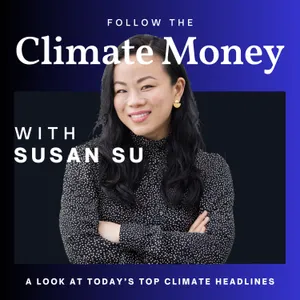
Free Daily Podcast Summary
Climate Money: Daily Summaries Delivered
by Susan Su
Follow the climate headlines, and the climate money with climate investor Susan Su.Fighting and solving climate change is the biggest value creation opportunity of our lifetime, and the movement is getting bigger every day. Here's your way to stay up to date on all things climate business, from venture investing to big government dollars to infrastructure financing deals. We'll cover the biggest headlines of the week with concise analysis so you can know what's going down — and what's going up —in the world of climate money.
Latest Episodes
The most recent episodes — sign up to get AI-powered summaries of each one.
- Jun 11, 202622 min
$326B is hiding in plain sight – and that's before the IPOs
There's $326 billion sitting in charitable accounts that face no legal requirement to ever pay out a cent — and the 2026 IPO wave is about to add hundreds of thousands more. Donor-advised funds are now 11 of the top 20 charities in the US by contributions, and the same vehicle that could fund the climate transition has spent two decades quietly funding the movement against it.In this episode, Susan Su reveals how DAFs became the fastest-growing force in American philanthropy, why that should bother anyone who cares about climate, and what donors can actually do about it.We cover:How financialization turned a sleepy 1931 community-foundation tool into the biggest charity engine in the country, once Fidelity, Vanguard, and Schwab got involved in the 1990sWhy DAFs are a regulatory free pass — immediate tax deduction, no payout requirement, near-total anonymity, and a clean way to erase capital gains before an IPOThe real cost to everyone else: the Institute for Policy Studies estimate that every $1 in a DAF carries a $0.74 taxpayer subsidyWhat's hiding behind the headline 20% payout rate, and why the median account tells a different storyHow DonorsTrust and Donors Capital Fund moved $479 million in untraceable money into the anti-climate movement — and how Fidelity, Schwab, and Vanguard routed $171 million to the groups behind Project 2025Why the IPO wave won't just mint a few whales but half a million minnows — the median Fidelity DAF holds just $23,500, which makes this everyone's problemFour ways DAF capital is uniquely suited to climate: catalytic first-loss equity, concessionary debt for first-of-a-kind projects, pooled funds, and funding the public goods markets ignoreOnly about 3% of US charitable giving goes to all environmental causes combined. Religious causes got 28% in 2020. The tool takes no sides — but right now, only one side is using it at scale.Read the full essay at climatemoney.substack.com.Warning: this could radicalize you.
- Apr 21, 202621 min
Climate Money S2 E4: Cheap oil's last, best job
Every climate VC post-Trump has said it: we don't invest in companies that rely on subsidies. But the entire climate transition has been living off the biggest subsidy in human history — 200 years of cheap, abundant fossil fuels that funded low interest rates, scalable manufacturing, global trade, and the financial architecture of the transition itself. In this Season 2 essay, Susan Su makes the case that energy is upstream of capital, capital is upstream of everything else, and the window is closing faster than the models assume. We walk through the petrodollar system, why Bitcoin, aluminum and green hydrogen (among other products) are all just energy repackaged, and what it means that 40% of the world's solar polysilicon is manufactured with captive coal in Xinjiang. The 15:1 debt-to-equity ratio at the heart of climate finance assumes stable energy pricing across a 20-year horizon. That assumption is about to get tested. The Gulf States used their fossil surplus to build sovereign wealth funds. The US used it to subsidize consumption. Which path the climate finance community takes from here — scenario planning over point estimates, auditing exposure on the energy-repackaged hierarchy, treating energy politics as alpha — will decide who navigates the volatility with options and who navigates it with debt.
- Mar 26, 202658 min
Climate Money S2 E3: Debt is the answer (it always was) — a conversation with Dimitry Gershenson
Venture capital for climate companies is drying up, and early stage companies can't exactly get a loan from the bank. So, who's actually financing the companies that are supposed to become tomorrow's bankable assets? Dimitry Gershenson, co-founder and CEO of Enduring Planet, joins us for a dispatch straight from the field. His firm lends against government grants and commercial contracts — starting at $100K, at the moment a contract is signed, not after an invoice is submitted. It's a gap that traditional lenders won't touch and most founders don't know exists. In this episode, we cover: How Enduring Planet evolved from revenue-based financing to grant advances to commercial contract lending — and the painful lessons along the wayWhy the firm has a zero default rate across 100 deals, even post-electionThe real math on why founders are "irrationally scared" of debt while happily giving away half their company in equityWhat Dimitry is seeing in his pipeline right now: the vibe, the mix of government vs. commercial lending, and where things are headedWhy the companies borrowing $100K today will be the ones borrowing $100M tomorrowThe fractional CFO business that grew out of founders showing up with broken booksDimitry has been building financial plumbing for the climate transition since his Peace Corps days in Honduras, through deploying catalytic capital at Meta, to founding Enduring Planet. This conversation is a close up look at what climate lending looks like when you strip away the narratives and look at the deals. Links:Enduring PlanetEnduring Planet case studiesClimate Money newsletter TAGS/KEYWORDS:climate finance, climate debt, climate tech, enduring planet, dimitry gershenson, grant advance, working capital, early stage lending, climate lending, contract financing, venture debt, climate startups, project finance, fractional CFO, climate VC, season 2
- Mar 12, 202618 min
Climate Money S2 E2: $6 trillion in Gulf capital is looking for the exit
The Iran war is dominating oil headlines, but the sleeper story is what happens to the $6 trillion in Gulf sovereign wealth fund capital that underpins the AI boom and the energy transition. We break down the unprecedented force majeure reviews now underway across Gulf economies, what they mean for climate project finance and fund formation, and why the real disruption isn't barrels — it's balance sheets.
- Feb 26, 202615 min
Climate Money S2 E1: Climate debt is the new climate money
Climate Money is back! In the Season 2 premiere, host Susan Su breaks down BloombergNEF's bombshell report: global energy transition investment hit $2.3 trillion in 2025 — a new all-time record and the fourth consecutive record year.But the real story isn't the headline number. It's what's inside it.Over half of that $2.3T — a massive $1.2 trillion — was debt. That's a 15:1 ratio of debt to equity issuance, and it tells us two things: climate tech is maturing fast enough to attract risk-averse lenders at scale, and the original cleantech 1.0 equity investors were right.Susan unpacks what $2.3 trillion actually buys (77 Manhattan Projects, 13 Marshall Plans, 85% of global military spending), why debt is the signal every VC should be watching, and the one number that keeps her up at night — a dangerous mismatch between accelerating debt markets and a shrinking equity pipeline that could bottleneck the next generation of climate innovation.This season on Climate Money, we're tracking all things debt: where the capital is flowing, where the gaps are, and what founders and lenders on both sides of the table are seeing on the ground.Topics covered:BloombergNEF Energy Transition Investment Trends 2026The 15:1 debt-to-equity pipeline ratioWhy cleantech 1.0 was rightDeutsche Bank, TotalEnergies/Google, and SkyNRG's non-recourse milestoneThe equity bottleneck and compounding mismatchPrivate capital replacing government-labeled debtRead the full analysis on Substack: climatemoney.substack.com
- Mar 28, 202427 min
Climate change and the cost of food
On today’s episode, we talk about climate change and the cost of food. New work from researchers at the Potsdam Institute for Climate Impact Research and the European Central Bank is projecting that climate change will drive up food prices around the world by up to 3.2% per year by 2035. Food will grow to take up a greater proportion of total household income because these price increases will outstrip overall climate-driven inflation. The impact will be disproportionately borne by people in sub-Saharan Africa, where many communities are already living with moderate to severe food insecurity. Today’s episode looks at exactly what these numbers mean for communities around the world, how it relates to markets, and how the actions of some larger players to mitigate food waste could contribute to a solution. Related links: https://www.nature.com/articles/s43247-023-01173-x https://www.bloomberg.com/news/articles/2024-03-14/google-is-trying-to-reduce-its-food-waste-without-irritating-employees https://www.weforum.org/agenda/2021/03/global-food-waste-solutions/ https://www.bloomberg.com/news/articles/2024-02-29/rising-cocoa-prices-drive-mars-hersey-to-use-less-chocolate https://www.ers.usda.gov/data-products/ag-and-food-statistics-charting-the-essentials/food-prices-and-spending/?topicId=1afac93a-444e-4e05-99f3-53217721a8be#:~:text=Average%20annual%20food%2Dat%2Dhome,is%202.5%20percent%20per%20year
- Mar 12, 202424 min
Climate Money Ep. 9: The True Cost of Direct Air Capture
Welcome to the Episode 9 of the Climate Money Podcast. In this episode, we look at: New research that shoes Direct Air Capture won’t be able to hit the magical $100/ton cost benchmark, and why this flies in the face of everything we’ve been told How a billion-dollar CO2 pipeline project is a secret force opposing EV adoption The blossoming frenemy-ship between Big Oil and Big Ag And how all this underscores the wicked, systems problem of climate change As always I welcome your feedback and reflections.
- Feb 28, 202425 min
Climate Money Ep. 8: The EU vs Fast Fashion
Welcome to the Episode 8 of the Climate Money Podcast. In this episode, we look at: The EU’s newly revised Extended Producer Responsibility proposal, and how it’s taking on food waste and fast fashion. Why linear capitalism’s days could be numbered The real numbers behind the climate wealth gap and what it means for builders and investors As always I welcome your feedback and reflections.
About Climate Money
Follow the climate headlines, and the climate money with climate investor Susan Su.Fighting and solving climate change is the biggest value creation opportunity of our lifetime, and the movement is getting bigger every day. Here's your way to stay up to date on all things climate business, from venture investing to big government dollars to infrastructure financing deals. We'll cover the biggest headlines of the week with concise analysis so you can know what's going down — and what's going up —in the world of climate money.
Customized Recaps
AI-powered recaps with compact key takeaways, quotes, and insights.
Straight to Your Inbox
Get key takeaways from Climate Money in a 5-minute read.
Save Hours Every Week
Stay current on your favorite podcasts without falling behind.
Frequently Asked Questions
What is Podzilla's Climate Money daily summary?
It's a free AI-powered email that summarizes new episodes of Climate Money as soon as they're published. You get the key takeaways, notable quotes, and links & mentions — all in a quick read.
How does the Climate Money podcast summary work?
When a new episode drops, our AI transcribes and analyzes it, then generates a personalized summary tailored to your interests and profession. It's delivered to your inbox every morning.
Is this an official Climate Money product?
No. Podzilla is an independent service that summarizes publicly available podcast content. We're not affiliated with or endorsed by Susan Su.
Can I get summaries of other podcasts too?
Absolutely! The free plan covers up to 3 podcasts. Upgrade to Pro for 15, or Premium for 50. Browse our full catalog at /podcasts.
How often does Climate Money release new episodes?
Climate Money publishes weekly. Our AI generates a summary within hours of each new episode.
What topics does Climate Money cover?
Climate Money covers topics including News, Business. Our AI identifies the specific themes in each episode and highlights what matters most to you.
Start getting Climate Money summaries tomorrow morning.
Free forever for up to 3 podcasts. No credit card required.
Free forever for up to 3 podcasts. No credit card required.