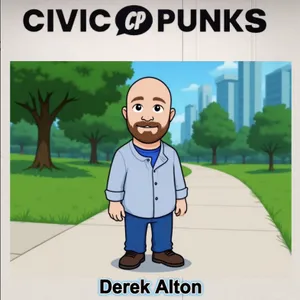
Free Daily Podcast Summary
Civic Punks: Daily Summaries Delivered
by Derek Alton
This is my experiment in creating interesting podcasts about public sector innovation.Disclaimer: All opinions on this channel are my own opinions or the personal opinions of those who I interview.
Latest Episodes
The most recent episodes — sign up to get AI-powered summaries of each one.
- 2 weeks ago53 min
You Might Get Fired - A Conversation with Iain Montgomery
What does it actually take to innovate inside institutions that aren’t always designed for experimentation? Iain Montgomery has become one of the voices I keep coming back to when I’m thinking about innovation, government, and what it means to genuinely challenge the status quo. After following and referencing his work for a while, I finally got to meet him at FWD50—and we sat down for this conversation. We talk about what brought Iain into innovation work, what keeps him grounded and inspired, and some of the ways we get innovation very right…and very wrong. We also dig into his work on Challenger Cities: looking at cities that are willing to think differently, challenge assumptions, and ask better questions about what actually helps a place flourish. And, in classic Iain fashion, there are a few lines in here that will rattle around in your head for the next week. Including, of course, why doing this work properly might occasionally mean you get fired, and that's a good thing. If you care about making government better, experimenting with new ways of working, or just thinking differently about how cities and institutions change, there’s a lot in this one. Make sure to check out his podcast on Challenger Cities: https://challengercities.substack.com/podcast
- 3 weeks ago36 min
Why Is Government So Bad at Working With Startups with Kateryna Frolova
I recorded this conversation with Kateryna Frolova, Head of the Global Government Technology Centre Kyiv, on my first morning in Ukraine, after a night of Russian bombing. We were both running on a little less sleep than we would have liked. But the conversation we had gets at a problem that reaches far beyond Ukraine. Governments everywhere love talking about supporting startups, entrepreneurs and small and medium-sized businesses. Actually working with them to solve public problems is much harder. Procurement gets in the way. Government and startups operate at different speeds. Smaller companies struggle to navigate the system. Governments struggle to identify, test and adopt new solutions. Everyone agrees collaboration would be useful, yet making it happen remains remarkably difficult. This is exactly the problem Kateryna and her team are working on in Kyiv. We talk about how government can build better relationships with entrepreneurs, how to create the conditions for collaboration rather than simply talking about it, and why this matters increasingly as countries think about technological and economic sovereignty. Kateryna’s own story is also part of a much bigger Ukrainian story. Like many young Ukrainians I met, she had built a promising international career before returning home out of a sense of responsibility to her country. She went on to work inside the Ukrainian government before moving into her current role helping government innovate from the edge of the system. There is a lot here for governments well beyond Ukraine. If we can figure out how governments can genuinely work with startups, SMEs and entrepreneurs around shared public problems, we may unlock an enormous source of innovation that today remains largely untapped. I hope you enjoy the conversation.
- Aug 20, 202637 min
Ukraine’s AI Playbook: Sovereignty, Agents and the Future of Government
Ukraine has become one of the most interesting governments in the world to watch when it comes to AI. In this episode of Civic Punks, I sit down with Roman Kyslyi, Chief AI Officer at Ukraine’s Ministry of Digital Transformation, to dig into where Ukraine is going next. We get deep into AI sovereignty, a topic Roman has been thinking about for years. What does it actually mean for a country to be sovereign in the age of AI? And how does that equation change as we move from chatbots toward AI agents that can actually take action on our behalf? We also unpack what Ukraine is building with Diia.AI, why Ukraine has emerged as a frontrunner in agentic government, and Roman’s bigger vision for how AI could reshape the relationship between citizens and the state. It’s a fascinating conversation about sovereignty, infrastructure, agents, and what the next generation of digital government might actually look like. Roman also runs a Ukrainian podcast all about AI. Check it out here: https://www.youtube.com/@aihouse_ukraine If you enjoy the conversation, share it with someone who should hear it, and make sure to like, follow, and subscribe for more Civic Punks.
- Aug 13, 202617 min
Why Kyiv Works: A Debrief with Denys Nazarenko
Last week, I shared my conversation with Victoria Itskovych, CIO for the City of Kyiv, about how Kyiv has continued to build and adapt under some pretty extraordinary circumstances. Six Weeks Under Siege Denys Nazarenko helped make that conversation happen. He’s a senior advisor to Victoria, and after we finished the interview, Denys and I wandered down to a nearby park to debrief. What followed was a more informal conversation about some of the things sitting underneath Kyiv’s story: the relationship between the city and Ukraine’s national government, what good collaboration between different levels of government can actually look like, and why Kyiv has been able to make some of this work. I’d recommend listening to the conversation with Victoria first. But if that one leaves you wanting to dig a little deeper, think of this as the after-hours addendum. What changes when national and local governments see each other as partners rather than obstacles?
- Aug 7, 202610 min
Six Weeks Under Siege: Kyiv’s CIO on Keeping the City Running
I started the European leg of this journey in Ukraine—a war zone, which is kind of a mad thing to do. I went to Ukraine because I think they are the most interesting case of government transformation in the world right now. Case in point, my first conversation. Victoria Iskovich, CIO and Director of IT for the City of Kyiv, takes us inside the first six weeks of Russia’s invasion. She shares how her team lived and worked from the city’s data centre, moved critical infrastructure in the middle of the night to protect it from being bombed, and repurposed technology they had already built to support the war effort. The story reads like an action film. The reality, of course, is far more brutal. This is a short conversation about crisis, courage, technology—and the people behind the scenes keeping a city running when almost everything around them is falling apart. What can public servants everywhere learn from the way Victoria and her team responded? Leg 2 has been sponsored by The Kindred Agency. A people-centred Canadian company focusing on building ethical agentic AI for good.
- Jul 28, 202633 min
Backing Civic Punks Before It Had a Name — Olivia Dorey on Kindred, Ambassadorship & Building a Movement
Olivia Dorey has been supporting Civic Punks since before Civic Punks had a name. So it feels pretty special to finally sit down with her — and to announce The Kindred Agency as our first sponsor. In this conversation, we get into Olivia’s story: how she became a Civic Punk, why she started The Kindred Agency, and what she has learned about building a company around work you actually care about. Then we dig into something we’ve been figuring out together: the Civic Punks Ambassador Program. We wanted to create a sponsorship model that felt a little different. Something built around shared values, trust and a belief that this community of people trying to make government better is worth investing in. My hope is that Kindred is the first of many organizations to come along for the ride. Have a listen — and if you’re part of an organization that thinks this kind of work should exist, I’d love to hear from you. You can reach me at derekalton@civicpunks.com. To learn more about the great work of The Kindred Agency and to test some of their new agentic AI's go to their website at: https://thekindredagency.com/
- Jun 14, 202614 min
Chika Masuda on Japan’s Digital Agency, Christian Bason, and Finding Your Way Into Government
Tokyo was already special. Getting to spend time with Chika Masuda made it even better. Chika is Head of Intelligence Research at Japan’s Digital Agency, and one of those rare public servants who seems to connect people, ideas, and institutions with real care. In this conversation, we talk about her journey into government, what she has learned from working inside the system, and why relationships matter so much in this field. We also get into the influence of Christian Bason — someone who has shaped both of our thinking in different ways — and what it means to build a life around public service, curiosity, and making government a little more human.
- May 28, 202637 min
The Local Government Everyone Is Asking About
What does it look like when a city council takes both AI and community engagement seriously — without making either feel like a corporate strategy exercise? In this episode, I talk with Jared Griffith, a senior leader at Hutt City Council in Greater Wellington, New Zealand. This conversation follows a chat Jared and I had when I was in Wellington a few months ago, where I became really intrigued by two things Hutt City Council is working on. First, they’ve launched a new community engagement strategy grounded much more deeply in local Indigenous ways of knowing and doing. We talk about what that changes, how it shifts the relationship between council and community, and what it means to engage people with more care and depth. Second, we get into AI. Hutt City Council has become something of a reference point for other municipalities trying to adopt AI well. And, unsurprisingly, the secret is not really the technology. It is people. This is a conversation about trust, culture, public service, and what it takes to change how local government works in practice. And yes, I push Jared a bit too.
About Civic Punks
This is my experiment in creating interesting podcasts about public sector innovation.Disclaimer: All opinions on this channel are my own opinions or the personal opinions of those who I interview.
Customized Recaps
AI-powered recaps with compact key takeaways, quotes, and insights.
Straight to Your Inbox
Get key takeaways from Civic Punks in a 5-minute read.
Save Hours Every Week
Stay current on your favorite podcasts without falling behind.
Frequently Asked Questions
What is Podzilla's Civic Punks daily summary?
It's a free AI-powered email that summarizes new episodes of Civic Punks as soon as they're published. You get the key takeaways, notable quotes, and links & mentions — all in a quick read.
How does the Civic Punks podcast summary work?
When a new episode drops, our AI transcribes and analyzes it, then generates a personalized summary tailored to your interests and profession. It's delivered to your inbox every morning.
Is this an official Civic Punks product?
No. Podzilla is an independent service that summarizes publicly available podcast content. We're not affiliated with or endorsed by Derek Alton.
Can I get summaries of other podcasts too?
Absolutely! The free plan covers up to 3 podcasts. Upgrade to Pro for 15, or Premium for 50. Browse our full catalog at /podcasts.
How often does Civic Punks release new episodes?
Civic Punks publishes every few days. Our AI generates a summary within hours of each new episode.
What topics does Civic Punks cover?
Civic Punks covers topics including Government. Our AI identifies the specific themes in each episode and highlights what matters most to you.
Start getting Civic Punks summaries tomorrow morning.
Free forever for up to 3 podcasts. No credit card required.
Free forever for up to 3 podcasts. No credit card required.