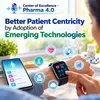
Better Patient Centricity by Adoption of Emerging Technologies
Better Patient Centricity by Adoption of Emerging Technologies What if healthcare could move beyond simply treating illness after it appears—and instead continuously help people predict, prevent, and manage their health? In this episode of Center of Excellence - Pharma 4.0, we explore how emerging technologies are transforming healthcare from a predominantly reactive, episodic model into a proactive, personalised, connected, and patient-centric ecosystem. The traditional healthcare experience often places patients in a passive role: waiting for appointments, relying on fragmented medical records, receiving generic recommendations, and seeking treatment only after symptoms appear. Emerging technologies are creating the possibility of a fundamentally different model—one in which the patient is at the centre and technology continuously supports better decisions, earlier interventions, and improved outcomes. From Reactive Healthcare to Proactive Care The episode explores the shift from the traditional "fix it when it breaks" approach toward continuous health management. Patient centricity is built around several important principles: Patient empowerment – giving individuals access to their health information and the digital tools needed to understand and manage it. Personalised care – using individual health, biological, and lifestyle data to support care tailored to each patient. Proactive healthcare – identifying potential problems earlier and intervening before conditions escalate. Continuous support – extending healthcare beyond occasional appointments into ongoing engagement and monitoring. Seamless access – creating a digital-first, omnichannel healthcare experience where patient information remains accessible across different channels and care settings. How Emerging Technologies Enable Patient Centricity The episode examines several technologies that could enable this transformation. Wearables and Remote Monitoring Smartwatches, connected medical devices, continuous glucose monitors, smart scales, and other technologies can continuously capture health and biometric information. Instead of relying exclusively on occasional measurements during clinical visits, healthcare providers can potentially gain access to a much richer picture of a patient's health over time. Internet of Things (IoT) Connected healthcare devices can transmit relevant information automatically, reducing manual data collection and enabling real-time monitoring. The discussion illustrates how IoT-enabled monitoring could help identify changes in a patient's condition earlier and trigger timely intervention. Artificial Intelligence and Advanced Analytics With potentially enormous volumes of health data being generated continuously, AI can help identify patterns, trends, and abnormalities that may be difficult to detect manually. AI can act as an intelligent layer that helps distinguish meaningful signals from the overwhelming volume of incoming data. Digital Twins The episode explores the concept of creating highly sophisticated virtual representations of an individual's physiological state using information such as medical history, biometric information, genetic characteristics, and continuously collected health data. Digital twins could potentially allow healthcare professionals to simulate different treatment scenarios and explore how an individual might respond before implementing a particular intervention—moving healthcare toward greater personalisation and reducing dependence on conventional trial-and-error approaches. Blockchain and Secure Health Data Sharing The discussion also examines blockchain as an enabler for secure and trusted data sharing across fragmented healthcare ecosystems. The objective is to help create an environment where authorised parties can access relevant health information securely while giving patients greater control over their data. The Potential Benefits A truly patient-centric technology-enabled healthcare ecosystem could deliver benefits across multiple dimensions: Improved health outcomes through earlier detection and more personalised interventions Higher patient satisfaction through more transparent, convenient, connected, and responsive healthcare experiences Lower healthcare costs by shifting the focus from expensiv
Podzilla Summary coming soon
Sign up to get notified when the full AI-powered summary is ready.
Free forever for up to 3 podcasts. No credit card required.
Listen to This Episode
More from Center of Excellence - Pharma 4.0 by Dr. Jayant Joshi
AI Success Foundations for Pharma 4.0
Business Creativity and Innovation in Pharma 4.0
Architecting the Global Pharma 4.0 AI Ecosystem
Pharma 2035: The Evolution to Autonomous Intelligence
Get summaries like this every morning.
Free AI-powered recaps of Center of Excellence - Pharma 4.0 by Dr. Jayant Joshi and your other favorite podcasts, delivered to your inbox.
Free forever for up to 3 podcasts. No credit card required.