Free Daily Podcast Summary
But For Real: Daily Summaries Delivered
by Valerie Martin & Emerson Ryder
Get key takeaways, quotes, and insights from But For Real in a 5-minute read. Delivered straight to your inbox.
Latest Episodes
The most recent episodes — sign up to get AI-powered summaries of each one.
- 6 days ago47 min
Unmasking Autism with Devon Price, PhD
What if the version of you most of the world knows… isn’t actually *you*?In this episode of But For Real, we’re sitting down with Devon Price, PhD—social psychologist, author of Unmasking Autism (+ several other books!), and badass autistic human—to get really REAL about something that is kinda the opposite of that:Masking.That pattern of adaptation that’s helped you survive… but can slowly erode at your sense of self. 🫠In this conversation, we get into what it actually means to “mask” as an autistic or otherwise neurodivergent person (hell, even just as a people-pleaser living in a capitalist society): how it shows up, why so many of us do it without even realizing, and what happens when you finally start to take that mask off.If you’re one of MANY people who was diagnosed with autism later in life, you know it can feel like a huge relief… but it can *also* feel like grief, anger, and even a full-on “who TF am I actually?” era.We’re talking about what it’s like to spend decades performing “normal,” only to realize you’ve been white-knuckling your way through life—and what it takes to rebuild something that actually fits.And we keep coming back to this:You don’t just “stop masking.”You slowly, painfully, honestly… learn how to exist as yourself.So if you’ve ever thought…“Why am I so exhausted ALL THE TIME?”“Why do I feel like I’m performing in every interaction?”“Who am I without all of this?”…this one’s for you. 🫂In this episode of But For Real, we unpack…What “masking” actually is—and why it’s so common in autistic adultsWhy late autism diagnoses often bring both relief AND griefThe hidden cost of people-pleasing and social “autopilot”Why you can’t just flip a switch and stop masking overnightHow identity confusion shows up after unmasking beginsThe role of burnout, exhaustion, and chronic overwhelmWhy safe relationships are essential for unmaskingThe emotional phases: relief → grief → anger → rebuildingHow to reconnect with your authentic self (without blowing up your whole life)And here’s the timestamps—00:00 – Welcome back to But For Real01:00 – Meet Devon Price, PhD (and why this convo matters)03:30 – The “hive mind” metaphor + masking as social survival05:30 – Listener question: late autism diagnosis in adulthood07:00 – Relief vs grief after diagnosis08:30 – “I’ve been performing my whole life…”10:30 – Why masking isn’t something you can just turn off13:00 – Identity confusion: who am I without the mask?16:00 – The emotional aftermath: anger, grief, and loss19:00 – Autistic burnout + chronic exhaustion22:00 – Safe people, safe spaces, and practicing authenticity26:00 – Reconnecting with your younger self30:00 – What unmasking actually looks like in real life35:00 – Why this process takes YEARS (not weeks)40:00 – Final thoughts: you’re not behind—you’re becomingConnect with Dr. DevonInstagram: https://www.instagram.com/drdevonprice/Substack: https://drdevonprice.substack.com/ Books: https://www.penguinrandomhouse.com/authors/2294535/devon-price-phd/ Connect with Us:Submit a story for The Lore segmentSubmit a request for advice for our Step Into My office segmentReach out: butforrealpod@gmail.com But For Real on IG: @butforrealpodNow That's What I Call... OKAAAAY PlaylistThe Gaia Center on IG: @thegaiacenterVal on IG: <a href="https://instagram.com/valkaymartin" rel="noop
- 2 weeks ago54 min
The One About Polyamory with Em Mortenson
So… your partner brings up opening the relationship. 👀And you’re trying to be thoughtful, open-minded, maybe even a little curious…but there’s also this voice in the background like:“Wait… do I actually want this?” 🫠In this episode of But For Real, we’re sitting down with therapist Em Mortenson to get into the real conversation around polyamory and ethical non-monogamy—beyond the labels, beyond the hot takes, and into what this actually looks and feels like in real life.Because yeah, on paper?It can sound freeing. Honest. Even aligned. ✨But in practice?It can bring up jealousy, fear, uncertainty—and a whole lot of questions about where your “yes” is actually coming from.We’re talking about what happens when a partner introduces this idea, how to navigate the in-between space of not knowing yet, and why this isn’t something you have to rush to figure out overnight.And we keep coming back to this:It’s one thing to understand something intellectually…and another to feel ready for it in your body.So if you’ve ever found yourself wondering:“Am I actually into this… or am I trying to be okay with it?”“Is jealousy a red flag—or just part of the process?”“How do I explore this without losing myself?”…yeah. This one’s for you. 💬From there, we unpack: How to tell if you’re genuinely interested in polyamory—or just trying to be “chill”Why jealousy is a normal part of ethical non-monogamy (and what to do with it)The difference between curiosity, pressure, and people-pleasing in relationshipsWhat polyamory and open relationships actually look like in real lifeWhy boundaries are essential—and constantly evolving—in non-monogamyCommon mistakes couples make when opening a relationshipHow fear of losing your partner can shape your decisionsWhy this isn’t a one-time “yes or no” decision—but an ongoing conversationWe talk about:00:00 – Welcome back to But For Real00:50 – Meet Em Mortenson (and the chaotic cat story 🐱)03:20 – Tiny pockets of joy when everything feels heavy05:50 – “My partner wants to open our relationship…” 👀07:10 – Am I open-minded… or just scared to lose them?09:00 – Polyamory vs monogamy: what are we actually talking about?12:30 – Why people jump into this too fast ⚠️15:30 – The biggest misconception about polyamory19:00 – Let’s talk about jealousy (because yeah… it’s coming)22:30 – Is jealousy a dealbreaker—or part of it?26:00 – What healthy polyamory can actually look like30:30 – Boundaries, communication, and real-life dynamics35:30 – When this goes wrong (and why it does)41:30 – Polyamory discourse, TikTok, and moral superiority 🙃47:30 – So… how do you know if this is right for you?Connect with Us:Submit a story for The Lore segmentSubmit a request for advice for our Step Into My office segmentReach out: butforrealpod@gmail.com But For Real on IG: @butforrealpodNow That's What I Call... OKAAAAY PlaylistThe Gaia Center on IG: @thegaiacenterVal on IG: @valkaymartinThe Gaia Center website: www.gaiacenter.co DISCLAIMER: But For Real Podcast is not a substitute for individualized mental health treatment or healthcare. This podcast is solely for entertainment and educational purposes. If you are in crisis, please utilize crisis support services, such as the Crisis Text Line (Text START to 741741 in the US) or the 988 Suicide & Crisis Lifeline: (Call 988 in the US), or visit www.findahelpline.com for international resources.
- Apr 15, 202637 min
Boundaries Aren’t B*tchy!
What if the thing you’ve been calling “being rude”… is actually just having a boundary?Yeah. Let’s talk about it.Because somewhere along the way—especially for women, people-pleasers, and anyone raised to prioritize politeness over honesty—boundaries got branded as selfish, cold, or straight-up b*tchy.And honestly? That narrative is doing damage.In this episode of But For Real, we’re doing a full, unfiltered deep dive into boundaries—what they actually are, why they feel so uncomfortable, and how your relationship with them changes as you grow up (or burn out).We’re talking about the subtle ways we’ve been conditioned to shrink, overextend, and contort ourselves to keep the peace… and the moment you realize: “Wait… I actually can’t keep living like this.”We get into the real-life evolution of boundaries—from being overly accommodating and “nice” to realizing that clarity is not cruelty.And yes, we’re saying the quiet part out loud:Not everyone who sets a boundary is a b*tch… …but also? You might have to tolerate being perceived that way anyway.Cool cool cool. 🫠Because boundaries aren’t just personal.They’re relational. Cultural. Political. Survival.So if you’ve ever wondered:“Am I being too much?”“Why does setting boundaries make me feel like I’m doing something wrong?”“How do I stop people-pleasing without becoming an asshole?”…yeah. This one’s for you.Let’s roll the tape.From there, we unpack: Why boundaries are often mistaken for being rude or “difficult”How people-pleasing and politeness culture shape your ability to set limitsThe difference between being a b*tch vs. having a boundaryWhy your relationship with boundaries changes over timeHow burnout and survival instincts force boundary growthThe hidden cost of over-accommodating yourself in relationshipsWhy clarity is actually kinder than silent resentmentHow cultural expectations (especially for women) distort boundary-settingWhat healthy boundaries actually sound like in real lifeWhy being misunderstood is sometimes part of doing it right We talk about:00:00 – Welcome to But For Real01:00 – Why we needed a boundaries deep dive02:00 – People-pleasing, politeness & cultural conditioning03:00 – “Am I rude… or do I just have boundaries?”04:00 – Why boundaries feel uncomfortable (especially for women)05:00 – Boundaries as survival, not just self-growth06:00 – Tea & Crumpets: Olympics, joy, and elite performance08:30 – What high performers teach us about boundaries10:00+ – The real conversation begins: boundaries, identity & growthResources Mentioned:Suicide & Crisis Lifeline (US): Call or text 988Find international support: https://www.findahelpline.comreasonstostay.co Connect with Us:Submit a story for The Lore segmentSubmit a request for advice for our Step Into My office segmentReach out: butforrealpod@gmail.com But For Real on IG: @butforrealpodNow That's What I Call... OKAAAAY PlaylistThe Gaia Center on IG: @thegaiacenterVal on IG: @valkaymartinThe Gaia Center website: www.gaiacenter.co DISCLAIMER: But For Real Podcast is not a substitute for individualized mental health treatment or healthcare. This podcast is solely for entertainment and educational purposes.
- Apr 1, 20261h 12m
The One About Suicide 💔🫂
We need to talk about suicide… like actually talk about it.Not in the polished, clinical, tip-list way. Not in the fear-based, “don’t say the wrong thing” way. But in the real, messy, human way that most of us have experienced—whether personally or through someone we love.Because here’s the truth: suicide is way more common, complex, and misunderstood than we’re comfortable admitting. And the way we talk about it? Often makes it harder—not easier—for people to feel seen, supported, or safe enough to open up.In this episode of But For Real, we’re going there.We’re talking about suicidal ideation (including the kind that doesn’t mean you actually want to die), the difference between passive and active thoughts, and why so many people feel ashamed of experiences that are actually more common than we think.We’re also unpacking the tension between holding the weight of this topic and still making space for humanity, humor, and connection—because healing doesn’t only happen in sterile silence.And yes… we’re bringing both the heavy and the real.We’re asking:Why is suicide still so stigmatized—even in mental health spaces?What actually counts as suicidal ideation?Is it “normal” to have passive thoughts about not wanting to exist?Why does shame keep people stuck in silence?And how do we talk about this in a way that actually helps?Because here’s the thing:Not every suicidal thought means someone wants to die.But every experience of suffering deserves to be taken seriously.So whether this topic touches your life directly or indirectly… we’re really glad you’re here.From there, we unpack: What suicidal ideation actually is (and what it’s not)The difference between passive vs. active suicidal thoughtsWhy passive SI can be more common—and human—than you thinkHow shame and stigma keep people from talking about their experienceWhy humor can be a legitimate coping skill, not avoidanceHow therapists actually think about and approach suicideWhy overly clinical conversations can feel disconnected—and what works betterHow to support yourself or someone else without defaulting to panic or silenceThe role of lived experience in shaping mental health workWe talk about:00:00 – Why this topic matters01:00 – Can we talk about suicide and still be human?02:30 – Humor as a coping skill (yes, really)03:00 – Content warning + how to take care of yourself while listening04:00 – Personal connections to suicide and why this work matters05:30 – Passive suicidal ideation: what it actually means06:00 – Tea & Crumpets: existential YouTube rabbit holes08:30 – The psychology of death, meaning, and “last meal” thinking09:00 – A movie that explores the afterlife—and what happens next10:00+ – The deeper conversation begins (suicide, stigma, and nuance)Resources Mentioned:Suicide & Crisis Lifeline (US): Call or text 988Find international support: https://www.findahelpline.comreasonstostay.co Connect with Us:Submit a story for The Lore segmentSubmit a request for advice for our Step Into My office segmentReach out: butforrealpod@gmail.com But For Real on IG: @butforrealpodNow That's What I Call... OKAAAAY PlaylistThe Gaia Center on IG: @thegaiacenterVal on IG: @valkaymartinThe Gaia C
- Mar 18, 202648 min
Is Sex Addiction Really a Thing?
We need to talk about sex addiction — because culturally, this phrase gets thrown around a lot. And depending on who you ask, it’s either a legitimate disorder… or a moral panic wrapped in clinical language.Either way, it is certainly true that some people need expert support to realign their sexual behavior with their values and intentions, and heal any wounds that may underlie sexual acting out. But is addiction the one best model for doing this work?In this episode of But For Real, we’re diving into the messy, controversial world of sex addiction, porn use, and what clinicians actually mean when they talk about “out of control sexual behavior.”Because here’s the truth: the phrase sex addict gets used everywhere — in couples fights, celebrity scandals, religious communities, and treatment centers. But clinically, the picture is way more nuanced.We’re asking:Is sex addiction actually recognized as a mental health disorder?Why does the DSM not include it?What’s the difference between a high libido, a porn habit, and something that’s truly out of control?And how much of this conversation is shaped by moral judgment, religion, and cultural discomfort around sex?Because here’s the thing:Not every high libido is pathology. Not every porn habit is addiction. And not every relationship betrayal means someone has a disease.But if your sexual behavior feels compulsive, secretive, or deeply distressing, that matters — and it deserves real support, not internet armchair diagnoses.In this episode, we break down the history of the sex addiction model, why many sex therapists challenge it, and what a more nuanced understanding of sexual behavior actually looks like.Plus, we explore the role of shame, porn culture, religion, attachment, and emotion regulation — because sometimes behavior isn’t the real issue. It’s the coping strategy underneath it.From there, we unpack: The origin of the sex addiction model and its roots in the 12-step worldWhy “sex addiction” has never been officially recognized in the DSMThe difference between sex addiction, compulsive sexual behavior, and out-of-control sexual behaviorWhy labeling someone a “sex addict” can sometimes pathologize normal sexualityThe cultural factors (religion, gender norms, and shame) shaping the conversationHow porn use actually fits into this discussionThe difference between sexual acting out vs. sexual offendingSigns sexual behavior might truly be compulsive or distressingWhy shame and secrecy often keep people stuck in the cycleHow sex therapy approaches this topic differently than addiction treatmentWe talk about:00:00 – Life hacks: hiccup cures & anxiety nausea tricks05:30 – Tea & Crumpets: internet rabbit holes and cultural commentary09:30 – Step Into My Office: porn, shame, and being labeled a “sex addict”14:00 – The DSM: is sex addiction a real diagnosis?17:00 – Val’s experience training as a sex addiction therapist20:00 – Why the DSM rejected hypersexual disorder22:00 – Th
- Mar 4, 202638 min
We Need To Talk About Child Stars 🎬
We need to talk about child stars, y’all. 🎬 Not just in a nostalgic “remember when?” way. And not just in a “look at their meltdown” way. In a developmental, nervous-system, attachment theory-informed way.Because culturally, we’ve been sold a shiny story about fame, money, and success. But from a developmental perspective, achieving fame early in life can leave lasting scars, which are too often exploited as memes and clickbait headlines. In this episode of But For Real, we unpack the psychological underbelly of child stardom — from Britney in that revealing schoolgirl uniform at 16 to Bieber stripped down at this year’s Grammys— and from the Disney/Nickelodeon machine to TikTok kids with brand deals before puberty.We’re asking:What happens when identity formation gets too blended with performance?What does it do to a child’s attachment system when they’re the breadwinner?How does a nervous system develop under constant visibility and evaluation?Because here’s the truth:Money does not regulate a nervous system.Fame does not replace attunement.And followers do not equal safety.From there, we unpack: How identity formation gets disrupted when a kid becomes a brand 🎭Why being rewarded for compliance and performance warps self-conceptWhat happens developmentally when you can’t have your “weird phase” in privateHow attachment dynamics shift when the child becomes the breadwinner 💸The psychological pressure baked into parentificationWhy money and fame don’t regulate a nervous systemThe mental health risks tied to chronic evaluation, overstimulation, and performance conditioningHow substance use becomes an understandable (but costly) regulation strategyWhat parasocial relationships and hyper-visibility do to individuation 📱Why the lack of federal protections for child influencers should concern all of usPlus— rabbit holes (well, of course) exploring Jeanette McCurdy, Val’s QVC host childhood dreams, paparazzi and algorithm culture, the Coogan Law, Ruby Franke’s family vlog fallout, and why “but they had everything” completely misses the point.We talk about:00:00 – Intro03:00 – Jeanette McCurdy and the child star reckoning06:00 – A 10-year-old who wants to be famous (Step Into My Office)11:00 – Erikson, identity formation & losing your “weird phase”15:00 – Attachment theory & the child-as-breadwinner dynamic20:00 – Substance use, performance pressure & shame23:00 – Paparazzi culture vs. algorithm culture27:00 – Parasocial relationships & hyper-visibility30:00 – “They had everything” — and why that argument failsConnect with Us:Submit a story for The Lore segment<li dat
- Feb 18, 202652 min
Why We Love The Drama (Until It's Ours) 🫣
Let’s be honest. We all love a little drama… as long as it’s not happening to us. 😜From celebrity family feuds to wedding-day chaos to messy public statements, we can’t look away. But the second that kind of public-facing conflict hits our own nervous system? We’re either shutting down, spiraling, or plotting our escape into permanent invisibility.In this episode of But For Real, therapists Val and Emerson unpack the psychology of why we love drama and gossip— at least, of course, until it’s about us. We’re talking attachment wounds, tribalism, and the very human tendency to consume chaos as entertainment while avoiding it in our own lives.As always, we’re kicking things off with some pop culture tea (the Beckhams are fighting, y’all), but quickly zoom out to explore the deeper question: why does other people’s relational conflict feel juicy, but our own feels threatening?If you grew up in a family where repair wasn’t modeled…If conflict makes your chest tighten and your brain short-circuit…If you find yourself glued to reality TV but allergic to confrontation…This one’s for you, babe.Because of course drama hits different when your attachment system is involved.From there, we unpack:Why other people’s drama feels safe to consumeWhat happens in your nervous system when conflict becomes personalHow attachment wounds shape your reaction to relational tensionThe difference between curiosity and ruminationWhy public family conflict hits so hard culturallyWhen drama becomes avoidanceHow to stop intellectualizing and start embodying repairWhy healing relational trauma requires tolerating discomfortPlus: Snowmageddon survival stories, exploding trees and frost cracking, unexpected love for a Super 8 motel, Spice Girls loyalty debates, and the trainwreck-you-can’t-look-away-from of the Beckhams fighting in public.This episode is for anyone who:Loves a little pop culture tea but gets dysregulated the second conflict hits close to homeGrew up around tension, enmeshment, or emotional landmines and now feels hyper-aware of drama everywhereFinds themselves glued to other people’s relational mess while avoiding their ownIs realizing their nervous system reacts to conflict like it’s a five-alarm fireBecause sometimes we’re not obsessed with drama. We’re just trying to understand something our body never got to feel safe inside of.We talk about:00:00 – Snowmageddon 2026 & survival mode03:30 – Pop culture tea: The Beckhams are fighting07:00 – Why we love drama when it’s not ours11:00 – Nervous system activation & conflict15:00 – Attachment wounds and emotional reactivity20:00 – Enmeshment, boy moms, and wedding-day chaos25:00 – When curiosity turns into rumination30:00 – Conflict avoidance vs. relational repair35:00 – Why drama can be a form of avoidance40:00 – Doing hard relational things anywayConnect with Us:<a href="https://docs.google.com/forms/d/e/1FAIpQLSf2OwwKwMpnDNKouH0Gb0fJ0o-lphc6pYbP4x95B2Co8P6Log/viewform" rel="noop
- Feb 4, 20261h 2m
The One About Repair ❤️🩹🫂
If conflict makes your chest tighten, your brain freeze, or your instinct scream “AVOID AT ALL COSTS, ABORT, ABORT!,” this episode is for YOU, honey.In Episode 37 of But For Real, therapists Val and Em talk honestly about repair—not the Instagram version, but the real-life, messy, emotionally vulnerable process of repairing relationships after conflict. We recorded this episode fresh off a hard week, which means we’re not speaking theoretically. We’re speaking from inside it.We unpack what repair actually looks like when it wasn’t modeled, when uncertainty feels unbearable, and when your nervous system is convinced that conflict equals danger. This isn’t about fixing everything perfectly or tying things up with a bow. It’s about starting, staying present, and choosing connection even when you’re scared.From there, we unpack:Why repair doesn’t mean “everything is fixed now”Why starting matters more than finishingHow uncertainty is anxiety’s worst nightmare (and still unavoidable)What it looks like to live your values instead of just talking about themWhy doing the messy, uncomfortable thing is often the most ethical choicePlus: fragrances, phone maximalism, dairy-free Boursin supremacy, Hobby Lobby slander, and letting your inner toddler run the show occasionally.This episode is for anyone who:Never saw repair modeled growing upFeels terrified of conflict but longs for deeper connectionThinks they’re “bad at relationships” when really they were just never taughtIs learning how to do hard things scared, tender, and imperfectRepair isn’t clean. It isn’t linear. And it isn’t always possible. But when it IS possible? Even if it’s messy, it can be powerful as hell.We talk about:00:00 – Welcome back, sleep deprivation, and why we sound unhinged01:30 – Why we chose repair as today’s topic (and why it’s personal)03:00 – Emerson on conflict avoidance, repair not being modeled, and inner-child witnessing05:00 – Anxiety, uncertainty, and why “not knowing how this ends” is brutal07:30 – Living your values vs. performing them10:00 – Tea & Crumpets: fragrance recs, phone maximalism, and inner toddler joy15:00 – Food opinions we feel unreasonably strong about18:00 – Why repair isn’t about blame, villains, or being “right”22:00 – Val’s tower moment: things falling apart to rebuild stronger26:00 – Starting repair without knowing the outcome30:00 – Why doing the messy thing is the work34:00 – Repair when it’s possible—and when it’s not38:00 – Final reflections: doing hard things scared, togetherConnect with Us:Send a story or ask for advice: butforrealpod@gmail.com But For Real on IG: @butforrealpod<a href="https://open.sp
Get But For Real summaries in your inbox
Free AI-powered daily recaps. Key takeaways, quotes, and mentions — in a 5-minute read.
Get Free Summaries →Free forever for up to 3 podcasts. No credit card required.
You Might Also Like
Listeners also like.

Real Pod
Dear Media
You Must Be Some Kind of Therapist
Stephanie Winn

Not As Crazy As You Think Podcast
Jen Gaita Siciliano
No Offence, But…
No Offence, But…
Mental Illness Happy Hour
Paul Gilmartin

The Real
TheRealPodcast
A Slice of Empathy
Valerie J Kelly
Why Do People Do That?
Stacy Pellettieri, LCSW and Heather Harten. LCSW

GET REAL
DIVE Studios
The Curious Introvert
Meredith Hackwith Edwards
Here For The Truth
Joel & Yerasimos

Be Real and Heal
Be Real and Heal
About But For Real
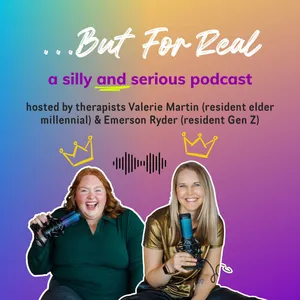
Welcome to But For Real: the podcast where all your swirling thoughts about mental health, pop culture, and how to human are blended into one delicious variety show, co-hosted by therapists Valerie Martin (resident elder millennial ✌️) and Emerson Ryder (resident Gen Z 🫶).
Customized Recaps
AI-powered recaps with compact key takeaways, quotes, and insights.
Straight to Your Inbox
Get key takeaways from But For Real in a 5-minute read.
Save Hours Every Week
Stay current on your favorite podcasts without falling behind.
Frequently Asked Questions
What is Podzilla's But For Real daily summary?
It's a free AI-powered email that summarizes new episodes of But For Real as soon as they're published. You get the key takeaways, notable quotes, and links & mentions — all in a quick read.
How does the But For Real podcast summary work?
When a new episode drops, our AI transcribes and analyzes it, then generates a personalized summary tailored to your interests and profession. It's delivered to your inbox every morning.
Is this an official But For Real product?
No. Podzilla is an independent service that summarizes publicly available podcast content. We're not affiliated with or endorsed by Valerie Martin & Emerson Ryder.
Can I get summaries of other podcasts too?
Absolutely! The free plan covers up to 3 podcasts. Upgrade to Pro for 15, or Premium for 50. Browse our full catalog at /podcasts.
How often does But For Real release new episodes?
But For Real publishes biweekly. Our AI generates a summary within hours of each new episode.
What topics does But For Real cover?
But For Real covers topics including Education, Fitness, Culture, Health & Fitness, Society & Culture, Mental Health, Self-Improvement. Our AI identifies the specific themes in each episode and highlights what matters most to you.
Start getting But For Real summaries tomorrow morning.
Free forever for up to 3 podcasts. No credit card required.
Free forever for up to 3 podcasts. No credit card required.