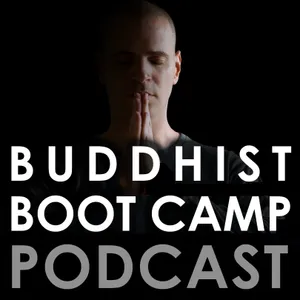
Free Daily Podcast Summary
Buddhist Boot Camp Podcast: Daily Summaries Delivered
by Timber Hawkeye
The intention is to awaken, enlighten, enrich, and inspire. Timber Hawkeye is the bestselling author of Buddhist Boot Camp, Faithfully Religionless, and the Opposite of Namaste. He offers a secular approach to being at peace with the world, both within and around us. As the Dalai Lama says, "Don't try to use what you learn from Buddhism to be a Buddhist, use it to be a better whatever-you-already-are."
Latest Episodes
The most recent episodes — sign up to get AI-powered summaries of each one.
- 1 weeks ago6 min
Disproportionate
Our reactions to life's ups and downs are so disproportionate, we create our own anguish and then blame other people for it. True mastery starts when we recognize that WE are the problem. If other people easily upset you, the problem isn't other people, it's your short fuse. May no-one and no-thing ever disturb your inner-peace.
- Aug 31, 20267 min
Anxiety
This is how I personally cope with general anxiety and dismiss intrusive thoughts.
- Jul 28, 20266 min
Poise
The difference between Sharing and Complaining, Supporting and Enabling, and how we can maintain a calm composure and peace of mind while listening to other people grumbling about one thing or another.
- Jun 26, 20266 min
Ready or Not
If you wait until you "feel ready" to make some changes in your life, you'll be waiting forever because "ready" is not a feeling, it's a decision. The way to embrace change instead of resisting it, even though we are wired to avoid what is different, is to stop thinking of change as scary or dangerous, and start getting excited about it (because change is going to happen whether you are ready or not).
- May 20, 20267 min
Belonging
Our need to belong is natural, healthy, and necessary, but the craving for acceptance is egocentric, fragile, and unstable. That's why many of us feel stuck between wanting connection, but resenting social convention pressuring us to conform in order to belong. The Buddha's realization was that he wasn't even separate from the tree under which he was meditating; they were one. We all are. My invitation is for us to bring that level of awareness into every interaction, and to see everyone and everything as an extension of ourselves. You don't need to "prove your worth," and you certainly don't need to pretend to be something you are not in order to belong. If you find value in these videos, please show your support at https://www.buddhistbootcamp.com/support — Thank you for being a Soldier of Peace in the Army of Love.
- Apr 25, 20265 min
Scapegoating
The more consistently you take ownership of your inner world, the less you try to outsource your well-being. It starts by noticing how often you blame something or someone else for your misery, and you might also see how dependent you've become on something or someone else for your happiness. The peace we are chasing is not "out there" somewhere, it is patiently waiting for us to come back to ourselves and reclaim it from within.
- Mar 30, 20268 min
Meaningful Communication
We are all taught a language, but we are not taught how to communicate, which is the reason for so many arguments and misunderstandings. When the Buddha spoke of Mindful Speech, it wasn't just about avoiding gossip and verbal abuse. Mindful Speech is also about purposeful and meaningful communication. Words can be useless and lack meaning, or they can be rich and offer healing. In a world where it costs absolutely nothing to transform casual interactions into meaningful connections, there is no reason for dismissive, vague, or entitled comments between us. So, let's lead by example in our conversations, and be as truthful, sincere, and articulate as possible to make meaningful connections the new norm.
- Feb 27, 20268 min
Stay In Your Lane
Trying to control someone is not the same as loving or caring for them. True compassion respects autonomy; it does not try to engineer outcomes. So, do not exhaust yourself trying to change what is not yours to fix. Peace comes from accepting what is, keeping in mind that acceptance does not mean approval, it simply means recognizing what is within our control, and gently releasing what is not.
Get Buddhist Boot Camp Podcast summaries in your inbox
Free AI-powered daily recaps. Key takeaways, quotes, and mentions — in a 5-minute read.
Get Free Summaries →Free forever for up to 3 podcasts. No credit card required.
You Might Also Like
Listeners also like.
The 12-Step Buddhist Podcast
Explores Buddhist principles and mindfulness practices integrated with 12-step recovery to heal trauma and addiction.
The Way Out Is In
A podcast exploring mindfulness and compassion through Buddhist teachings, hosted by a Zen monk and a transformational coach.
Thich Nhat Hanh Dharma Talks
Teachings and dharma talks by Zen Master Thich Nhat Hanh.

Recovery Dharma Audiobook
A guided audiobook exploring Buddhist practices and principles to support recovery from addiction.

Tara Brach
Teaches mindfulness and self-compassion through meditation, blending psychology and Eastern spirituality to ease emotional suffering.

10% Happier with Dan Harris
Practical mindfulness and meditation advice from experts, blending science and ancient wisdom for skeptics.

Achievers Therapy
Spiritual wisdom and motivational messages to inspire personal growth and purposeful living through faith.

Meet the Monastics
Conversations with monks and nuns about their path to monastic life and ongoing spiritual inspiration.
Being Well with Forrest Hanson and Dr. Rick Hanson
Explores the science of lasting well-being through psychology, neuroscience, and mindfulness with expert guests.

BYU Speeches
BYU Speeches
Unlearned Wisdom by Johnny Chang
Biblical insights and life lessons drawn from personal experiences and faith, offering practical spiritual guidance.

Jack Hibbs Podcast
A pastor addresses contemporary cultural issues and theological errors from a biblical perspective to strengthen listeners' Christian faith.
About Buddhist Boot Camp Podcast
The intention is to awaken, enlighten, enrich, and inspire. Timber Hawkeye is the bestselling author of Buddhist Boot Camp, Faithfully Religionless, and the Opposite of Namaste. He offers a secular approach to being at peace with the world, both within and around us. As the Dalai Lama says, "Don't try to use what you learn from Buddhism to be a Buddhist, use it to be a better whatever-you-already-are."
Customized Recaps
AI-powered recaps with compact key takeaways, quotes, and insights.
Straight to Your Inbox
Get key takeaways from Buddhist Boot Camp Podcast in a 5-minute read.
Save Hours Every Week
Stay current on your favorite podcasts without falling behind.
Frequently Asked Questions
What is Podzilla's Buddhist Boot Camp Podcast daily summary?
It's a free AI-powered email that summarizes new episodes of Buddhist Boot Camp Podcast as soon as they're published. You get the key takeaways, notable quotes, and links & mentions — all in a quick read.
How does the Buddhist Boot Camp Podcast podcast summary work?
When a new episode drops, our AI transcribes and analyzes it, then generates a personalized summary tailored to your interests and profession. It's delivered to your inbox every morning.
Is this an official Buddhist Boot Camp Podcast product?
No. Podzilla is an independent service that summarizes publicly available podcast content. We're not affiliated with or endorsed by Timber Hawkeye.
Can I get summaries of other podcasts too?
Absolutely! The free plan covers up to 3 podcasts. Upgrade to Pro for 15, or Premium for 50. Browse our full catalog at /podcasts.
What topics does Buddhist Boot Camp Podcast cover?
Buddhist Boot Camp Podcast covers topics including Education, Philosophy, Culture, Society & Culture, Self-Improvement. Our AI identifies the specific themes in each episode and highlights what matters most to you.
Start getting Buddhist Boot Camp Podcast summaries tomorrow morning.
Free forever for up to 3 podcasts. No credit card required.
Free forever for up to 3 podcasts. No credit card required.