Free Daily Podcast Summary
Broadway Bound: The Musicals That Never Came to Broadway: Daily Summaries Delivered
by Robert W. Scheider & Broadway Podcast Network
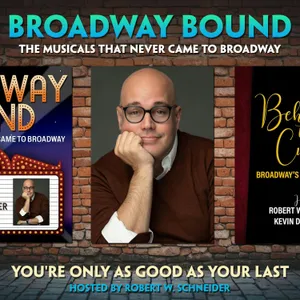
Join Broadway historian, director, and all around MT nerd Robert W. Schneider for a wild and exhaustively researched celebration of the musicals that had set their sights on Broadway but missed the mark. The third season of Broadway Bound is called "I'M THE GREATEST STAR" explores twelve Broadway Bound musicals that were starred major performers. From a Bea Arthur to Randy Quaid, Broadway Bound: The Musicals That Never Came To Broadway is sure to open your eyes to some of the most bizarre, brilliant, and bold musicals that tried to get themselves on the Great Bright Way!
Latest Episodes
The most recent episodes — sign up to get AI-powered summaries of each one.
- Yesterday58 min
GINGER ROGERS in The Pink Jungle
For decades, Ginger Rogers made difficult things look effortless. Then she tried Broadway. This week, we examine The Pink Jungle, a musical that arrived at exactly the wrong moment for one of Hollywood's most beloved stars. Beneath the sequins and backstage drama lies a surprisingly human story about aging, relevance, and what happens when a legend can't see the forest through the trees. If you like what we are doing DONATE HERE Fair use is a legal doctrine that promotes freedom of expression by permitting the unlicensed use of copyright-protected works in certain circumstances. Section 107 of the Copyright Act of 1976 provides the statutory framework for determining whether something is a fair use and identifies certain types of uses—such as criticism, comment, news reporting, teaching, scholarship, and research—as examples of activities that qualify as fair use. Learn more about your ad choices. Visit megaphone.fm/adchoices
- 2 weeks ago51 min
BARBARA COOK in Halloween
Barbara Cook is one of the greatest voices Broadway has ever produced. Which makes Halloween one of the strangest chapters in her story. This week, we explore a musical about witches, ghosts, and suburban eccentrics—but more importantly, an artist standing at a crossroads. Because sometimes a flop isn't the end of a career. Sometimes it's intermission before Act Two. If you like what we are doing DONATE HERE Fair use is a legal doctrine that promotes freedom of expression by permitting the unlicensed use of copyright-protected works in certain circumstances. Section 107 of the Copyright Act of 1976 provides the statutory framework for determining whether something is a fair use and identifies certain types of uses—such as criticism, comment, news reporting, teaching, scholarship, and research—as examples of activities that qualify as fair use. Learn more about your ad choices. Visit megaphone.fm/adchoices
- 4 weeks ago1h 16m
GENE BARRY in Spotlight/Watergate: The Musical
Somewhere in America, a producer once looked at Watergate and said, "You know what this scandal needs? A kick line." This week, we follow Gene Barry through not one but two Broadway-bound curiosities: Spotlight and Watergate. The real story isn't politics. It's about Broadway's eternal belief that absolutely anything can become a musical. Sometimes that belief gives us Hamilton. Sometimes it gives us this. If you like what we are doing DONATE HERE Fair use is a legal doctrine that promotes freedom of expression by permitting the unlicensed use of copyright-protected works in certain circumstances. Section 107 of the Copyright Act of 1976 provides the statutory framework for determining whether something is a fair use and identifies certain types of uses—such as criticism, comment, news reporting, teaching, scholarship, and research—as examples of activities that qualify as fair use. Learn more about your ad choices. Visit megaphone.fm/adchoices
- Aug 27, 20261h 14m
ROBERT PRESTON in We Take The Town/The Prince of Grand Street
Most actors spend the rest of their lives trying to escape the role that made them famous. Robert Preston spent the rest of his career trying to find another one. This week, we look at We Take the Town and The Prince of Grand Street, two fascinating near-misses that reveal a star stubbornly refusing to become his own tribute act. It's a story about reinvention, risk-taking, and the terrible burden of being Harold Hill forever. If you like what we are doing DONATE HERE Fair use is a legal doctrine that promotes freedom of expression by permitting the unlicensed use of copyright-protected works in certain circumstances. Section 107 of the Copyright Act of 1976 provides the statutory framework for determining whether something is a fair use and identifies certain types of uses—such as criticism, comment, news reporting, teaching, scholarship, and research—as examples of activities that qualify as fair use. Learn more about your ad choices. Visit megaphone.fm/adchoices
- Aug 13, 202643 min
JERRY LEWIS in Hellzapoppin
Jerry Lewis looked at one of the craziest stage comedies ever written and thought, "Needs more Jerry Lewis." The result was Hellzapoppin' '76, a musical so ambitious, so expensive, and so gloriously overstuffed that it practically collapsed under the weight of its own enthusiasm. This week, we explore the age-old Broadway question: when does confidence become hubris? Or, put another way, how many clowns can you fit into one flop? If you like what we are doing DONATE HERE Fair use is a legal doctrine that promotes freedom of expression by permitting the unlicensed use of copyright-protected works in certain circumstances. Section 107 of the Copyright Act of 1976 provides the statutory framework for determining whether something is a fair use and identifies certain types of uses—such as criticism, comment, news reporting, teaching, scholarship, and research—as examples of activities that qualify as fair use. Learn more about your ad choices. Visit megaphone.fm/adchoices
- Jul 30, 202645 min
BETTE DAVIS in Miss Moffat
By 1974, Bette Davis had spent forty years winning fights, collecting enemies, and becoming Bette Davis. Then she decided to do a musical. What could possibly go wrong? Everything. This week, we tell the story of Miss Moffat, the legendary out-of-town disaster that finally met its match in an equally legendary star. At its heart, this isn't a story about a flop. It's about what happens when Broadway and Bette Davis both expect to be the boss. If you like what we are doing DONATE HERE Fair use is a legal doctrine that promotes freedom of expression by permitting the unlicensed use of copyright-protected works in certain circumstances. Section 107 of the Copyright Act of 1976 provides the statutory framework for determining whether something is a fair use and identifies certain types of uses—such as criticism, comment, news reporting, teaching, scholarship, and research—as examples of activities that qualify as fair use. Learn more about your ad choices. Visit megaphone.fm/adchoices
- Jul 16, 202643 min
ANGELA LANSBURY in Prettybelle
CW: This episode frequently mentions the word r**e in relation to the story Angela Lansbury survived murder mysteries, Tom Bosley's New England accent, and a murderous nephew. But could she survive a musical about a Southern woman who decides the solution to racism is......well, you just need to listen to this episode about the Styne/Merrill musical Prettybelle This week, we examine one of the most baffling concepts ever set to music and discover how one of Broadway's most beloved stars managed to walk away from a catastrophe with her reputation not only intact—but somehow improved. If you like what we are doing DONATE HERE Fair use is a legal doctrine that promotes freedom of expression by permitting the unlicensed use of copyright-protected works in certain circumstances. Section 107 of the Copyright Act of 1976 provides the statutory framework for determining whether something is a fair use and identifies certain types of uses—such as criticism, comment, news reporting, teaching, scholarship, and research—as examples of activities that qualify as fair use. Learn more about your ad choices. Visit megaphone.fm/adchoices
- Jul 2, 20261h 2m
BEA ARTHUR in A Mother's Kisses
Bea Arthur spent her career playing women who could level a grown man with a single look. So naturally she starred in A Mother's Kisses, a musical about a stage mother so terrifying she makes Mama Rose look like Maria Von Trapp. This week, we explore the show that seemed perfectly suited to Bea's talents and ask a simple question: can a star be too right for a role? Along the way, we'll uncover a musical that wasn't really about Broadway at all—it was about what happens when nobody in the room is willing to blink first. If you like what we are doing DONATE HERE Fair use is a legal doctrine that promotes freedom of expression by permitting the unlicensed use of copyright-protected works in certain circumstances. Section 107 of the Copyright Act of 1976 provides the statutory framework for determining whether something is a fair use and identifies certain types of uses—such as criticism, comment, news reporting, teaching, scholarship, and research—as examples of activities that qualify as fair use. Learn more about your ad choices. Visit megaphone.fm/adchoices
About Broadway Bound: The Musicals That Never Came to Broadway
Join Broadway historian, director, and all around MT nerd Robert W. Schneider for a wild and exhaustively researched celebration of the musicals that had set their sights on Broadway but missed the mark. The third season of Broadway Bound is called "I'M THE GREATEST STAR" explores twelve Broadway Bound musicals that were starred major performers. From a Bea Arthur to Randy Quaid, Broadway Bound: The Musicals That Never Came To Broadway is sure to open your eyes to some of the most bizarre, brilliant, and bold musicals that tried to get themselves on the Great Bright Way!
Customized Recaps
AI-powered recaps with compact key takeaways, quotes, and insights.
Straight to Your Inbox
Get key takeaways from Broadway Bound: The Musicals That Never Came to Broadway in a 5-minute read.
Save Hours Every Week
Stay current on your favorite podcasts without falling behind.
Frequently Asked Questions
What is Podzilla's Broadway Bound: The Musicals That Never Came to Broadway daily summary?
It's a free AI-powered email that summarizes new episodes of Broadway Bound: The Musicals That Never Came to Broadway as soon as they're published. You get the key takeaways, notable quotes, and links & mentions — all in a quick read.
How does the Broadway Bound: The Musicals That Never Came to Broadway podcast summary work?
When a new episode drops, our AI transcribes and analyzes it, then generates a personalized summary tailored to your interests and profession. It's delivered to your inbox every morning.
Is this an official Broadway Bound: The Musicals That Never Came to Broadway product?
No. Podzilla is an independent service that summarizes publicly available podcast content. We're not affiliated with or endorsed by Robert W. Scheider & Broadway Podcast Network.
Can I get summaries of other podcasts too?
Absolutely! The free plan covers up to 3 podcasts. Upgrade to Pro for 15, or Premium for 50. Browse our full catalog at /podcasts.
How often does Broadway Bound: The Musicals That Never Came to Broadway release new episodes?
Broadway Bound: The Musicals That Never Came to Broadway publishes biweekly. Our AI generates a summary within hours of each new episode.
What topics does Broadway Bound: The Musicals That Never Came to Broadway cover?
Broadway Bound: The Musicals That Never Came to Broadway covers topics including History, Arts, Performing Arts. Our AI identifies the specific themes in each episode and highlights what matters most to you.
Start getting Broadway Bound: The Musicals That Never Came to Broadway summaries tomorrow morning.
Free forever for up to 3 podcasts. No credit card required.
Free forever for up to 3 podcasts. No credit card required.