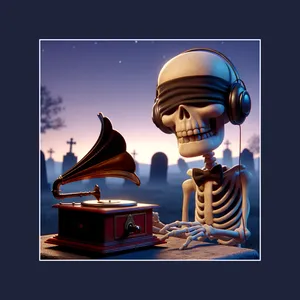
Free Daily Podcast Summary
Blind Skeleton's Three Tune Tuesday: Daily Summaries Delivered
by Boneapart and Yulia
Welcome to "Three Tune Tuesday," where vintage sound meets timeless music in a weekly exploration of acoustically recorded gems. Each episode, join us on a unique auditory journey through different genres and eras, as we feature three carefully selected tracks that showcase the rich tapestry of music history. Whether you're a seasoned audiophile or new to the world of vintage entertainment, there's something here for everyone.Dive into the heart of music with your host, a passionate collector who brings these tracks to life on period-appropriate phonographs, offering not just songs but an authentic listening experience. From jazz and blues to folk and beyond, our "theme of the week" format keeps every episode fresh and exciting, blending informative insights with a casual, engaging style."Three Tune Tuesday" is for music lovers and vintage enthusiasts alike, providing a rare glimpse into the past through the lens of a private collection that stand
Latest Episodes
The most recent episodes — sign up to get AI-powered summaries of each one.
- 6 days ago41 min
Memories
This week on Three Tune Tuesday, we’re spending an episode with memory itself — twenty-five years on from September 11th, right at the point where a shared national memory starts becoming history for the people who never lived through it, even as it stays close and present for everyone who did — and we let three of the earliest recorded sound era’s own records do the talking: “Ben Bolt,” a mid-19th-century parlor ballad that’s really just a list of everyone the narrator has outlived, still popular enough in 1908 for Victor to cut a brand-new version sixty years after it was written; “Long, Long Ago,” a song so deliberately vague — no names, no place, no year — that it became one of the most popular songs in America a decade after it was written and kept getting recycled by every generation after (it eventually became Glenn Miller’s “Don’t Sit Under the Apple Tree” in 1942); and, closing somewhere unexpected, Paul Lincke’s “Birthday Serenade,” a lighthearted German instrumental with nothing to do with loss at all, picked on purpose because this episode happens to be recorded on my own daughter’s birthday — a reminder that in the middle of an episode about grief and history, new memories are still being made, today, right now. Lyrics Ben Bolt Oh don’t you remember sweet Alice, Ben Bolt Sweet Alice whose hair was so brown Who wept with delight when you gave her a smile And trembled with fear at your frown. In the old church yard in the valley, Ben Bolt In a corner obscure and alone They have fitted a slab of granite so gray And sweet Alice lies under the stone They have fitted a slab of granite so gray And sweet Alice lies under the stone Oh don’t you remember the wood, Ben Bolt Near the green sunny slope of the hill Where oft we have sung beneath its wide spreading shade And kept time to the click of the mill? The mill has fone to decay, Ben Bolt And a quiet now reigns all around See, the old rustic porch, with its roses so sweet Lies scattered and fallen to the ground See, the old rustic porch, with its roses so sweet Lies scattered and fallen to the ground And don’t you remember the school, Ben Bolt And the master so kind and so true, And the little nook by the clear running brook, Where we gathered the flowers as they grew? On the masters grave grows the grass, Ben Bolt, And the running little brook is now dry, And of all the friends who were schoolmates then, There remain, Ben but you and I, And of all the friends who were schoolmates then, There remain, Ben but you and I Long Long Ago Tell me the tales that to me were so dear, Long, long ago, long, long ago: Sing me the songs I delighted to hear, Long, long ago long ago: Now you are gone my grief is remov’d, Let me forget that so long you have rov’d, Let me believe that you love as you lov’d, Long, long ago, long ago: Do you remember the path where we met, Long long ago, long long ago. Ah yes you told me you ne’er would forget, Long long ago, long ago. Then to all others my smile you prefer’d, Love when you spoke gave a charm to each word, Still my heart treasures the praises I heard, Long long ago, long ago. Thought by your kindness my fond hopes were rais’d, Long long ago, long long ago, You by more eloquent lips have been prais’d, Long long ago, long ago, But by long absence your truth has been tried, Still to your accents I listen with pride, Blest as I was when I sat by your side, Long long ago, long ago.
- 1 weeks ago55 min
Lakes
This week’s Great Lake headline sent us hunting for a fitting protest song — turns out nobody in the 1910s was singing about who gets to name a body of water. So instead, Three Tune Tuesday goes looking for what people actually did put on record about lakes: three love songs, recorded across 35 years, all built around the same setting — a lake, a couple, and moonlight — put to three completely different uses. We start with “Moonlight on the Lake,” a genteel 1878 parlor ballad recorded by the Peerless Quartet — the kind of thing a family once sang around the piano, long before it reached a phonograph. Next, Charles Wakefield Cadman’s “From the Land of the Sky-Blue Water” (1909), performed by soprano Florence Hinkle — a concert-hall art song built from real fieldwork among Omaha and Winnebago communities, and later, oddly enough, a beer commercial jingle. We close with “Row, Row, Row” (1912–13), Arthur Collins’s Ziegfeld Follies novelty hit about a couple out on a rowboat who may or may not be behaving themselves. Genteel, elevated, and mischievous — three very different ways early-20th-century America fell in love beside the water, decades before anyone thought to put a country’s name on the lake itself.
- 2 weeks ago1h 14m
Food Glorious Food
A hundred years before “supply chain” became a household word, people were already singing about it. This week we dig into three records — 1918 to 1926 — that capture the same anxieties making headlines today: a real worldwide banana shortage that became the biggest novelty hit of 1923 (“Yes! We Have No Bananas”), a folk song about the boll weevil that devastated Southern cotton farming, recorded by none other than poet Carl Sandburg, and an early piece of regional food pride dressed up as a love song (“Everything Is Peaches Down in Georgia”) that turns out to be a genuine ancestor of today’s “shop local” movement. The songs are silly. What’s behind them isn’t — and we talk honestly about both. A heads-up: our recording of “The Boll Weevil” includes a racial slur common to the period, which we discuss directly rather than skip past. We felt it was worth keeping in the conversation rather than out of it.
- 3 weeks ago1h 11m
The Beach
Grab your bathing suit—we’re heading to the beach as Americans heard it more than a century ago. Through “By the Beautiful Sea,” “On the Beach at Waikiki,” and “In the Beautiful Seaside Air,” we’ll explore how the shoreline became a destination for recreation, romance, tropical fantasy, and good old-fashioned people-watching. Along the way, we’ll meet Billy Murray, hear the sound of Hawaiian steel guitar, and discover how the modern beach vacation was already taking shape by the 1910s.
- Aug 18, 20261h 20m
Musical Interpretations
Isolde’s final six minutes in Wagner’s Tristan und Isolde have been recorded again and again for over a century — but no two performers have ever told it quite the same way. This week, Boneapart and Yulia compare three recordings of the “Liebestod,” Wagner’s famous “love-death,” made 23 years apart: an intimate 1903 reading sung in Italian by Budapest soprano Italia Vasquez, a mature 1914 performance from Amelia Pinto — who was singing the actual staged role at La Scala under Toscanini that same year — and a 1926 orchestral-only recording from the San Francisco Symphony under Alfred Hertz, a conductor once banned for life from Wagner’s own festival at Bayreuth. Same six minutes of music, three completely different ideas about what it needs to say — and one of them doesn’t use a single word.
- Aug 11, 20261h 5m
Schubert
Franz Schubert died at 31, but he left behind an almost unbelievable amount of music — and no two performances of it sounded quite the same, even a century ago. This week we dig into three very different acoustic-era recordings that show just how far his music could stretch: an unfinished symphony movement so large it had to be split across multiple 78s, a spine-chilling four-character ballad sung by legendary contralto Ernestine Schumann-Heink, and a tiny two-minute piano miniature blown up into a full orchestral showpiece by Leopold Stokowski and the Philadelphia Orchestra. Along the way, we talk about what happens when a composer’s music becomes raw material for the people recording it — and why “faithful to Schubert” meant something different to every engineer, arranger, and performer who touched it.
- Aug 4, 20261h 23m
Strike!
While Canada’s WestJet flight attendants walk the picket line this month over unpaid working hours, we’re digging back a hundred years to find out what the lead-up to a strike actually sounded like on record. This week’s three records were never meant as protest songs — Charlie Poole’s “Can I Sleep in Your Barn Tonight, Mister?” is a wandering man’s plea for shelter, Vernon Dalhart’s “The Chain Gang Song” is a convict’s lament, and Ernest V. Stoneman’s “Sinking of the Titanic” is a disaster ballad about who got a lifeboat and who didn’t. But every one of them was cut by, or built around, someone who’d lived close to the hard end of the working world: a cotton-mill spinner, a coal miner, a family with real prison time behind them. No union rhetoric anywhere in these three — just the daily grind that eventually makes people say enough.
- Jul 28, 20261h 12m
Empire
The Commonwealth Games began life as the British Empire Games, making them the perfect inspiration for this week’s Three Tune Tuesday. Through three fascinating recordings from the early twentieth century, we explore how music reflected the rise, confidence, and changing legacy of the British Empire. From Harry Lauder’s comforting vision of soldiers carrying home across the globe, to the triumphant strains of Land of Hope and Glory, and finally an Irish folk melody that speaks to a culture finding its own voice, these records reveal how popular music could celebrate power, shape public opinion, and preserve identity. Rather than asking whether empire was simply good or bad, this episode examines how ordinary people experienced it—and how a few minutes of music can open a window into one of history’s largest and most complex stories. Lyrics The Foggy Dew As down the glen one Easter morn To a city fair rode I. There armoured lines of marching men In squadrons passed me by. No pipe did hum, no battle drum Did sound its loud tattoo But the Angelus bell o’er the Liffy’s swell Rang out in the foggy dew. Right proudly high over Dublin town They hung out that flag of war. ’Twas better to die ‘neath an Irish sky Than at Suvla or Sud el Bar. And from the plains of Royal Meath Strong men came hurrying through; While Brittania’s sons with their long-range guns Sailed in from the foggy dew. oh the night fell black and the rifle’s crack made perfidious Albion reel mid the leaded rail seven tongues of flame did shine o’re the lines of steel by each shining blade a prayer was said that to Ireland her sons be true when the morning broke still the war flag shook out its fold on the foggy dew it was England bade our wild geese go That small nations might be free. Their lonely graves are by Suvla’s waves On the fringe of the grey North Sea. But had they died by Pearse’s side Or fought with Cathal Bruagh, Their graves we’d keep where the Fenians sleep ’Neath the shroud of the foggy dew. but the bravest fell, and the requiem bell Rang mournfully and clear For those who died that Eastertide In the springing of the year. And the world did gaze in deep amaze At those fearless men and true Who bore the fight that freedom’s light Might shine through the foggy dew. then back through that glen I rode again and my heart with grief was sore for I parted then with valiant men whom I never shall see more and back to and fro in dreams I’ll go and I’ll kneel and pray for you oh slavery fled oh glorious dead when you fell in the foggy dew It’s Just Like Bein’ at Hame A Highland regiment was forced to start, To a distant land across the foam; Whilst a poor old mither, with a heavy heart, Waited anxiously at home. Soon her sad face turned into a smiling one, When a letter came from across the sea For it said “Don’t cry! Don’t you sigh! I’m as happy as can be”: There’s a piper playing in the morning, An auld Scotch tune so fine There’s a tartan pladdie buckled on each laddie Oh it’s just like Auld Lang Syne. I can hear them praising Bonnie Scotland, Bonnie Scotland’s fame, So don’t sigh dear, Am a’richt here It’s just like being at hame. The fierce fight lengthened and the months dragged on, Whilst the roll call shorten’d every day; Though they saw their comrades falling, one by one Yet they bravely fought their way; For the handful left had sworn to do or die, And with one long cheer they forged ahead; And a Highland lad fought like mad, As mither proudly read: The flag was planted beneath the scorching sun, Where the white man’s rule will ever reign; And the brave Scots soldiers who had fought and won Were returning home again. And the Highland mither watched the passing ranks For the face of one she loved so dear, And in frenzied joy, kissed her boy, As he whispered in her ear:
Get Blind Skeleton's Three Tune Tuesday summaries in your inbox
Free AI-powered daily recaps. Key takeaways, quotes, and mentions — in a 5-minute read.
Get Free Summaries →Free forever for up to 3 podcasts. No credit card required.
You Might Also Like
Listeners also like.

Twenty Thousand Hertz
Explores the hidden stories and science behind iconic sounds, from movie effects to jingles and animal communication.

The Open Ears Project
People from diverse backgrounds share the classical music piece that profoundly matters to them and why.

You'll Hear It: Full Album Deep Dives with Jazz Musicians
Two jazz pianists break down full albums track by track, sharing insights on listening, playing, and appreciating music.

Sound Opinions
A music review and interview show featuring rock critics discussing new releases, classic records, and artist conversations.

The Music Podcast for Kids!
Children learn about world music, instruments, and genres through interactive lessons and listening challenges with hosts Mr. Henry and Mr. Fite.
Jazz Library
Offers advice and guidance on building a library of jazz recordings.
Takin' A Walk - Music History with Buzz Knight
Artist interviews and stories exploring music history across rock, pop, country, jazz, and reggae.
Sticky Notes: The Classical Music Podcast
Explores classical music through artist interviews, piece analyses, and deep dives into musical eras for listeners of all experience levels.

Private Passions
People from diverse backgrounds share how music has influenced their lives and discuss their personal musical passions.
Classical Fix
A podcast introducing beginners to classical music.

Tuesdays with Stories!
Two New York comedians share and riff on humorous personal stories each week, often with guest comics.

Soul Music
Explores music that has a profound emotional effect on people.
About Blind Skeleton's Three Tune Tuesday
Welcome to "Three Tune Tuesday," where vintage sound meets timeless music in a weekly exploration of acoustically recorded gems. Each episode, join us on a unique auditory journey through different genres and eras, as we feature three carefully selected tracks that showcase the rich tapestry of music history. Whether you're a seasoned audiophile or new to the world of vintage entertainment, there's something here for everyone.Dive into the heart of music with your host, a passionate collector who brings these tracks to life on period-appropriate phonographs, offering not just songs but an authentic listening experience. From jazz and blues to folk and beyond, our "theme of the week" format keeps every episode fresh and exciting, blending informative insights with a casual, engaging style."Three Tune Tuesday" is for music lovers and vintage enthusiasts alike, providing a rare glimpse into the past through the lens of a private collection that stand
Customized Recaps
AI-powered recaps with compact key takeaways, quotes, and insights.
Straight to Your Inbox
Get key takeaways from Blind Skeleton's Three Tune Tuesday in a 5-minute read.
Save Hours Every Week
Stay current on your favorite podcasts without falling behind.
Frequently Asked Questions
What is Podzilla's Blind Skeleton's Three Tune Tuesday daily summary?
It's a free AI-powered email that summarizes new episodes of Blind Skeleton's Three Tune Tuesday as soon as they're published. You get the key takeaways, notable quotes, and links & mentions — all in a quick read.
How does the Blind Skeleton's Three Tune Tuesday podcast summary work?
When a new episode drops, our AI transcribes and analyzes it, then generates a personalized summary tailored to your interests and profession. It's delivered to your inbox every morning.
Is this an official Blind Skeleton's Three Tune Tuesday product?
No. Podzilla is an independent service that summarizes publicly available podcast content. We're not affiliated with or endorsed by Boneapart and Yulia.
Can I get summaries of other podcasts too?
Absolutely! The free plan covers up to 3 podcasts. Upgrade to Pro for 15, or Premium for 50. Browse our full catalog at /podcasts.
How often does Blind Skeleton's Three Tune Tuesday release new episodes?
Blind Skeleton's Three Tune Tuesday publishes weekly. Our AI generates a summary within hours of each new episode.
What topics does Blind Skeleton's Three Tune Tuesday cover?
Blind Skeleton's Three Tune Tuesday covers topics including Music, Culture, Society & Culture. Our AI identifies the specific themes in each episode and highlights what matters most to you.
Start getting Blind Skeleton's Three Tune Tuesday summaries tomorrow morning.
Free forever for up to 3 podcasts. No credit card required.
Free forever for up to 3 podcasts. No credit card required.